-
-
See your Crew members, their streaks and badges, and keep the competition going with the people you actually spend time with.
-
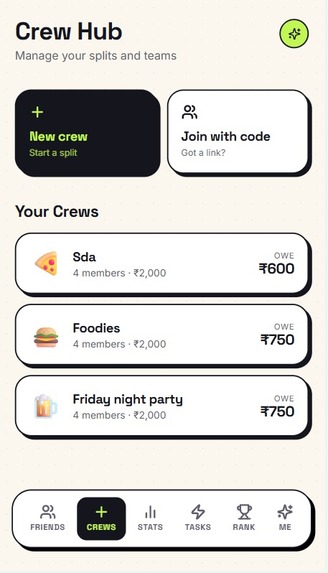
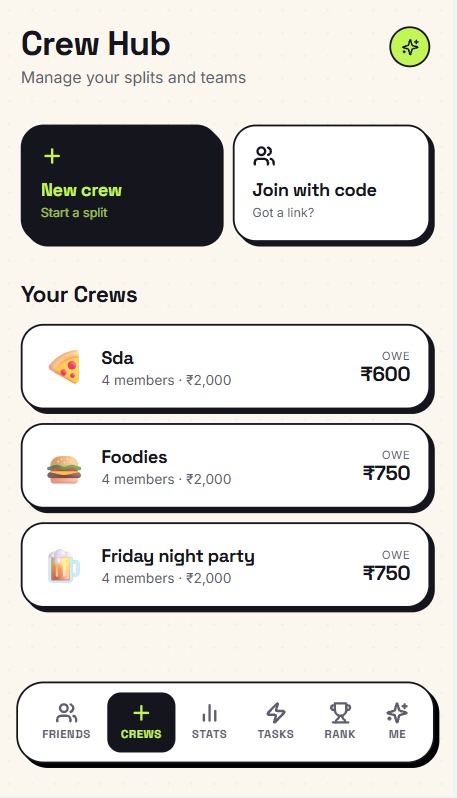
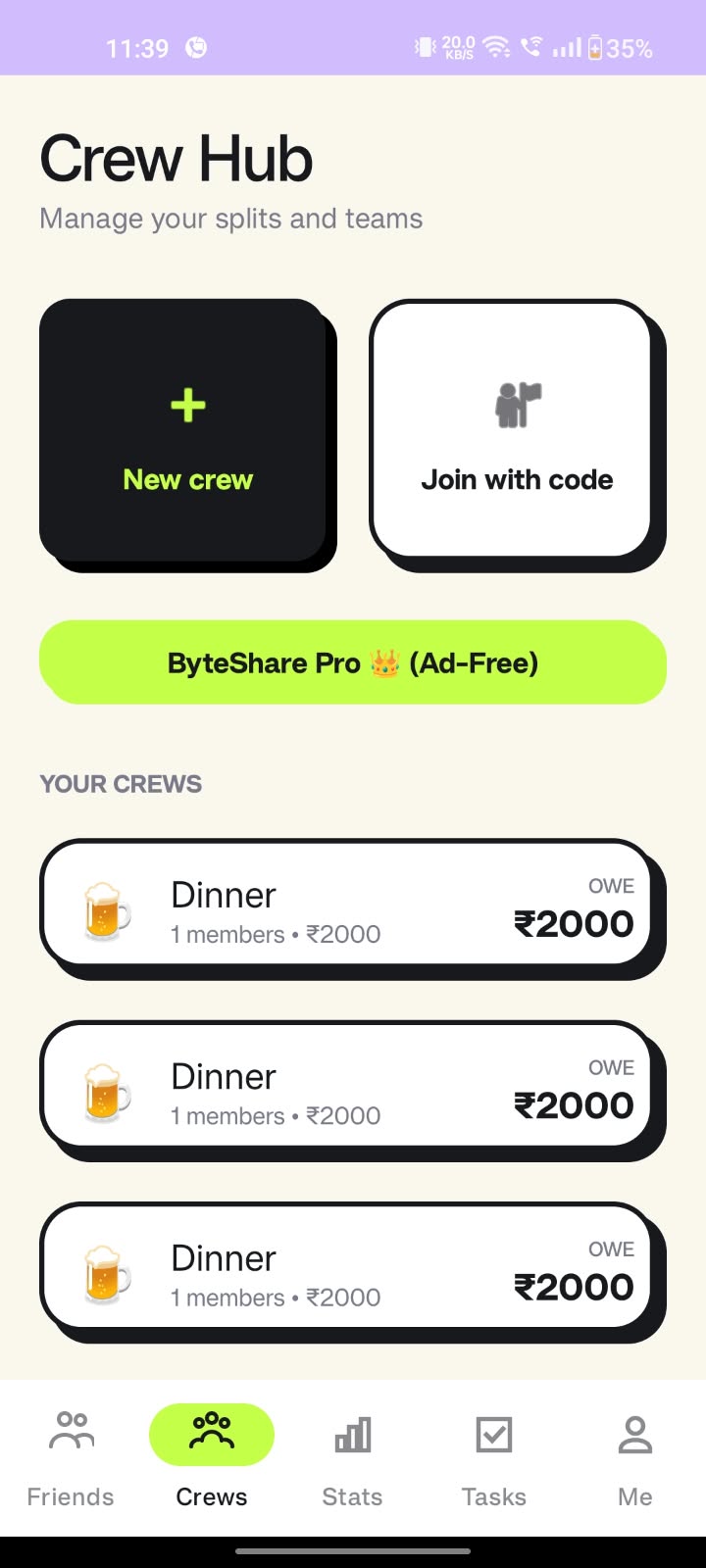
Create or join a Crew, manage your groups, and see how much your screen-time habits can affect your shared bills.
-
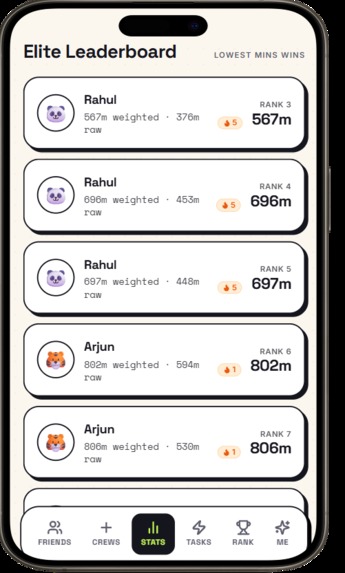
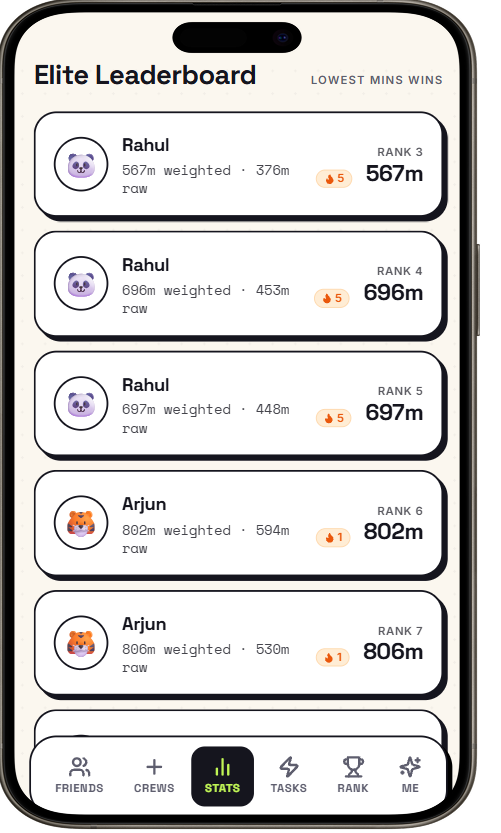
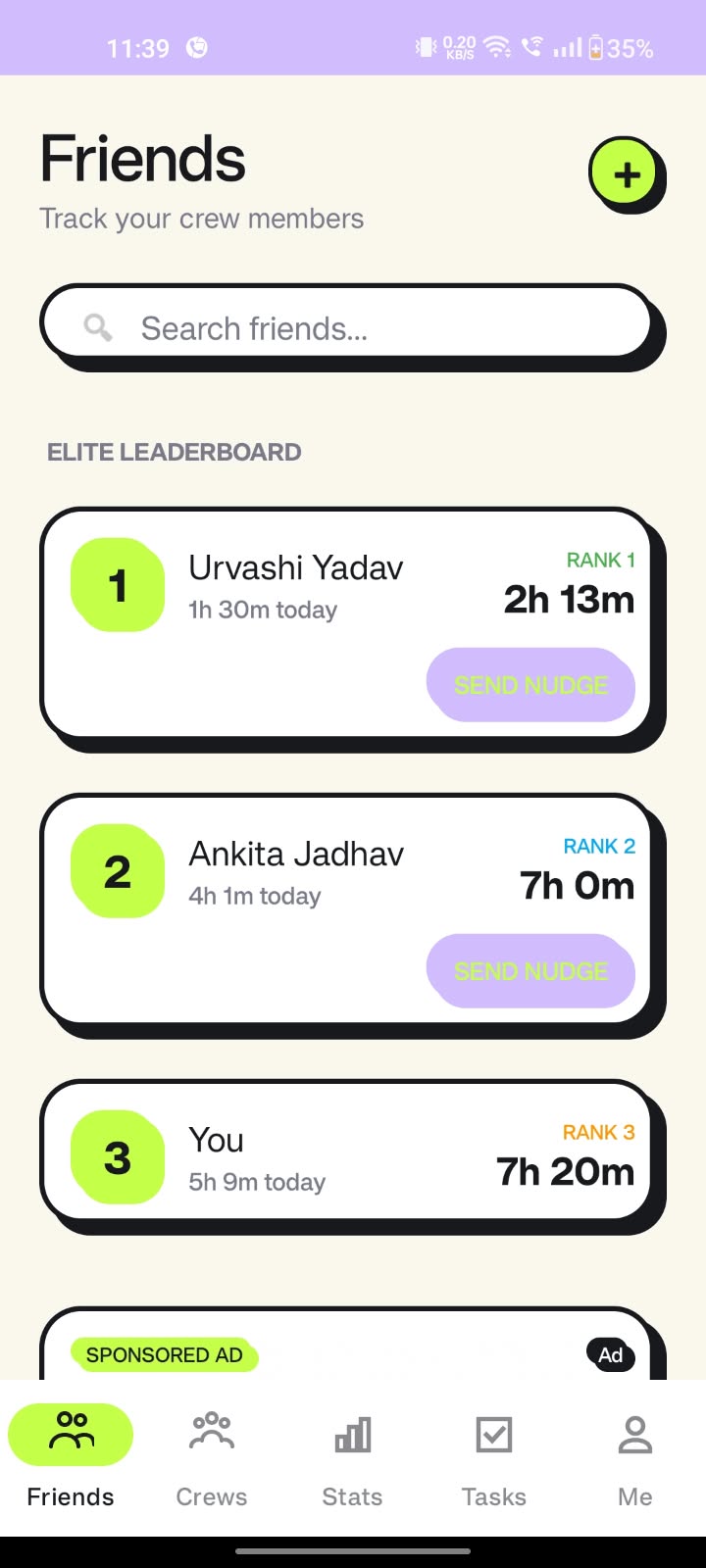
Compare weighted screen-time with your friends and climb the leaderboard by spending less time on distracting apps.
-
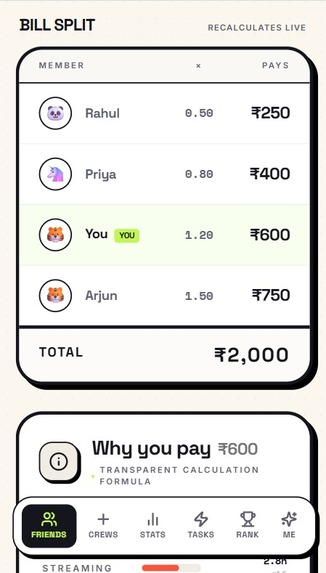
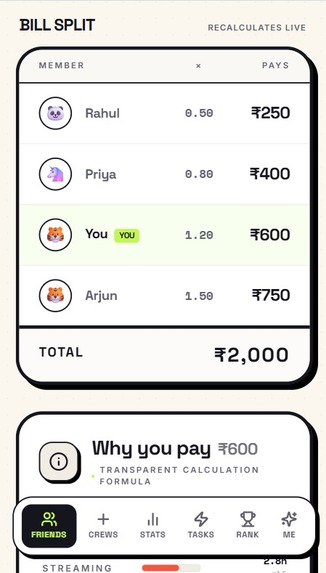
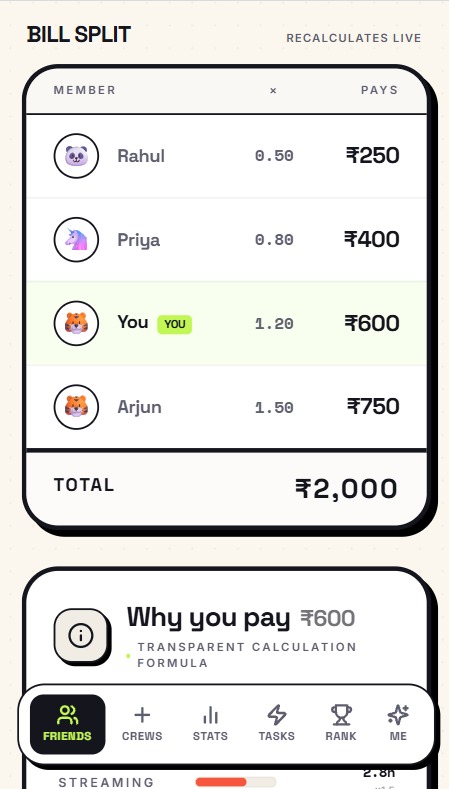
Your screen-time rank changes your share of the bill, with a transparent breakdown showing exactly why you pay your amount.
-
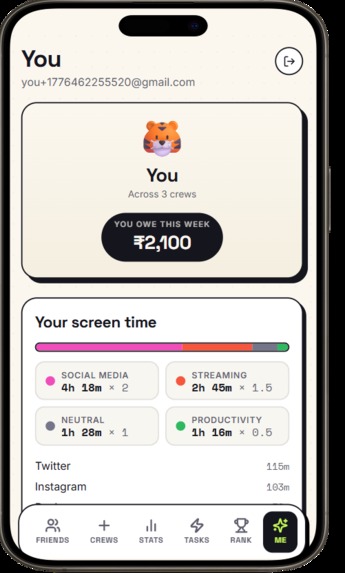
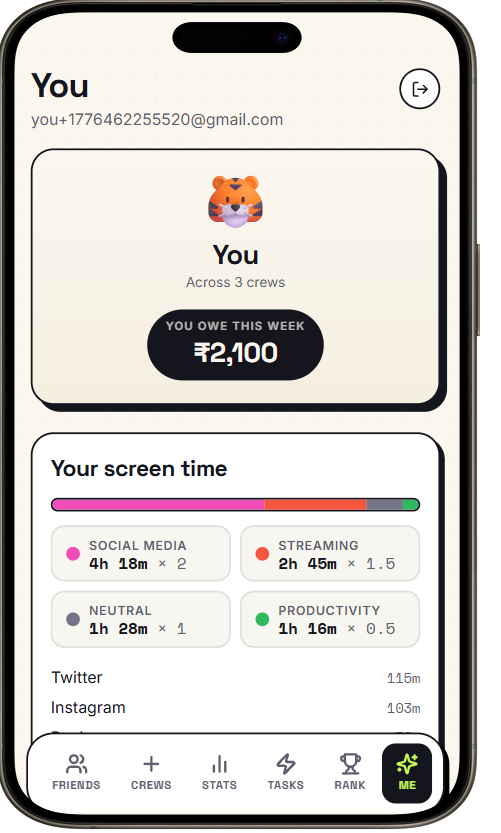
See your screen-time breakdown by category, understand your weighted score, and track the habits that affect your ByteShare ranking.
-

App logo
-
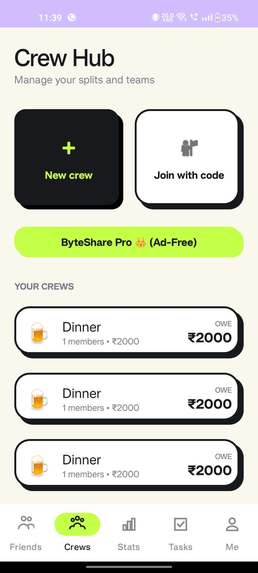
Create or join a Crew, manage your groups, and see how much your screen-time habits can affect your shared bills.
-
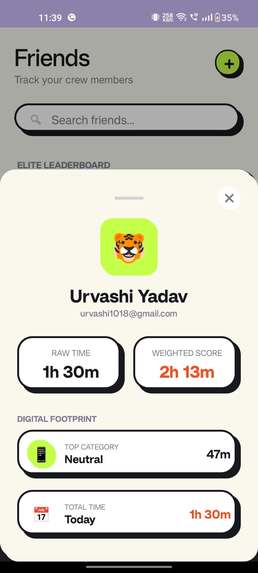
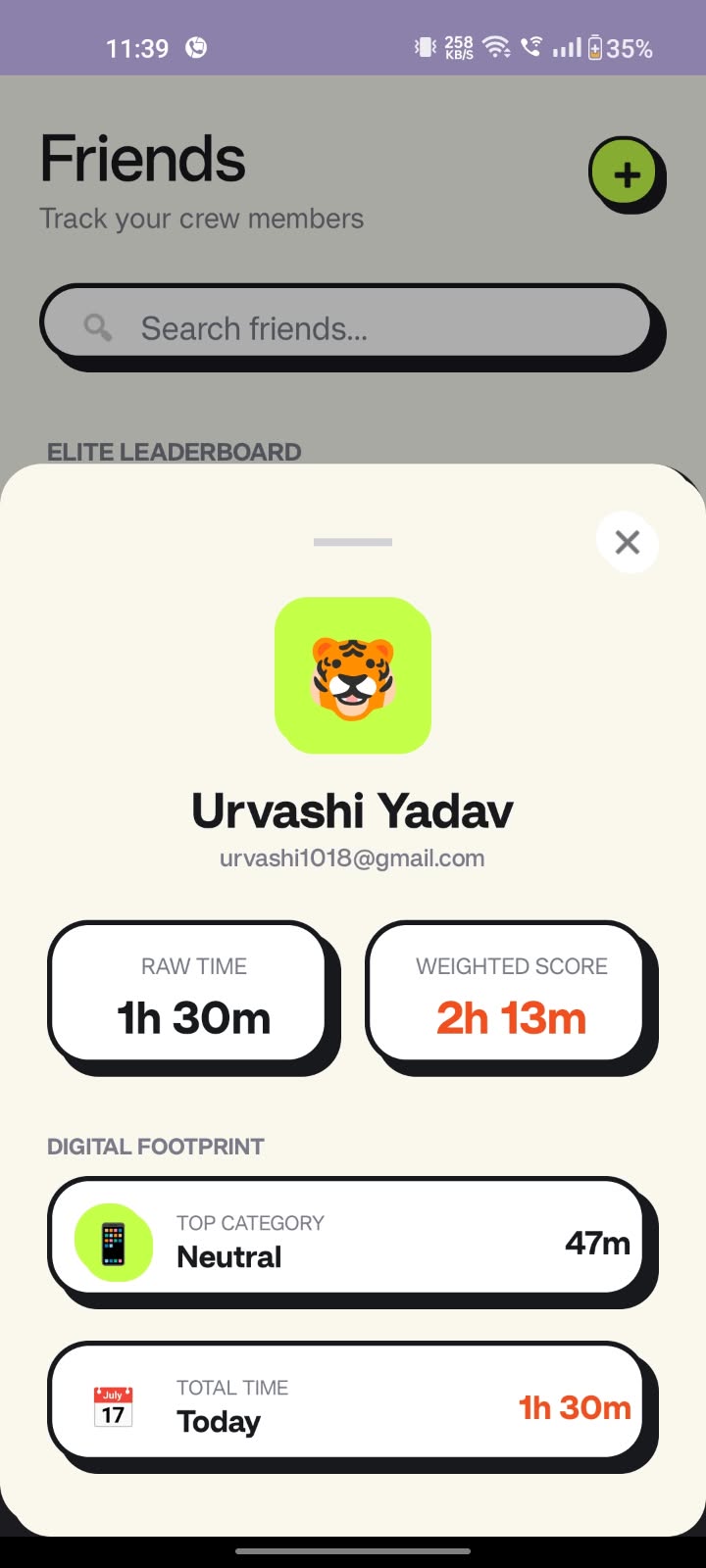
See your friends screen time, to get motivated
-
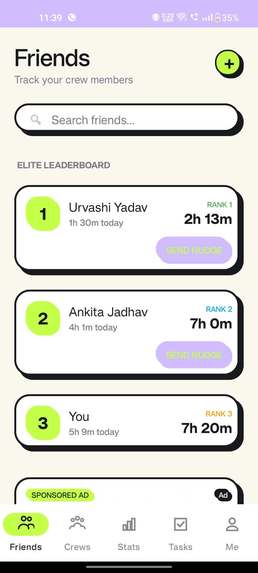
Byte share home page

Inspiration
The idea behind ByteShare came from a very common situation that we have experienced ourselves.
Imagine going out for dinner with your friends. Everyone is sitting at the same table, but after a few minutes, almost everyone has their phone in their hand. Someone is checking Instagram, someone is watching reels, someone is replying to messages, and someone is just scrolling because they are bored.
Technically, everyone is together. But in reality, everyone's attention is somewhere else.
The same thing happens during family gatherings, parties, trips, study sessions, and even when people are working together. We realized that the problem is not that people don't know they are spending too much time on their phones. Smartphones already provide screen-time reports and notifications that tell us exactly how much time we have spent on different apps.
The problem is that knowing the number doesn't necessarily make us change our behavior.
We wanted to approach the problem differently.
Instead of building another application that simply tells a person, "You spent 5 hours on your phone today," we wanted to make screen time something that friends could experience and react to together.
That idea became ByteShare.
ByteShare is an Android application where friends can create or join a group called a Crew. The application tracks their phone usage and turns that information into a score. Members can then compare their scores on a shared leaderboard.
But the most interesting part is that the score can have a real-world consequence.
When a group goes out for dinner or another shared activity, the members can enter the bill into ByteShare. Instead of automatically dividing the bill equally, the application uses the members' screen-time rankings to calculate how much each person contributes.
This creates a simple motivation:
If you want to pay less, put your phone down more.
We wanted this to feel more like a game between friends than a strict digital-wellness application. The idea is not to tell people that using their phone is bad. It is to encourage them to be more intentional about when they use it.
What it does
ByteShare is an Android application for groups of friends who want to reduce unnecessary phone usage when they are spending time together.
The application is built around a simple cycle:
Create or join a Crew → Track screen time → Calculate a weighted score → Compare with friends → Earn a better rank → Get rewarded for healthier usage.
1. Create or join a Crew
A user can create a new Crew and invite their friends using a joining code.
Alternatively, someone who already has a Crew code can use it to join an existing group.
The Crew is the central part of ByteShare because the application is designed around social accountability, not just individual screen-time tracking.
Once people are in the same Crew, they can see each other's relevant rankings, streaks, badges, and progress.
2. Track actual phone usage
ByteShare uses Android's device usage information to understand how much time a user spends on their phone and which applications are being used.
Instead of requiring users to manually enter their screen time every day, the application can use the available Android usage data to calculate their usage.
This gives the application something more useful than a simple self-reported number.
For example, instead of asking:
"How much time did you spend on your phone today?"
ByteShare can work from the actual usage information available on the device.
3. Not all screen time is treated equally
This is one of the most important parts of ByteShare.
We didn't want to treat every minute spent on a phone as equally harmful.
For example, using Google Maps for an hour is very different from spending an hour scrolling through Instagram.
Similarly, using Notion or a calendar for work or study is different from watching short-form videos for the same amount of time.
So ByteShare assigns different weights to different categories of applications.
For example:
| Category | Example Apps | Weight |
|---|---|---|
| Social Media | Instagram, Snapchat, Twitter/X | 2.0× |
| Streaming | YouTube, Netflix, Reels | 1.5× |
| Neutral | Maps, Weather, Calculator | 1.0× |
| Productivity | Notion, Calendar, Duolingo | 0.5× |
This means that one hour of social-media usage contributes more to the score than one hour spent using a productivity application.
For example:
1 hour of Instagram × 2.0 = 2 weighted hours
while:
1 hour of Notion × 0.5 = 0.5 weighted hours
This gives us a more meaningful way of comparing phone usage.
Two people could both spend four hours on their phones, but their scores can be very different depending on how those four hours were spent.
The purpose is not to say that one application is always "good" and another is always "bad."
The purpose is to encourage intentional phone usage.
4. The Fame Engine
The Fame Engine is the main mechanic that connects screen time with the real-world experience.
After calculating the weighted screen-time scores of the members, ByteShare ranks everyone in the Crew.
The person with the lowest weighted screen-time score gets Rank 1.
The person with the highest score gets the last rank.
For a Crew of four people, the current bill multipliers are:
| Rank | Screen-Time Position | Multiplier |
|---|---|---|
| Rank 1 | Lowest weighted usage | 0.5× |
| Rank 2 | 0.8× | |
| Rank 3 | 1.2× | |
| Rank 4 | Highest weighted usage | 1.5× |
The multipliers add up to 4.0×:
0.5 + 0.8 + 1.2 + 1.5 = 4.0
This is important because each person normally represents one quarter of the bill.
For a ₹2,000 bill, the equal share would be ₹500 per person.
The ranking then changes each person's contribution:
- Rank 1: ₹500 × 0.5 = ₹250
- Rank 2: ₹500 × 0.8 = ₹400
- Rank 3: ₹500 × 1.2 = ₹600
- Rank 4: ₹500 × 1.5 = ₹750
The final total is still:
₹250 + ₹400 + ₹600 + ₹750 = ₹2,000
So the screen-time ranking changes who pays more or less, but the complete bill is always covered.
This is what makes ByteShare different from a normal screen-time tracker.
The number on your screen is no longer just a statistic.
It can affect something that happens in the real world.
5. Transparent bill splitting
We also wanted the bill calculation to be understandable.
If someone has to pay ₹750 instead of ₹500, the application should clearly explain why.
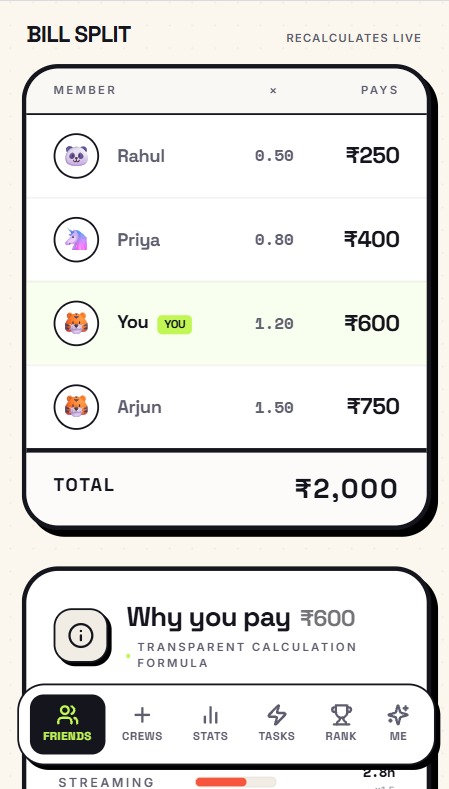
The bill breakdown shows each Crew member, their multiplier, and their final contribution.
For example:
| Member | Multiplier | Pays |
|---|---|---|
| Rahul | 0.50× | ₹250 |
| Priya | 0.80× | ₹400 |
| You | 1.20× | ₹600 |
| Arjun | 1.50× | ₹750 |
| Total | ₹2,000 |
This makes the calculation transparent instead of making the final amount feel random.
6. Leaderboards and social competition
The Crew leaderboard lets members see where they stand compared with their friends.
Instead of keeping screen-time information completely isolated, ByteShare turns it into a friendly competition.
Users can see things such as:
- Current rank
- Weighted screen-time
- Streaks
- Badges
- Progress
- Crew position
The intention is to create small moments of competition between friends.
For example, someone who normally spends a lot of time scrolling might see their friend move ahead on the leaderboard and decide to reduce their usage the next day.
7. Redemption mechanics
We also realized that competition alone can have a problem.
If someone is already at the bottom of the leaderboard halfway through the week, they might simply give up.
ByteShare therefore includes ways for users to recover.
One example is a Screen Sabbath.
A user can declare a period where they intentionally stay away from their phone.
For example:
Sunday, 10 AM – 6 PM: I'm going offline.
If the user successfully completes the period, their score can receive a reduction.
This gives users a way to recover instead of permanently being stuck with a bad score.
8. Detox Challenges
Crews can also participate in group challenges.
For example:
Nobody opens Instagram for 48 hours.
A challenge can involve the entire Crew rather than just one person.
Successfully completing a challenge can provide a score reduction or reward, while failing can result in a penalty depending on the challenge rules.
The idea is to turn reducing screen time into something friends can actively participate in together.
9. Social nudges
ByteShare also introduces lightweight social interactions.
If someone becomes the highest screen-time user in the Crew, other members can send them a simple one-tap nudge.
For example:
"Put the phone down 💀"
There is no need for a full chat system.
The leaderboard and these small interactions are enough to create social pressure while keeping the experience playful.
10. Friends, streaks and achievements
ByteShare also includes a friend system where users can keep track of their friends and their progress.
Streaks and badges provide additional reasons to continue improving.
The application is therefore not just about one dinner or one day of screen time.
It is designed to create a longer-term habit where users gradually become more conscious of how they use their phones.
How we built it
ByteShare is built as an Android application using Kotlin and traditional XML layouts.
We chose XML layouts because we wanted direct control over the UI and wanted to closely follow the visual designs we created for the application.
The Android application handles the main user experience, including:
- User onboarding
- Creating a Crew
- Joining a Crew using a code
- Friends
- Screen-time information
- Leaderboards
- Challenges
- Streaks and badges
- Bill splitting
- Bill breakdowns
- User profile and progress
One of the important technical parts is accessing Android's usage statistics. The application needs the appropriate Android permission and uses the available device usage information to understand application-level usage.
We also paid attention to the permission flow because access to screen-time information is sensitive and should not simply be assumed.
For the UI, we created a global theme so that the application maintains the same visual language across different screens.
The same design principles are used throughout the application:
- Consistent typography
- Rounded cards
- Consistent spacing
- Reusable components
- Consistent buttons
- Shared colors
- Consistent navigation
- Similar visual treatment for rankings and statistics
This was important because ByteShare contains several different sections, but they should still feel like parts of one application.
Challenges we ran into
One of our biggest challenges was figuring out how to turn raw screen-time data into something that actually makes sense for a social competition.
Simply comparing total screen time didn't feel fair.
Someone could spend three hours using Maps and productivity applications while another person spends three hours scrolling social media. Treating both users exactly the same would not represent the kind of behavior we were trying to discourage.
This led us to the weighted category system.
Another challenge was designing the bill multipliers.
We needed the difference between the highest and lowest ranks to be noticeable enough that people would actually care, but not so large that the system would feel unfair or ruin the social experience.
At the same time, all multipliers needed to work mathematically with the total bill.
We also had to think about what happens when someone is already losing.
A system based entirely on punishment can make people stop trying. That's why we introduced redemption mechanics such as Screen Sabbaths and Detox Challenges.
The Android side also introduced its own challenges.
Accessing device usage information requires working with Android's permission model and usage statistics APIs. We had to make sure the application handled this properly rather than assuming access would always be available.
Finally, maintaining UI consistency across multiple screens was more difficult than it initially looked. Small differences in spacing, typography, card sizes, or navigation can make an application feel inconsistent, so we created shared theme values and reusable UI patterns.
Accomplishments that we're proud of
The thing we are most proud of is the basic idea itself: taking something as ordinary as screen time and connecting it to something people actually care about in the real world.
A normal screen-time report might tell someone:
"You spent 5 hours on your phone."
ByteShare can turn that same information into:
"You're currently Rank 4 in your Crew, and you might pay more toward the next shared bill."
That creates a completely different reason to care about the number.
We're also proud of the Crew system because the application is designed around people rather than just individual users.
The weighted screen-time system is another part we are proud of because it recognizes that how someone uses their phone matters, not just how long they use it.
We are also happy with the transparent bill breakdown and the overall visual design. We wanted the application to feel playful and competitive instead of feeling like a strict health-monitoring application.
What we learned
Building ByteShare taught us that solving a behavioral problem is not always about giving people more information.
People already know that spending hours scrolling on their phones isn't necessarily good for them.
The harder problem is giving them a reason to change.
We learned that social motivation can make a familiar problem feel completely different.
A personal notification saying:
"Your screen time increased today."
can be ignored very easily.
But seeing your friends move ahead of you on a leaderboard, knowing that your screen-time score can affect a shared bill, or having a Crew challenge that everyone is participating in creates a much stronger reason to pay attention.
We also learned that features that look simple from the outside can involve a lot of decisions underneath them.
Screen-time tracking involves Android permissions and usage data. Ranking requires a fair scoring system. Bill splitting requires consistent calculations. Social features require careful handling of what information should be visible to other people.
Most importantly, we learned that a digital-wellness application doesn't necessarily have to feel like a digital-wellness application.
It can be competitive.
It can be funny.
It can involve friends.
And it can give people a reason to put their phones down without constantly telling them that they should.
What's next for ByteShare
ByteShare is still something we want to keep developing.
One area we want to improve is application categorization. We want the classification of applications into social media, streaming, productivity, neutral, and other categories to become more accurate and flexible.
We also want to expand the Crew challenge system with more types of challenges and different ways for users to recover their scores.
Another area we want to explore is making the system work for more real-life situations.
For example, ByteShare could be used during:
- Family dinners
- Group trips
- Study sessions
- College events
- Parties
- Team activities
- Work sessions
We also want to continue improving privacy controls because screen-time information is personal. Users should have a clear understanding of what information the application uses and what their Crew members can see.
In the long term, our goal isn't to make people stop using their phones.
Phones are useful, and we use them for work, communication, navigation, learning, entertainment, and many other things.
The goal of ByteShare is much simpler:
When you are with people, give the people around you a reason to be more interesting than the screen in your hand.
Built With
- kotlin
- pocketbase
- react
- typescript
- vite

Log in or sign up for Devpost to join the conversation.