-
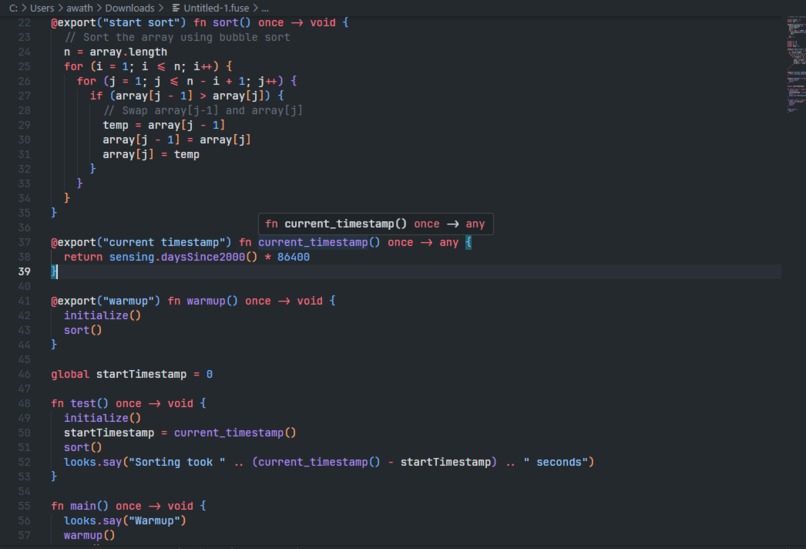
Highlighting for example extension included by FUSE CLI repository.
Inspiration
The scratch-fuse project was born out of frustration with existing Scratch text-based solutions like Goboscript and Tosh. I (FurryR) found these tools suffered from several issues: Goboscript's local variable system was flawed and buggy in recursive or complex scenarios; struct implementations were just collections of variables, hard to organize and unable to support nesting; and its syntaxes were too "Pythonic," leading to a poor coding experience. To create a truly practical Scratch programming language and toolchain, I decided to build FUSE language from the ground up.
What it does
scratch-fuse is a complete ecosystem toolchain that compiles the advanced FUSE programming language into Scratch 3.0 projects. The organization maintains 8 core repositories:
- Core Functionality: The core repo provides the lexer and parser; compiler implements FUSE to IR compilation and decompiler features; serializer converts IR to Scratch SB3 format and supports deserialization.
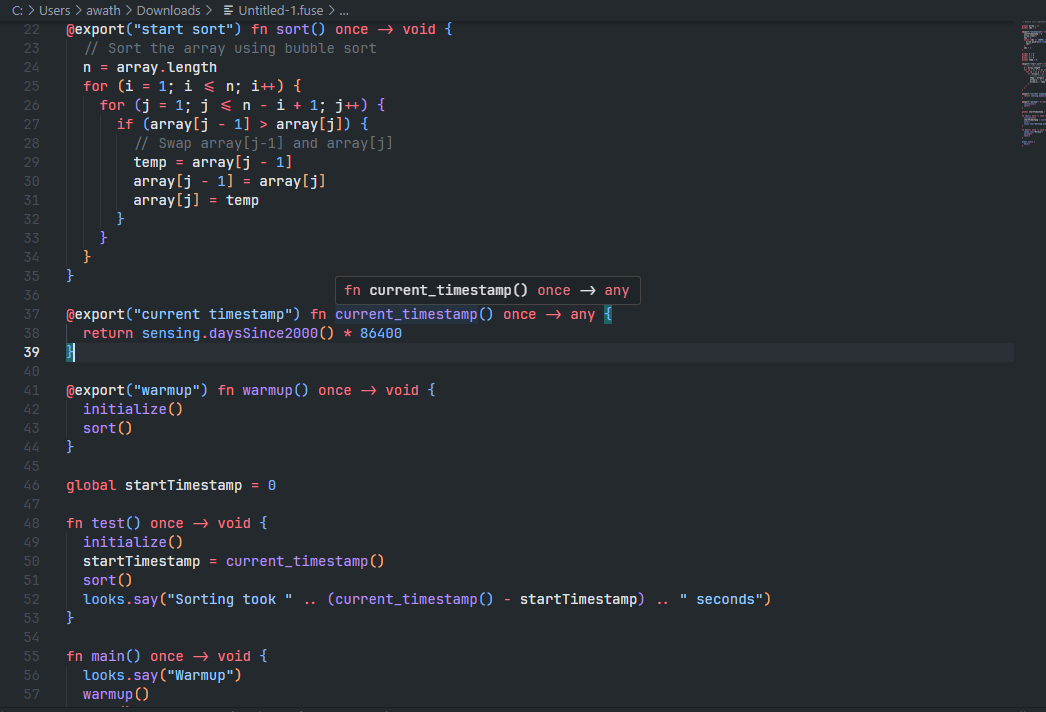
- Developer Tools: The lsp repo offers Language Server Protocol (LSP) support, including syntax highlighting, code completion, error checking, and other IDE features. The formatter repo provides code formatting tools.
- Utility Components: builtins contains Scratch builtin block definitions; utility supplies common functions; fuse is the main CLI compiler.
How we built it
The project uses TypeScript as its principal language and builds a modular architecture. Each module has specific responsibilities:
- Parsing Layer: Utilizes core’s lexer to parse FUSE into AST.
- Compilation Layer: compiler turns AST into IR, providing advanced decompiler capabilities including intelligent variable renaming, function format detection, operator reconstruction, and namespace matching.
- Serialization Layer: serializer handles conversion between IR and Scratch SB3.
- Tools Layer: Offers LSP server, code formatter, and CLI interface.
All modules use unified build tooling (tsup) and follow the MPL-2.0 license.
Challenges we ran into
Currently, the parser fails on parsing large (>30MB) scripts and we'd like to find a solution to resolve the issue. We have refactored parser and lexer with streaming API, but it has poor effect.
Accomplishments that we're proud of
- Complete Toolchain: Built a fully-featured toolchain from parsing to Scratch project generation, supporting bidirectional conversion.
- Modern IDE Features: Implemented (partial) LSP support for a contemporary programming experience, and even compatibility with tooling like GitHub Copilot.
- Advanced Decompiler: Developed a decompiler to decompile Scratch projects into FUSE projects, which helps developer to migrate their projects into FUSE seamlessly.
- Modular Architecture: Each component is highly modular, developers may use any of these repositories to create their own FUSE-based project (e.g. Scratch vibe coding)
What we learned
Through this project, we gained deep insights into:
- Compiler Theory: Building a full language toolchain from lexing to code generation.
- Language Server Protocol: Integrating custom language support for modern IDEs.
- Scratch Internal Mechanics: Thorough understanding of Scratch’s block and project formats.
- Open Source Management: Managing and expanding a multi-module open-source ecosystem.
What's next for scratch-fuse
Future directions include:
- Ecosystem Expansion: Improving and extending the toolchain with more practical features and integrations, e.g. Scratch editor integration.
- Community Development: Promoting the project through hackathons and growing developer contributions.
- Performance Improvements: Continuously optimizing the compiler and LSP for larger projects.
- Educational Applications: Introducing tools into EDU environments to help students learn programming concepts.
- Standardization: Driving FUSE language standardization and establishing robust syntax guidelines.
The scratch-fuse project showcases open source innovation in educational tech, bringing powerful new capabilities to Scratch-related development and enabling more efficient and professional creation of complex Scratch projects, while empowering Scratch editors (IDEs) with the ability of text-based programming language.

Log in or sign up for Devpost to join the conversation.