Inspiration
The inspiration for ScrapeFlow came from a recurring real-world problem we observed during internships, hackathons, and startup projects: extracting structured data from the web was always time-consuming, fragile, and heavily dependent on custom scripts. Even small UI changes on a website would break scrapers, forcing developers to repeatedly fix and redeploy code.
We wanted to reimagine web scraping not as a one-off script, but as a visual, repeatable workflow—something that both technical and non-technical users could design, understand, and maintain. This led to the idea of combining no-code workflow design with AI-assisted data extraction.
What it does
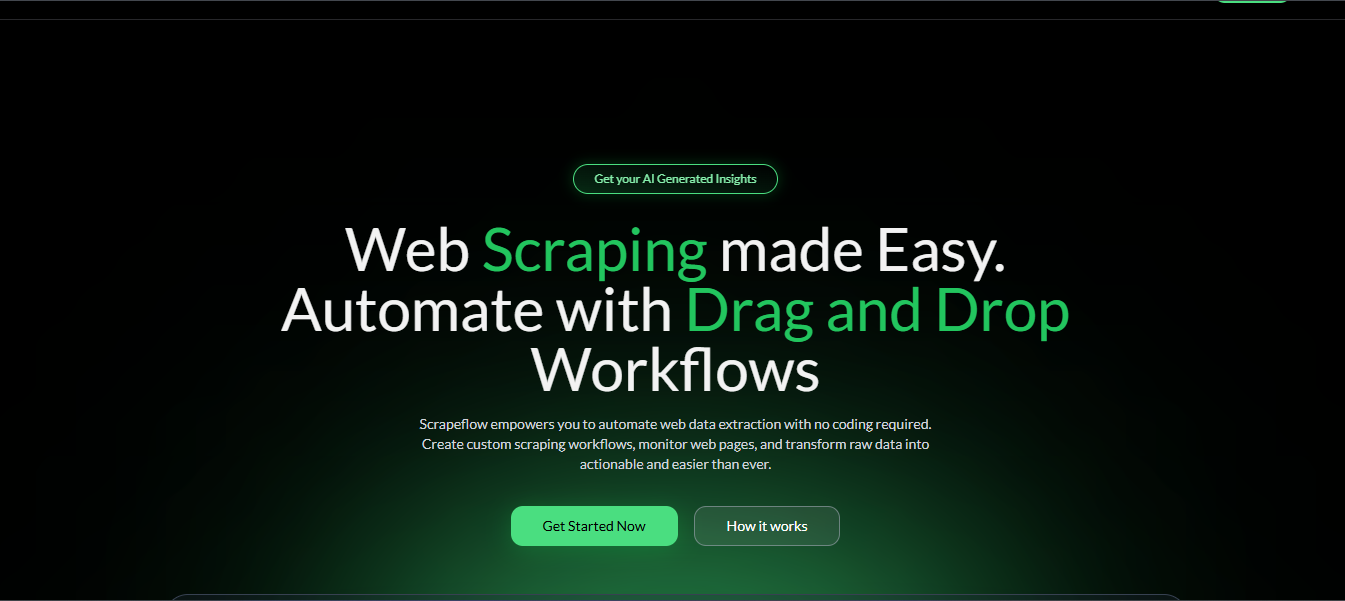
ScrapeFlow is a no-code / low-code platform that allows users to visually design, automate, and manage web scraping workflows.
Key capabilities include:
- Drag-and-drop workflow creation for scraping pipelines
- AI-powered extraction of structured data from unstructured web pages
- Support for dynamic, JavaScript-heavy websites
- Automated execution through schedules or triggers
- Easy integration with databases, APIs, and webhooks
In simple terms, ScrapeFlow turns web pages into reliable data pipelines instead of fragile scripts. ([Devpost - The home for hackathons][1])
How we built it
ScrapeFlow was built as a full-stack, modular system:
Frontend: Next.js 14 with React and React Flow to create an intuitive visual workflow builder Backend: Node.js to orchestrate scraping tasks and workflow execution Scraping Engine: Puppeteer for handling dynamic content and browser automation Database: PostgreSQL (Neon DB) with Prisma ORM for workflow metadata and extracted data AI Layer: Pluggable AI models integrated via API keys for intelligent data extraction
Each workflow node represents a logical scraping step, and the execution engine processes these nodes sequentially, similar to a directed graph:
[ Workflow = (V, E) ]
where (V) represents scraping actions and (E) represents execution flow.
Challenges we ran into
- Handling dynamic websites that load content asynchronously
- Designing a visual workflow system that is both powerful and easy to use
- Managing execution order and failure handling in complex scraping pipelines
- Preventing scraping failures due to minor UI changes
- Balancing flexibility for developers with simplicity for non-technical users
These challenges pushed us to think beyond traditional scraping scripts and focus on robustness and usability.
Accomplishments that we're proud of
- Successfully built a visual, no-code scraping workflow engine
- Implemented AI-assisted extraction that reduces manual selector writing
- Designed a scalable architecture that supports future automation features
- Created a platform that transforms scraping into a maintainable business process
What we learned
Through ScrapeFlow, we learned:
- How to architect scalable, event-driven scraping systems
- The importance of UX in developer tools
- How AI can reduce brittleness in automation pipelines
- How to convert a technical capability into a product-level solution
This project significantly improved our understanding of full-stack systems, automation design, and AI integration.
Additional Project Requirement (Drive Link)
Project demo / documentation can be accessed here:
Google Drive Link: https://drive.google.com/file/d/1dKwMoJA3wpCBjz6vJkIYgYSVjxQpu2Wr/view?usp=drive_link
What's next for ScrapeFlow – No-Code Intelligent Web Scraping Platform
Our roadmap includes:
- Self-healing AI agents that adapt to website changes automatically
- Team collaboration and role-based access control
- Cloud-native deployment with autoscaling
- Pre-built workflow templates for common scraping use cases
- Advanced monitoring, logging, and alerting
ScrapeFlow aims to evolve from a scraping tool into a complete web data automation platform.
Built With
- javascript
- next
- prisma
- react
- reactflow
- typescript
- vercel

Log in or sign up for Devpost to join the conversation.