-
-
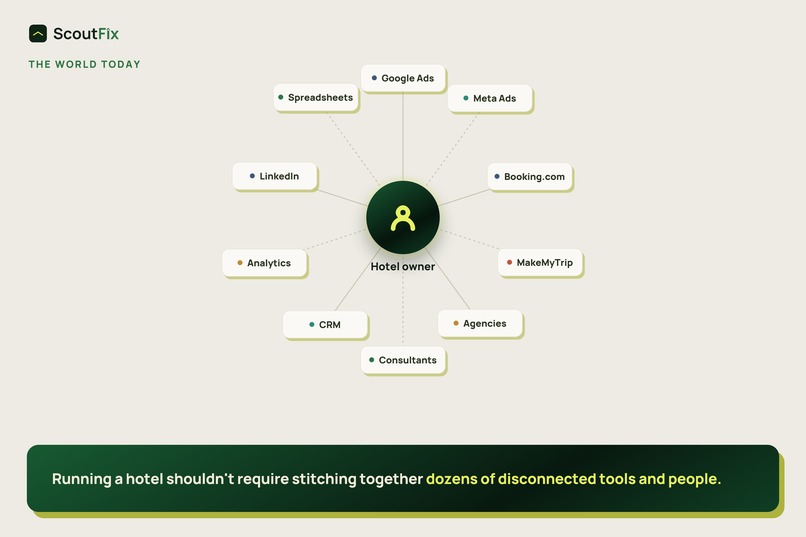
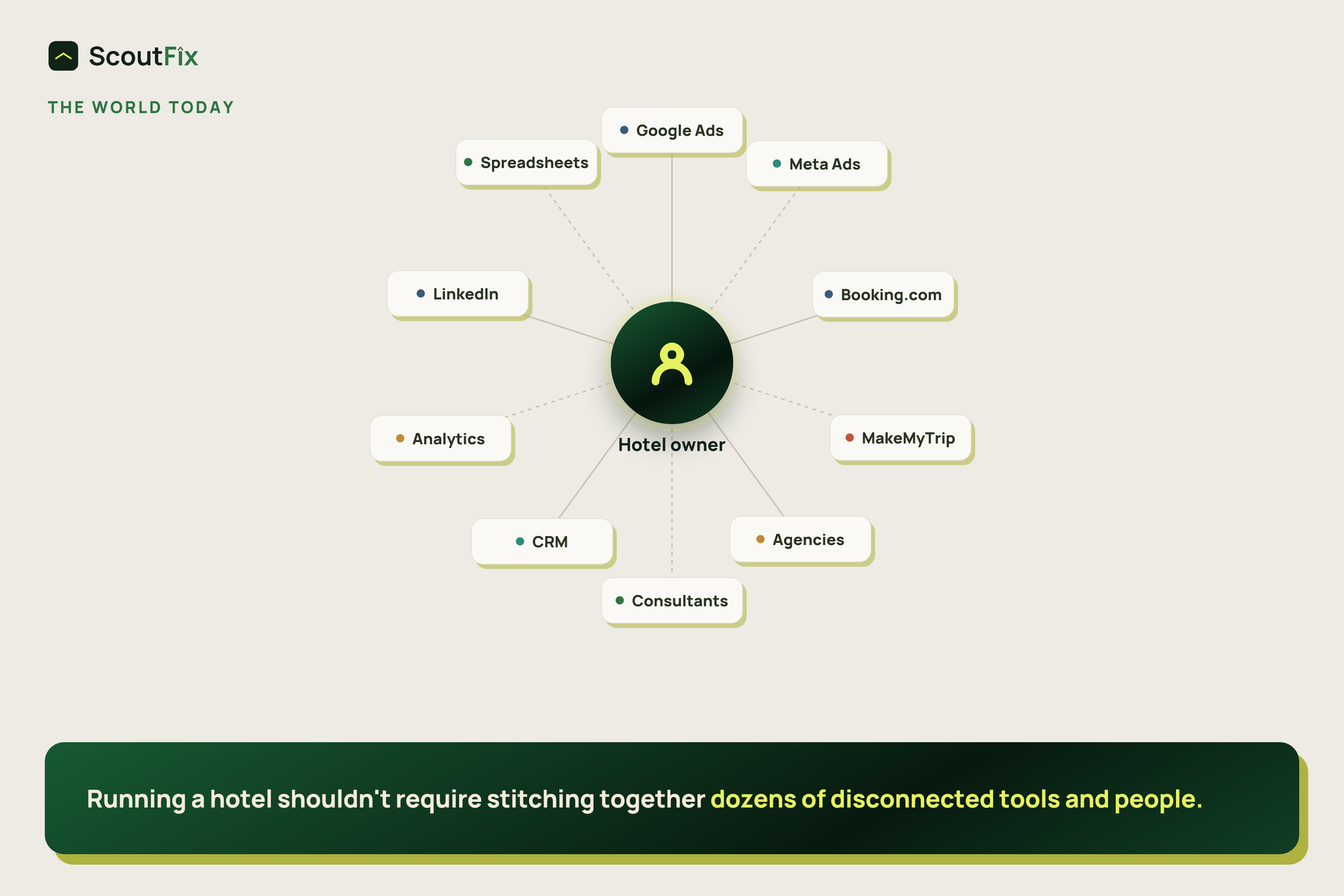
Hotels today rely on dozens of disconnected tools and people to run their business.
-
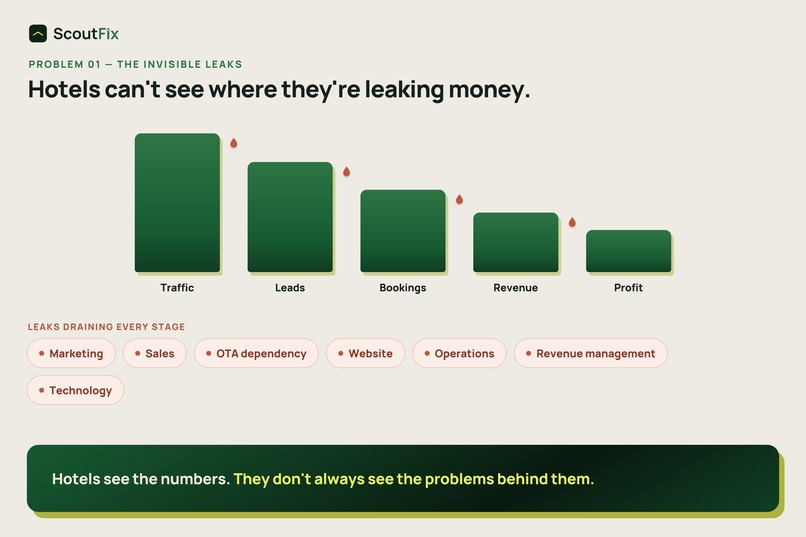
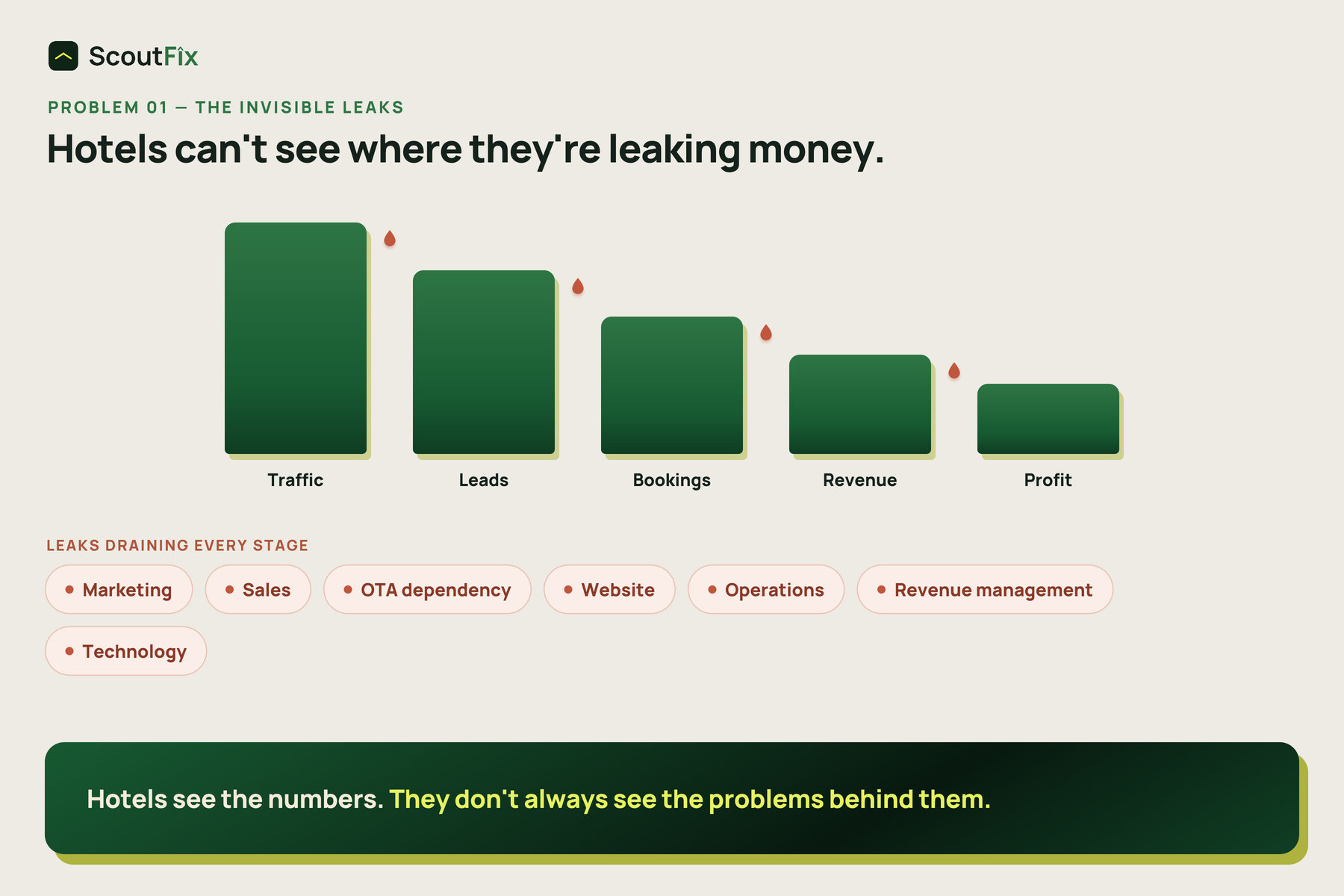
Hotels see the numbers, but hidden leaks across marketing, sales, operations, and revenue remain difficult to diagnose.
-
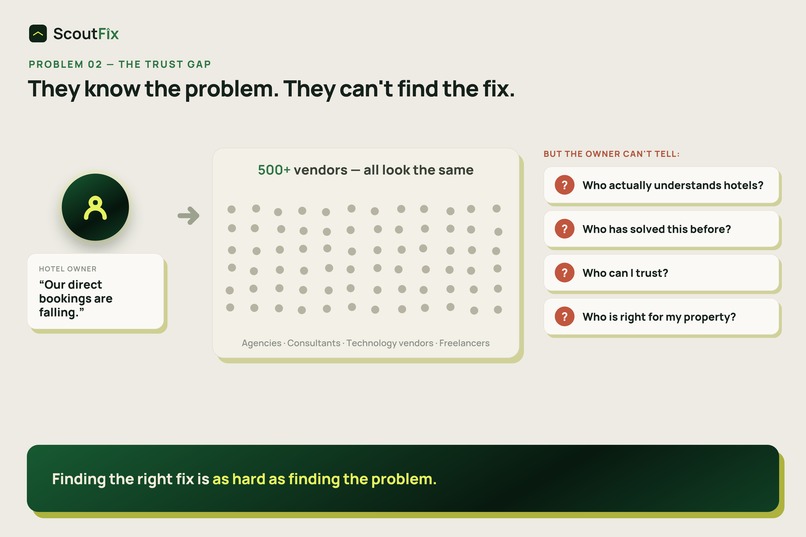
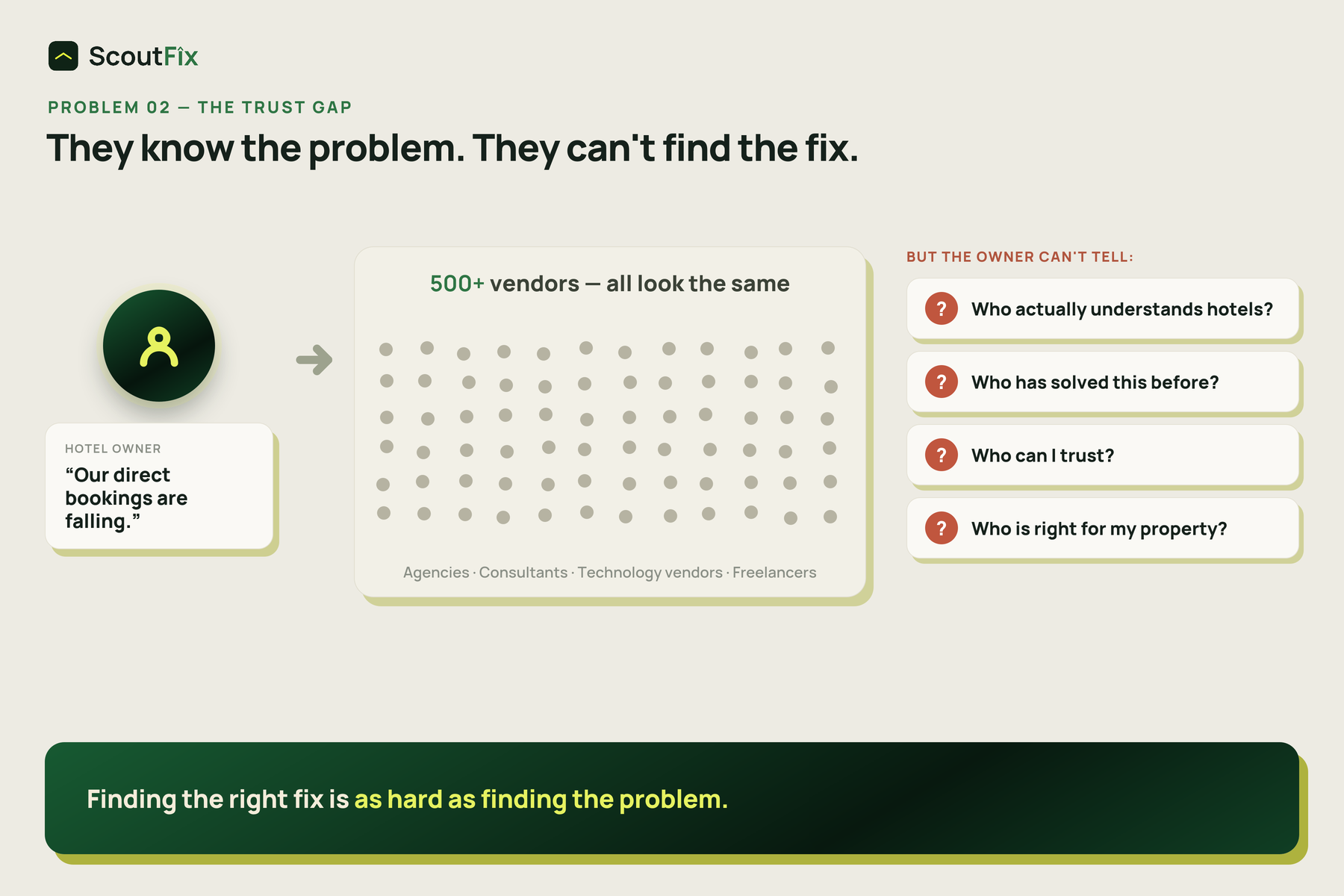
Hotels face hundreds of vendors, but struggle to know who truly understands their problem, can be trusted, and is right for their property.
-
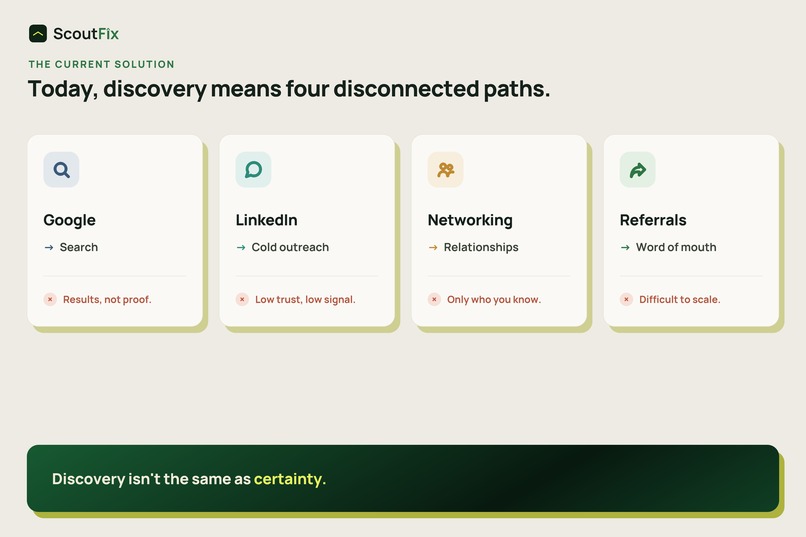
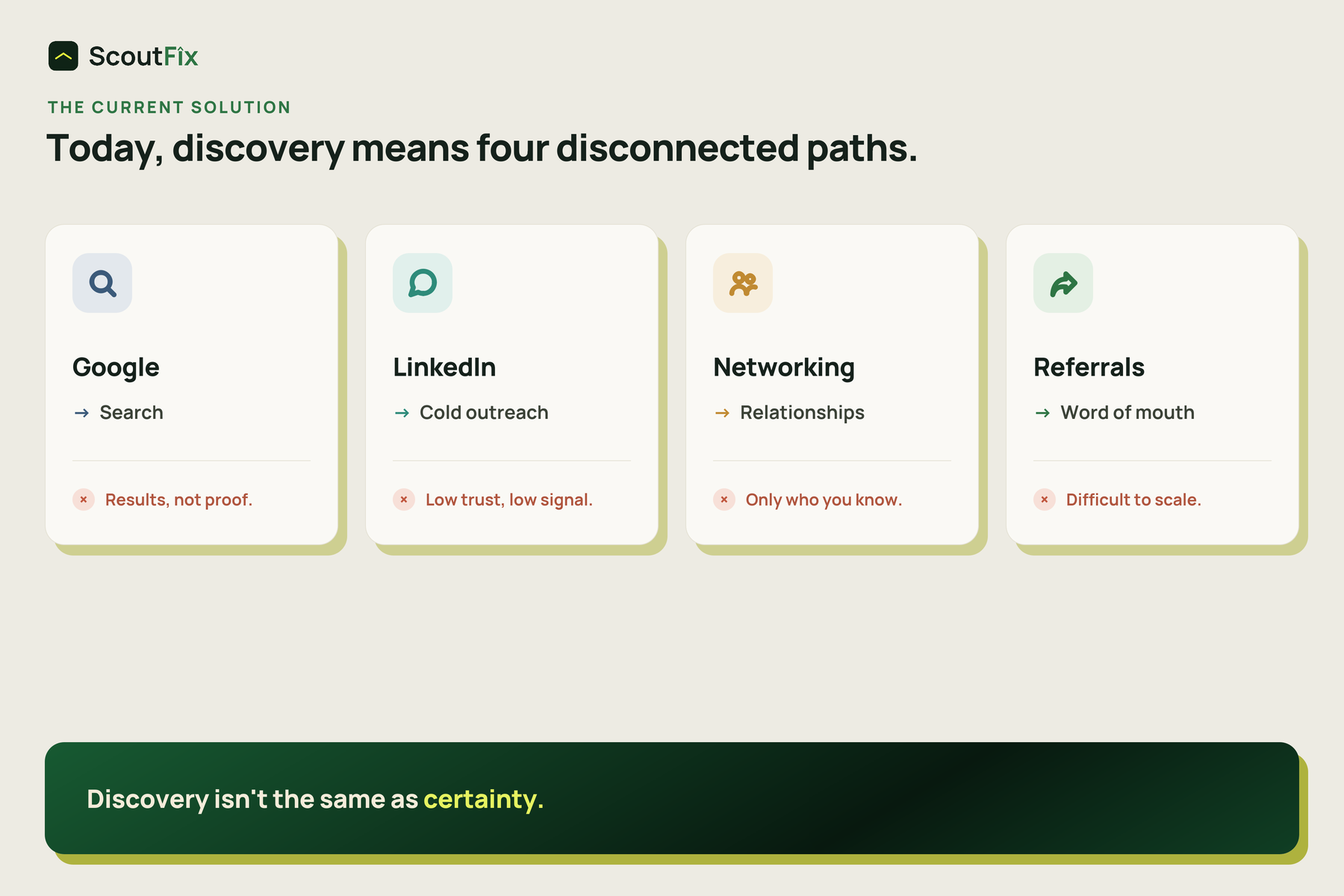
Today, hotels rely on fragmented discovery through search, cold outreach, networking, and referrals—with no clear path to the right fix.
-
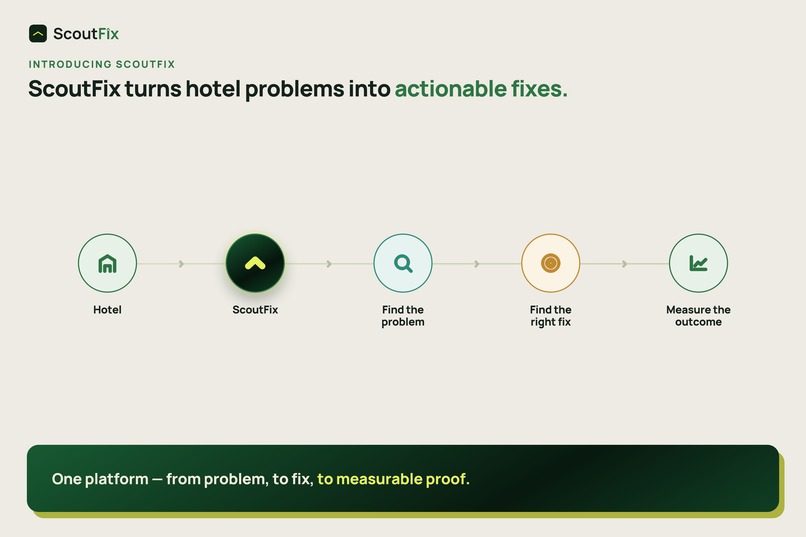
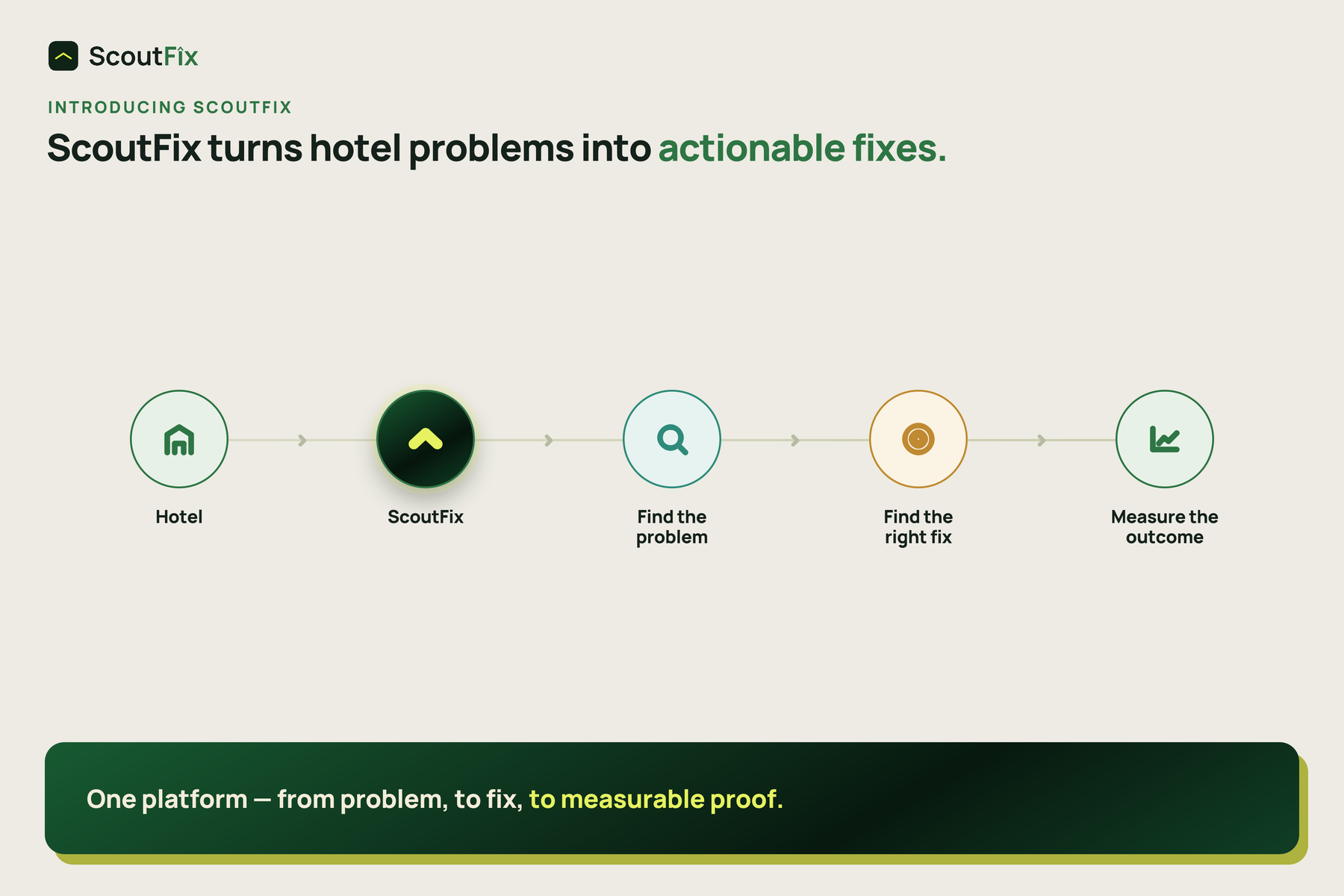
ScoutFix connects the full journey—from identifying the problem to finding the right fix and measuring the outcome.
-
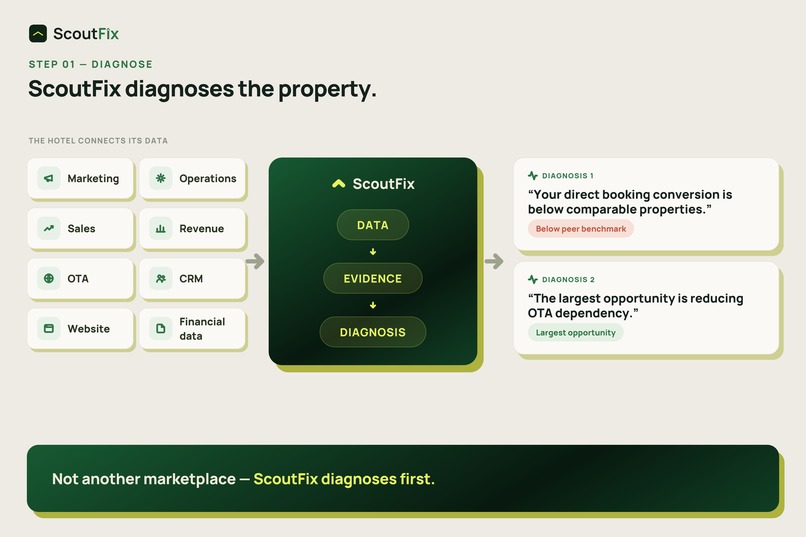
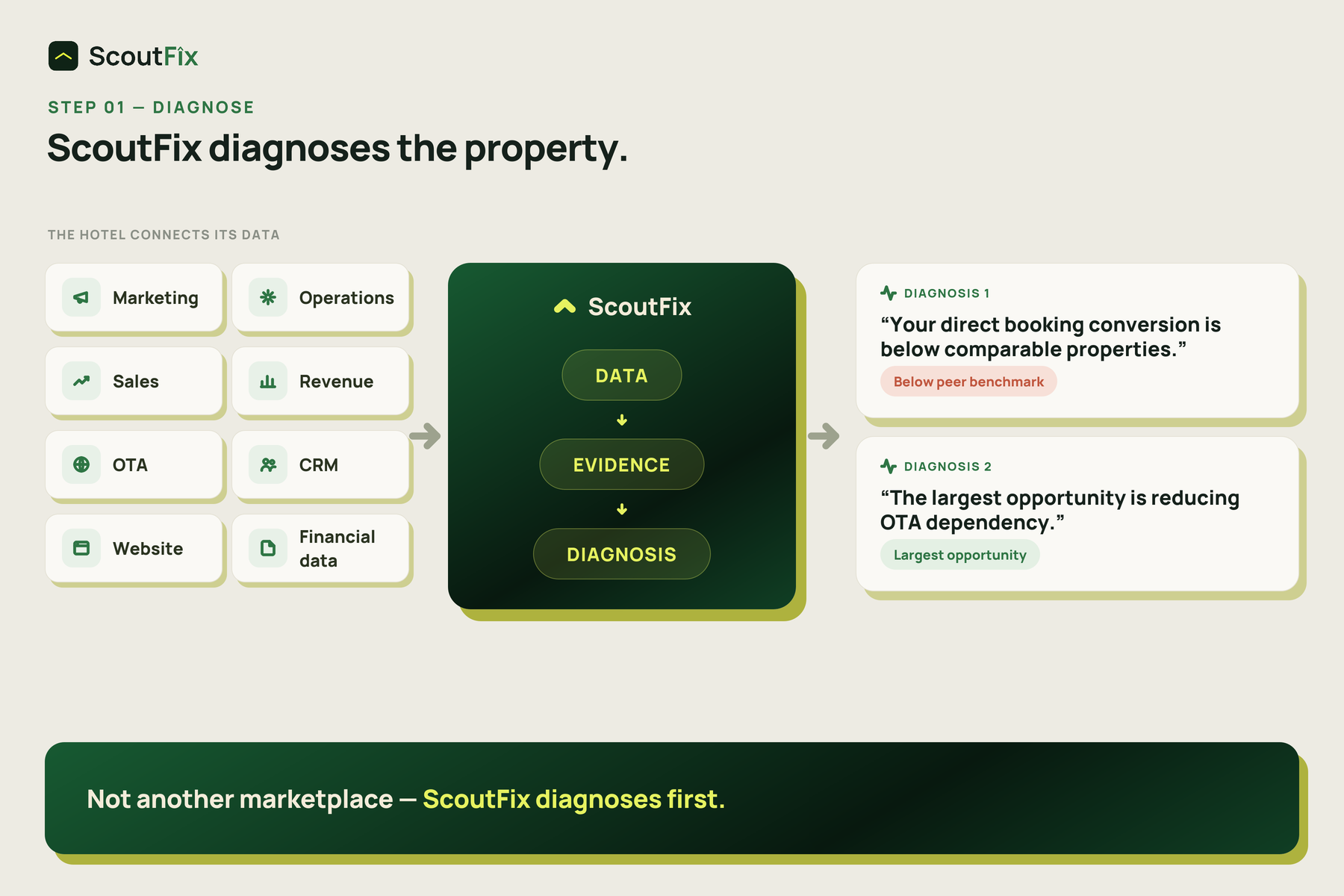
Hotels connect their data, and ScoutFix turns it into evidence-based diagnoses—revealing where performance falls below relevant benchmarks.
-
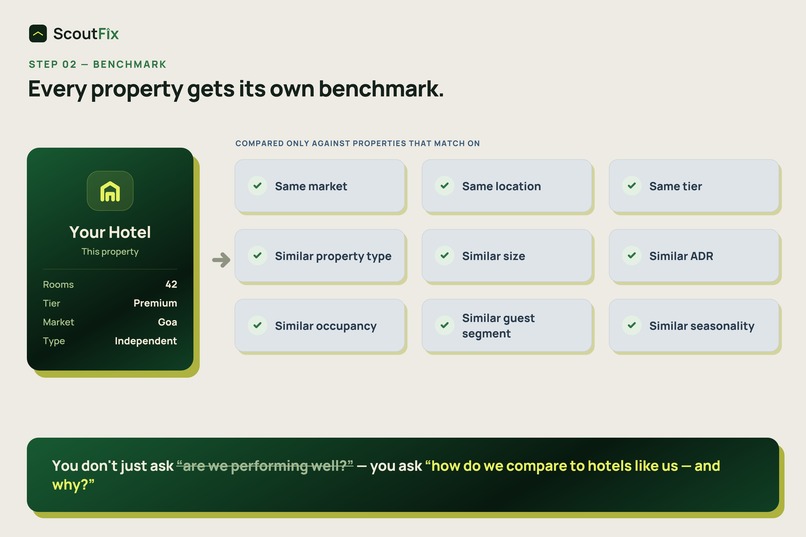
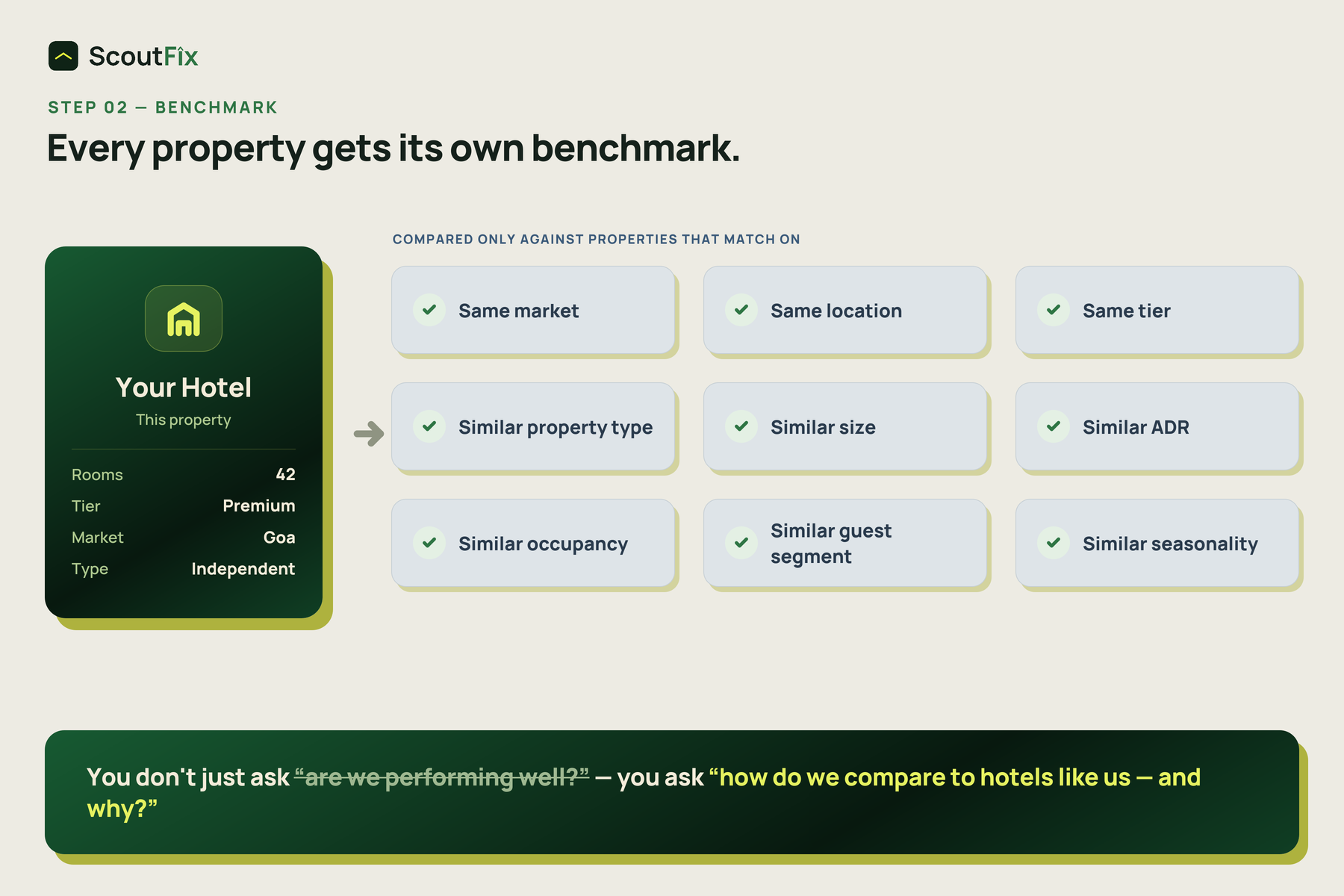
Every property is benchmarked against comparable hotels by market, location, tier, size, ADR, occupancy, guest segment, and seasonality.
-
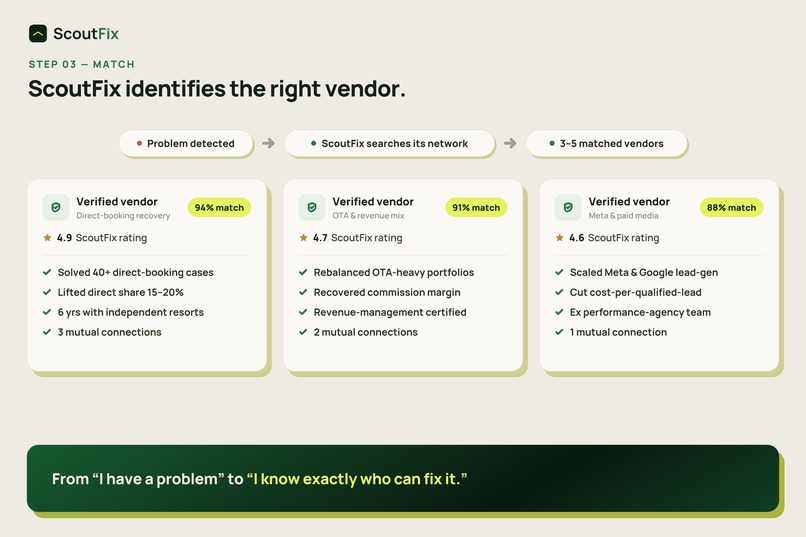
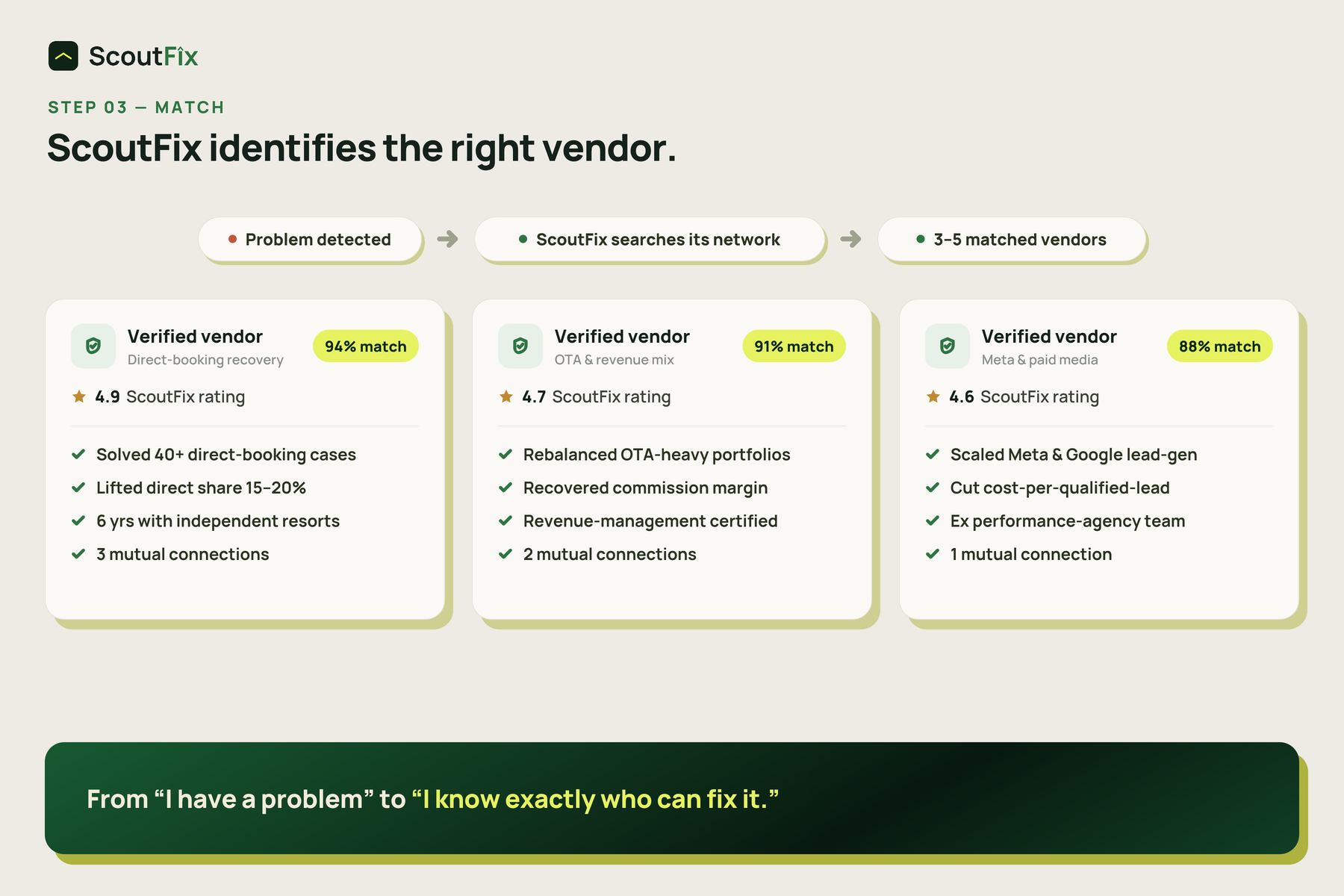
ScoutFix matches each problem with the right vendors using verified expertise, past results, ratings, and mutual connections.
-
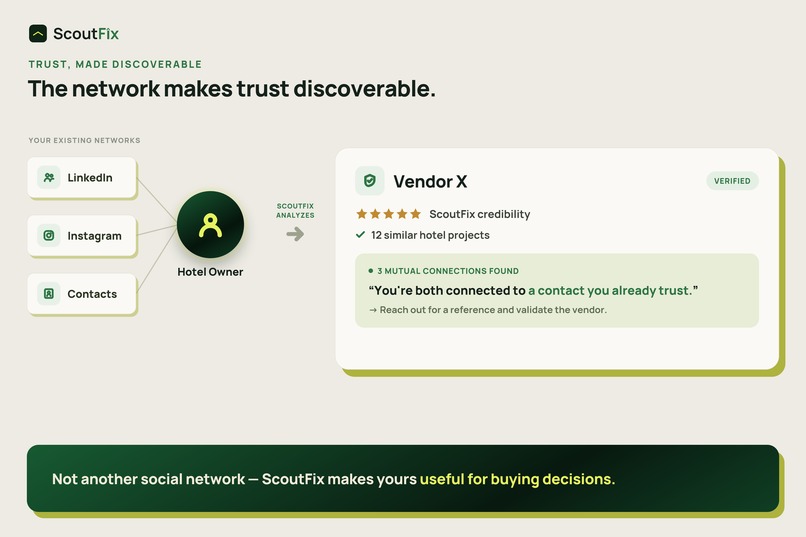
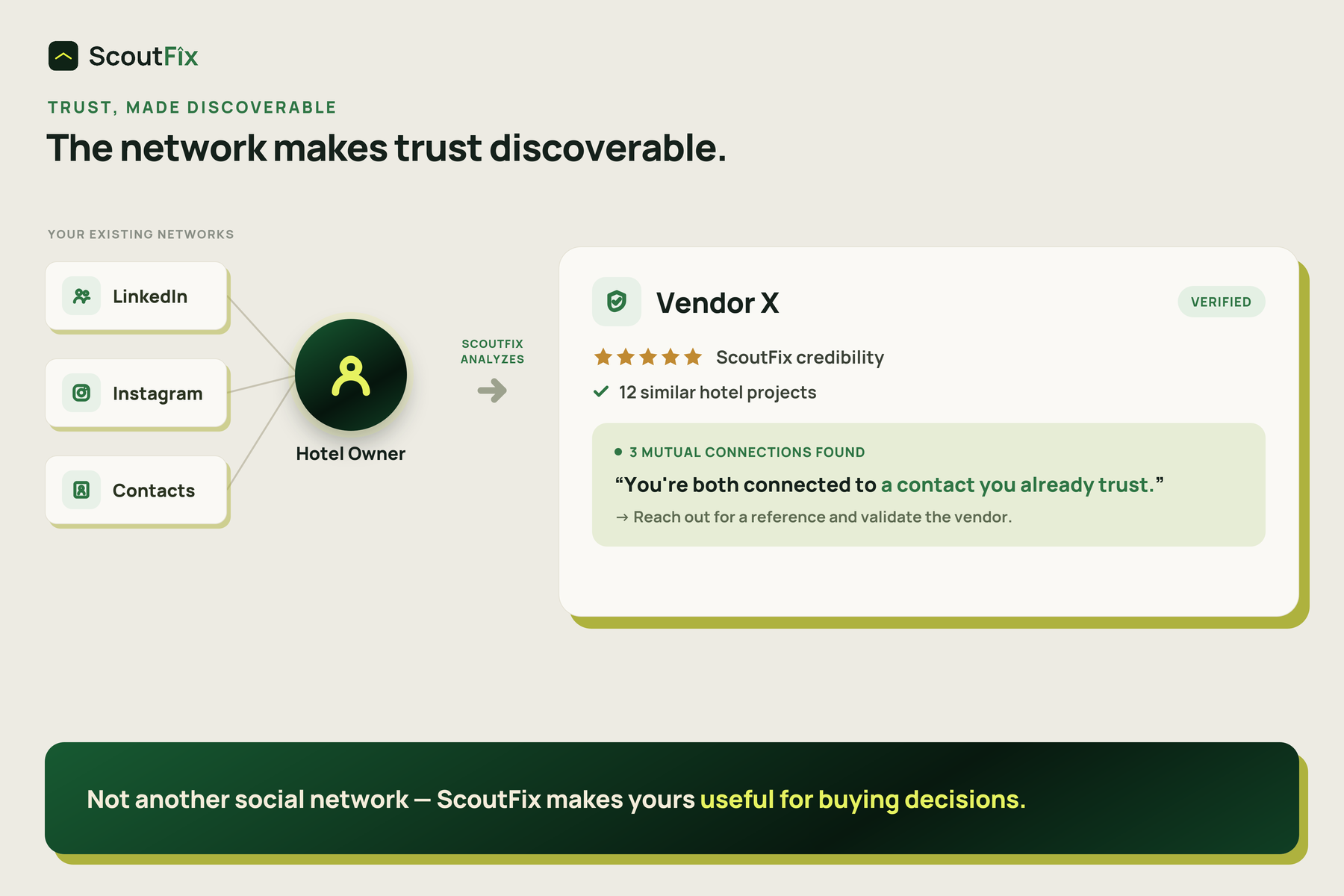
ScoutFix uses LinkedIn, Instagram, and contact networks to surface mutual connections, helping hotel owners validate vendors they can trust.
-
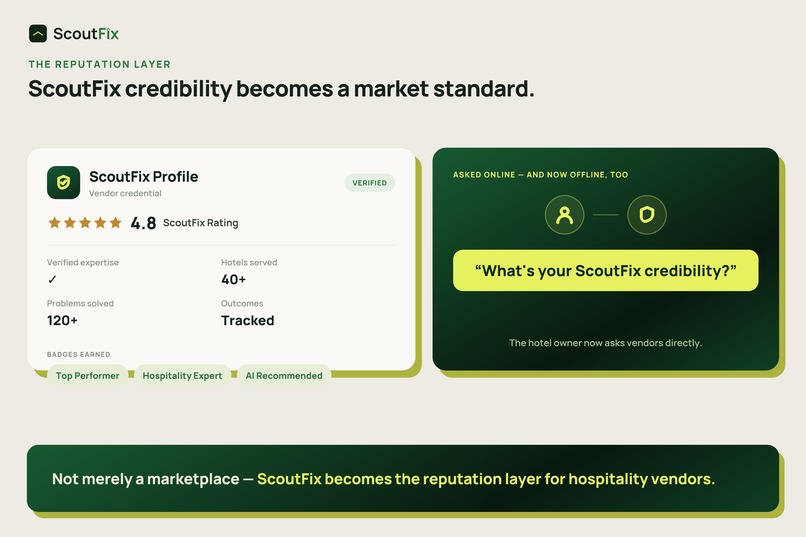
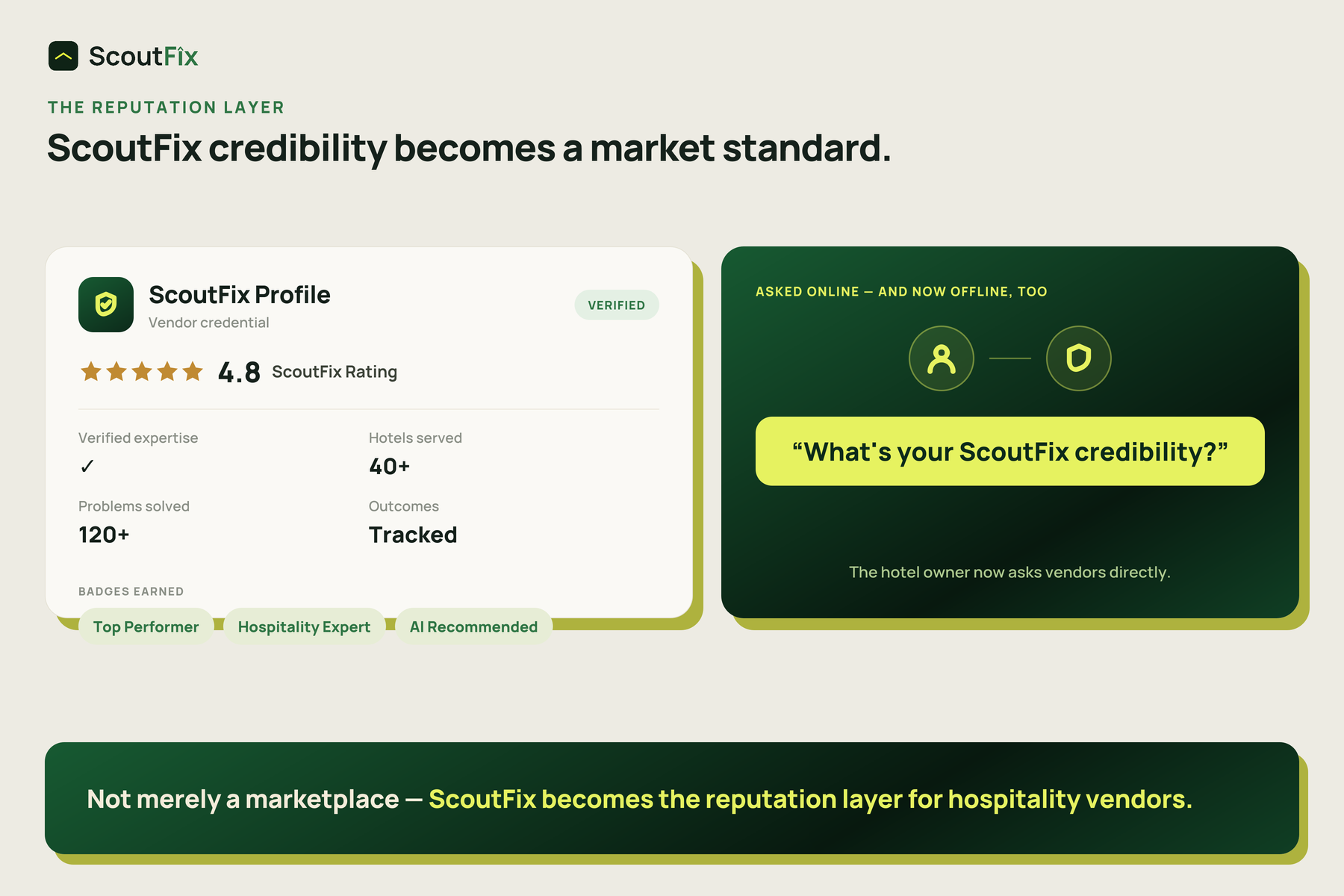
ScoutFix creates a trusted vendor reputation layer with verified expertise, outcomes, ratings, and credibility for better buying decisions.
-
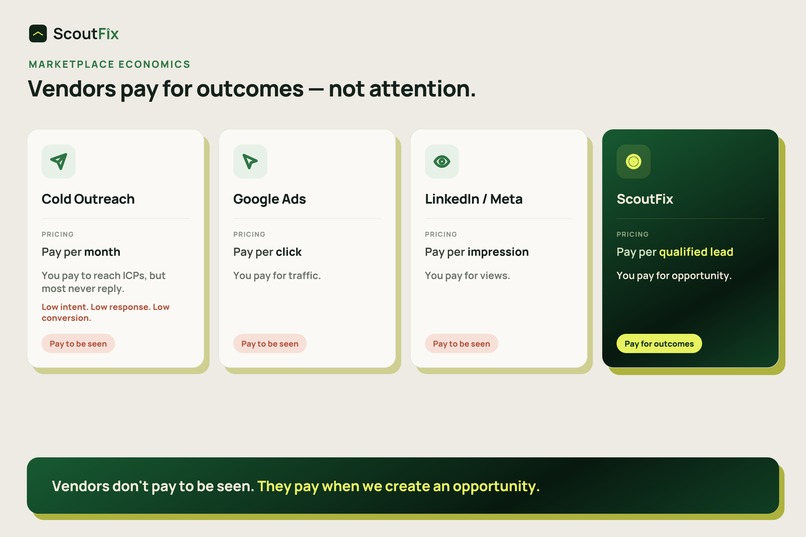
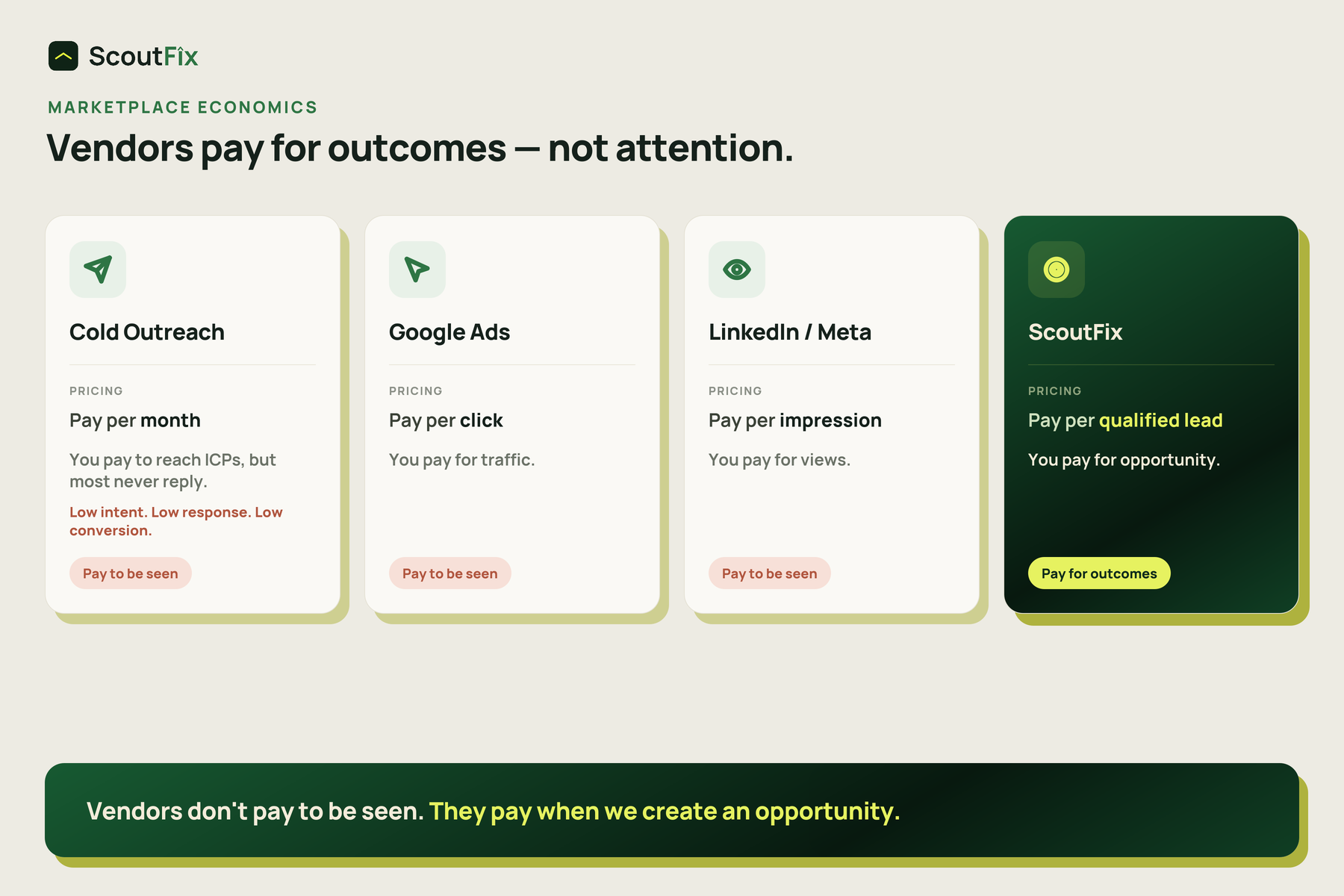
ScoutFix changes B2B vendor acquisition from paying for attention to paying for qualified opportunities and measurable outcomes.
-
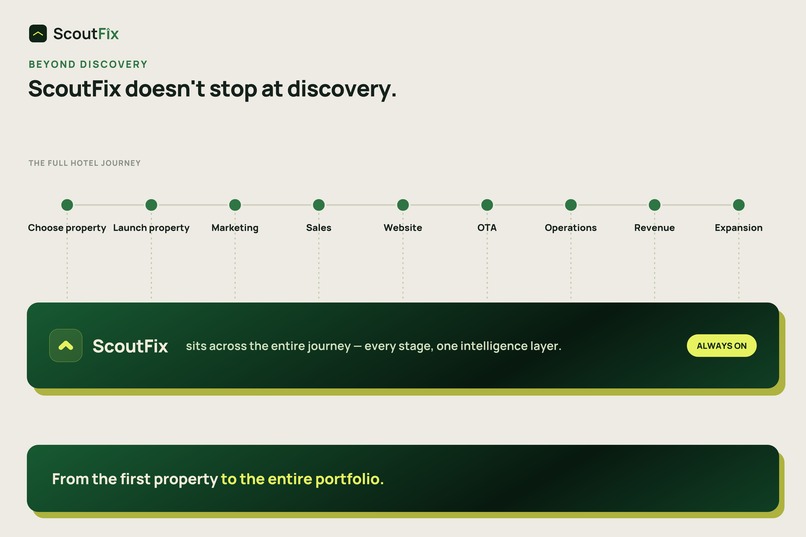
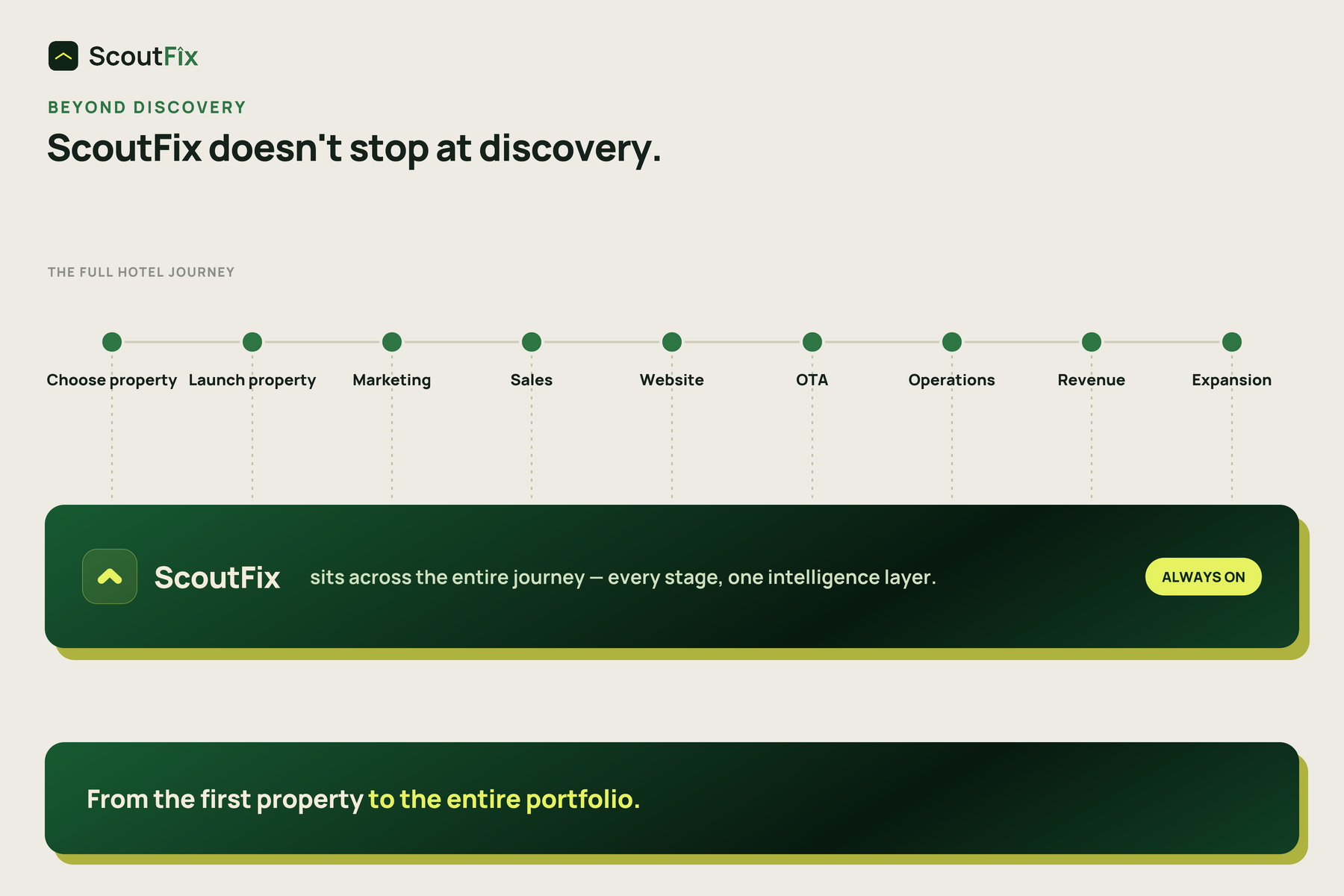
ScoutFix stays with the hotel from launch to expansion, identifying bottlenecks and matching the right solutions at every stage for growth.
-
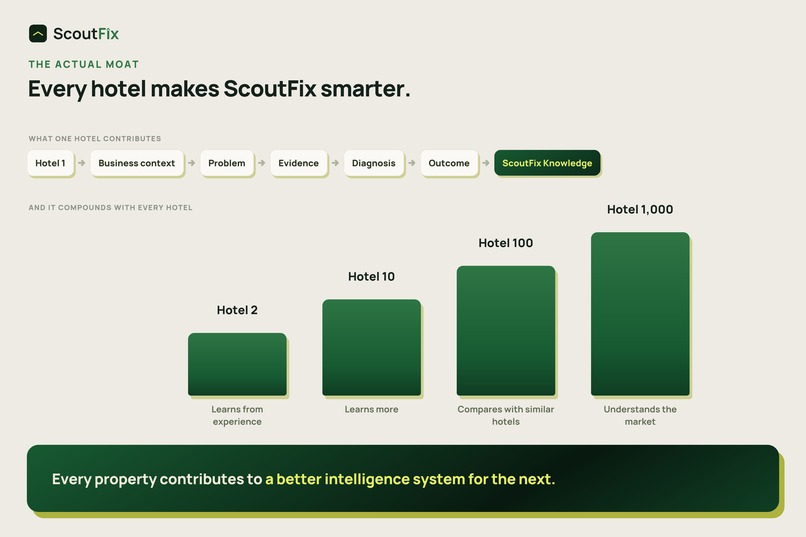
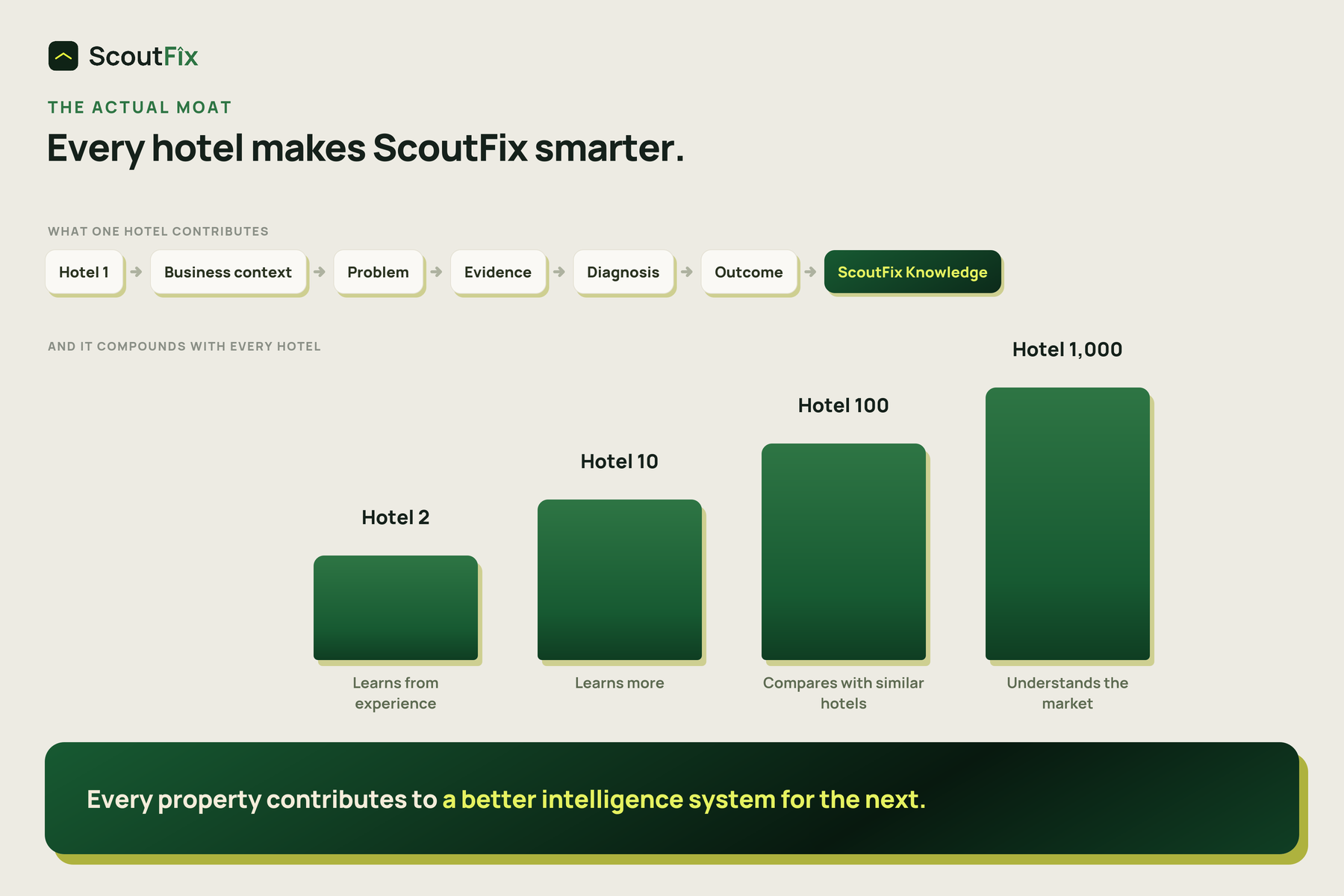
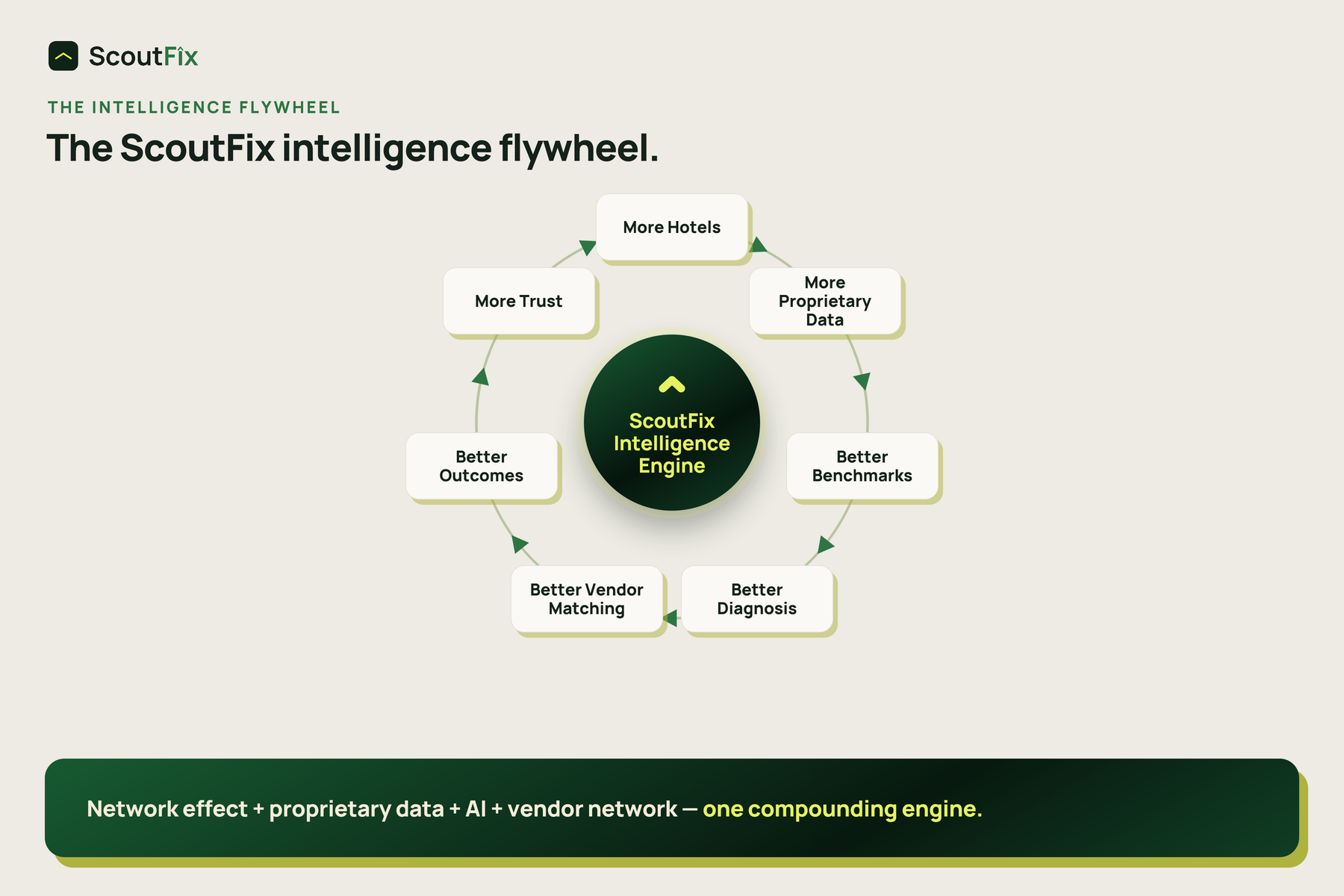
Every hotel adds real business context, problems, evidence, and outcomes, making ScoutFix smarter and more useful for the next property.
-
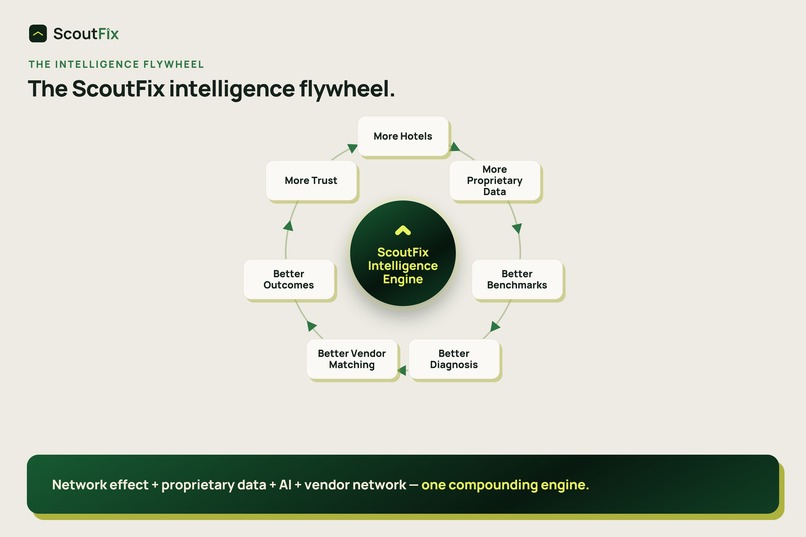
Every hotel adds data, outcomes, and trust, making ScoutFix smarter and strengthening the flywheel with every new property.
-
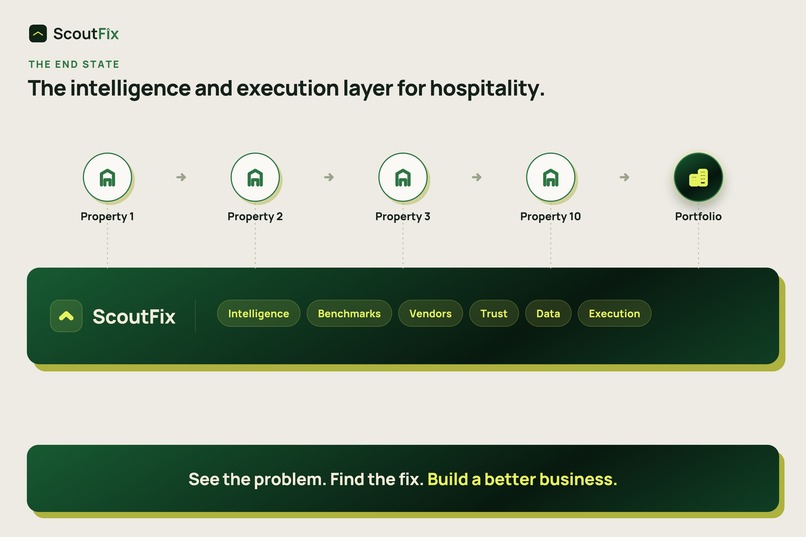
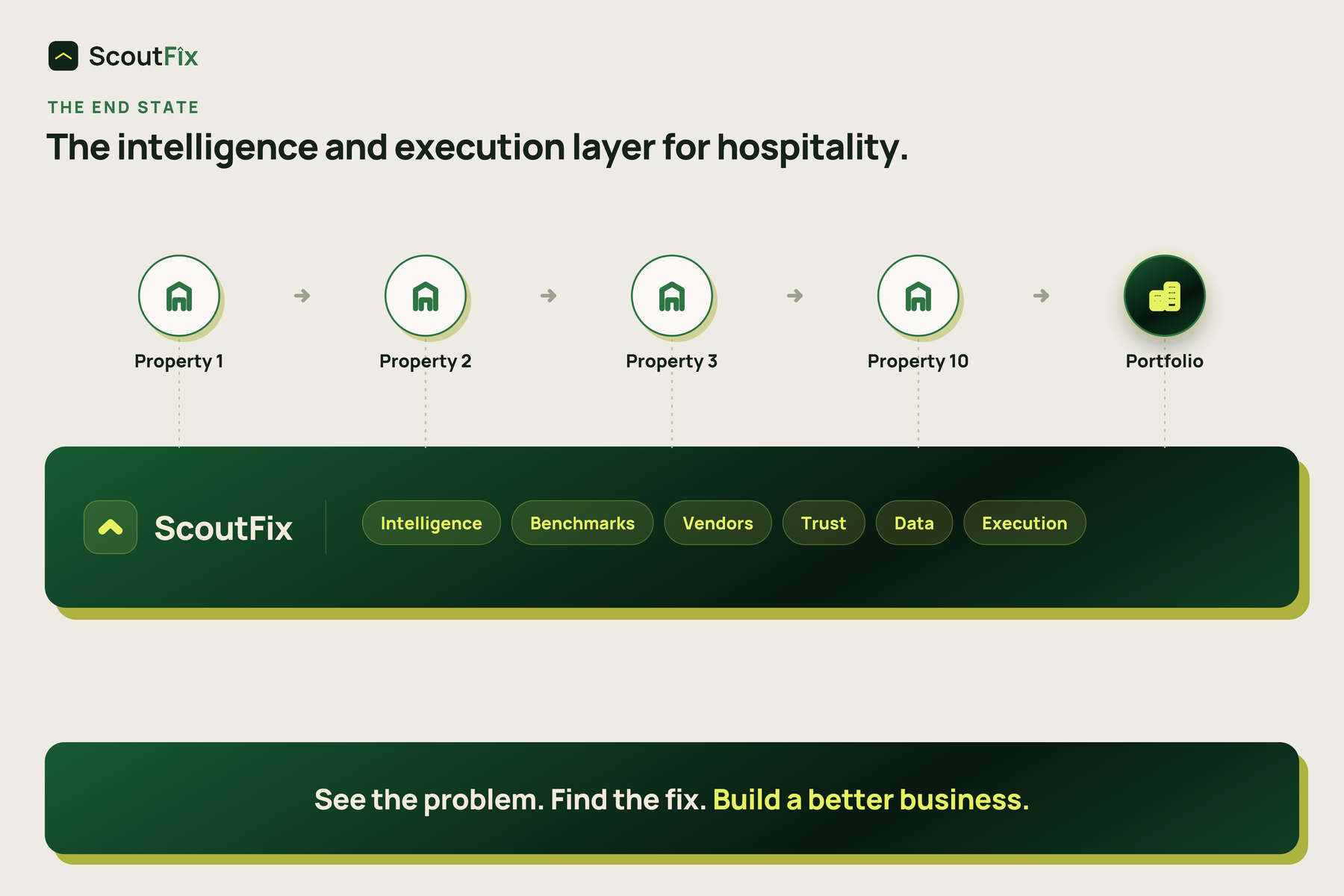
ScoutFix becomes the intelligence and execution layer for hospitality, helping every property see problems, find the right fix, and scale on
Inspiration
We have been running a marketing agency for more than three years, providing services to businesses. Most of the clients that we acquired came through our network. Once our network got exhausted, it became a very big challenge for us to scale our business.
We analysed that, in the upcoming years, with the help of AI, a lot of service providers and products will be available across every niche and every category. The supply of products and services is going to skyrocket in the next five years because of AI. The best way to win in the future is to have really good distribution.
I believe that in today's world, most B2B marketing depends on cold outreach. There is a very big problem with that:
- It is a saturated way to reach out to businesses.
- If you are reaching out, you don't know if your ICP wants that service or product, or if you are pitching to them at the right time.
- The business owners to whom you are pitching get a lot of these kinds of emails and LinkedIn messages that create very little value for them.
This, for us, is a very broken way because we have spent a lot of money on the best talent and best infrastructure that can do the cold outreach for us, and it did not work. While on this path, we have been working with a lot of business owners and B2B businesses, and it did not work for them as well. According to us, that was a great opportunity to solve the problem of B2B marketing.
The realisation was that if we can solve the distribution problem for upcoming businesses, upcoming service providers, and upcoming products and agent companies, it is a huge market.
Secondly, because AI is going to deal with a lot of niche tasks, there is a great possibility to analyse the data of businesses across different categories like marketing, sales, operations, legal, etc. We can go deeper and deeper into data and find out what problems these businesses are facing.
If we can get a chance to predict the bottlenecks of businesses and provide them with the exact solutions, for example:
- Who can solve their problem statements
- Who can be an agentic AI product
- Who can be a service provider
- Who can be a software company that can actually solve their problem statements
It is going to be a great solution for business owners.
We started with this idea that we would pick one niche to master this concept. We started our journey on June 15, 2026, and picked the hospitality industry because, according to the problem statements we analysed, hospitality is one of the great industries where we can provide immense value. The industry needs frequent B2B vendors and still operates in a very fragmented manner.
We started building this product with the idea of solving these problems for the hospitality industry.
What it does
ScoutFix helps business owners identify the issues and bottlenecks in their businesses and find the exact businesses that can solve those problem statements.
We started with hospitality, where business owners can connect their data and figure out what is going wrong in areas such as marketing and sales, and who could be the best solution to fix their problem statements.
ScoutFix can help identify:
- Who can solve their problem statements
- Which agentic AI product can solve the problem
- Which service provider can solve the problem
- Which software company can solve the problem
On the other side, vendors can get leads based on intent rather than cold outreach, where you don't know what your ICP wants or whether they actually need your product or service.
This was absolutely a great solution for resort owners. They could come to our platform, connect their data, figure out what is going wrong in their marketing and sales, and find out who could be the best solution to fix their problem statements.
How we built it
We started building ScoutFix on June 15, 2026.
When we started building, we started with a property called Glampeco, which was the property of one of my close friends. We started building this product with them, so whatever idea we had, we actually started getting data from Glampeco, made a model for them, and then tried to solve their problem statements. That is how we started it.
We come from a tech and marketing background, and within a month, we built a prototype.
We first figured out:
- What kind of data do we need?
- How can we analyse the data?
- What would be the different cohorts we need to make in order to sort this data?
- How can we analyse it?
- How can AI help us go deeper and deeper into the insights?
- How can we gather the final outcome?
- How can we connect those problems with vendors and probably the business providers who can actually solve these problems using AI?
Within the prototype, a business owner can enter their query. The AI asks a couple of questions and tries to understand what data is required. We built multiple connectors for marketing, sales, and legal problems.
On the basis of that data, the algorithm will pick the exact data points and figure out what the exact problem is.
After that, we started onboarding vendors who are service providers, who could be running agencies, who could be building agentic AI companies, or who could be building software companies. We started onboarding them to our platform.
After that, we started selling this product to business owners, hotels, and resorts who would be interested in this kind of solution.
Challenges we ran into
The first challenge was convincing customers that we would be using their data in order to provide the best analysis.
The second challenge was deciding what the benchmarks, data points, and algorithms should be used to analyse the data. For example, in the query, the data should go into three buckets: revenue, expenses, and reputation. Defining these conditions and determining how the data should be analysed became a very big challenge for us.
The third challenge was getting customers to rely on the analysis, because these analyses can be wrong as well. Making sure that the analyses are accurate and relevant to each individual business was a major challenge.
The fourth challenge was deciding on what basis we would map vendors and solution providers with the identified problems. Finding the right way to connect a specific problem statement with the right solution provider was another major challenge for us.
Accomplishments that we're proud
Within a month, we built a prototype and then started onboarding hotels and resorts.
Within a one-month time span, we onboarded around 10 hotels. Out of them, eight were actively using our platform. They paid for the premium subscription and started using our platform. They also signed contracts with vendors.
We got around 40 vendors on our platform.
The total GMV was around $18,800, and the revenue generated by the companies was around $1242.
We also built connectors for the major companies in each segment, including OTA, performance marketing, PMS, and CRM.
What we learned
This journey has been a great learning curve for us.
First, we learned how to analyse data on a very deep basis and how to build the cohorts in order to do the entire analysis.
Second, we learned about sales: how to sell our solution to buyers or hotel owners and how to onboard vendors.
Setting up and building the prototype within one month was also a great journey for us. We worked seven days a week, 12 to 14 hours a day, and learned how to really put in the hard work required to achieve what you really want to do.
We also started getting a lot of criticism and questions because, when we were meeting a lot of vendors and buyers, they were asking a lot of questions and criticising our idea. That helped us learn more about the problem and improve our thinking.
We also learned more about AI tools:
- Which AI platform should we use?
- Which agent should we use in order to solve the problem statements?
- At what stage do we need agentic technology?
- How should we use agents?
These were the kinds of learnings we had throughout this journey.
What's next for ScoutFix
After completing this hackathon, our MVP is ready, and now we will be making our product much better.
Our only goal right now, for the next six months, is to build a world-class product that literally creates value for the hotel industry.
We want to capture the hotel industry from end-to-end, from setting up their first property to the expansion point. We want to manage everything and make sure that, by building a great product, we can find the really important bottlenecks for our business owners and resort owners.
These business owners should be able to find the relevant people in order to fix their problem statements.
That is what we are going to do, and we just want to build a monopoly in this particular niche.
You can also view the pitch deck: https://docs.google.com/presentation/d/1JfxCd7JDFn9_TPHSDWPWo-sPm0CRWJ2eJG116UELKH0/edit?slide=id.p1#slide=id.p1
This is the pitch deck we used to pitch hotel owners: https://docs.google.com/presentation/d/1SVjNEhv02ocv-meU1fNA69jZPLG4e_Aa/edit?slide=id.p1#slide=id.p1
Built With
- claude
- fastapi
- gemini
- google-adk
- google-ads
- google-analytics
- google-cloud
- nango
- nexts
- openai
- postgresql
- python
- salesforce

Log in or sign up for Devpost to join the conversation.