Inspiration
In today's fast-paced business environment, staying ahead of competitors requires constant vigilance across multiple channels, GitHub repositories, job postings, news articles, and social media. Traditional competitive intelligence tools either focus on single data sources or require extensive manual analysis.
We were inspired by the challenge of creating an autonomous intelligence system that could continuously monitor competitors across all digital touchpoints and surface actionable insights in real-time. The vision was simple: What if competitive intelligence could run itself?
What it does?
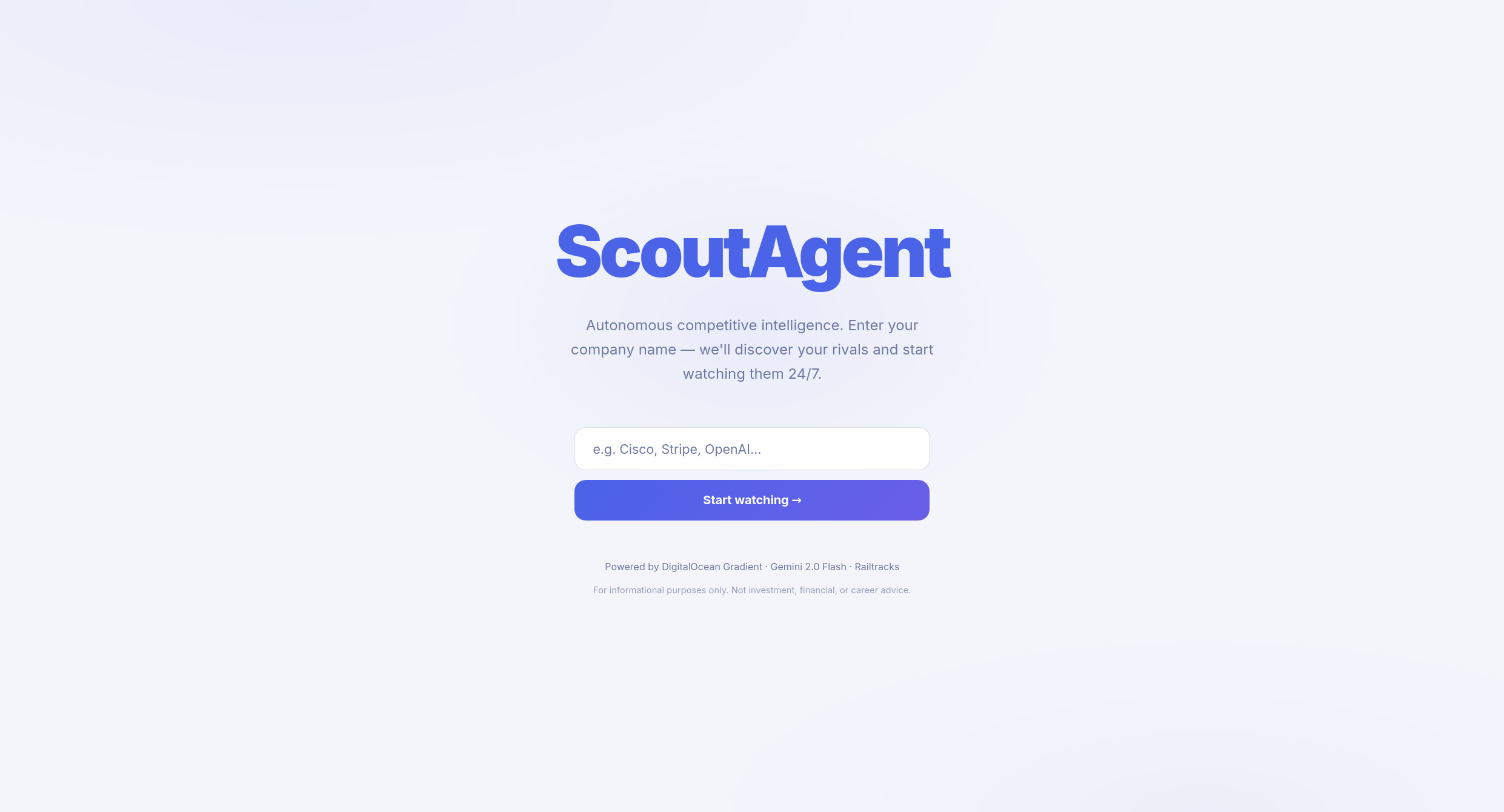
ScoutAgent is an AI-powered competitive intelligence platform that automatically:
- Discovers Competitors - Takes any company name and intelligently identifies relevant competitors
- Multi-Source Monitoring - Simultaneously tracks competitors across:
- GitHub repositories (code changes, releases, contributor activity)
- Job postings (hiring patterns, role expansions)
- News articles and press releases
- YouTube content (product demos, executive interviews)
- Web presence and announcements
- Signal Extraction - Uses specialized AI agents to analyze content and extract actionable business signals for both employees and investors
- Urgency Scoring - Prioritizes findings based on business impact, recency, and confidence levels
- Real-time Dashboard - Provides a React-based interface to explore competitor insights and signal timelines
How we built it
Architecture:
├── Frontend (React 19 + TanStack Router)
├── FastAPI Backend with CORS support
├── LangGraph Multi-Agent Orchestration
├── Parallel Worker System:
│   ├── GitHub Watcher (repository monitoring)
│   ├── News Monitor (Exa neural search)
│   ├── Jobs Tracker (RSS feeds + scraping)
│   ├── YouTube Analyzer (yt-dlp integration)
│   └── Web Scraper (BeautifulSoup4)
└── Memory & Deduplication Layer (JSON-based)
Key Technologies:
- DigitalOcean Gradient AI Platform for serverless LLM inference
- LangChain/LangGraph for agent orchestration and workflow management
- Exa API for neural web search beyond keyword matching
- Multiple LLM providers (Gradient/OpenAI + Google Gemini for multimodal tasks)
- Async Python processing with httpx for concurrent API calls
- TypeScript frontend with Vite build tooling
Challenges we ran into
Rate Limiting Coordination - Managing concurrent requests across GitHub, Exa, YouTube, and news APIs without hitting rate limits required implementing intelligent backoff strategies and request queuing.
Signal Quality vs. Noise - Early iterations generated too many low-value alerts. We had to develop sophisticated scoring mechanisms to distinguish routine updates from genuinely significant competitive moves.
Multimodal Content Analysis - Processing diverse content types (code repositories, news articles, job descriptions, videos) in a unified framework required careful prompt engineering and output standardization.
Deployment Complexity - Ensuring the multi-agent system works seamlessly both locally and on DigitalOcean's serverless infrastructure required extensive environment configuration management.
Real-time vs. Batch Processing - Balancing immediate responsiveness for high-priority signals while efficiently processing large volumes of historical data.
Idea clarity and narrowing the application down to competitive market analysis took us some time.
Accomplishments that we're proud of
- Fully Autonomous Intelligence Pipeline - Created a system that discovers competitors and monitors them without human intervention
- True Multi-Agent Architecture - Successfully orchestrated 5+ specialized AI agents working in parallel using LangGraph
- Neural Search Integration - Went beyond keyword matching to implement semantic understanding of competitive landscapes
- Production-Ready Deployment - Built for cloud-native deployment on DigitalOcean's AI platform with local development support
- Comprehensive Signal Extraction - Developed domain-specific prompts and scoring algorithms for different content types
- Real-time Dashboard - Created an intuitive interface for exploring competitive intelligence insights
What we learned
- Orchestration Complexity - Coordinating parallel AI workers across different data sources requires careful state management and error handling. LangGraph proved essential for robust workflow orchestration.
- The Signal vs. Noise Problem - Raw data from multiple sources creates overwhelming information. The real value lies in developing effective urgency scoring algorithms: Urgency Score=w1⋅Recency+w2⋅Business Impact+w3⋅Confidence
- Incremental Intelligence - Memory and deduplication systems are crucial for avoiding redundant analysis while building cumulative understanding over time.
- Platform Abstraction Benefits - Designing for DigitalOcean's Gradient AI Platform taught us the importance of cloud-native AI deployment patterns and serverless inference optimization.
- Multi-Modal AI Coordination - Different content types require specialized processing approaches, but can be unified through consistent output schemas.
What's next for ScoutAgent
Immediate Roadmap:
- Enhanced Multimodal Analysis - Process patents, technical documentation, and conference presentations
- Predictive Analytics - Use historical signal patterns to forecast competitor moves using time-series analysis
- Integration Ecosystem - Native connections to CRM systems, Slack notifications, and BI platforms
Long-term Vision:
- Industry Benchmarking - Automated comparison against industry standards and best practices
- Strategic Recommendation Engine - AI that doesn't just monitor but suggests tactical responses
- Collaborative Intelligence - Team-based insights sharing and annotation capabilities
- Advanced Threat Detection - Early warning systems for disruptive competitive threats
The ultimate goal is evolving ScoutAgent from a monitoring tool into an AI strategic advisor that understands competitor strategies, predicts their next moves, and provides actionable recommendations for competitive positioning.
Built With
- fastapi
- gemini
- gradient
- httpx
- javascript
- langchain
- openai
- python
- react
- typescript


Log in or sign up for Devpost to join the conversation.