-
-
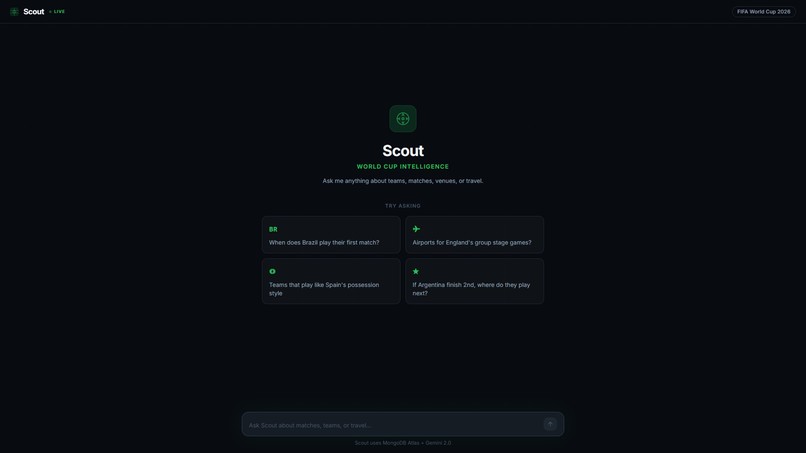
Landing page
-
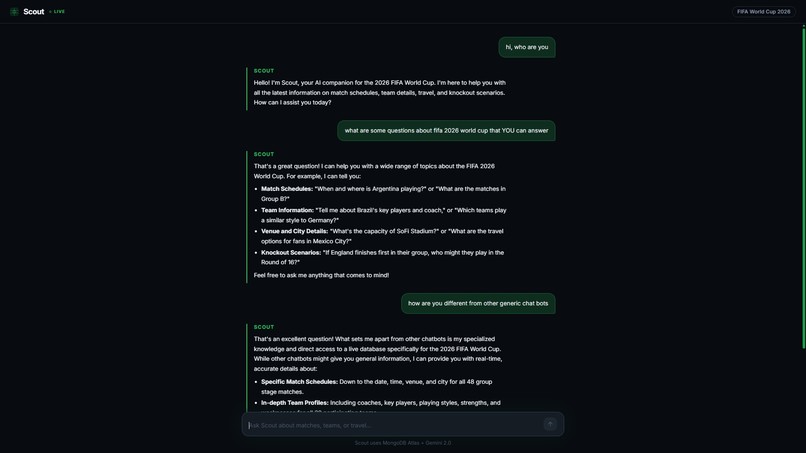
Example questions 1
-
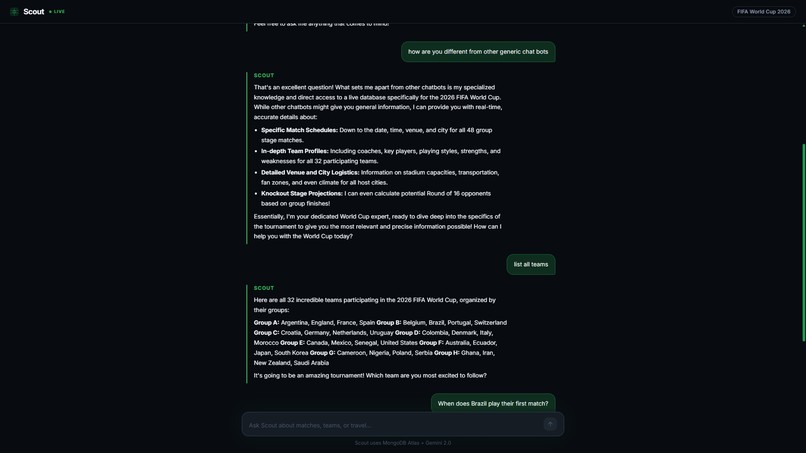
Example questions 2
-
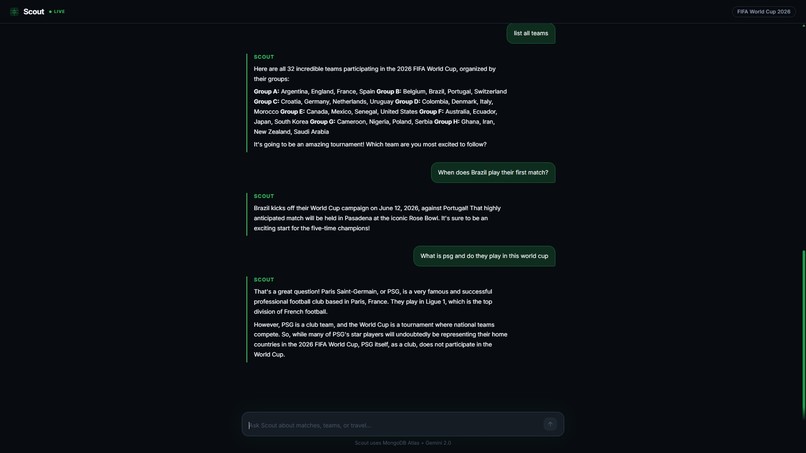
Example questions 3
-
Example questions 4
Inspiration
When fans prepare to travel for a massive global event like the 2026 FIFA World Cup, they are immediately confronted with a deeply fragmented logistical nightmare. They have to jump between one app for match schedules, another to figure out stadium parking, another to book flights to the correct host city, and endless search engine queries to learn about the participating teams. We realized that the modern sports fan doesn't just need a search engine; they need a unified, intelligent travel companion. The inspiration for Scout was to eliminate this friction entirely by leveraging the conversational power of modern AI to bring all these scattered data points into one seamless, intuitive interface.
What it does
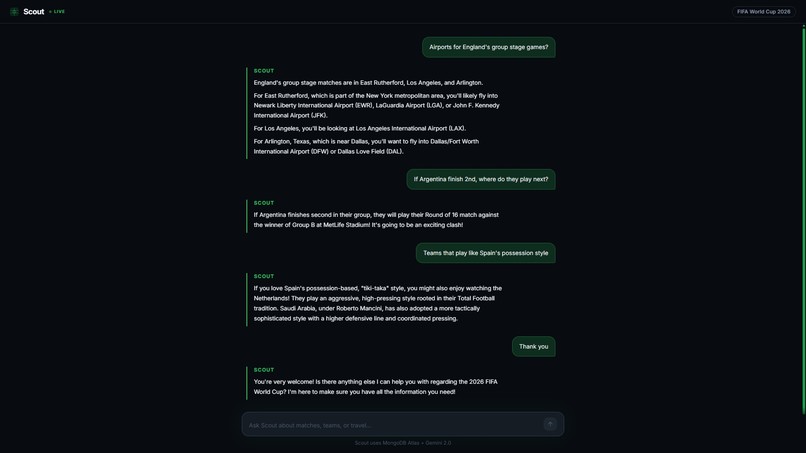
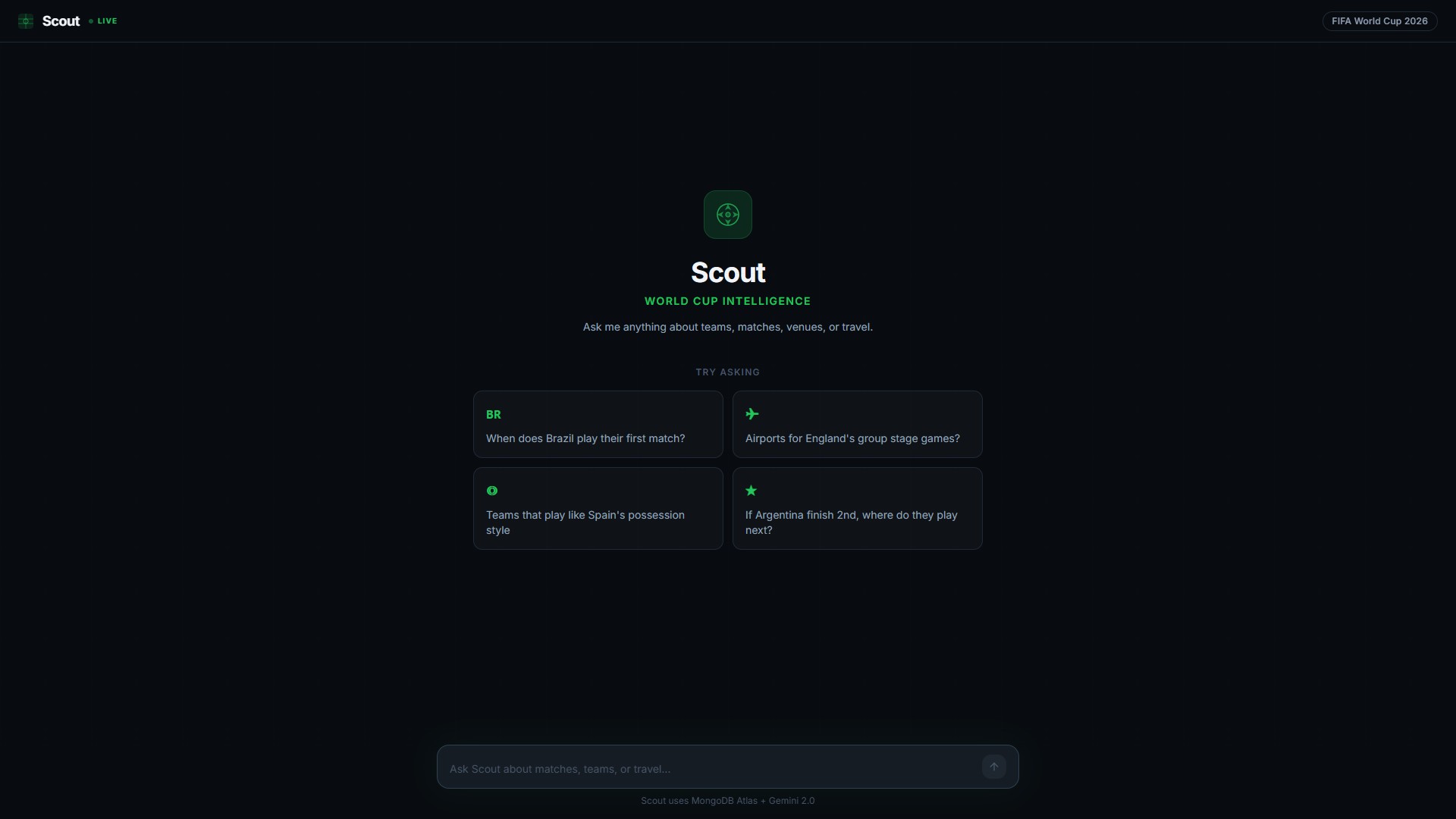
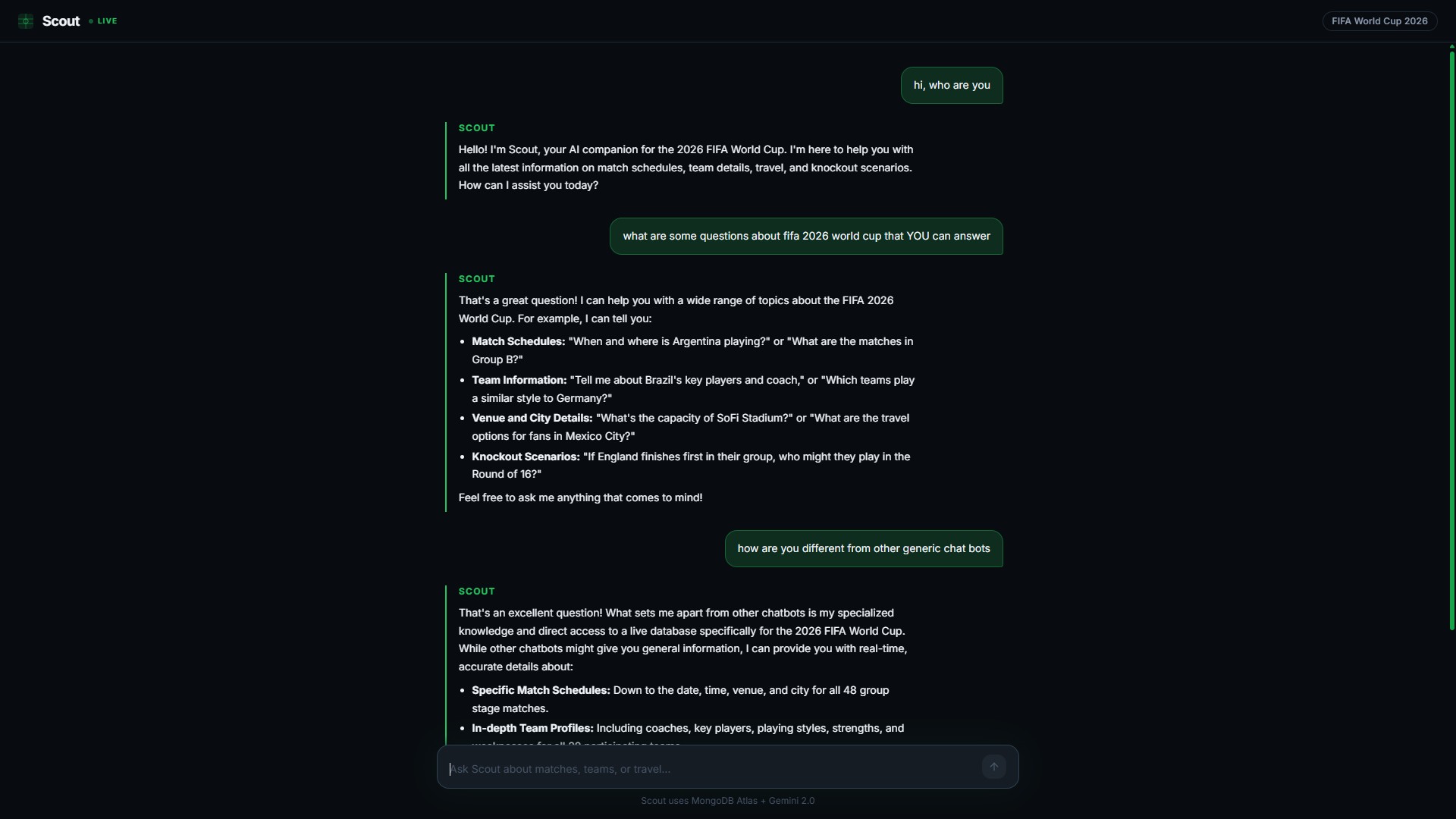
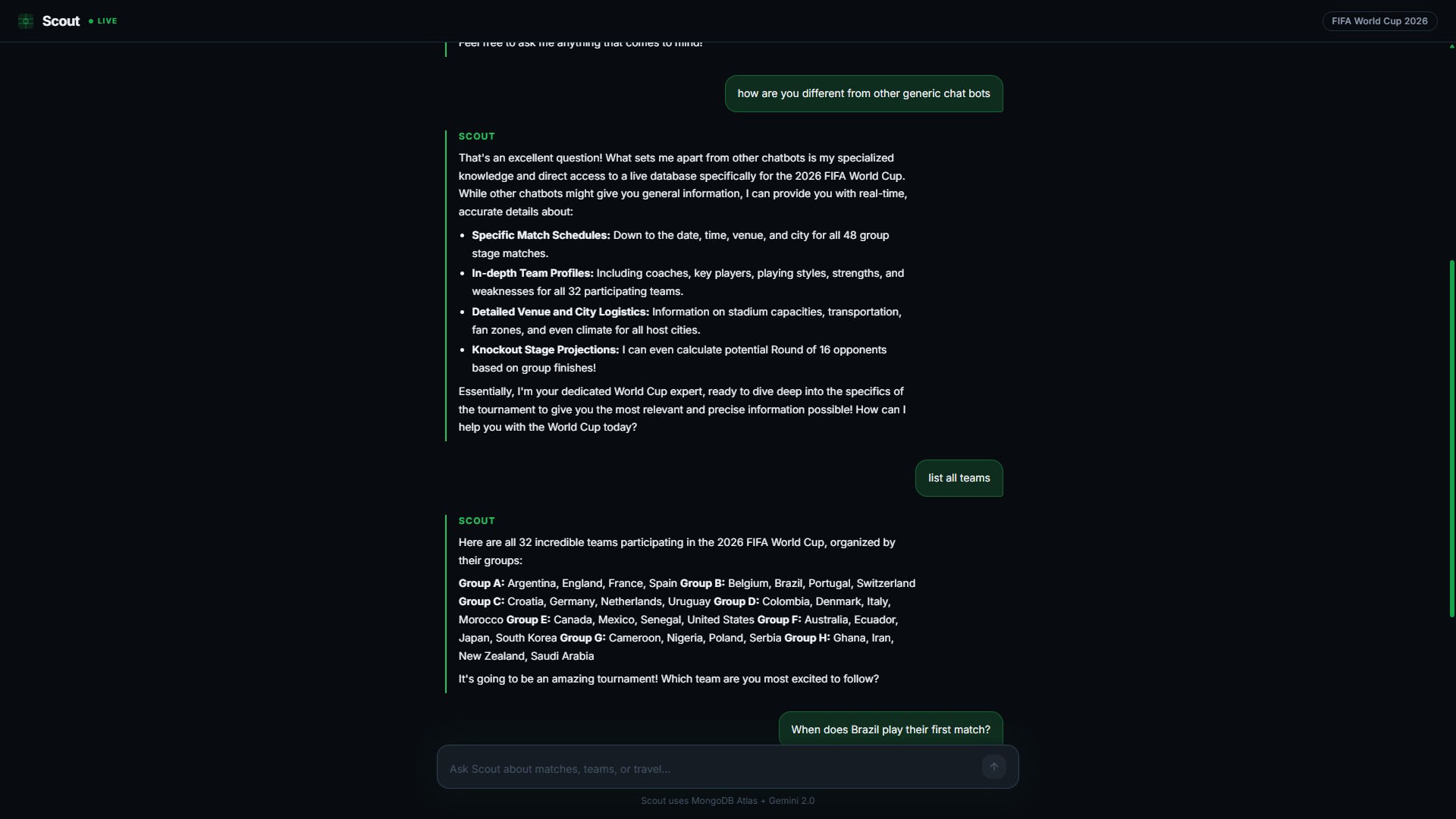
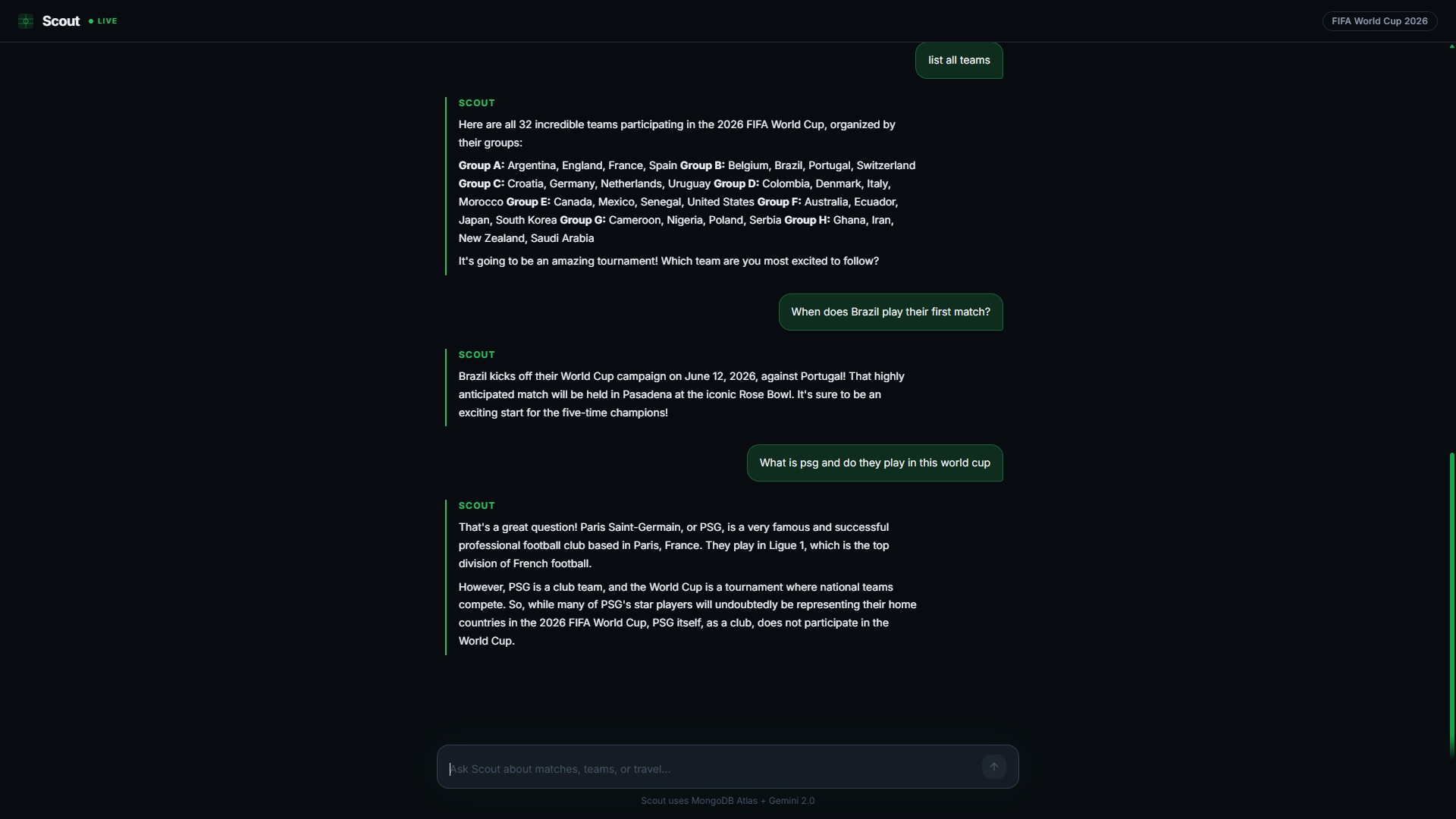
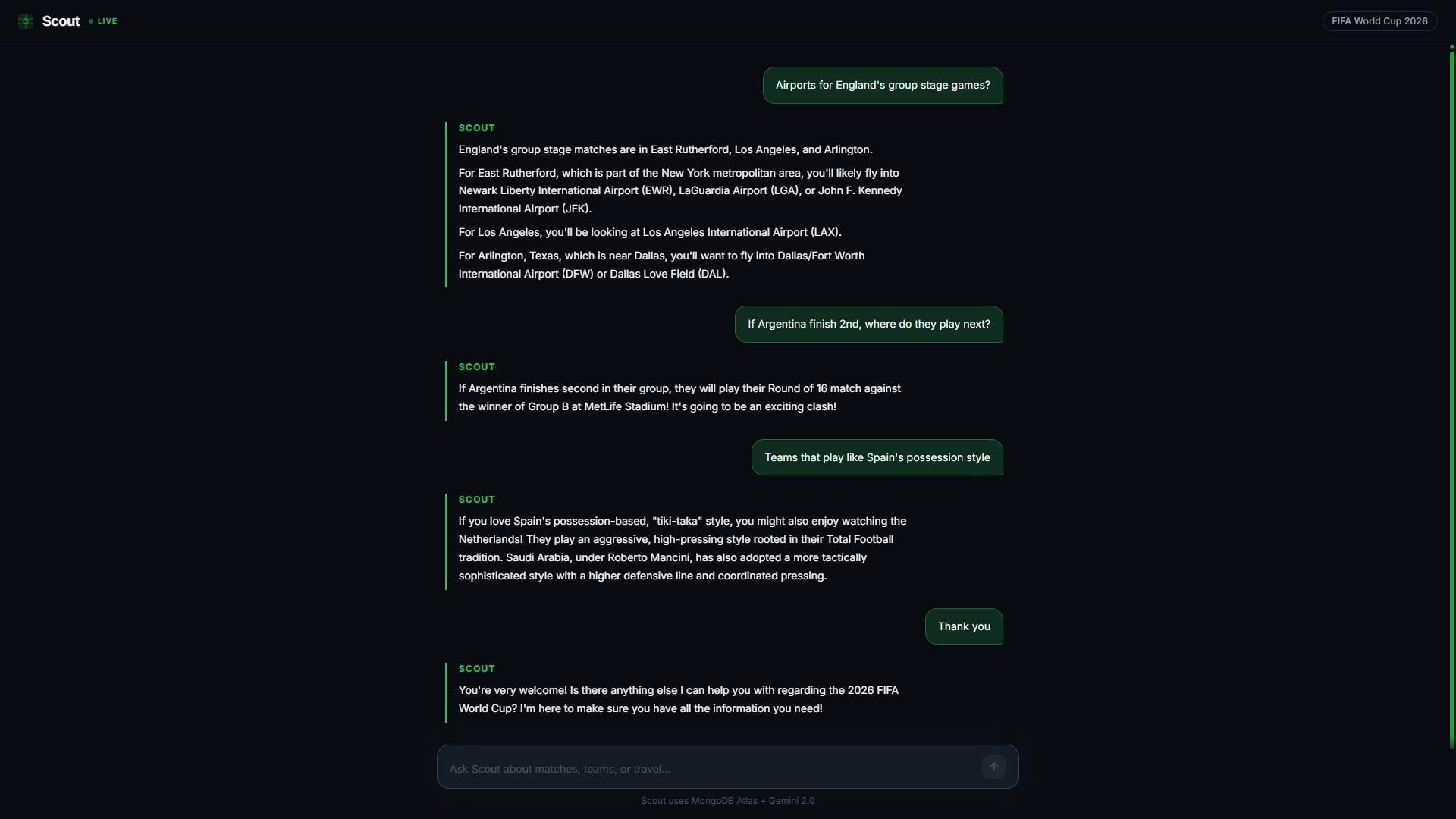
Scout is an intelligent, conversational World Cup agent powered by Google Cloud Vertex AI. Instead of navigating complex menus or digging through static web pages, fans can simply ask Scout natural questions. If a user asks, "When does Brazil play their first match?", Scout instantly queries our live database and returns the exact schedule and venue. If they ask, "What are the airports for England's group stage games?", Scout maps the team to their specific host cities and returns the exact international airports fans need to book flights for. Scout can even perform semantic vector searches, allowing users to ask for "Teams that play like Spain's possession style." If a user asks a general football question outside of the database, Scout gracefully falls back to its foundational generative knowledge to provide a rich, contextual answer without ever breaking character.
How we built it
We built Scout utilizing a highly scalable, serverless architecture on Google Cloud. The core intelligence is driven by Vertex AI Agent Builder, where we configured dynamic Tools and an intricate OpenAPI specification to route user intents.
Our frontend is a modern Next.js application, designed for speed and a premium user experience. It communicates directly with our custom Node.js API backend. Both the frontend and backend are fully containerized and deployed on Google Cloud Run. This allows the entire infrastructure to scale to zero for maximum cost efficiency, while guaranteeing millisecond wake-times when users interact with the site.
The backend acts as a strict Model Context Protocol (MCP) server, interfacing securely with a MongoDB Atlas cluster. This database houses our comprehensive datasets, including all 32 participating teams, 48 group stage matches, venue logistics, and host city guides.
Challenges we ran into
One of the most significant technical hurdles we faced was mastering the strict data validation parsing within Vertex AI's OpenAPI schema constraints. Initially, when our backend returned robust JSON objects, Vertex AI's security parser would aggressively strip out nested arrays and undocumented properties before handing the data to the LLM, resulting in the agent believing the database was empty.
We had to painstakingly map out every single nested property in our OpenAPI YAML specification—down to the specific string types of array items like stadium parking logistics and fan zones. Getting the LLM to seamlessly transition between strict tool-calling and generative fallback without apologizing or hallucinating required extensive prompt engineering and multiple iterations of our system instructions.
Accomplishments that we're proud of
We are incredibly proud of achieving a truly seamless fallback mechanism. Watching the agent attempt a complex, multi-step database tool call, realize it needs more context, and instantly pivot to using its foundational knowledge to answer the user gracefully is a magical experience. We are also proud of our infrastructure; deploying a fully containerized, serverless stack on Cloud Run that seamlessly bridges a Next.js frontend, a Node.js backend, MongoDB, and Vertex AI in a matter of days was a massive achievement.
What we learned
This project was a masterclass in the nuances of AI agent orchestration. We learned that an LLM is only as smart as the data structures you feed it, and that strict schema validation is just as important as the generative prompt itself. We also gained deep, hands-on experience with Google Cloud Run and the Vertex AI ecosystem, learning how to optimize container deployments for both cost and latency.
What's next for Scout WC
For the immediate future, we plan to expand Scout's database to include real-time ticket availability and live API integrations for flight and hotel booking. Ultimately, we envision Scout evolving beyond the World Cup into a white-label conversational agent architecture that can be adapted for any massive global event, from the Olympics to international music festivals.
Built With
- dialogflow-cx
- express.js
- google-cloud
- google-cloud-run
- javascript
- mongodb
- nextjs
- node.js
- typescript
- vertex-ai


Log in or sign up for Devpost to join the conversation.