-
-

Scout guiding a virtual walk through the city with AI narration on top of Street View.
-
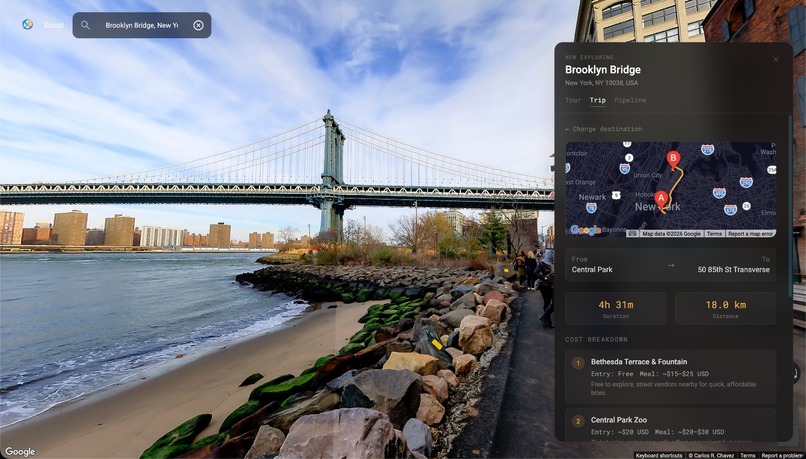
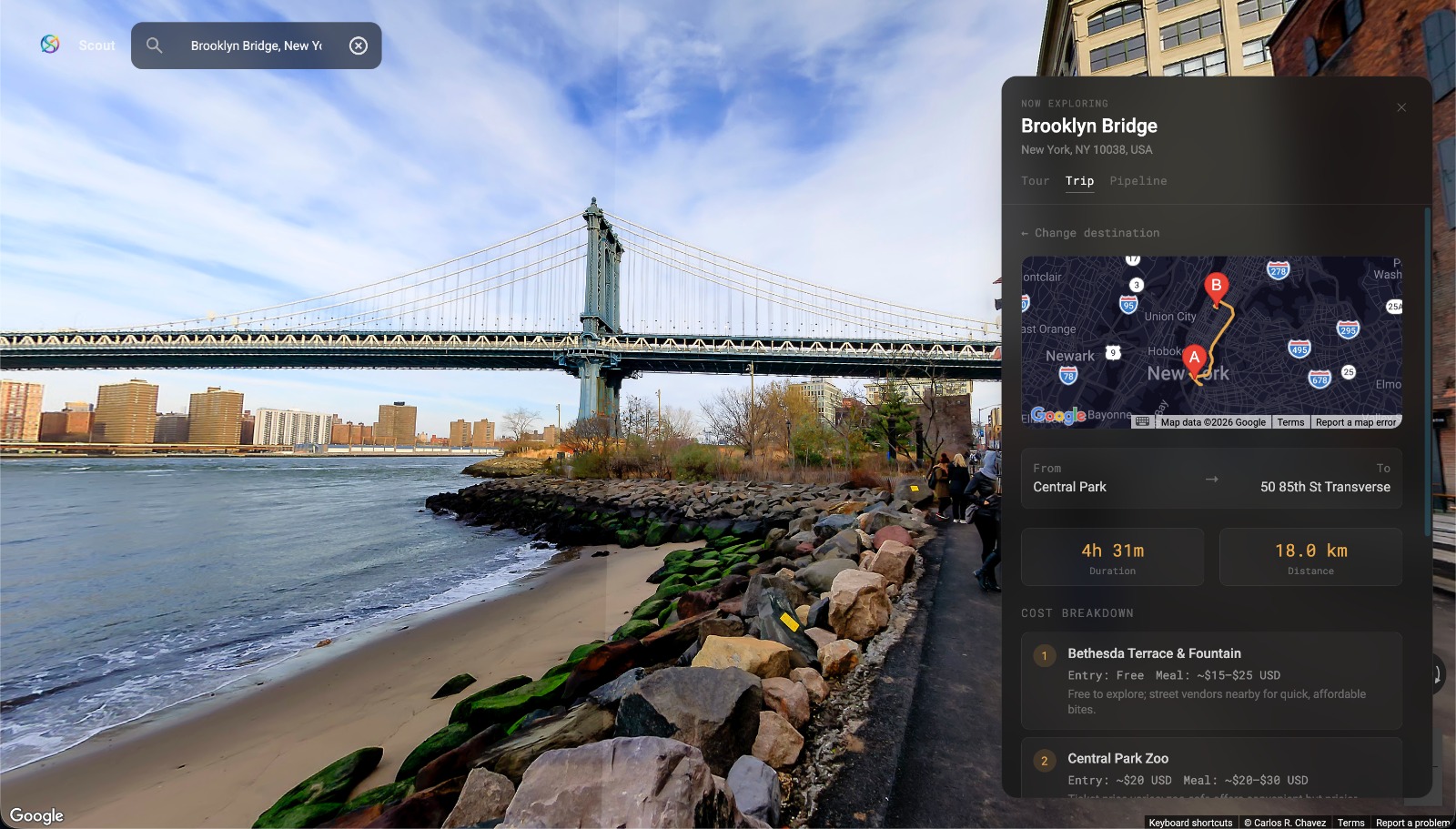
Planning a scenic drive from Brooklyn Bridge to Central Park with Scout’s trip mode.

Inspiration
Travel content online is either too generic or locked inside long blog posts and videos that are hard to navigate.
We wanted something that feels like walking with a local friend who just knows what to show you, but available for any city on Earth and instantly.
Since we love maps, Street View, and AI, we decided to combine all three into a single experience that makes exploring a new place actually fun.
What it does
Scout is an AI-powered virtual city tour guide.
You search any place on Earth and get an interactive 3D globe, Google Street View, and an AI-generated tour that explains history, curiosities, must-see spots, and local tips.
You can click any point of interest to jump Street View directly there, and use the built-in trip planner to pick stops, get routes, and see AI-estimated costs and budgets for your visit.
How we built it
We built a React + Vite frontend that renders an interactive 3D globe and embeds Google Street View and Maps.
The backend is an Express server that connects to Gemini 3.1 Flash Lite to generate the tour narrative and trip-planning text, grounding the AI with Wikipedia and Google Places data.
We use the Google Maps Platform (Places, Street View, Directions) to search locations, fetch POIs, calculate routes, and estimate basic travel costs that the AI can turn into simple budgets.
Challenges we ran into
Getting all the pieces (3D globe, Street View, AI, and maps) to feel like one product instead of four separate tools was harder than it sounded.
We had to deal with API limits, slightly different coordinate systems, and making sure that when the AI references a place, Street View actually jumps to the correct spot.
Prompting Gemini so it produced grounded, concise tours instead of long, fluffy essays also took a lot of experimentation.
Accomplishments that we're proud of
We’re proud that Scout feels smooth and “just works”: you pick a place, and within seconds you are virtually walking through the city with a guided tour.
The tight integration between the 3D globe, Street View, and AI tours makes the experience feel more like a real product than a weekend hack.
We also like that we went beyond a simple demo and added a trip planner with routes and cost estimates, which makes Scout actually useful for real trips.
What we learned
We learned how to coordinate multiple Google Maps Platform APIs and Gemini in a way that stays reliable and relatively fast.
We also learned a lot about prompt design: giving the model structure (sections like “history”, “must-see spots”, “local tips”) greatly improves quality.
Finally, we improved our skills in building React apps that talk to a Node/Express backend while keeping the UX simple enough for anyone to understand.
What's next for Scout
Next, we want to make tours more personalized: for example, “2‑day food‑lover trip”, “family friendly weekend”, or “backpacker on a tight budget”.
We also plan to add saving and sharing of custom itineraries, export to maps/calendar, multi-language support, and maybe basic offline PDFs for travelers.
Longer term, Scout could become a plug-in for travel sites or a paid “AI guide” layer on top of booking platforms, turning exploration into a monetizable product.
Built With
- api
- css
- elevenlabs
- express.js
- gemini
- html
- javascript
- maps
- node.js
- react
- rest
- vite


Log in or sign up for Devpost to join the conversation.