Inspiration
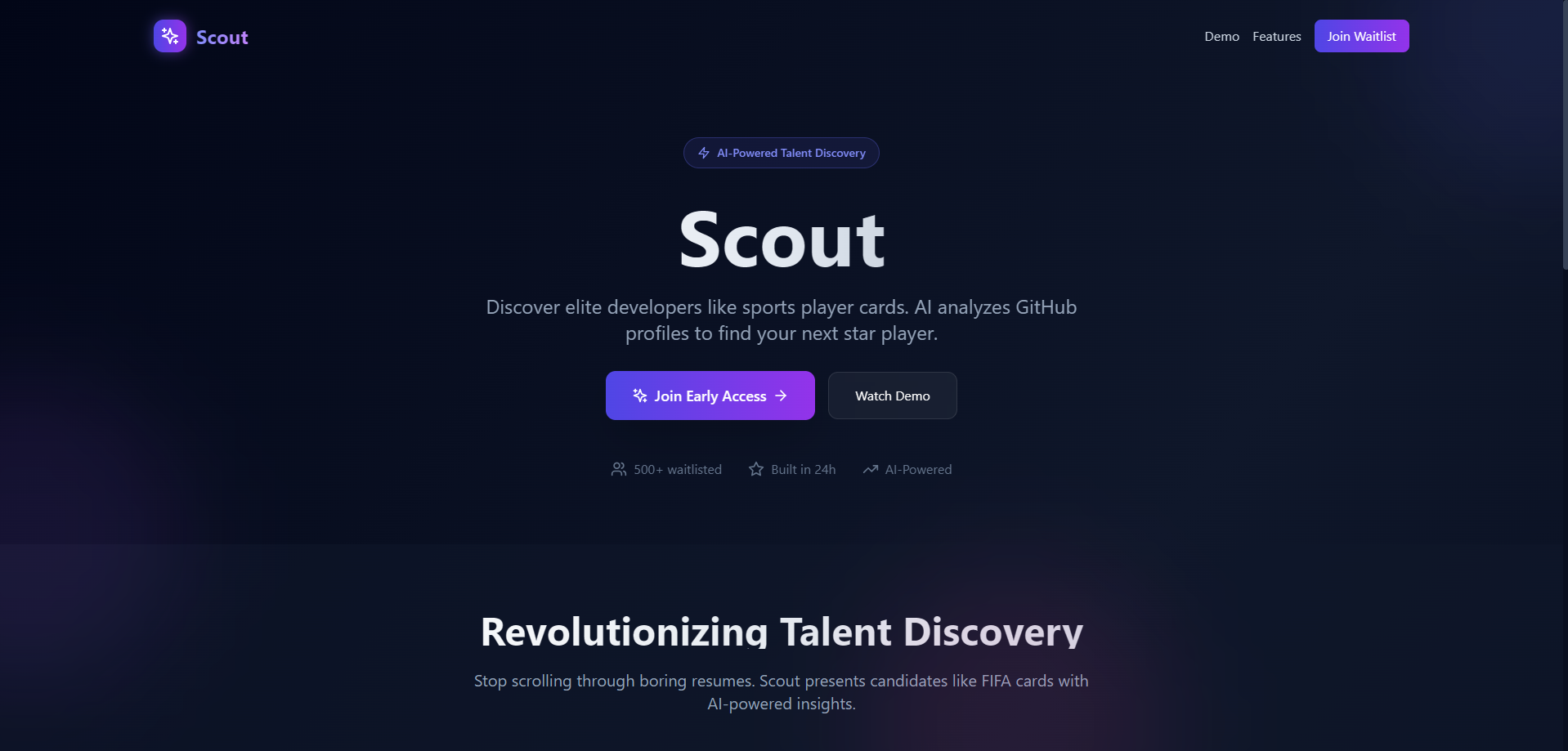
Recruitment is broken. It’s a sea of same-looking resumes, buzzword-filled LinkedIn profiles, and "ghosting." We realized that finding a 10x Engineer shouldn't feel like filing taxes—it should feel like Draft Day.
We were inspired by sports analytics (like Moneyball and FIFA/EA Sports). In sports, you don't just look at a player's previous team; you look at their Speed, Creativity, and Technical Stats. We asked: "Why don't we have this for Software Engineers?"
Scout was born to turn the boring process of "Headhunting" into the strategic, high-stakes game of "Talent Drafting."
What it does
Scout is an AI-powered talent discovery dashboard that:
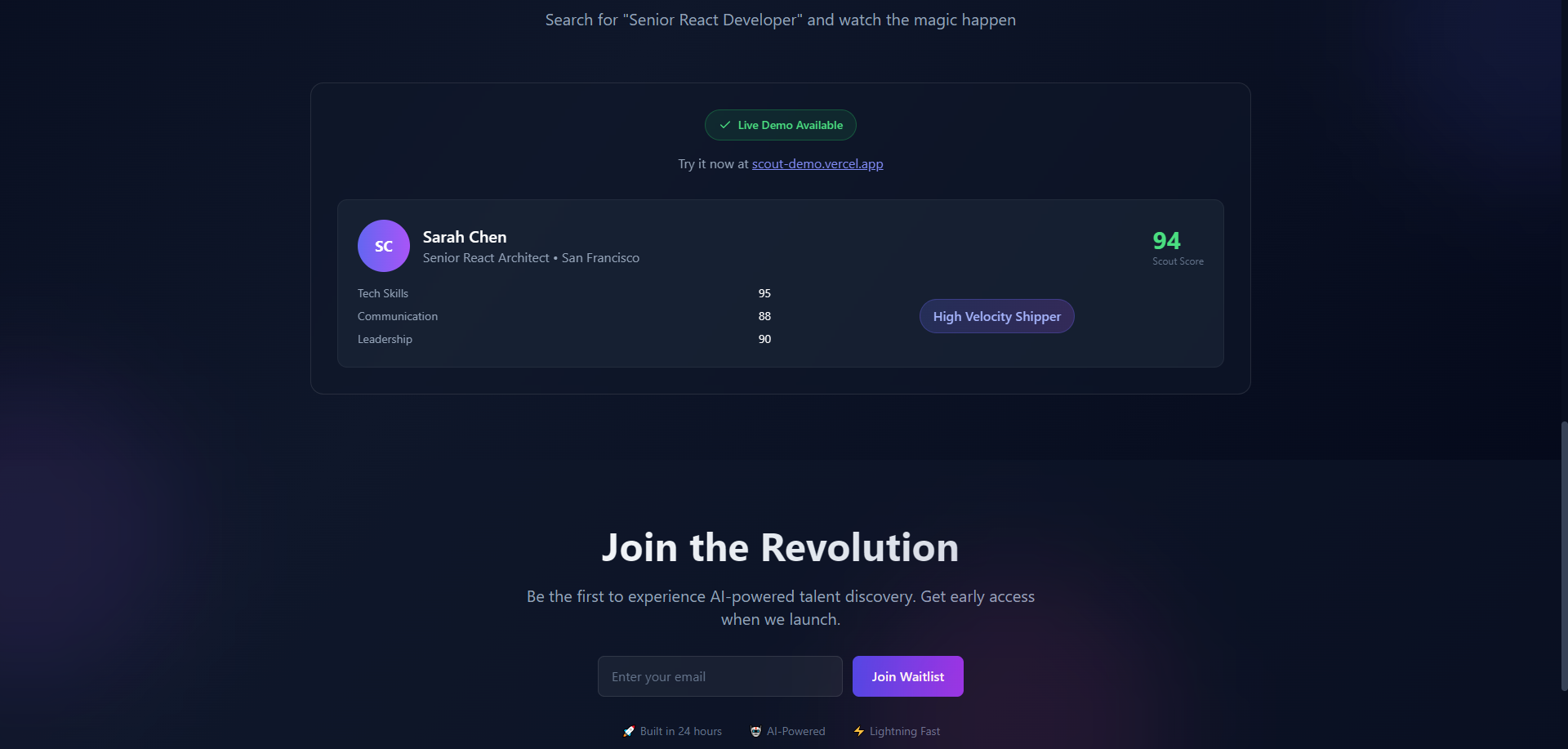
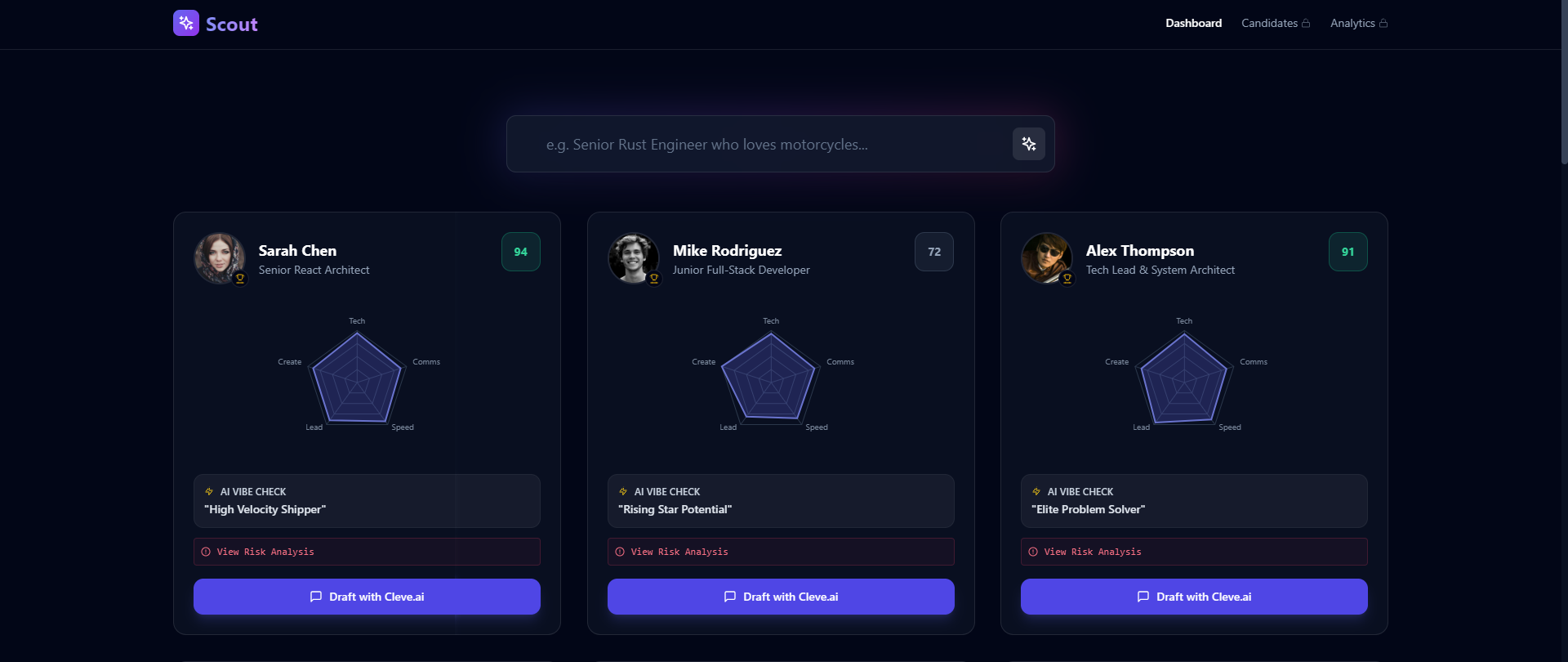
- Transforms Resumes into Player Cards: Instead of text, candidates are presented as holographic trading cards.
- Visualizes Skills: We use Hexagonal Radar Charts to map soft and hard skills instantly.
- Detects Red Flags: Our AI analyzes work history to flag risks like "Job Hopping" or "Burnout" (e.g., GitHub commits at 3 AM).
- Drafts with Cleve.ai: Once you find a gem, a single click generates a hyper-personalized outreach prompt and opens Cleve.ai, bridging the gap between "Finding" and "Hiring."
How we built it
We focused heavily on "High-DPI" Design and User Experience. The stack is built for speed and visual impact:
Frontend: Next.js 14 (App Router) for the framework.
Styling: Tailwind CSS with a custom "Cyberpunk" dark mode palette (Slate-950 background with Indigo/Purple glowing accents).
Physics & Animation: We used Framer Motion extensively. The candidate cards use 3D transforms based on mouse position to create a holographic tilt effect.
Data Visualization: Recharts powers the skill radar charts.
The Intelligence:
- The Terminal: We built a custom "Hacker Terminal" component that simulates the deep-web scraping process to keep users engaged during loading states.
- The Workflow: We utilized the Clipboard API to create a seamless "AI-to-AI" handoff between Scout and Cleve.ai.
We even formulated a "Scout Score" algorithm concept to rank candidates.
Challenges we ran into
- The "Holographic" Feel: Getting the 3D tilt effect (rotateX / rotateY) to feel physical without being dizzying took a lot of fine-tuning with Framer Motion springs.
- Visual Noise vs. Clarity: We wanted a "Cyberpunk" look, but it still had to be a functional HR tool. Balancing the glowing neons with readable text was a design challenge.
- The "No-API" Hurdle: We wanted to integrate Cleve.ai, but without a public developer API, we had to get creative. We built a "Prompt Injection" workflow that copies a perfectly engineered prompt to the user's clipboard and auto-launches Cleve, creating the illusion of a direct integration.
Accomplishments that we're proud of
We are most proud of the "Red Flag" detector. It brings a moment of comedy and harsh truth to the app that judges and users love. We're also proud that we turned a boring spreadsheet concept into something that looks like a video game interface.
What we learned
- Theatrics Matter: A loading screen isn't just a spinner; it's a chance to tell a story. Our "Terminal Loader" makes the user feel like the AI is working hard for them.
- Vibe > Data: In a hackathon, showing the insight (e.g., "Chaos Driven Shipper") is more valuable than showing raw data rows.
- Next.js Server vs. Client: Managing state for complex animations (Client Side) while keeping the app performant taught us a lot about the Next.js boundary model.
What's next for Scout
- Real-time GitHub Scraping: Connecting our simulation engine to live Apify actors.
- Multi-Agent Mode: Having one AI "Scout" the candidate and another AI "Debate" whether to hire them.
- Mobile App: Putting the power of the Draft in your pocket.
Built With
- anthropic-api
- cleve.ai
- cursor
- framer-motion
- lucide-react
- next.js
- recharts
- sonner
- tailwind-css
- typescript
- vercel


Log in or sign up for Devpost to join the conversation.