-
-
Search results
Inspiration
Finding information online is easy; knowing whether a search result actually supports what you asked is much harder. Event directories, outdated pages, and undated listings can look convincing even when they don't confirm that an event is happening at the requested time and place.
We built Scout to make web research more transparent and help people distinguish useful leads from evidence-backed results.
What it does
Scout is a web research assistant with two demonstrated use cases:
- Source-focused research: Search for information and prioritize official sources when the user explicitly requests them, such as NASA pages for space-related questions.
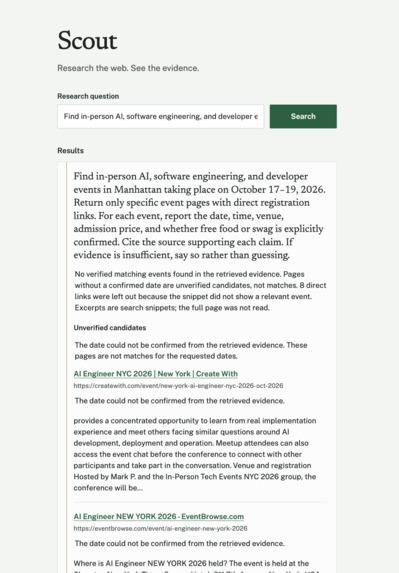
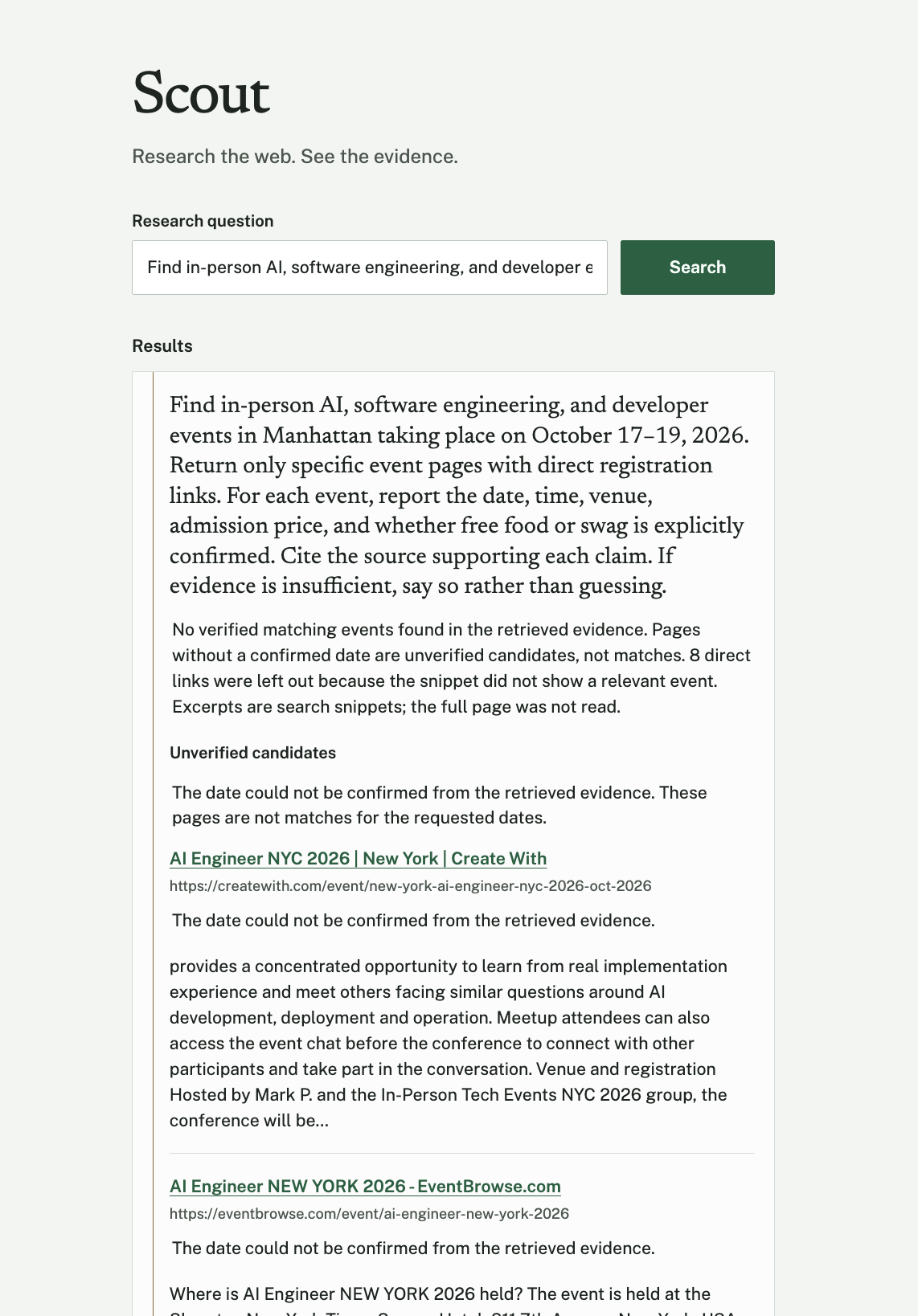
- Event discovery: Find potentially relevant in-person developer and AI events while distinguishing date-verified matches from unverified candidates.
Scout does not treat an event directory or an undated page as proof that an event matches the requested date. It also makes clear that its evidence comes from search-result snippets, not full verification of every webpage.
How we built it
- Next.js, React, and TypeScript power the web application.
- Tavily provides web search results.
- A source-aware qualification layer filters, ranks, and categorizes results.
- Official-source searches use domain restrictions to prioritize relevant official websites.
- Event discovery applies evidence checks to separate matching events from unverified candidates.
- Tests cover important search and qualification behavior.
We focused on making the distinction between a promising search result and a supported match visible to the user.
Challenges we ran into
The hardest part was deciding what qualifies as evidence. Search results may mention a topic without confirming the requested date, location, or event details. Directory pages can be useful for discovery, but they are not necessarily evidence for an individual event.
We refined the event qualification rules to avoid presenting unsupported matches, prices, venues, food, or swag as confirmed facts. Another challenge was balancing useful search results with honest communication about the limitations of snippets.
Accomplishments that we're proud of
- Built a working research application rather than a static mockup.
- Demonstrated official-source prioritization with NASA Science results.
- Separated unverified event candidates from events whose dates are supported by the retrieved evidence.
- Added explicit transparency about what Scout's search evidence can—and cannot—establish.
- Created a compact demo showing both research scenarios.
What we learned
Search relevance is not the same as factual evidence. A result can look relevant without proving the specific claim a user needs. We learned to treat uncertainty as part of the product experience instead of hiding it behind a confident-looking list of results.
What's next for Scout Labs
- Retrieve and inspect full webpages when stronger verification is needed.
- Add clearer citations linking individual claims to supporting passages.
- Improve event verification using official event pages and structured event data.
- Expand test coverage for ambiguous dates, conflicting sources, and outdated listings.
- Explore saved searches and monitoring for newly announced events.
Our goal is to make web research more useful without making it appear more certain than the evidence allows.
Built With
- ai
- developer-tools
- javascript
- next.js
- react
- search
- tavily
- typescript
- web-app

Log in or sign up for Devpost to join the conversation.