-
-
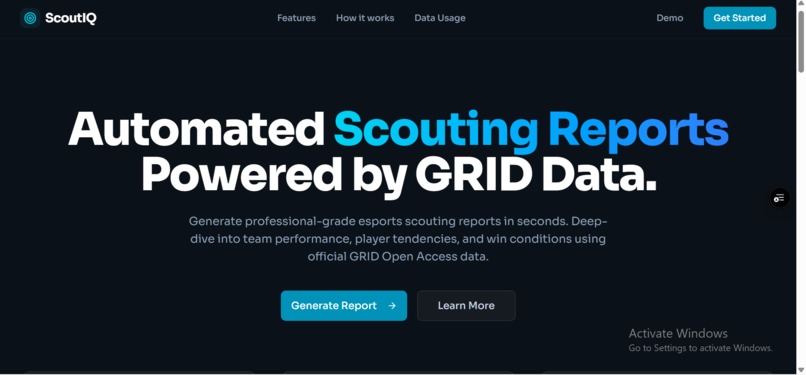
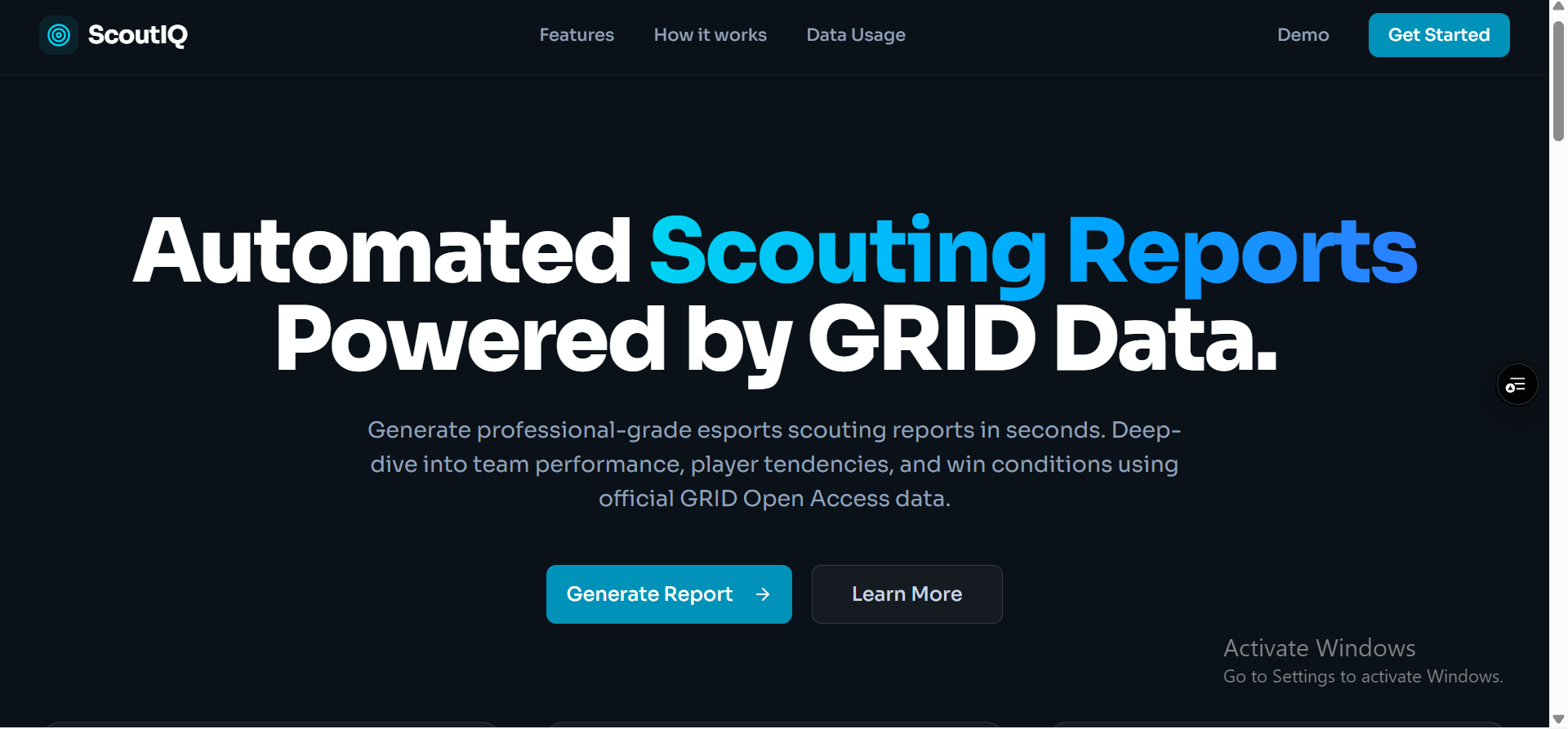
Scounting Report Home page
Inspiration
In esports, preparation is everything.
Coaches and analysts don’t just need raw numbers — they need clear answers:
- What does this opponent do well?
- Where are they vulnerable?
- How should we prepare against them?
Most existing tools either overwhelm users with raw stats or require paid access to deep datasets.
I wanted to explore a different question:
Can we build a genuinely useful scouting tool using only open, limited data — and still make it feel professional?
That question became Scoultiqq: an AI-powered scouting report generator that turns accessible esports data into actionable match insights.
What it does
Scoultiqq generates team-level scouting reports for esports teams using available GRID Open Access data.
Users can:
- Select a game title (VAL or LoL)
- Enter an opponent team name
- Choose a recent match window (last X matches)
The system then:
- Fetches available team statistics
- Computes meaningful indicators (win rate, kills per series, deaths per round, match volume)
- Uses AI to transform those stats into a clear, structured scouting report
Each report includes:
- Strengths and weaknesses
- How-to-win recommendations
- Risk warnings
- Evidence (the exact stats used)
- Transparent notes about data limitations
The goal is not just analytics but decision support.
How we built it
Backend & Data Layer
- Built with Next.js App Router
- Strict schema validation using Zod
- Rate limiting for production safety
- Defensive error handling for API restrictions
Because the GRID Open Access key has limited permissions, I relied on:
teamStatistics- Aggregated metrics
- Time-windowed queries
I avoided guessing fields by using GraphQL introspection to verify exactly what was accessible before querying.
AI Integration
The OpenAI API is used after data aggregation not instead of it.
Instead of sending raw API responses, the system:
- Passes structured, curated metrics to the AI
- Forces reasoning only from provided evidence
- Explicitly instructs the model to declare missing data
This ensures the report is data-grounded, not hallucinated.
Frontend & UX
The UI is designed like a real SaaS product:
- Clean landing page
- Dedicated report generation flow
- Interactive cards and visual breakdowns
- Clear sections for insights, evidence, and limitations
The experience is inspired by professional analytics platforms, but adapted to what the data can realistically support.
Challenges we ran into
The biggest challenge was data access.
With the Open Access key:
series(id)is restricted in many cases- Player-level and draft/map data are unavailable
- Some documented fields are not present in the live schema
This meant advanced features like:
- Player tendencies
- Draft compositions
- Map-specific strategies
were not possible.
Instead of forcing incomplete solutions, I made a deliberate product decision:
Focus on team-level scouting and be transparent about limitations.
This kept the system reliable and honest.
Accomplishments that we're proud of
- Built a complete scouting workflow using limited public data
- Designed an AI system that explains why it makes recommendations
- Avoided hallucination by tying every insight to evidence
- Delivered a clean, production-ready UI instead of a hackathon-only demo
- Clearly communicated data constraints instead of hiding them
Most importantly, the app produces reports that a real analyst could actually use.
What we learned
- Data constraints are not blockers they’re design inputs
- AI works best when guided, scoped, and grounded in evidence
- Schema introspection saves massive development time
- Transparency builds trust, even when features are limited
- Good UX can elevate even simple datasets into powerful tools
This project reinforced the importance of product thinking, not just coding.
What's next for Scoultiqq
With expanded API access, Scoultiqq could evolve into a full competitive intelligence platform, adding:
- Player-level tendencies
- Draft and composition analysis
- Map and objective breakdowns
- Match-to-match trend comparison
- Coach-facing exportable reports
Even now, Scoultiqq proves that useful scouting doesn’t require perfect data it requires thoughtful design. Thank you!
Built With
- html5
- javascript
- jetbrain
- jetbrainai
- nextjs
- react
- shadcnui
- tailwind
- typescript
- webstorm


Log in or sign up for Devpost to join the conversation.