Inspiration
The [case]Hacks 2026 prompt was clear: Scotiabank's deposits are growing among 18–34 Canadians, but their investment accounts aren't. The bank has the trust, the infrastructure, and the customer relationship — but Wealthsimple owns the demographic.
The TD Bank Group Saving and Investing Poll (November 2024) put numbers on it: 34% of Canadians have never invested. 35% contribute to a savings account only — not a TFSA, RRSP, or FHSA. 45% don't feel confident in their investment knowledge. When the Ontario Securities Commission asked millennial non-investors what they'd do, 67% said they'd likely start within five years — and 75% of those said they'd ask their bank first.
The opportunity was sitting right there. Young Canadians want to invest. They don't know how to start. The bank is who they'll ask.
We built Scotia Spark for that conversation.
What it does
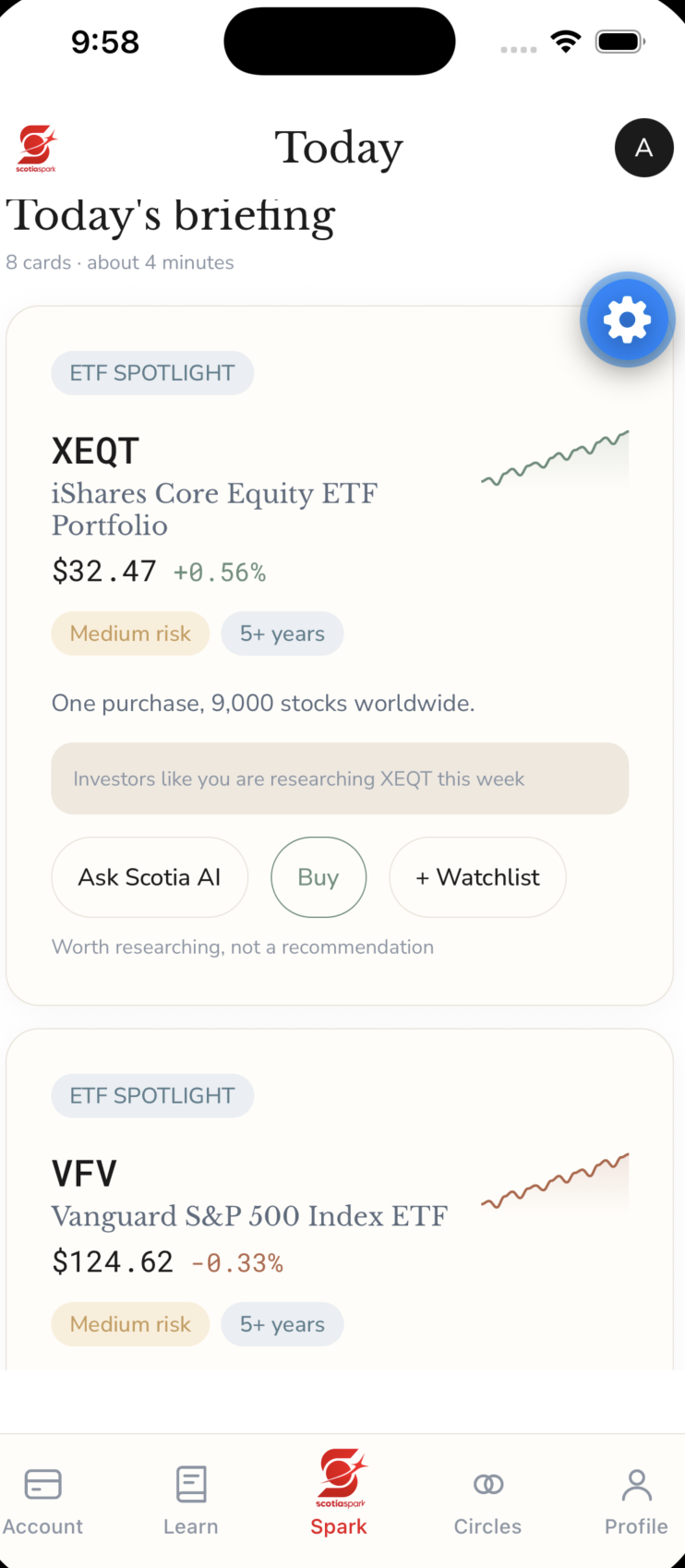
Scotia Spark is a mobile-first investing onboarding app for Canadians who've never invested before. Five tabs — Account, Learn, Spark (the elevated daily ritual), Circles, Profile.
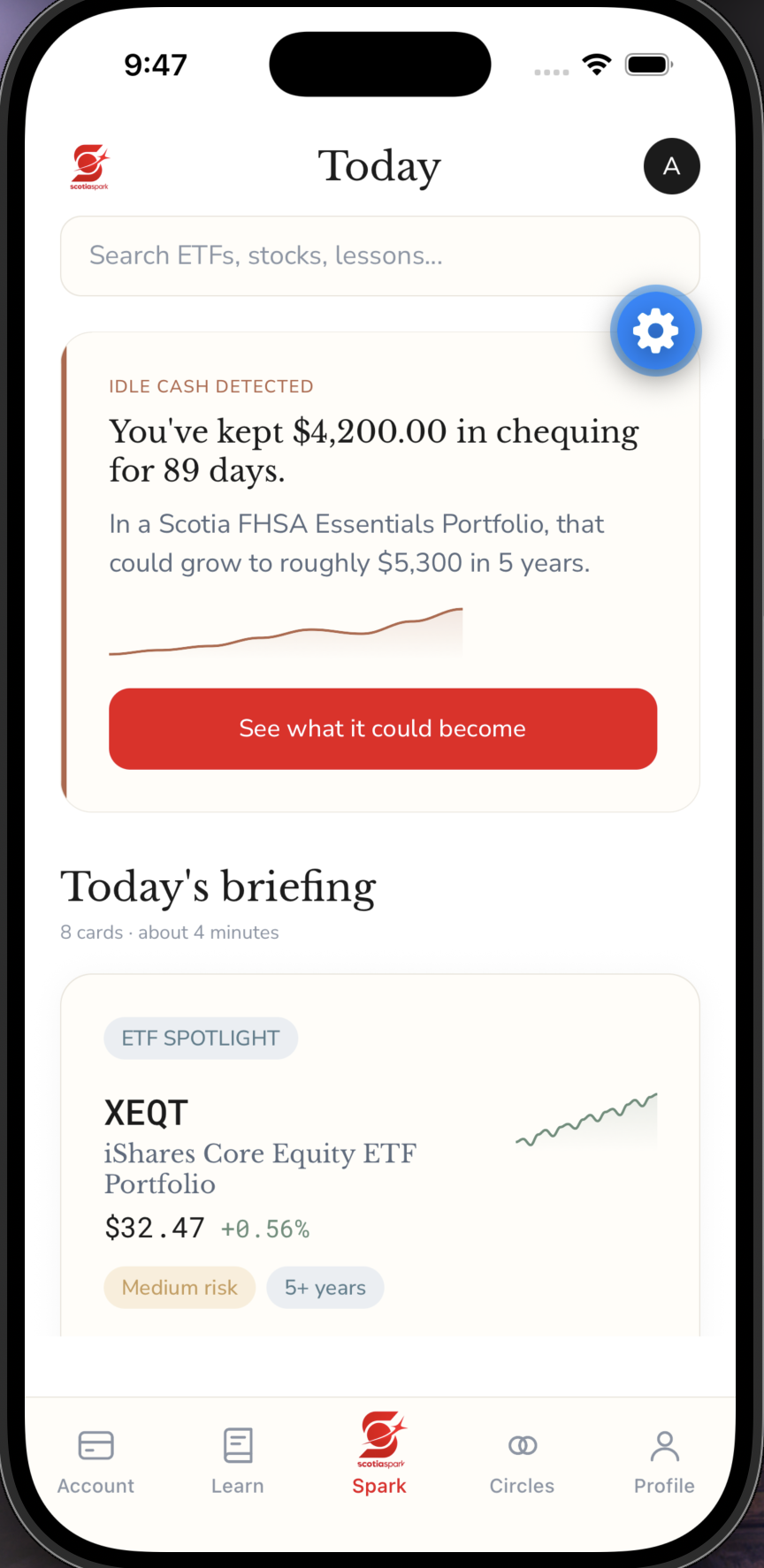
The hero feature is the Idle Cash Detector. When the app sees money sitting still in chequing (in our demo, $4,200 untouched for 89 days for our persona Claire), it shows what that money could become in a Scotia FHSA Essentials Portfolio over 5 years — and offers a one-tap conversion. The FHSA balance counts up live in front of the user.
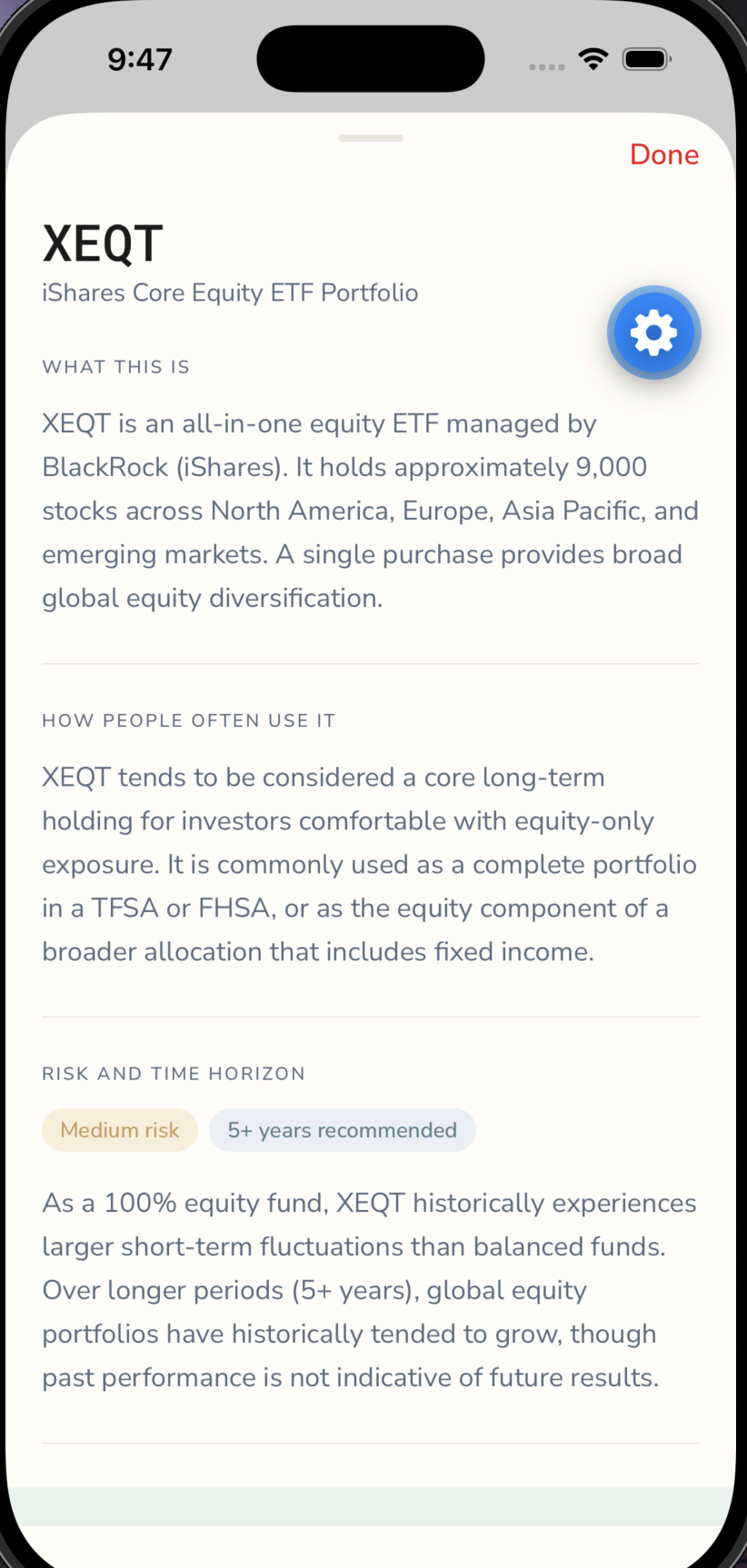
Ask Scotia AI is a structured advisor — four labeled sections, an "Explain this →" audit trail, and a strict rule against generating dollar figures in narrative form. The AI explains what a thing is, never what it will return.
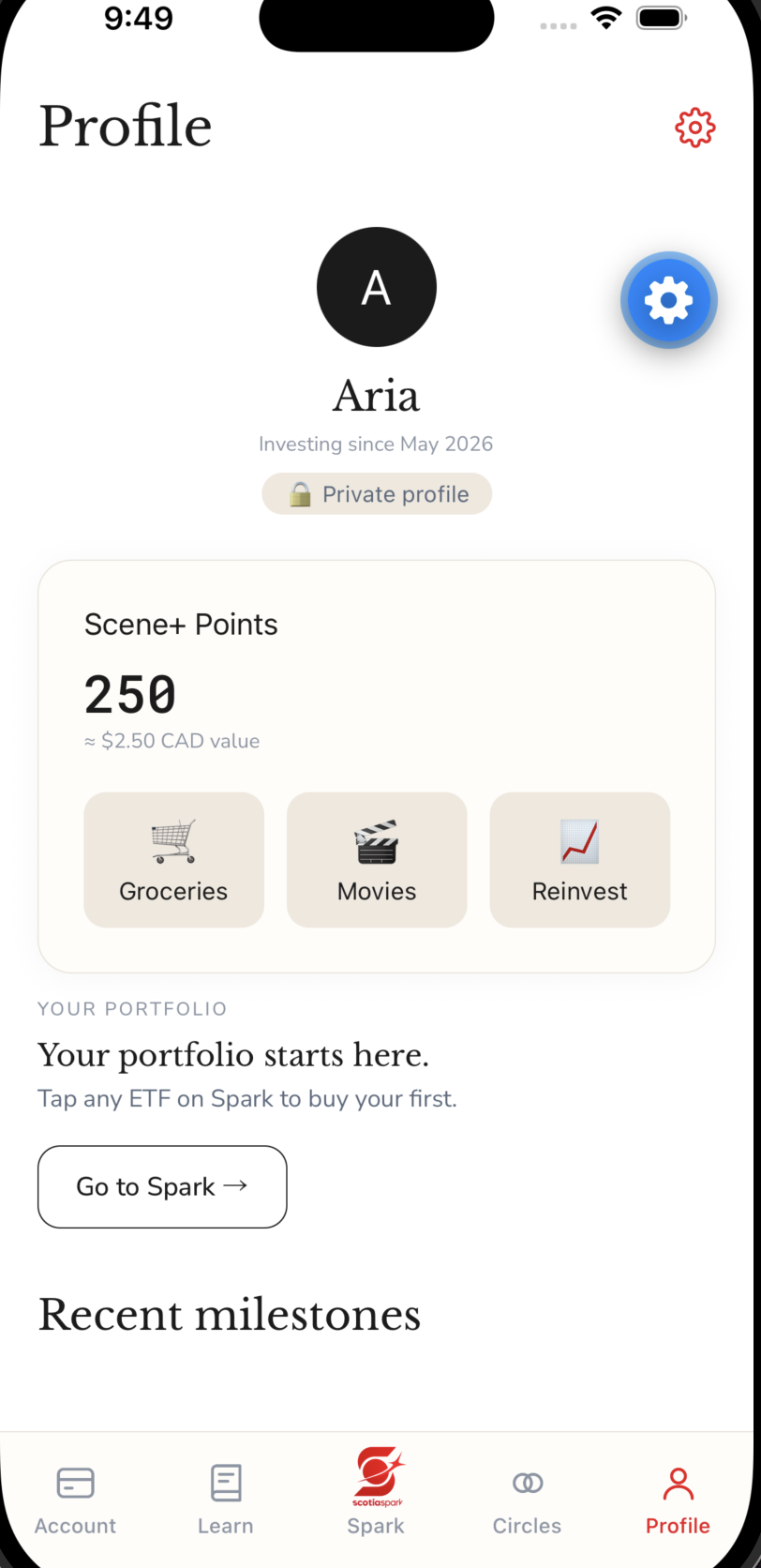
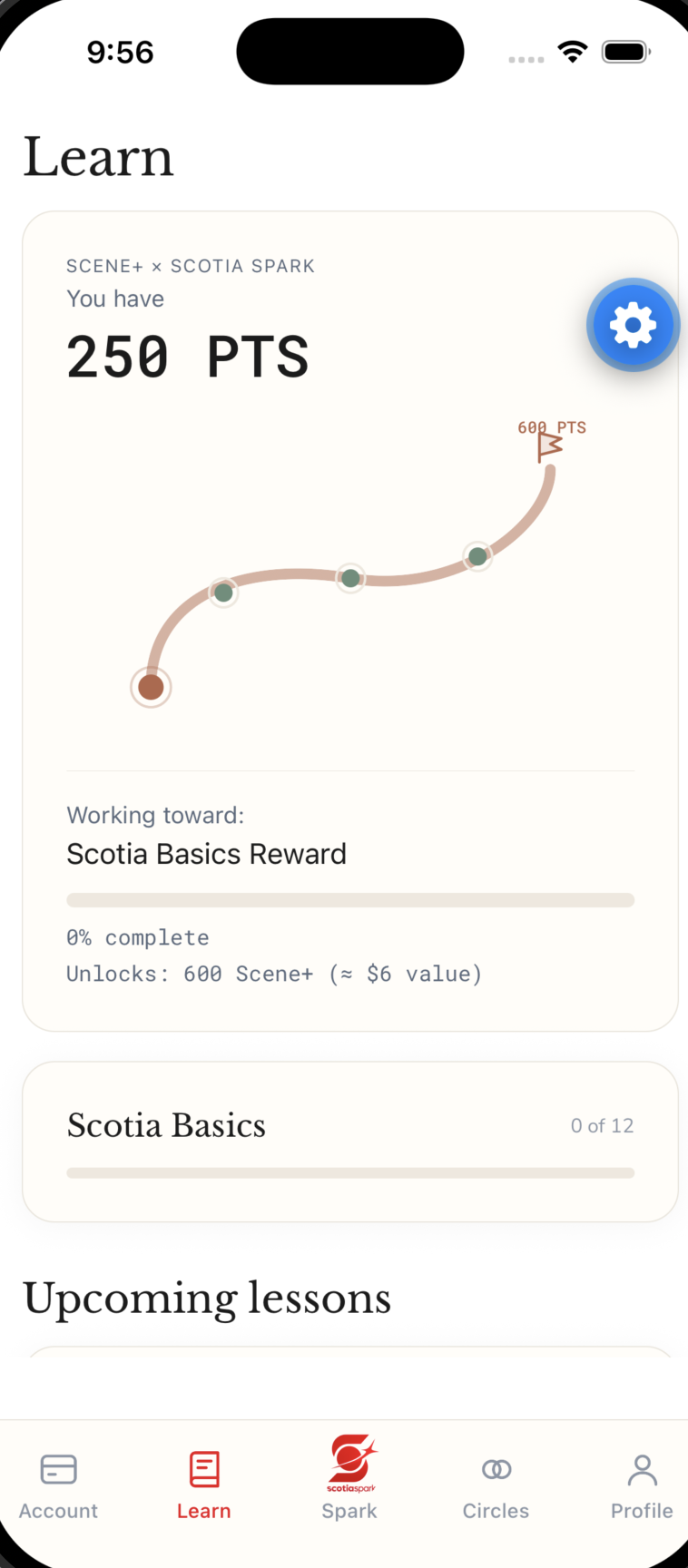
Scene+ Journey rewards real behaviors: completing lessons, setting up recurring contributions, hitting goal milestones, booking an advisor. Not trading frequency. Not portfolio returns. Not daily logins. The "What we don't reward" trust card is visible on the Profile tab.
How we built it
React Native + Expo, TypeScript end-to-end. We chose StyleSheet over Tailwind to keep the design system tight (cream #F6F1E8 background, Scotia red #EC111A, sage #6B8E7B for positive states, terra #B5664A for alerts).
Typography: Source Serif Pro for editorial moments, Inter for UI, Roboto Mono with tabular figures for every dollar value in the app — non-negotiable.
Navigation: react-navigation with five tabs and Spark elevated as the center. Bottom sheets via RN Modal. expo-haptics for one soft haptic per CTA. Quote data mocked via local TypeScript modules.
Pitch deck built in pptxgenjs against the same design system. Source documentation in docx-js. Both validated and rendered through LibreOffice for cross-platform fidelity.
Challenges we ran into
Compliance posture. The hardest design problem in finance UX is not the upside — it's the downside. We spent more time on what not to ship (no streaks, no leaderboards, no status tiers, no buy/sell→Scene+ event hooks) than on what to ship.
The AI honesty problem. Our first version of Ask Scotia AI generated specific dollar projections. We rewrote the prompt template to forbid this. The header strip shows account values with timestamps; the narrative never speculates with numbers.
Demo path. Apple removed Expo Go from the iOS App Store in 2024. Our demo runs on Android Play Store, iOS Simulator, or web fallback — not a one-tap iPhone install.
Source honesty. Our initial deck had fabricated statistics with false source attribution. We audited every claim and either replaced it with verified third-party research or relabeled it as projection. The companion Source Documentation tracks every figure.
Accomplishments that we're proud of
A working app — React Native + Expo, running on a real device today, not a Figma prototype. Seven structural moats each tied to a verified Scotia asset (891 branches, Scene+ JV with Empire and Cineplex, StartRight, in-house mortgage origination). A compliance-by-design philosophy that's visible to the user, not buried in legal copy. And full source documentation behind every statistic in the pitch.
What we learned
Young Canadians don't need a flashier investing app. They need an investing app they trust. Bank trust beats fintech polish — especially for the first investment. The "Scotia version of a feed" is one where every reward ties to behavior, not to outcome.
We also learned that good design and good compliance are often the same problem.
What's next for Scotia Spark
Real prototype screenshots in the deck. Native iOS build for App Store testing. French localization for full Canadian coverage. A/B testing the conversion CTA. And — the obvious one — getting this in front of someone at Scotia.
Built With
- next.js
- react-native
