About the Project
Inspiration
ScotiaFutureFlex was inspired by a simple problem: many young Canadians want to start investing, but they often do not know where to begin. Investing can feel intimidating, especially when users are worried about rent, bills, groceries, tuition, or simply making the wrong decision.
We noticed that young people are already comfortable with digital banking, but there is still a gap between using a banking app and becoming an investor. ScotiaFutureFlex was built around that gap.
Our idea was to make investing feel less like a major financial decision and more like a natural extension of everyday banking. Instead of asking first-time investors to understand everything upfront, ScotiaFutureFlex helps them start small through round-ups, beginner-friendly portfolio guidance, and goal-based progress tracking.
The core inspiration was:
What if Scotiabank could turn everyday spending into the first step toward long-term investing?
What We Built
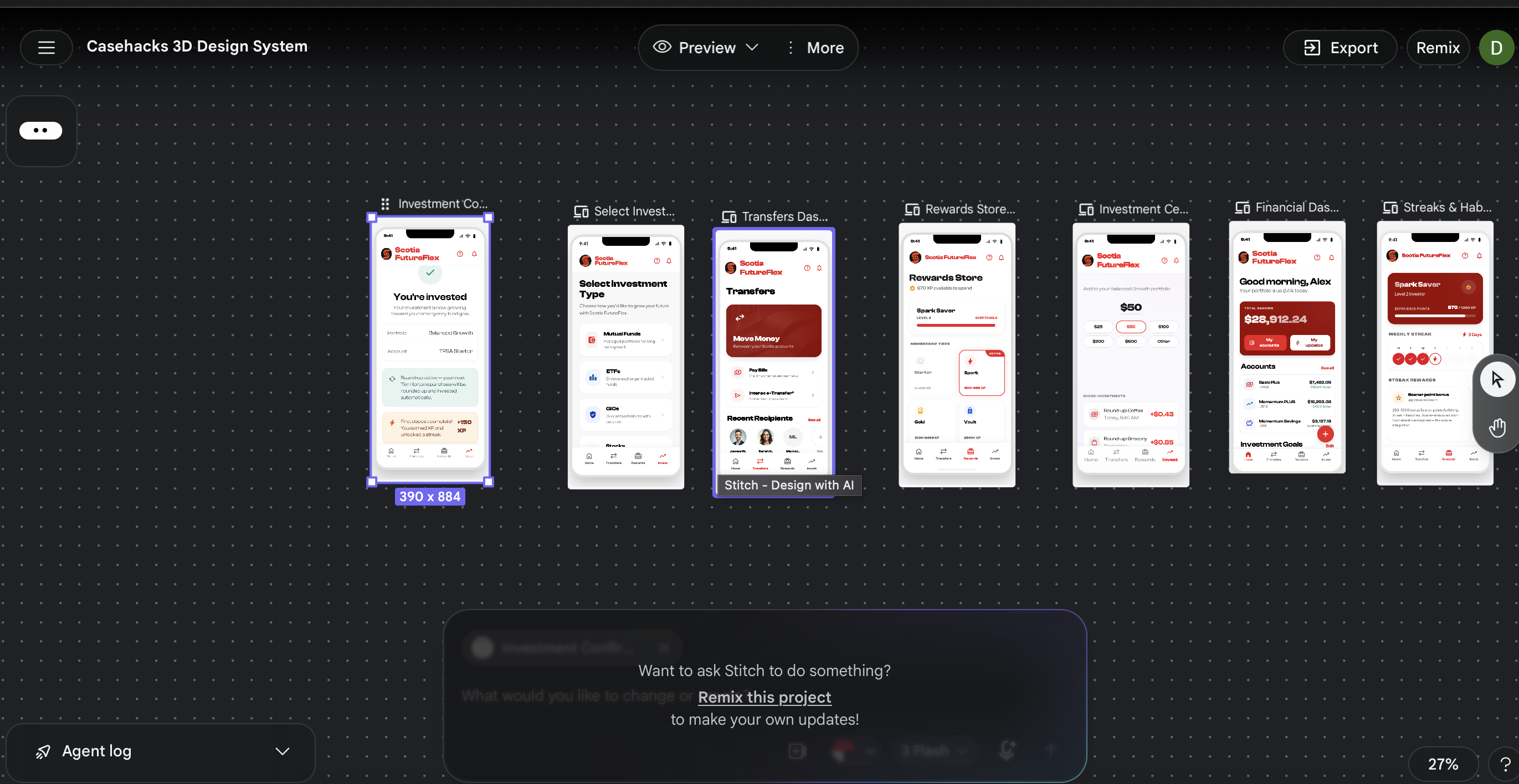
ScotiaFutureFlex is a digital investing concept designed to help first-time investors start with confidence.
The solution includes three main features:
Round-Up Investing
Every purchase rounds up to the nearest dollar, and the spare change is automatically invested.Instant Starter Portfolio
A simple 60-second quiz recommends a beginner-friendly investment path, such as a TFSA, FHSA, RRSP, or starter portfolio.Rewards & Streaks
Users earn XP for positive investing actions, build streaks, and can convert engagement into Scene+ rewards.
The product is designed to be automatic, cash-flow aware, and goal-based. This means users are not just investing randomly. ScotiaFutureFlex can consider payday timing, upcoming bills, and spending behaviour before suggesting how much a user can safely invest.
Market Opportunity
We also built a TAM–SAM–SOM model to understand whether the idea was commercially viable.
Our base-case model estimates:
| Market Layer | Meaning | Estimate |
|---|---|---|
| TAM | Total Addressable Market | 15.5M people, ~$496B AUM |
| SAM | Serviceable Addressable Market | 3.6M targetable customers, ~$54B AUM |
| SOM | Serviceable Obtainable Market | 360K obtainable customers, ~$5.4B AUM |
The simple revenue logic is:
$$ \text{Annual Revenue} = \text{AUM} \times \text{Blended Fee Rate} $$
Using a base-case obtainable market of:
$$ \$5.4B \times 0.45\% = \$24.3M $$
This shows that ScotiaFutureFlex is not only a user-friendly product idea, but also a realistic business opportunity.
How We Built the Project
We built the project by combining product design, market research, business modelling, and pitch strategy.
First, we identified the core problem: young Canadians are digitally active, but many are not confident investors. Then, we designed a solution that removes friction from the investing journey.
We structured the product around a simple user flow:
Spend → Round-Up → Safety Check → Starter Portfolio → Track Progress
This helped us make the idea easy to understand in a pitch setting. We also created a roadmap showing how ScotiaFutureFlex could be launched over 18 months:
| Phase | Timeline | Focus |
|---|---|---|
| Build & Launch | Months 1–6 | Launch the core investing experience and acquire first-time users |
| Engage & Retain | Months 7–12 | Improve onboarding, education, and recurring usage |
| Personalize & Scale | Months 13–18 | Use data-driven personalization to grow AUM and customer value |
Finally, we designed the pitch visuals around Scotiabank’s red-and-white brand identity to make the project feel realistic, polished, and competition-ready.
What We Learned
Through this project, we learned that a strong financial product is not just about adding features. It has to solve a real behavioural problem.
The biggest insight was that young people do not simply need another investing platform. They need a platform that helps them answer:
- Can I afford to invest right now?
- Where should I start?
- What account should I use?
- How does this help my real-life goals?
- How do I stay consistent?
We also learned that business viability depends on more than user sign-ups. For a product like ScotiaFutureFlex, the most important metrics are:
- onboarding completion rate
- first funded account rate
- recurring contribution rate
- average AUM per customer
- retention
- revenue per customer
This helped us connect the product idea to measurable business outcomes.
Challenges We Faced
One of the biggest challenges was balancing simplicity with credibility. We wanted ScotiaFutureFlex to feel easy for first-time investors, but we also needed the business model to be realistic.
Another challenge was avoiding the appearance of overclaiming. Competitors like Wealthsimple and Questrade already have strong digital investing platforms, so we had to clearly explain why Scotiabank could still win. Our answer was that Scotiabank has access to a deeper banking relationship: spending, payday, bills, savings behaviour, and existing customer trust.
We also had to think carefully about risk. Automatic investing can sound convenient, but users may worry about losing control. To solve this, we added safety checks, clear limits, pause controls, and beginner-friendly education.
Final Vision
ScotiaFutureFlex is designed to make investing feel personal, safe, and built around real life.
Instead of asking young Canadians to become investing experts overnight, it helps them start small, build habits, and grow over time.
ScotiaFutureFlex turns everyday banking relationships into long-term investing relationships.
Built With
- cors
- css
- database
- fastapi
- html
- javascript
- middlewarestatic
- pydantic
- python
- schemas
- sqlalchemy
- sqlite
- uvicorn

Log in or sign up for Devpost to join the conversation.