-
Pulse_prototype1
-
Pulse_prototype2
-
Pulse_prototype3
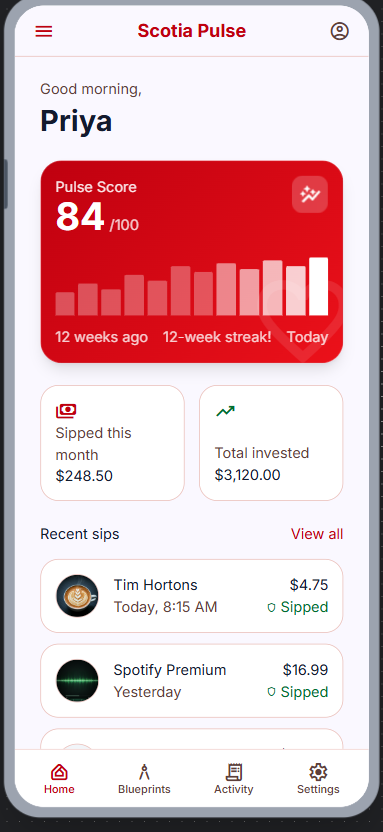
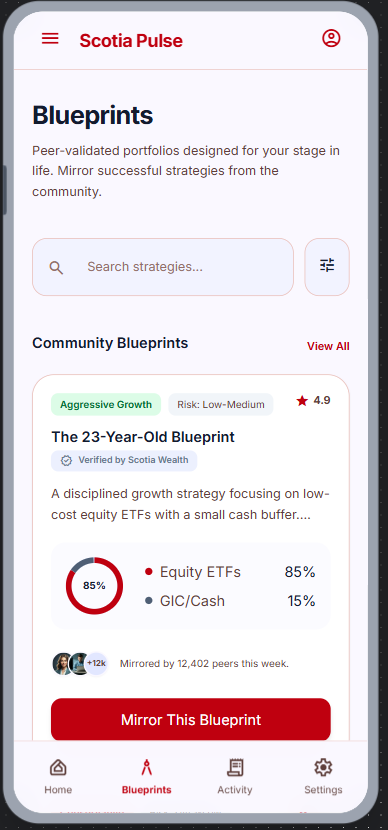
Scotia Pulse
Inspiration
We were inspired by a growing problem that many young people face today: they want to invest and build wealth, but they feel overwhelmed, anxious, and financially stuck before they even begin.
Gen Z and younger millennials are entering adulthood during a period of rising living costs, housing pressure, economic uncertainty, and constant exposure to financial content online. Despite having more access to investing platforms than any previous generation, many still hesitate to start investing because of fear, confusion, and lack of confidence.
We noticed a pattern:
- Young users constantly consume finance content on TikTok, YouTube, Reddit, and Instagram.
- They feel pressured to “figure investing out” on their own.
- Traditional banking platforms feel intimidating and emotionally disconnected.
- Existing investing apps focus heavily on charts, volatility, and performance instead of behavioral confidence.
The problem was not simply access to investing tools.
The real problem was behavioral paralysis.
We wanted to build something that makes investing feel emotionally approachable, automatic, social, and consistent instead of stressful.
That became the foundation for Scotia Pulse.
What It Does
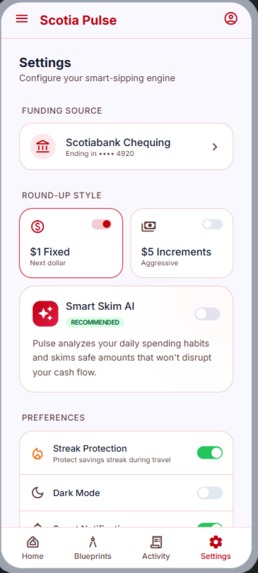
Scotia Pulse is a behavioral-fintech layer designed to help young users start investing confidently through:
- passive micro-investing,
- community-driven financial blueprints,
- momentum tracking,
- and psychologically supportive investing experiences.
Instead of overwhelming users with technical financial dashboards, Scotia Pulse focuses on reducing emotional friction and building healthy investing habits over time.
The platform introduces three core ideas:
Smart-Sipping
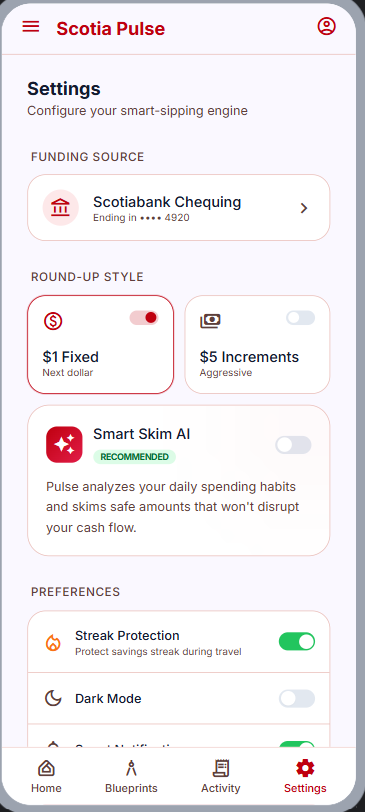
Users can automatically round up purchases or contribute small passive amounts into investments without needing to make large financial decisions upfront.
This lowers the psychological barrier to entry and helps users begin investing gradually.
Community Blueprints
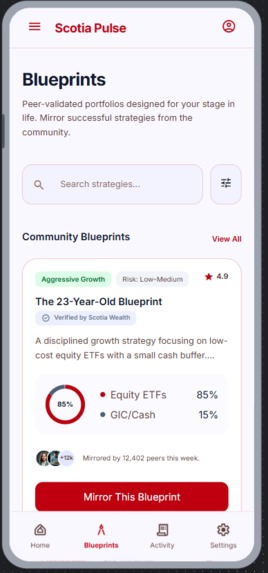
Instead of relying on risky “finfluencers” online, users can explore anonymized and compliant investment patterns inspired by people in similar age groups or financial situations.
This transforms social proof into a safer and more trustworthy investing experience.
Momentum Tracking
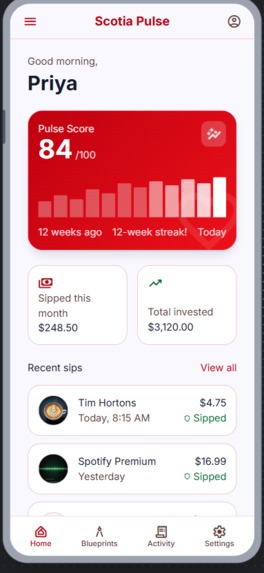
Rather than emphasizing short-term gains and losses, Scotia Pulse rewards:
- consistency,
- savings streaks,
- contribution milestones,
- and long-term habits.
The goal is to reduce panic-driven investing behavior and create healthier financial psychology.
How We Built It
We approached Scotia Pulse as both a behavioral and technical design challenge.
First, we researched:
- Gen Z investing behavior,
- financial anxiety,
- fintech adoption,
- social investing psychology,
- and habit-forming digital products.
We analyzed:
- Reddit discussions,
- financial surveys,
- banking reports,
- and existing fintech platforms such as Wealthsimple, Acorns, Moka, and robo-advisors.
From there, we mapped emotional pain points directly into product features.
We designed the user experience around:
- reducing cognitive overload,
- simplifying onboarding,
- encouraging passive investing,
- and making financial progress feel visible and motivating.
The prototype and presentation were built using:
- Canva for UI and pitch design,
- behavioral-finance research,
- fintech market analysis,
- and product strategy frameworks.
We intentionally designed Scotia Pulse to leverage existing banking infrastructure rather than requiring an entirely new financial ecosystem. This makes the concept more feasible for large institutions such as Scotiabank to implement.
Challenges We Faced
One of the biggest challenges was balancing:
- emotional simplicity, with
- financial responsibility.
Many existing fintech apps become overly gamified and unintentionally encourage impulsive investing behavior. We wanted Scotia Pulse to feel engaging without turning investing into gambling.
Another major challenge was compliance and trust.
Features involving social investing or community behavior can quickly raise concerns around:
- investment advice,
- privacy,
- regulation,
- and financial liability.
To address this, we designed the system around:
- anonymized insights,
- institution-approved portfolios,
- and behavioral guidance rather than speculative trading.
We also faced an important strategic challenge: micro-investing alone does not create massive wealth.
Because of this, we reframed Smart-Sipping not as the final wealth-building solution, but as a behavioral gateway that helps users overcome fear and begin building consistent financial habits.
What We Learned
This project taught us that financial technology is not only about money.
It is deeply connected to:
- psychology,
- identity,
- trust,
- and human behavior.
We learned that many young people are not avoiding investing because they are lazy or uninterested. They are overwhelmed by uncertainty and afraid of making irreversible mistakes.
We also learned that the future of fintech may not belong to the platforms with the most advanced charts or trading tools.
It may belong to the platforms that best understand human behavior.
Scotia Pulse is our attempt to bridge that gap by transforming investing from something intimidating into something approachable, social, and sustainable.
Future Vision
In the future, Scotia Pulse could expand into:
- AI-powered financial coaching,
- adaptive savings goals,
- educational investment pathways,
- real-time behavioral insights,
- and personalized financial wellness systems.
Our long-term vision is to help young people build confidence with money before they build wealth with money.
Because confidence is what allows long-term investing behavior to begin.
Built With
- stitch

Log in or sign up for Devpost to join the conversation.