-
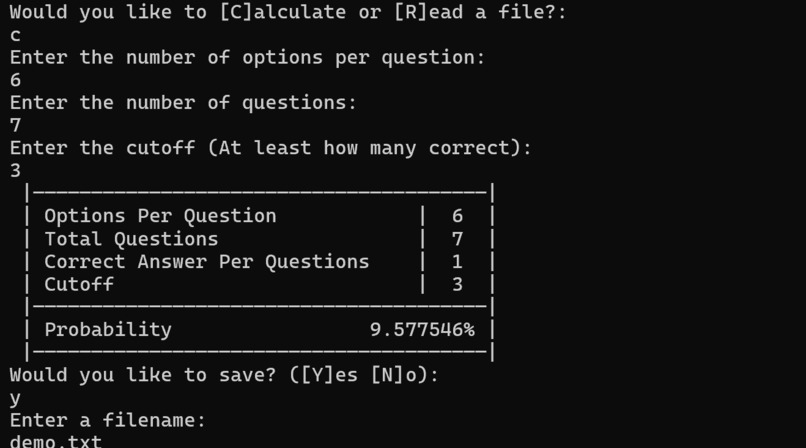
Calculating the results for a test
-
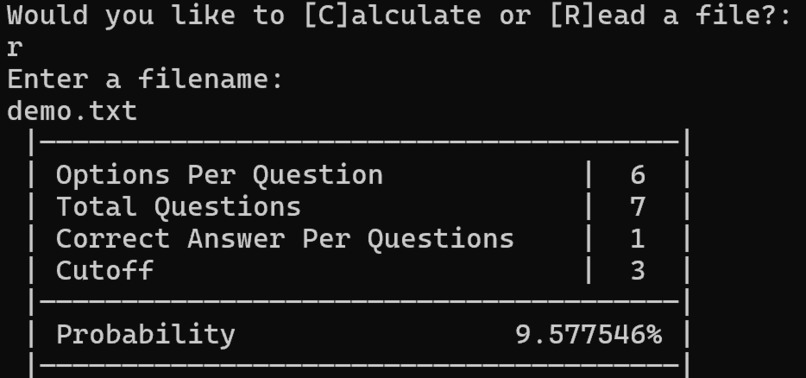
Reopening the test results from a file
Inspiration
The original idea came from one member of our team, whose mother is a neuropsychologist and had previously mentioned how helpful a similar tool would be for her work.
In neuropsychology, testing is used to evaluate a patient's brain function. In some cases where brain function is severely deficient in a particular area, a patient's results can reflect random chance. This project aims to allow for a more nuanced and accurate understanding of whether a result could be achieved randomly, so as to allow for better understanding of results such as those from neuropsychological testing.
What it does
The program allows a user to generate and save tests, and to calculate the likelihood of getting a given score on a test.
How we built it
The entire project was coded in c++, with a Makefile to automatically compile files and run tests. Gtest was used to create unit tests, making sure that the probability calculations were accurate.
Challenges we ran into
Early on, we made the decision to implement the project in c++, as we both have lots of experience in the language. However, multiple hours into the project, when it was too late to pivot, we realized that was a somewhat poor choice of language, and we likely should have gone with Python. On the front-end, Python is very good at processing and displaying strings, while in c++, cout is famously clunky to use. On the back-end, Python dynamically allocates space for integers within RAM, meaning there is no maximum size, while c++ has a maximum integer size of 64 bits, which becomes a serious limitation in scale when the program includes calculating the binomial coefficient. Additionally, Python includes the Decimal data type, which would allow for full precision on decimal values, as opposed to the rounding of c++ doubles.
Accomplishments that we're proud of
- Having a working final product by the end of the Hackathon
- Written by hand
What we learned
We wrote the code by hand, because for this hackathon, we wanted to focus on writing the code ourselves. We're both enrolled in a c++ class, although once again, python could have saved so much time. This was the first time we ran into cases where doubles were too small for calculations because factorial grow extremely fast. Because c++ isn't the best with string formatting, we had to do all of it ourselves with string manipulation. In fact, we had to implement a lot of little things like centering text, prompting inputs safely, and case insensitive comparison. Those were often pre-made methods in other languages but c++ was minimal.
What's next for Score Probability Calculator
Allowing it to calculate the score distribution for tests with two correct answers, with potentially even more flexibility in the future!

Log in or sign up for Devpost to join the conversation.