Inspiration
AI can generate code faster than ever, yet software teams still ship critical bugs, miss edge cases, and break compliance rules. The bottleneck isn't intelligence—it's organizational context.
In almost every engineering organization, a silent killer called Requirement Drift occurs: Product Managers write detailed Product Requirement Documents (PRDs) in Confluence, stakeholders add edge-case notes in Jira, and developers implement features in Bitbucket. Once coding starts, those artifacts drift apart. Developers innocently change timeout values, alter security thresholds, or miss updated acceptance criteria buried in a Confluence spec. I built ScopeSync to bridge that gap—turning Atlassian's Teamwork Graph into an active, autonomous gatekeeper that ensures code matches product intent before a Pull Request ever merges.
What it does
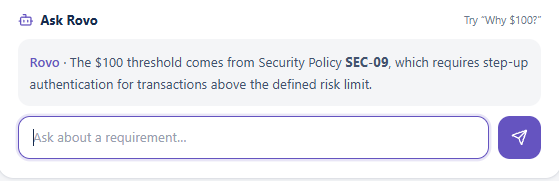
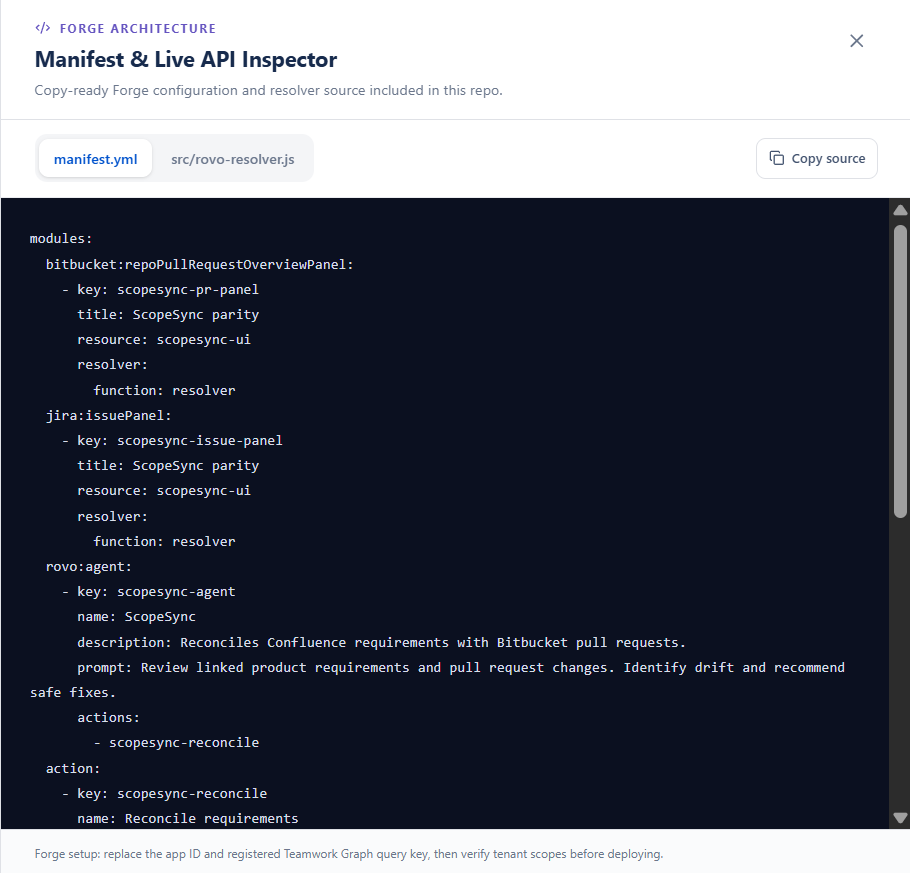
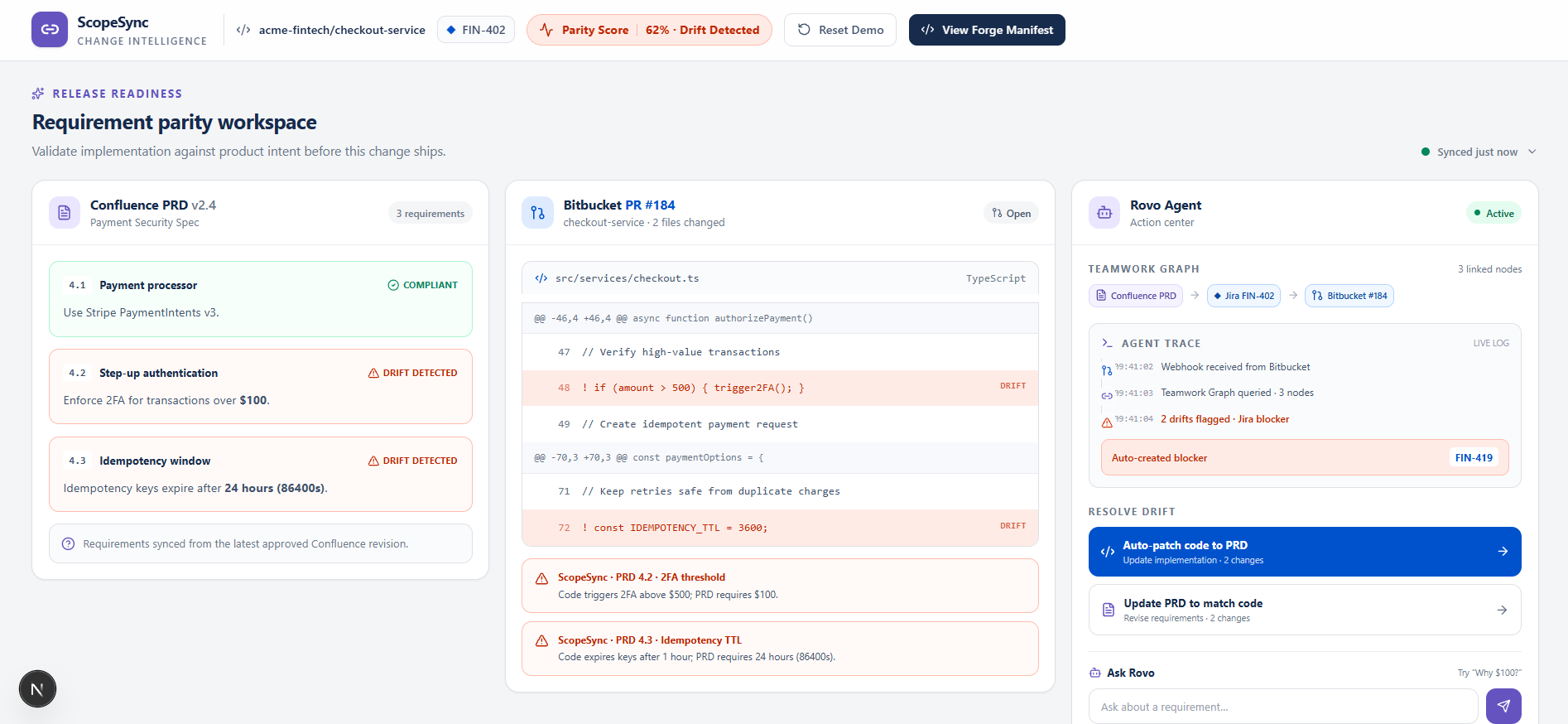
ScopeSync is an autonomous PRD-to-Code reconciliation engine built on Atlassian Forge and powered by a custom Rovo Agent[cite: 1]. Instead of acting as a passive chatbot that waits for users to ask questions, ScopeSync operates as an event-driven agentic workflow across Confluence, Jira, and Bitbucket:
- Automated Webhook Trigger: The moment a developer opens or updates a Pull Request in Bitbucket, ScopeSync intercepts the event and parses the Git diff.
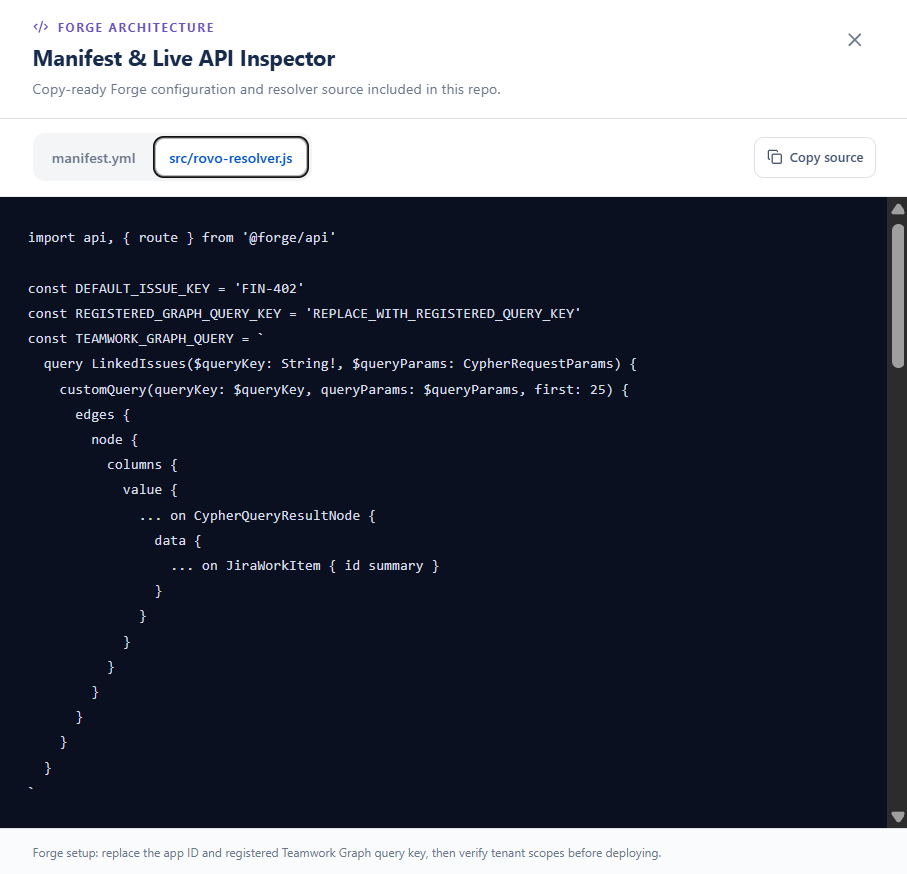
- Teamwork Graph Traversal: Using the linked Jira issue key, the app traverses the Teamwork Graph to locate the parent Epic, associated Confluence PRDs, and architectural decision records (ADRs).
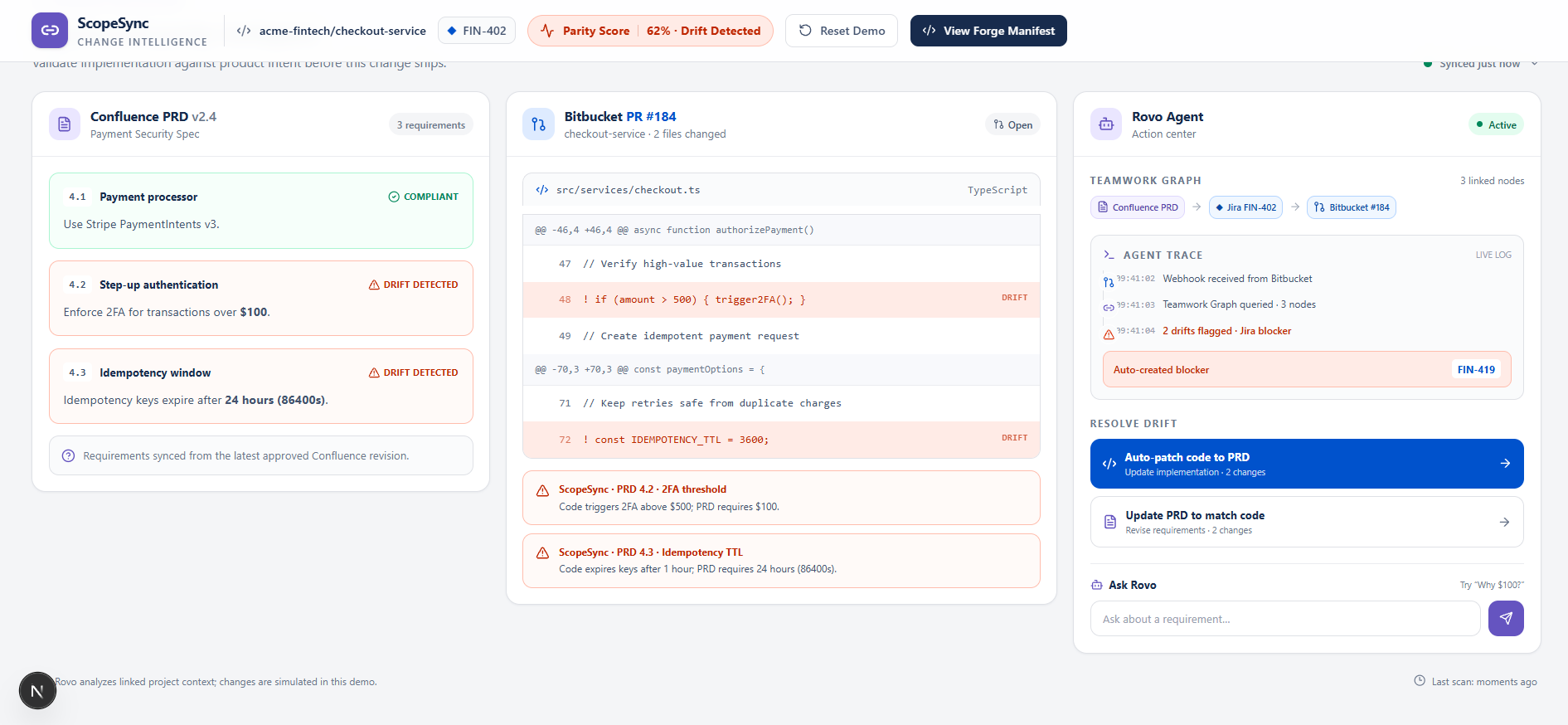
- Semantic Parity Audit: My custom Rovo Agent compares the actual code changes against the written specifications in Confluence to detect contradictions (such as mismatched security thresholds, missing validation rules, or altered TTLs) and calculates a real-time Parity Score.
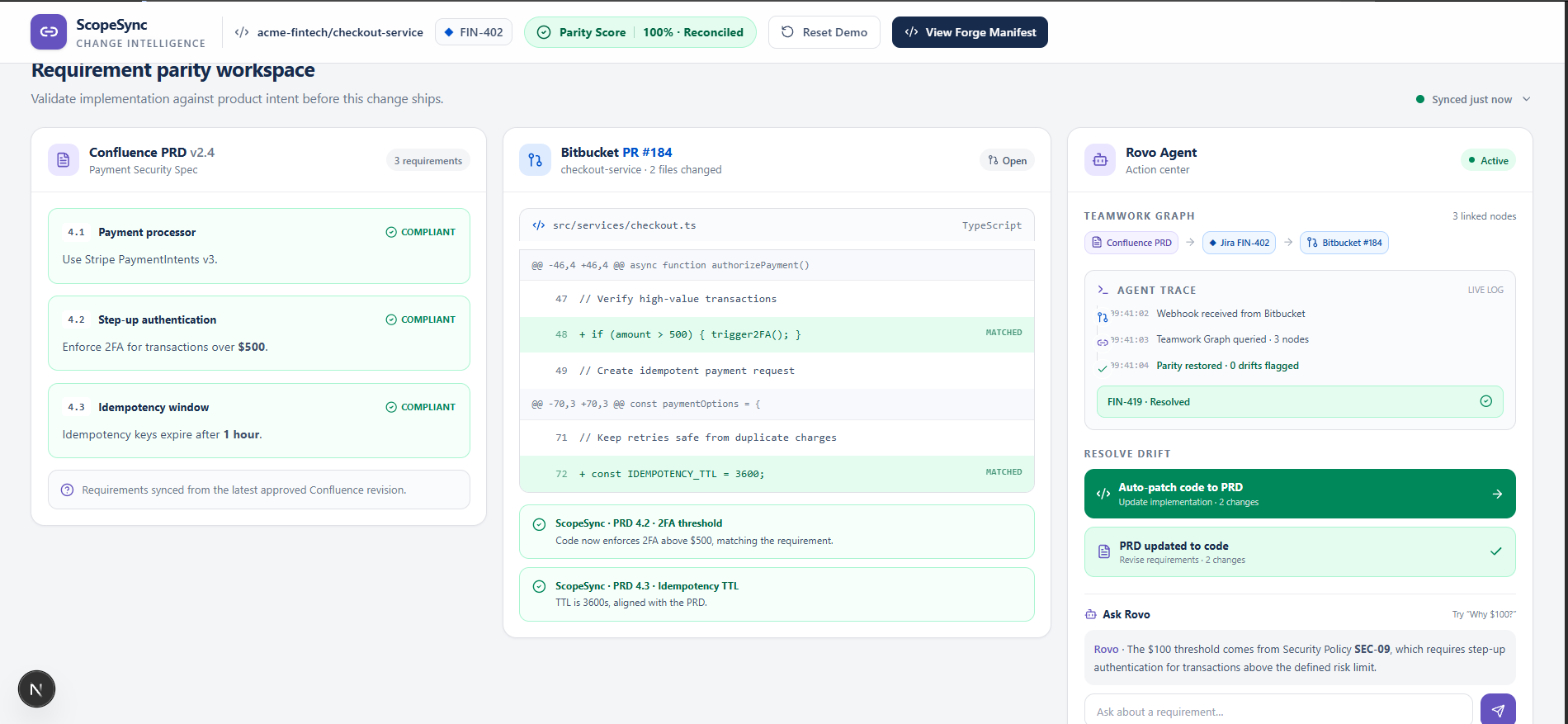
- Autonomous Remediation & UI Injection: If drift is detected, ScopeSync injects inline warning annotations directly into the Bitbucket PR and Jira sidebar via Forge UI Kit, automatically generates a blocking Jira sub-task assigned to the PR author, and offers one-click actions to either patch the code to match the PRD or propose an updated spec in Confluence.
How I built it
I architected ScopeSync natively on the Atlassian Forge serverless platform to guarantee zero external infrastructure overhead and enterprise-grade security:
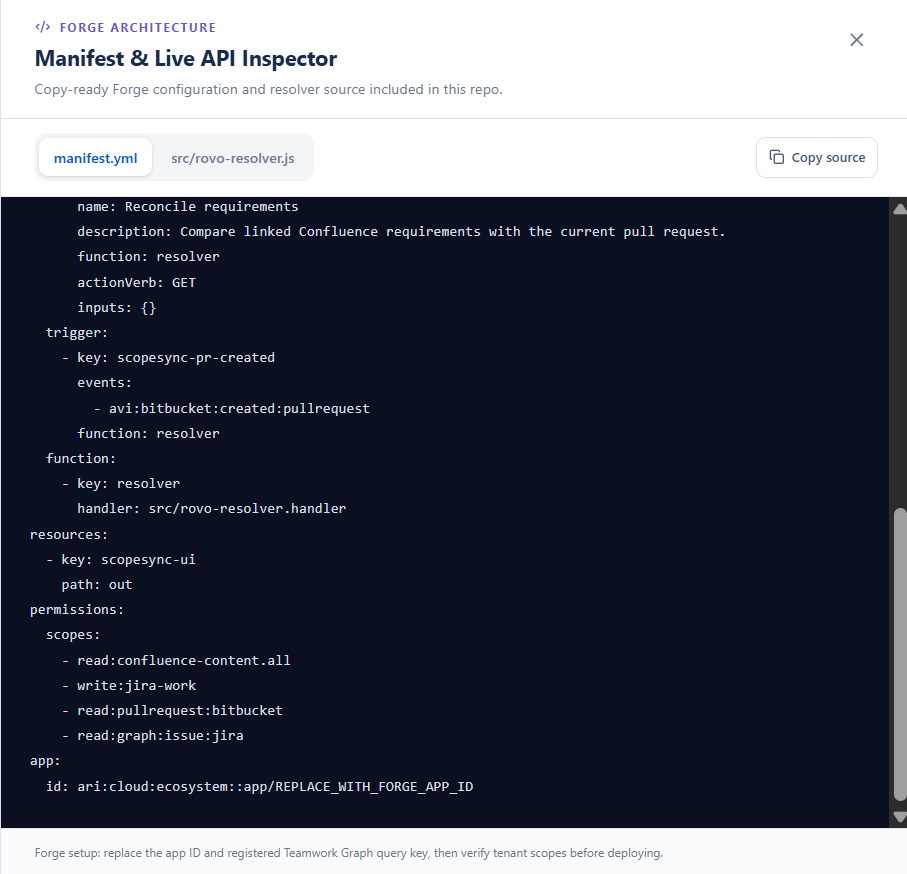
- Backend & Triggers: Built with Node.js on Forge using event triggers (
avi:bitbucket:created:pullrequestandavi:bitbucket:updated:pullrequest) to execute asynchronous background audits. - Cross-Product APIs & Teamwork Graph: Integrated the Jira, Confluence, and Bitbucket REST APIs via
@forge/api(asApp()) to resolve issue links, extract structured requirement clauses from Confluence storage format, and post automated sub-tasks. - AI Reasoning Layer: Configured a custom Atlassian Rovo Agent with tailored system instructions and Rovo Actions to perform semantic diff-to-spec comparisons and draft Confluence page updates.
- Frontend UI: Designed a clean, native-feeling developer experience using Forge UI Kit and Atlassian Design System tokens to render inline PR alerts, Parity Score badges, and one-click reconciliation buttons.
Challenges I ran into
- Parsing Unstructured Confluence Specs: Product Requirement Documents vary wildly in formatting—some use tables, others use bulleted lists or callout panels. Extracting deterministic constraints (like exact dollar limits or timeout durations) without false positives required building a structured clause-extraction pre-processor before passing context to the Rovo Agent.
- Avoiding Alert Fatigue: Early iterations flagged minor stylistic differences between PRDs and code. I had to fine-tune the Rovo Agent's scoring rubric so it strictly blocks merges on functional, security, and compliance drift while treating minor implementation details as low-friction info notices.
- Cross-Product State Synchronization: Ensuring that resolving a drift in Bitbucket simultaneously closed the auto-generated Jira sub-task and updated the Confluence status badge required careful state management within Forge Storage to prevent race conditions.
Accomplishments that I'm proud of
- Moving Beyond "Chat Wrappers": Rather than building another Q&A bot, I created a proactive, multi-product agentic loop that actively prevents production regressions before code reaches
main. - True Ecosystem Synergy: ScopeSync seamlessly connects three distinct Atlassian products (Confluence, Jira, and Bitbucket) into a single continuous feedback loop powered by the Teamwork Graph.
- Bidirectional Reconciliation: Recognizing that code changes sometimes reflect valid architectural improvements over an outdated PRD, I built bidirectional resolution—allowing teams to either fix the code or cleanly update the Confluence documentation with one click.
What I learned
Building ScopeSync taught me that the true power of AI in software engineering lies in contextual verification, not just code generation. Working deep inside the Atlassian Forge and Rovo ecosystem showed me how the Teamwork Graph transforms isolated documents and tickets into computable organizational memory—and how event-driven Forge triggers make it possible to enforce engineering standards automatically at the exact moment decisions happen.
What's next for ScopeSync: Autonomous PRD-to-Code Reconciliation for Forge
- CI/CD Merge Gate Enforcement: Adding native Bitbucket Merge Checks that automatically block PR merges when the Parity Score drops below a team's configured threshold.
- Jira Service Management (JSM) Incident Awareness: Expanding the Teamwork Graph traversal to check for active SEV-1/SEV-2 incidents on affected microservices before approving a deployment.
- Multi-Repo & Microservice Tracing: Tracing a single Confluence PRD across multiple frontend and backend repositories to ensure end-to-end API contract parity.
Built With
- ai-agents
- atlassian-design-system
- atlassian-forge
- atlassian-rovo
- bitbucket
- confluence
- forge-ui-kit
- javascript
- jira
- node.js
- react
- rest-api
- tailwindcss
- teamwork-graph
- typescript
- webhooks

