Inspiration
AI coding tools can generate code quickly, but teams still lose time when the original plan drifts across documents. A scope decision can disappear from the PRD, a spec can contradict the agreed product boundary, or acceptance criteria can become too vague to verify. I wanted to build a small, practical tool that catches those problems before implementation starts.
That idea became ScopeSeal: an executable scope guard that checks whether planning documents still honor the same product contract.
What it does
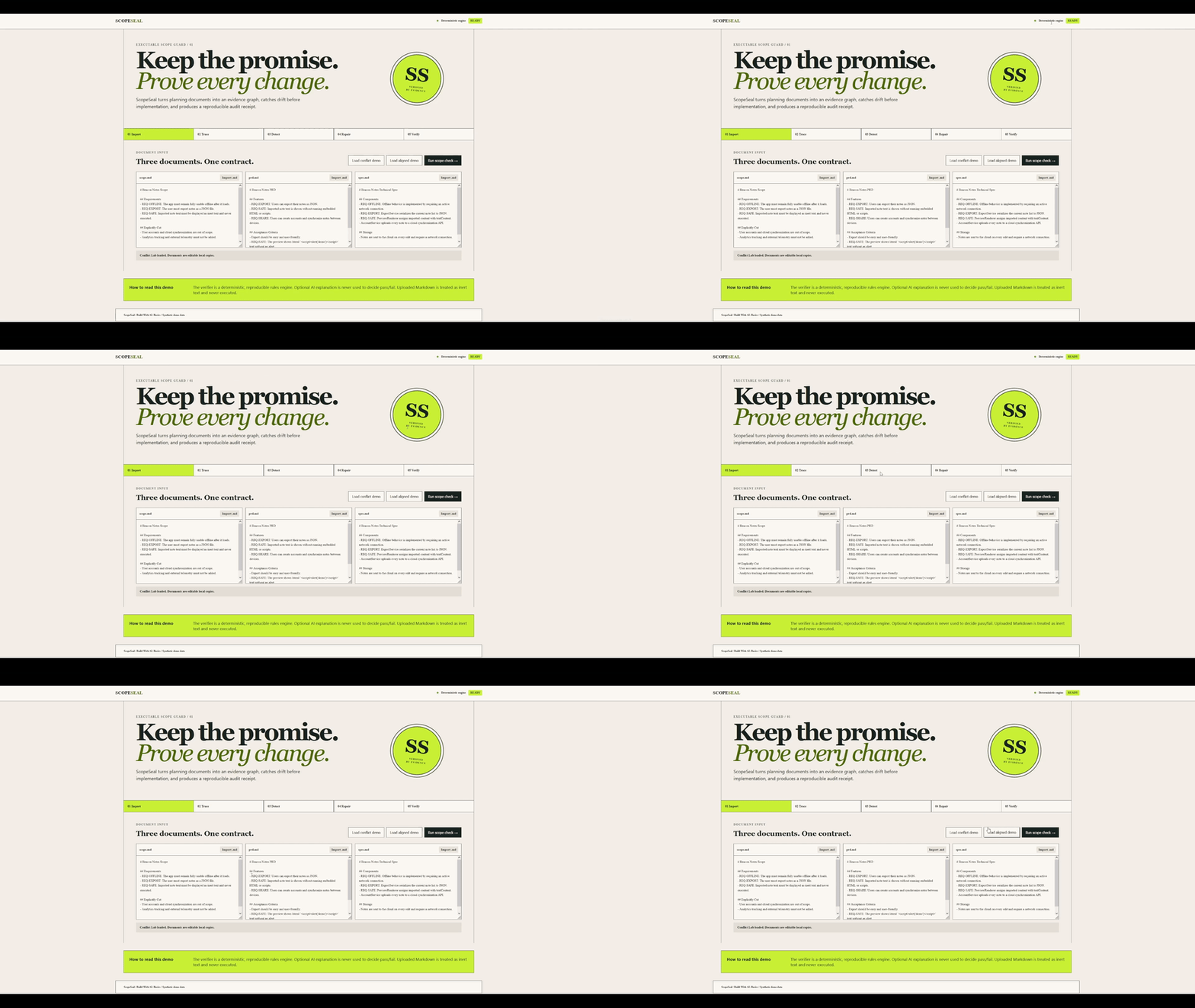
ScopeSeal analyzes three planning documents — scope.md, prd.md, and spec.md — and turns them into a deterministic review flow.
It helps teams:
- catch missing downstream requirements
- detect scope drift between planning documents
- find contradictions between product intent and technical spec
- flag unsupported features that appear without scope evidence
- identify vague acceptance criteria that are not observable
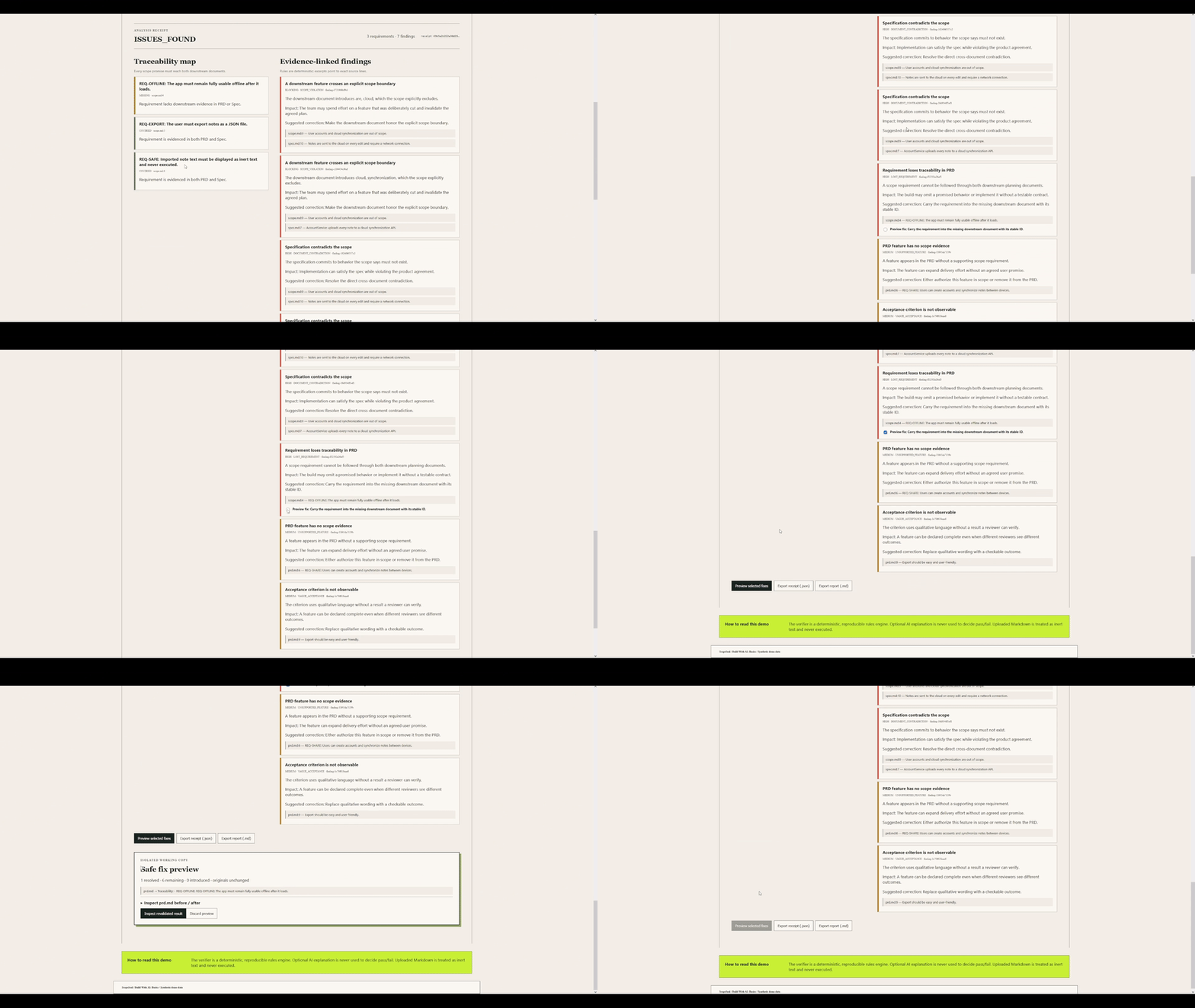
The app then offers a safe fix preview for supported cases, shows exactly what would change, and revalidates the result before anything is accepted. It also produces an audit-style receipt so the review is reproducible.
How we built it
I built ScopeSeal as a lightweight web app with a deterministic verification engine at the core.
The workflow is:
- import
scope.md,prd.md, andspec.md - extract evidence-linked requirements and downstream references
- run deterministic checks for traceability, contradictions, unsupported features, and vague criteria
- present findings with source excerpts and suggested corrections
- allow a safe preview fix in an isolated working copy
- revalidate the updated working copy and show the result
The application uses a Python backend and a simple browser UI so the full flow is easy to demo end to end. Optional local AI is limited to explanation only; it does not decide pass/fail. The actual verification is deterministic and reproducible.
I also used the Devpost Learn Skill Pack workflow to shape the project from an empty folder, define the scope, write the PRD and spec, and then build in small, reviewable slices.
Challenges we ran into
The main challenge was making the product useful without making it vague.
I did not want ScopeSeal to be "an AI opinion tool." It needed to make clear, evidence-based decisions. That meant carefully designing the checks so that each finding points back to real text in the planning documents.
Another challenge was the repair flow. I wanted the app to show how a fix would help without mutating the original files. That led to the isolated preview approach: ScopeSeal shows the proposed correction, re-runs validation, and reports what was resolved, what remains, and whether anything new was introduced.
I also spent time polishing the demo so the product story is visible quickly: load a conflict scenario, run the check, preview a fix, and verify the improved result.
Accomplishments that we're proud of
I'm proud that ScopeSeal is not just an idea — it works end to end.
Highlights:
- a working deterministic scope-checking engine
- evidence-linked findings with direct source references
- a safe preview repair flow
- revalidation after the proposed fix
- a reproducible audit receipt
- a clean demo with both conflict and aligned scenarios
- public repo, deployed demo, and short walkthrough video
In the conflict demo, ScopeSeal surfaces multiple planning issues and can safely preview a fix for a missing downstream requirement. In the aligned demo, it verifies the planning set cleanly.
What we learned
This project reinforced how valuable planning discipline is when building with coding agents.
The biggest lesson was that good AI-assisted building starts with a clear contract. If the scope, PRD, and spec disagree, implementation gets noisy fast. Building ScopeSeal also showed me that deterministic checks and AI can complement each other well: rules provide trust, and AI can help explain results without becoming the source of truth.
I also learned how much polish matters even for a small proof of concept. A short, focused workflow makes the product much easier to understand.
What's next for ScopeSeal
Next, I want to expand ScopeSeal in a few directions:
- support more repair actions, not just previewing a missing requirement carry-forward
- add richer diff views across multiple documents
- integrate with GitHub or PR review workflows
- support team review history and saved validation runs
- add more rule packs for release readiness, testability, and acceptance quality
- make the audit receipt easier to share across product and engineering teams
Longer term, I see ScopeSeal becoming a practical guardrail for teams that plan with Markdown and build with AI-assisted workflows.

Log in or sign up for Devpost to join the conversation.