-
-
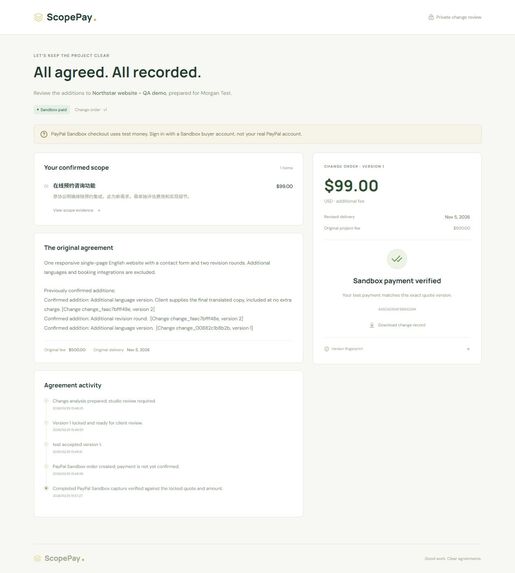
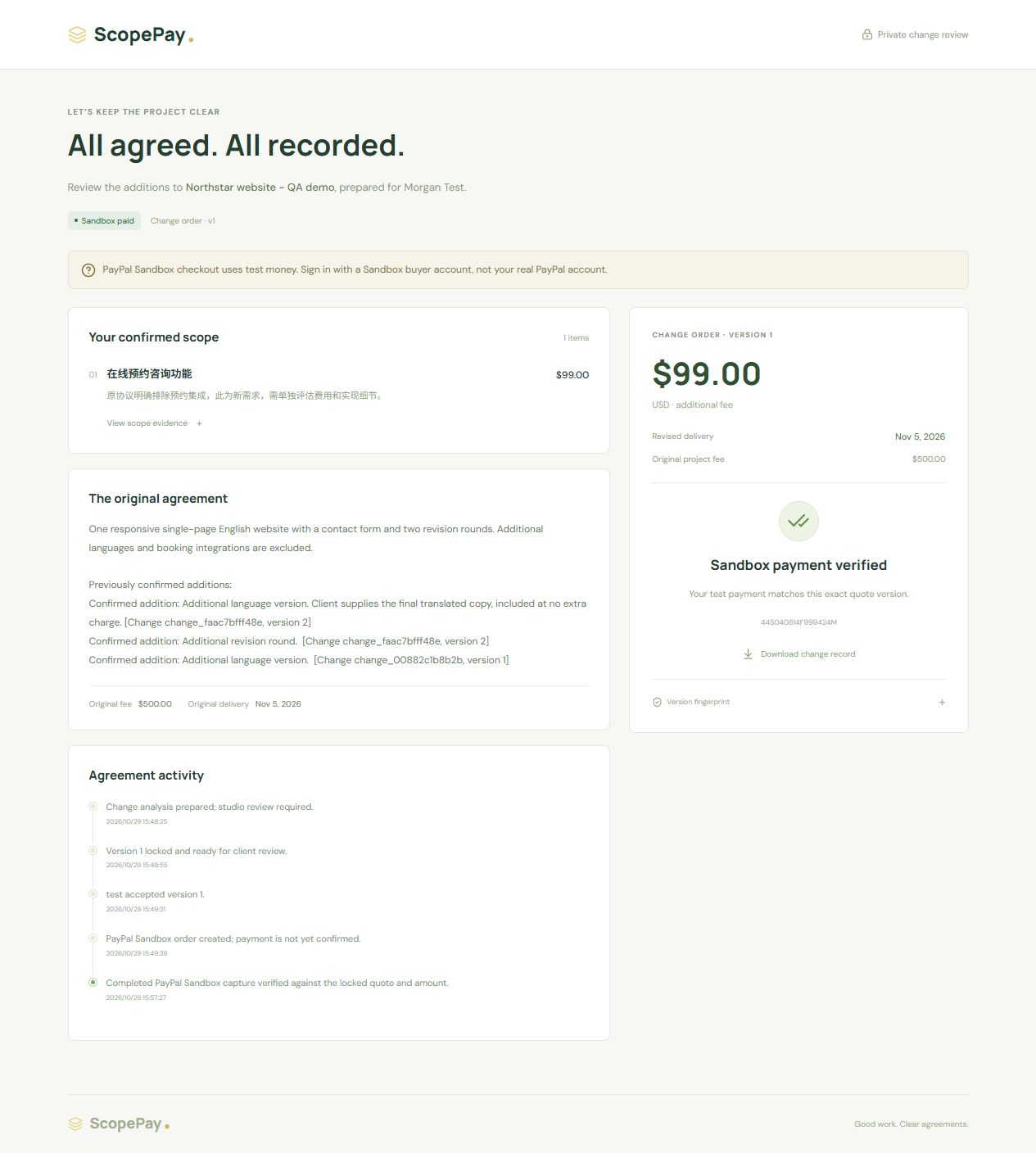
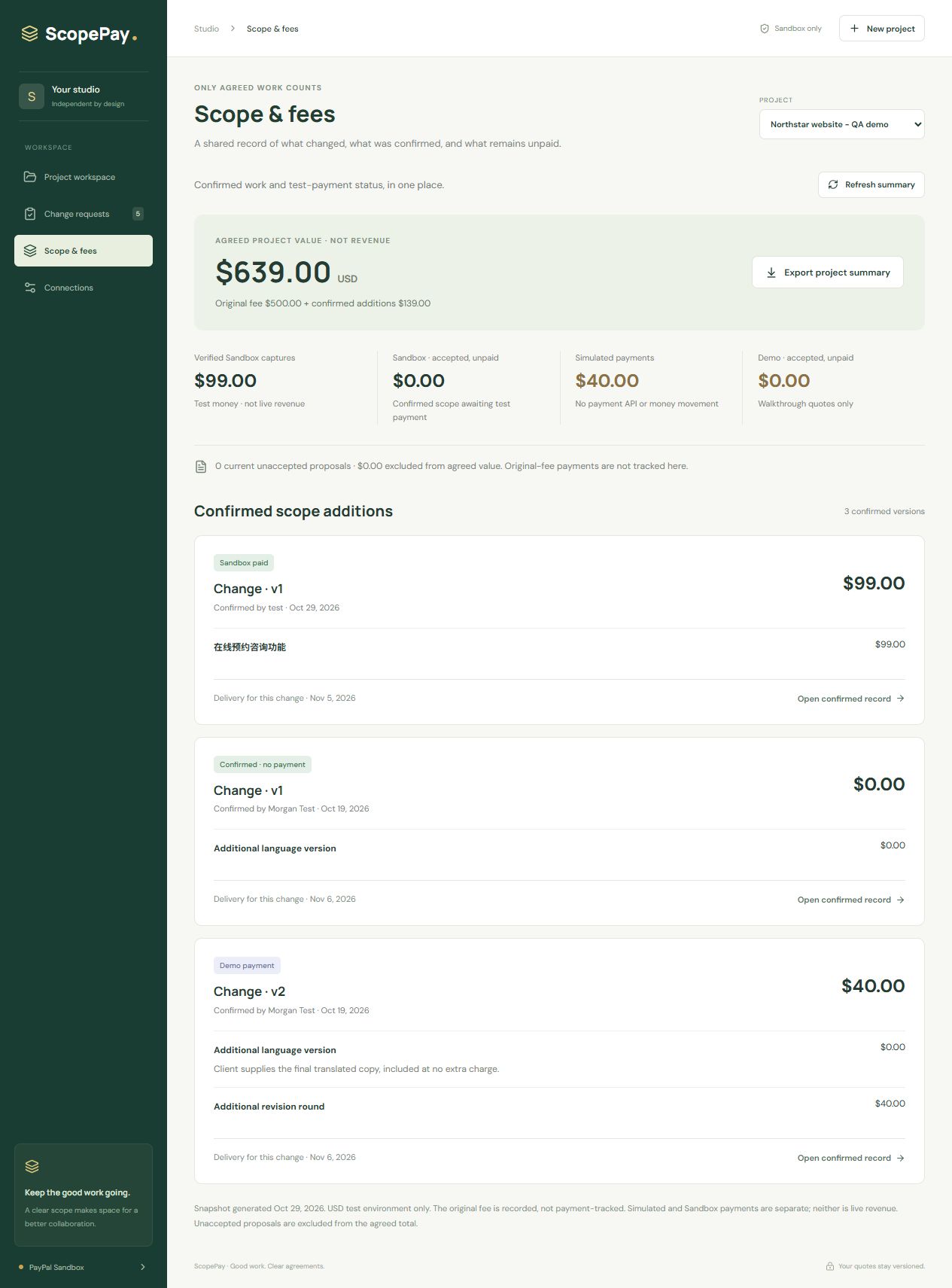
Northstar: USD 99 Sandbox capture verified against the locked quote. Chinese item: Online consultation booking. Test funds only.
-
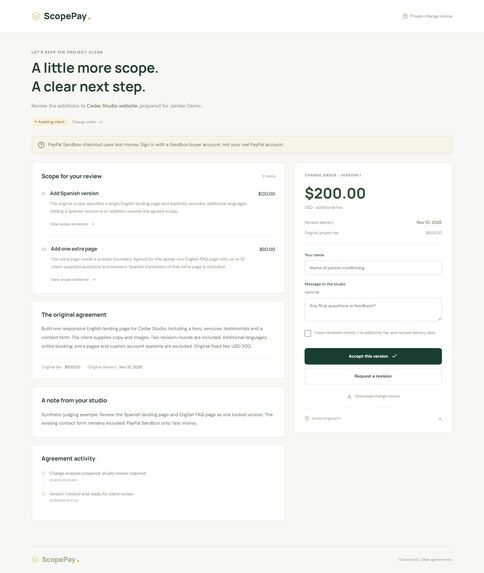
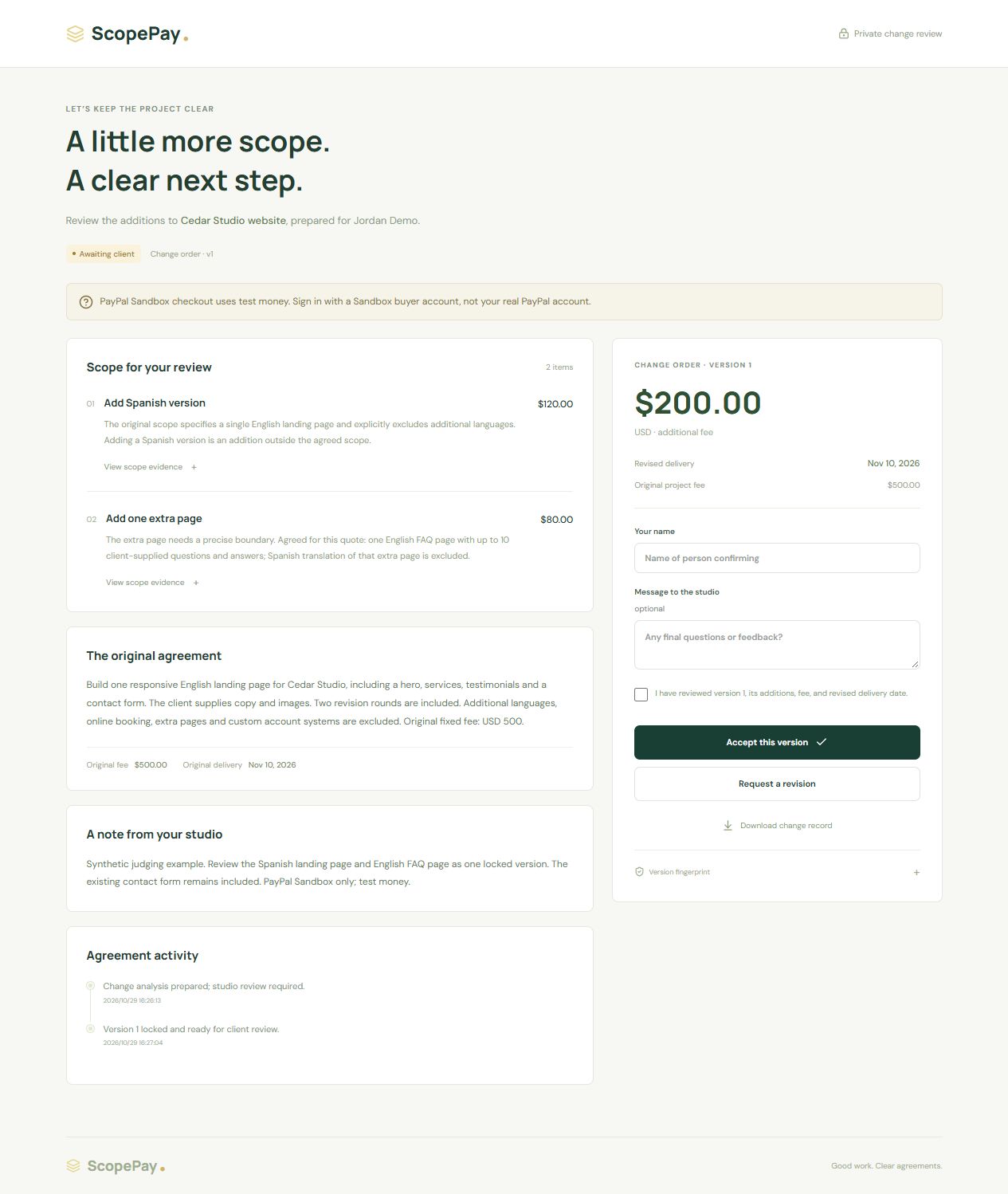
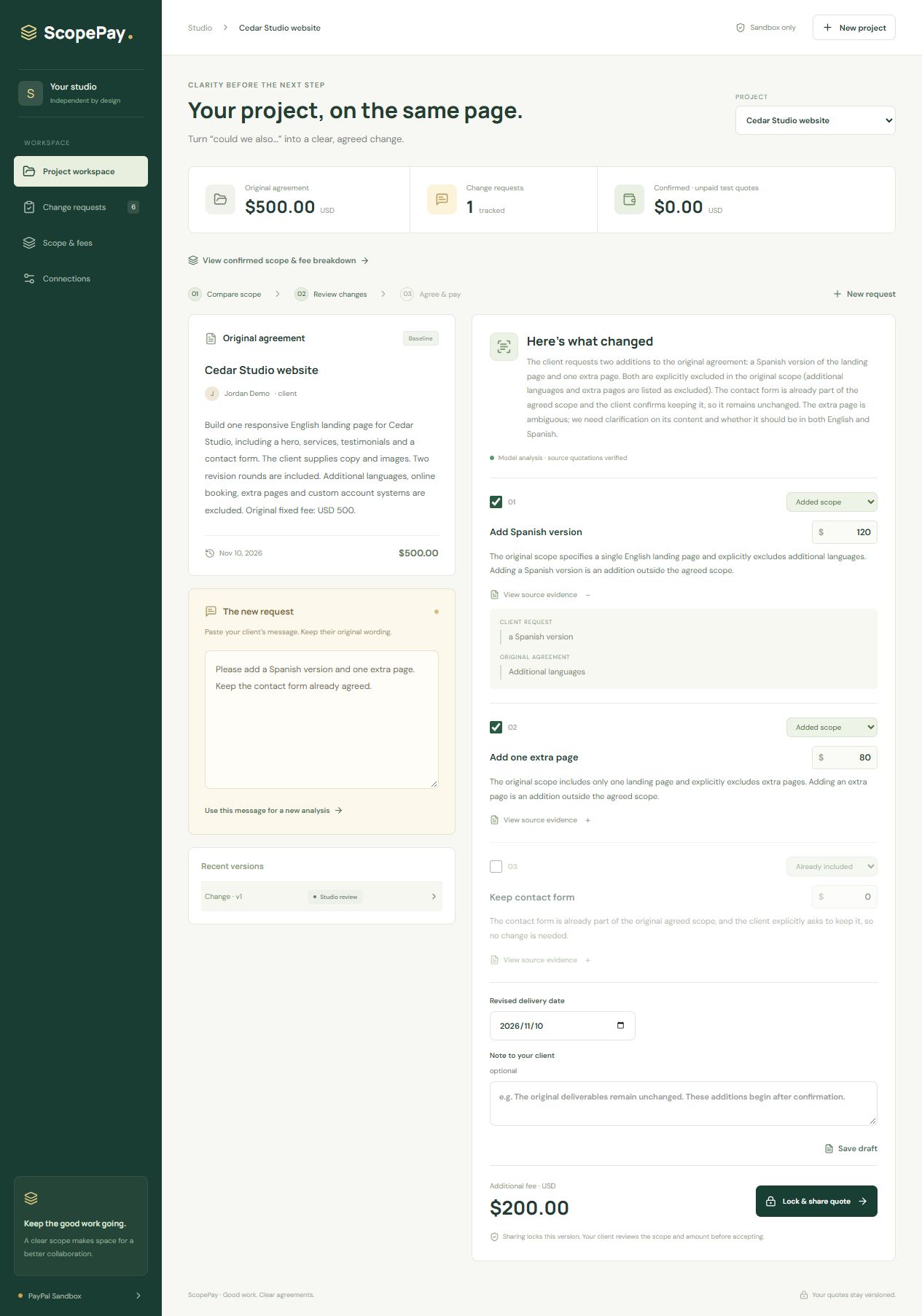
Cedar v1: locked USD 200 quote awaiting client review at capture time; later replaced. No payment was made.
-
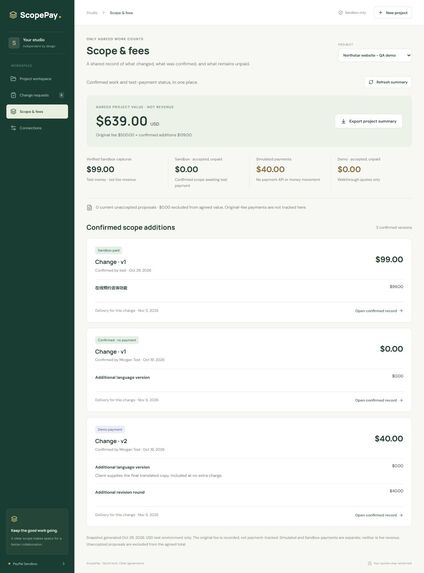
USD 639 agreed scope value is not revenue. USD 99 verified Sandbox funds and USD 40 simulated payments are separate.
-
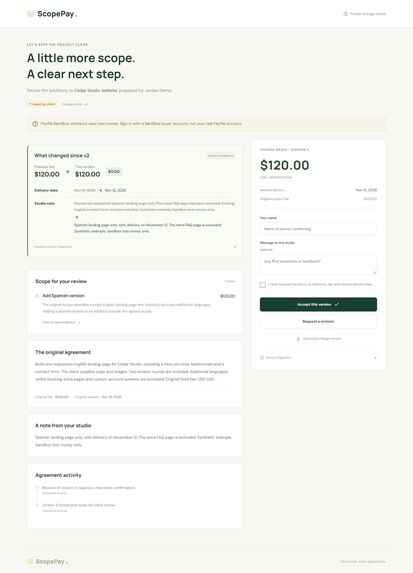
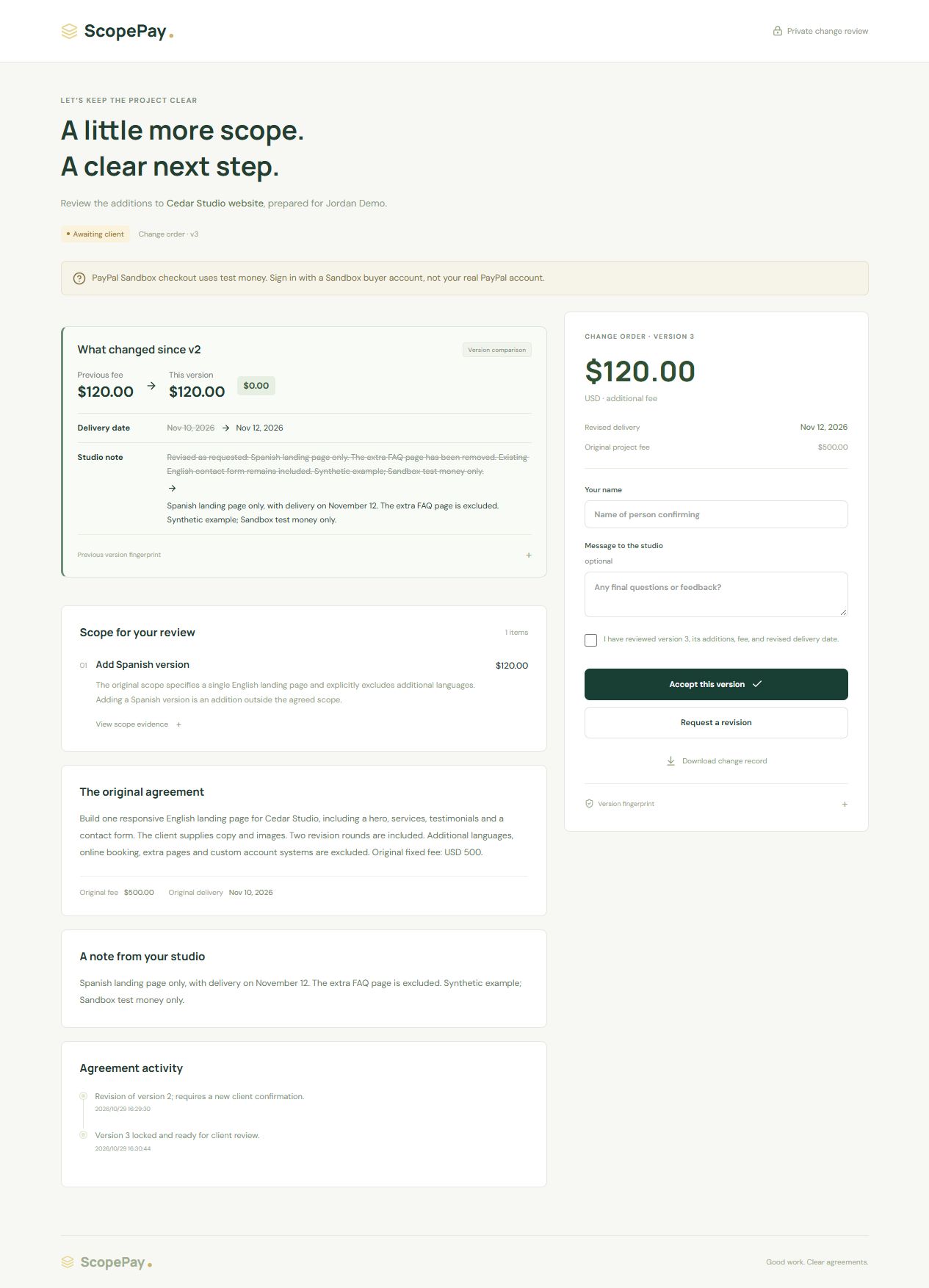
Cedar v3: delivery changes from Nov 10 to Nov 12; fee remains USD 120 versus v2. Awaiting client review, not paid.
-
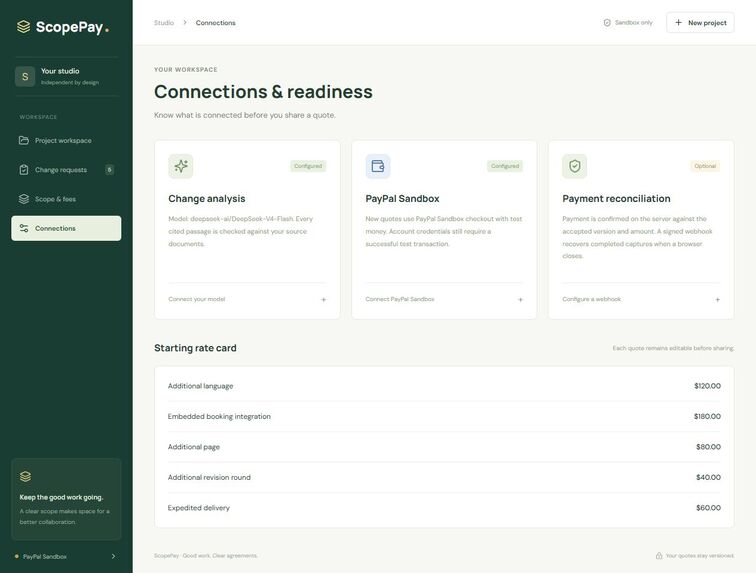
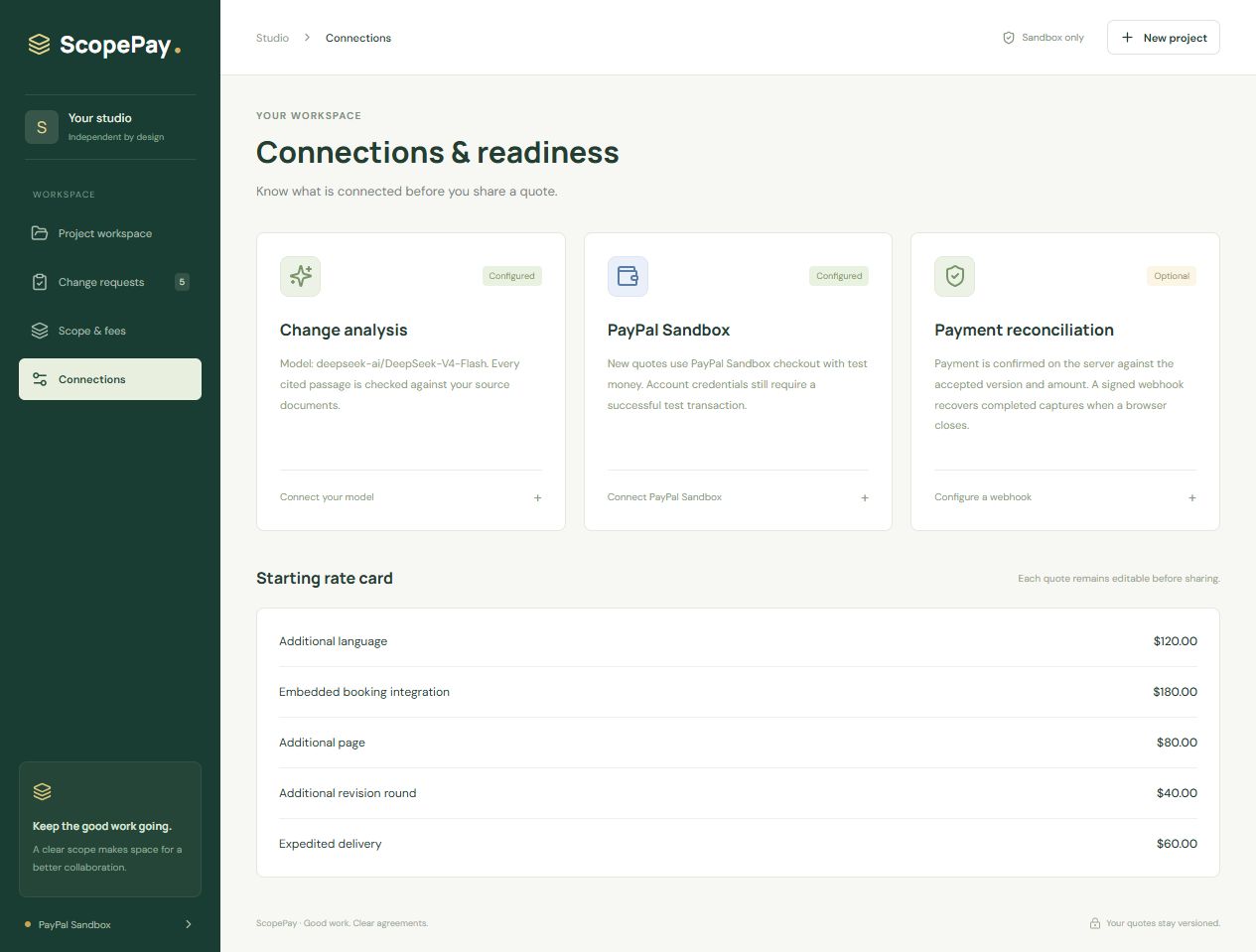
Real model and PayPal Sandbox configured. Credentials remain server-side; the optional public webhook is not configured.
-
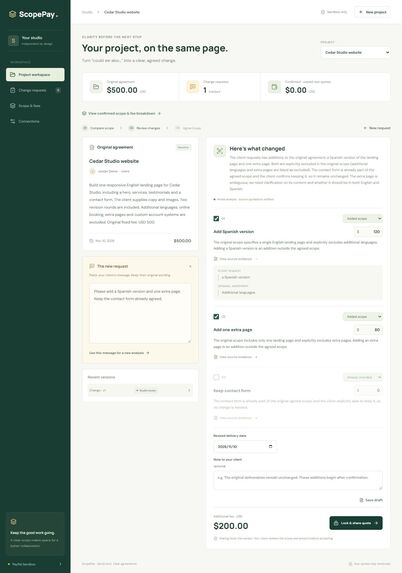
Real model analysis with exact-source evidence. Proposals remain subject to human review.
Inspiration
“Could we also add booking?” sounds small, but it may change a freelancer's deliverables, price, deadline, and expectations. The request sits in a conversation, the original scope sits elsewhere, and payment often loses the connection to the exact work being approved.
We built ScopePay AI for independent web developers and designers who need one clear next step: identify the change, resolve uncertainty, agree on a version, and collect its additional fee.
What it does
ScopePay compares the original agreement and previously confirmed additions with a new client request. A language model proposes added, changed, already-included, or unclear work, citing exact source passages. The server rejects fabricated quotations and malformed results; citations support human review rather than proving that a model's interpretation is correct.
The freelancer reviews classifications, prices and delivery dates. Classification corrections retain the initial model category and require a reason. Included work cannot silently acquire a fee. Ambiguous selected items need a clarification before publication.
Publishing freezes the quote. A private client page records acceptance or a revision request for that exact version. Revisions show changed terms, removed work and fee differences; old links cannot accept replaced versions. If another agreement changes the project's baseline, older unaccepted snapshots must be refreshed.
PayPal is central to this workflow: it collects the fee for the specific accepted change, not an unrelated shopping-cart item. The server creates the Sandbox order from the immutable stored quote. It verifies order identity, version fingerprint, reference, completed capture, amount and USD currency before marking the quote paid. Buyer approval alone is not recorded as payment.
No-charge changes have their own confirmation path without checkout. The scope-and-fees ledger separates confirmed value, accepted-unpaid fees, verified Sandbox captures and simulated payments. Markdown/JSON record exports include source evidence, clarification, confirmation, version, activity and payment metadata, with checksums.
How we built it
React, TypeScript and Vite power the studio and client views. FastAPI validates input and transitions; SQLite stores projects, frozen versions, confirmations and activity. The model adapter uses HTTPX with an OpenAI-compatible chat endpoint. The verified provider is SiliconFlow with deepseek-ai/DeepSeek-V4-Flash.
AI suggests interpretations; humans control the scope and fees. Payment amounts never come from client-side input or model-issued payment instructions. A SHA-256 fingerprint binds the published terms. Revisions also link a frozen snapshot of the previous terms. These fingerprints support integrity comparison, not certified signatures or identity verification.
PayPal Orders API provides order creation, approval and server-side capture verification. Retry handling inspects existing orders before recovery; network errors do not blindly create replacement orders. A signed, deduplicated webhook path is implemented as optional recovery for completed captures, but it has not been verified against a public live listener.
Challenges we ran into
The difficult part was not adding a payment button. It was keeping conversation, human decisions, version history and payment consistent when a client asks for a revision, an existing scope changes, checkout is interrupted, or a change has no fee.
We also had to separate three easily confused outcomes: a model-generated suggestion, a client-approved change, and a completed payment. The demo-rule fallback and simulated payments remain explicitly labeled and separate from real model inference and Sandbox transactions.
Accomplishments that we're proud of
We connected real model analysis to a completed PayPal Sandbox workflow. On October 29, a USD 99 test quote reached paid; a subsequent server query returned a COMPLETED order and a capture matching the locked quote and local record. This used test funds, not live money.
The current automated suite has 65 passing tests, covering scope/version gates, exports, quote validation, authorization boundaries and mocked provider/payment failure paths. The TypeScript check and production build also pass. These are engineering checks, not claims of production readiness, model accuracy, or proven market impact.
What we learned
Uncertainty needs a visible place in the product. A useful AI-assisted workflow should let a person inspect the evidence, correct the classification, preserve why the decision changed, and see precisely what the payment covers.
We also learned to keep accounting language honest: an agreed project value is not revenue, Sandbox captures are test money, and simulated payments are not transactions.
What's next for ScopePay AI
Validate the workflow with a small number of consenting freelancers using anonymized change requests. Improve the review experience based on their feedback, then add operational safeguards such as backups, retention controls and multi-studio isolation before considering production use.
The current scope is deliberately narrow: one studio, USD change fees and typed confirmations. It does not offer escrow, certified electronic signatures, legal guarantees, automated dispute resolution or production money movement.
Demo and screenshot notes
Cedar Studio and Northstar are separate synthetic cases. Cedar shows live model analysis and version review, not a completed payment. Northstar shows the verified USD 99 PayPal Sandbox capture; this is test money, not production revenue. The Chinese booking item means "Online consultation booking". Its explanation means: "The original agreement explicitly excludes booking integrations. This is a new request requiring a separate review of fees and implementation details."
AI coding assistance was used in development. The real model integration is SiliconFlow, not an OpenAI-hosted model. Optional webhook code has automated coverage but no public listener was live-verified.
Hosted judging build and latest verification
Hosted build: https://47.79.243.86:18080
Public MIT-licensed source and English judging guide: https://github.com/huanglianggit/scopepay-ai
On November 2, the hosted build passed HTTPS and owner-access checks, real SiliconFlow analysis, Sandbox OAuth, 34 public API regression checks, and cancellation/retry checks. A separate clean installation passed all 65 automated tests and the production build. Unit-test provider failures are mocked, not live-provider edge-case validation. The entrant then completed the hosted Harbor version 2 USD 12.00 Sandbox purchase. A separate server-to-PayPal order read verified the COMPLETED order and capture, exact locked quote reference/fingerprint, amount and USD currency. All 24 follow-up checks passed, including persistent paid state, exactly one paid audit event, Sandbox-only ledger totals and matching client/owner exports. This is separate from the historical October 29 capture, and all funds are test funds.
The studio access code is supplied privately to judges, not in this public story. All examples are synthetic. In the hosted Spanish example, "Versión en español de la página de aterrizaje" means "Spanish version of the landing page"; the reviewed clarification is in English.
Built With
- fastapi
- paypal
- python
- react
- siliconflow
- sqlite
- typescript
- vite

Log in or sign up for Devpost to join the conversation.