-
-
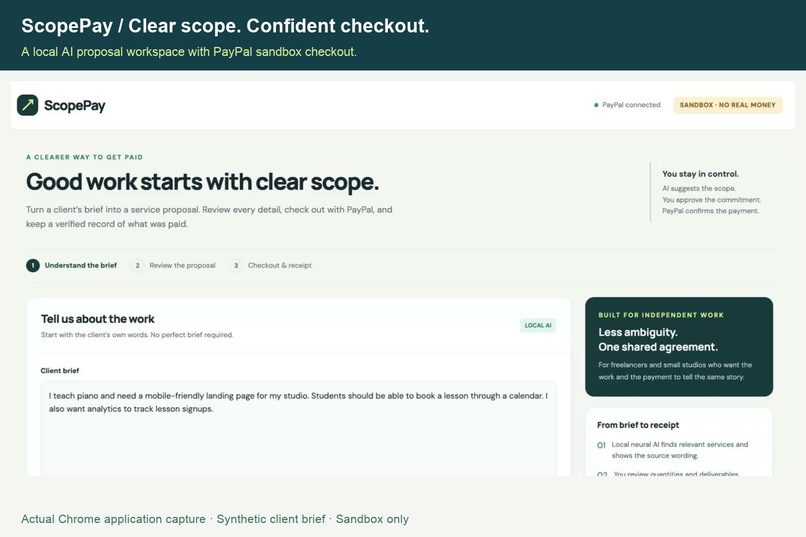
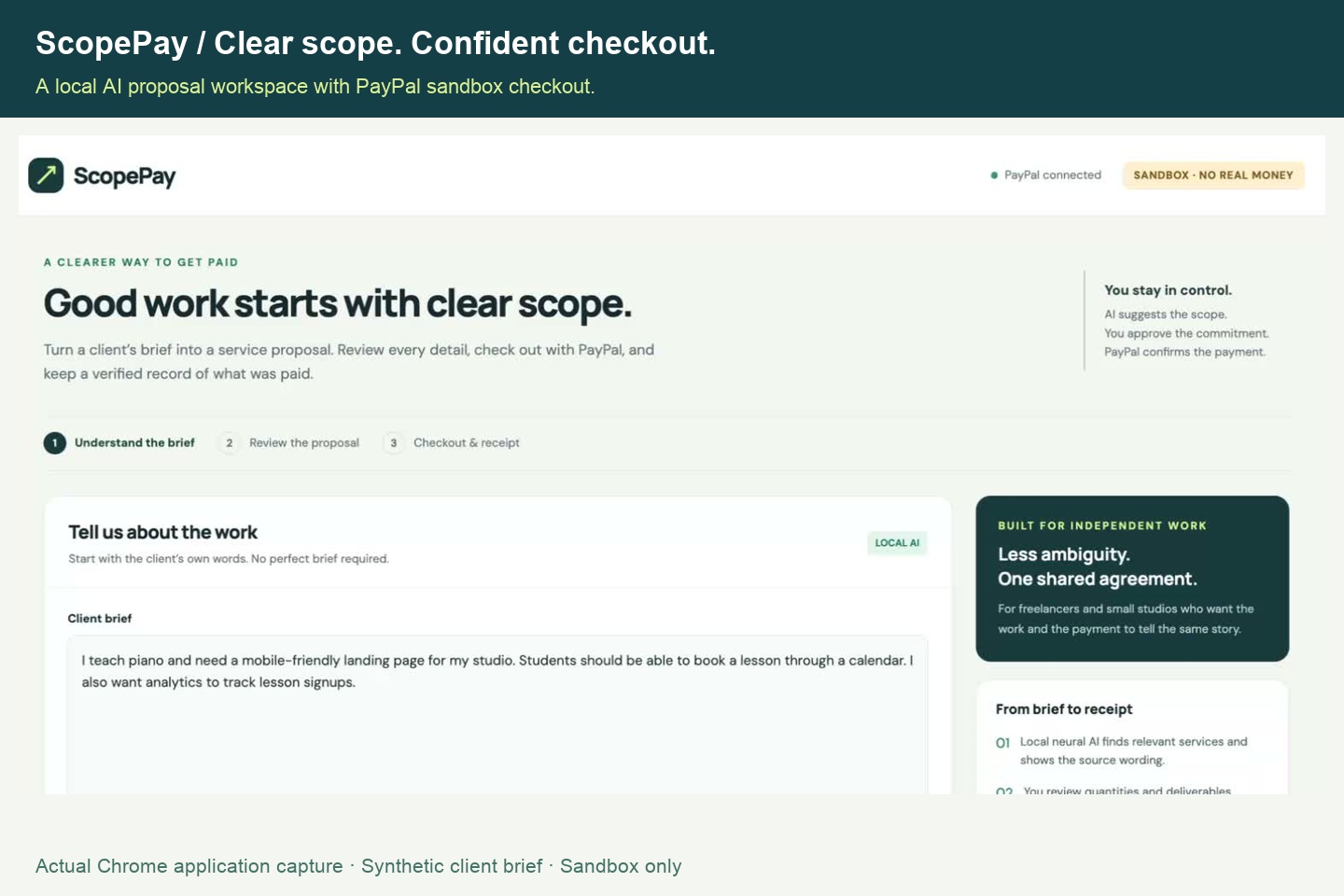
Actual Chrome application: a synthetic piano-studio brief enters a local AI proposal workflow. Sandbox only.
-
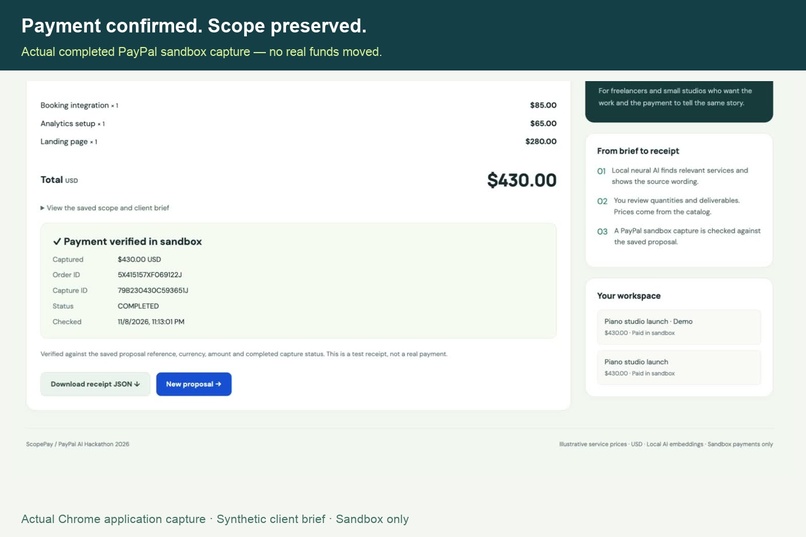
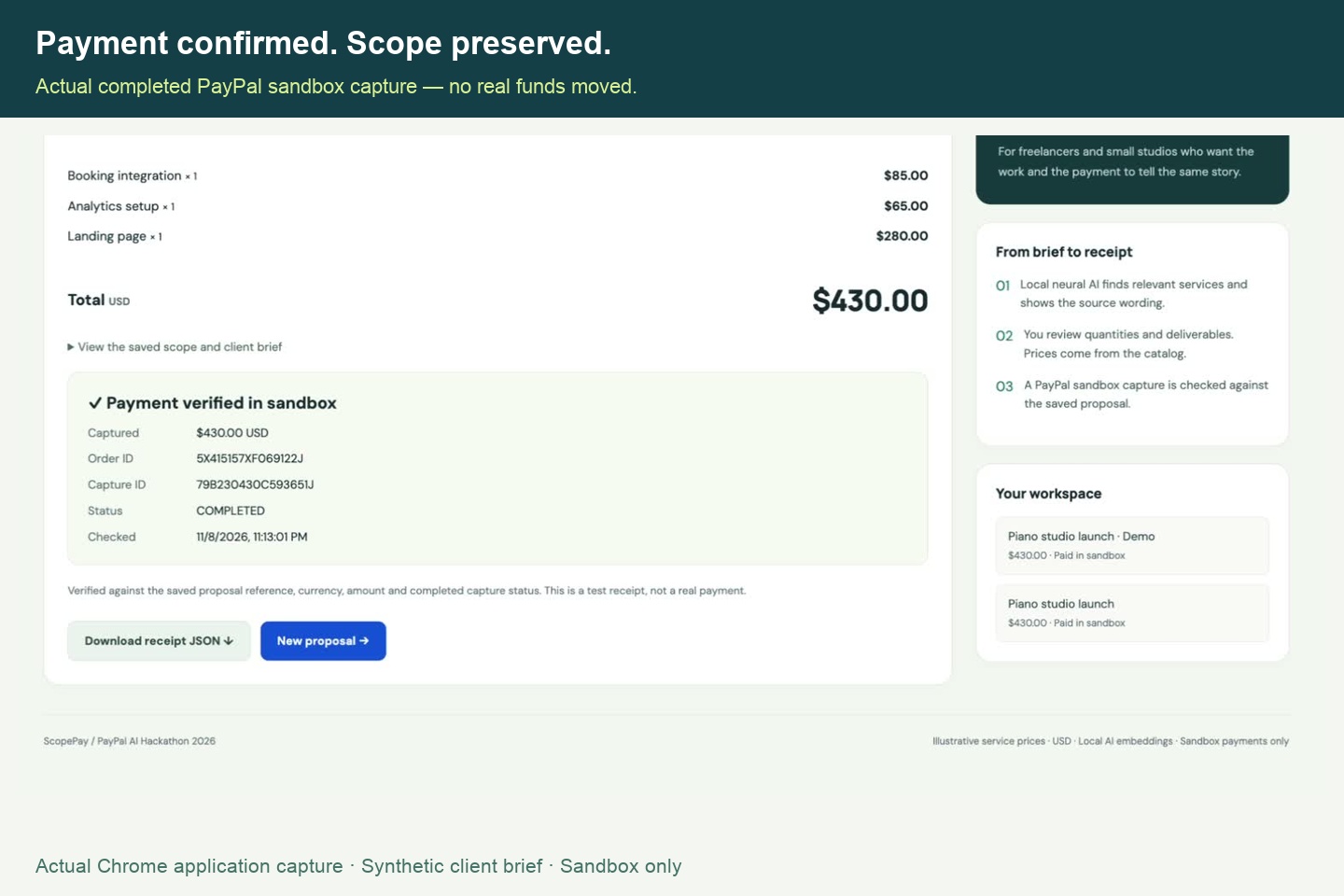
Actual completed PayPal sandbox capture reconciled against the reviewed proposal. No real funds moved.
-
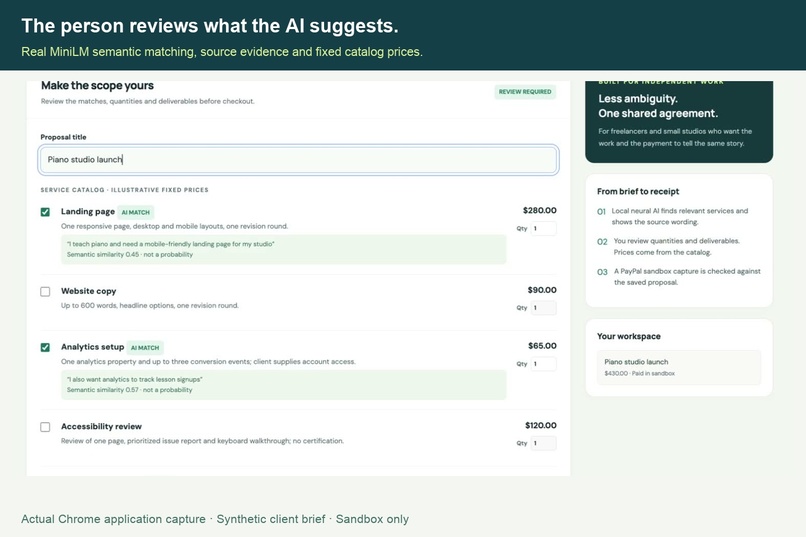
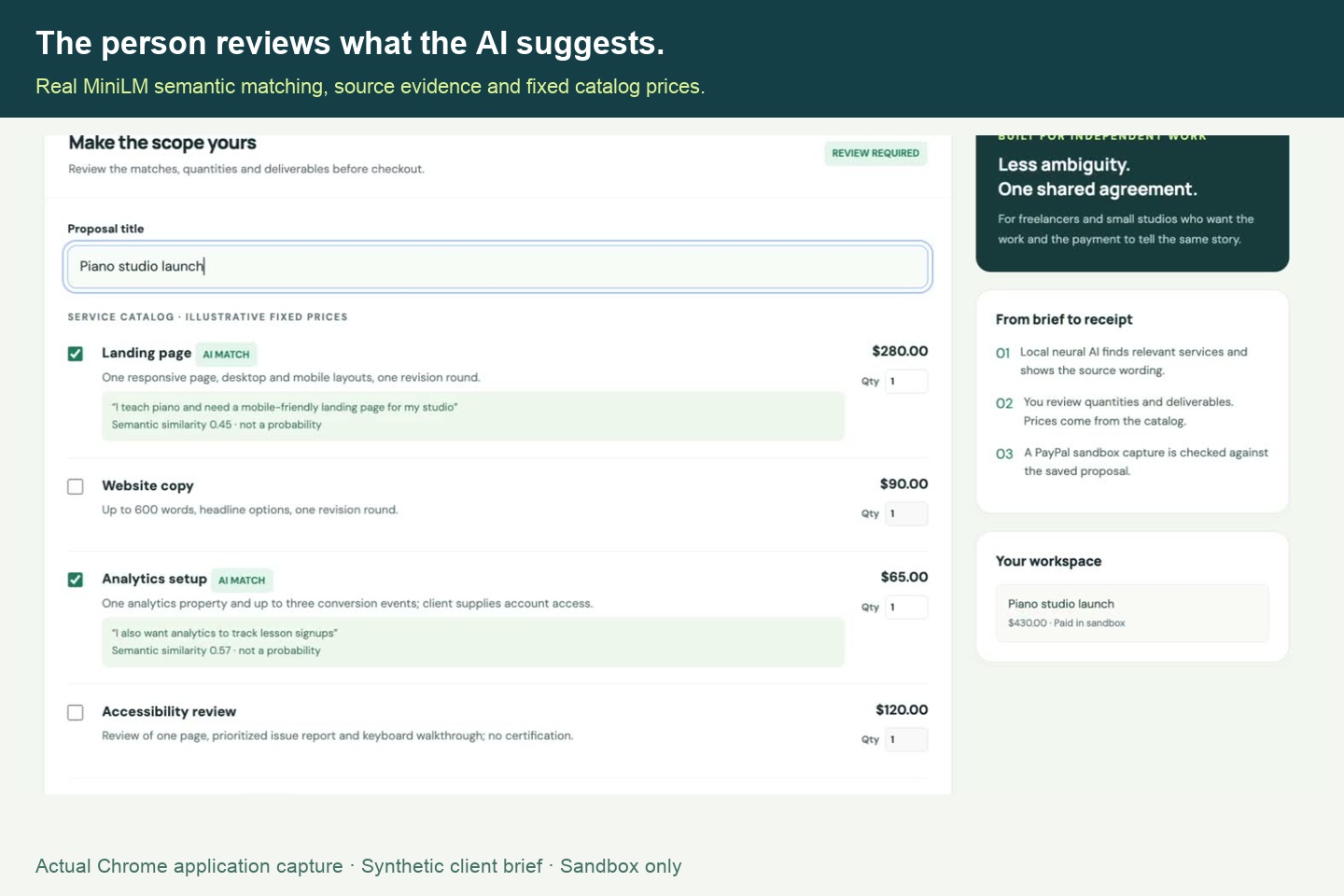
Actual local MiniLM matching with source evidence. A person reviews catalog services and quantities before saving.
Inspiration
A freelancer can agree on a price before both sides agree on the work. ScopePay explores a more explicit handoff: understand the request, review a concrete service scope, then keep the payment tied to that saved scope. The piano-studio example is synthetic; we do not claim interviews or a real client pilot.
What it does
Paste a client brief. A local neural model suggests services from a six-item illustrative catalog and shows the exact source sentence behind each match. Review the selections, quantities and deliverables, then save a fixed proposal snapshot. In the example, a landing page, booking integration and analytics total $430.00 USD in test funds.
Create an itemized PayPal sandbox order, approve it as a generated personal sandbox buyer on PayPal's official checkout, then return to explicitly verify and capture it. ScopePay checks the completed capture against the proposal reference, currency and exact amount before displaying a paid test receipt. Records survive reload and can be reopened; a JSON receipt includes the reviewed scope and capture identifiers. A return URL or pending order never counts as payment.
How we built it
The original application was created during the submission period using Node.js, browser JavaScript, HTML/CSS, Transformers.js and ONNX Runtime. The quantized MiniLM sentence model runs locally on CPU. Cosine similarity retrieves a nearest catalog service for each sentence; the UI shows evidence and scores rather than hiding the matching process. This is semantic retrieval, not generative AI. Review prompts are fixed, and AI does not invent prices, quantities or deadlines.
PayPal is central: server-side sandbox OAuth2, Orders v2 create/get/capture, itemized server-priced orders, buyer approval and capture reconciliation. Persisted PayPal-Request-Id values protect retries. Browser workspaces use random HttpOnly cookies; mutations check Origin and session CSRF tokens. Credentials stay in ignored server configuration, never the public source or browser UI.
Challenges and lessons
Broadly related website services initially matched the same sentence. Restricting suggestions to nearest sentence matches reduced that over-selection; people still review every item, since semantic matching can misunderstand negations or multiple requirements. We also separated payment approval from proof of payment: only server reconciliation may issue a receipt, and a cancelled or pending checkout stays unpaid.
What we verified
Five tests passed, including real local-model paraphrase matching, invalid input, server-owned pricing and capture/reference/currency/amount validation. HTTP checks covered origin/CSRF enforcement, per-browser ownership, review requirements and invalid quantities. Two genuine PayPal sandbox buyer approvals and captures completed, each for $430.00 USD simulated funds. Native Chrome checks covered the full flow, refresh recovery and receipt download. Repeated reconciliation returned the same completed capture. We independently extracted the source ZIP, ran npm ci and passed all five tests again. A 390-pixel Chrome emulation view was checked; this was not physical-phone testing.
Run it
The public repository contains ScopePay-source.zip, the canonical complete editable source tree, plus a detectable MIT LICENSE, verification notes and disclosure. Download and extract the ZIP, enter ScopePay/, run npm ci, copy .env.example to .env, add your own free PayPal sandbox client ID/secret, run npm run warmup, then npm start. Open http://localhost:4317 and follow the complete README walkthrough. Obtain a personal test buyer from the official sandbox dashboard. No shared private credentials or publicly hosted server are needed; local setup is allowed by the competition rules.
Limits and next steps
This is a single-computer sandbox prototype. There are no live payments, webhook listener, tax/refund/dispute features, customer-sharing accounts, real-client pilot or measured business benefit. The first model download requires internet. Next steps are validating the workflow with freelancers, broader catalog/negation evaluation and authenticated customer sharing before considering production payment support.
AI, source and media disclosure
AI coding assistance helped implementation, debugging, tests, documentation, demo assembly and submission copy. The participant requested end-to-end execution and personally handled account login and final entry confirmations. This project's app code and concept are new; existing Node/Python/Pillow/FFmpeg development infrastructure and third-party dependencies are disclosed in the repository. Original code is MIT licensed; dependencies keep their own licenses.
The 2:13 demo uses genuine native Chrome-window recordings at normal speed, explicitly labeled application stills, English captions and synthetic macOS Daniel narration. No generated feature footage, real-money payment, microphone recording or copyrighted music is presented.
Source and setup: https://github.com/Tomhao10225101490/ScopePay-PayPalAI
