-
-
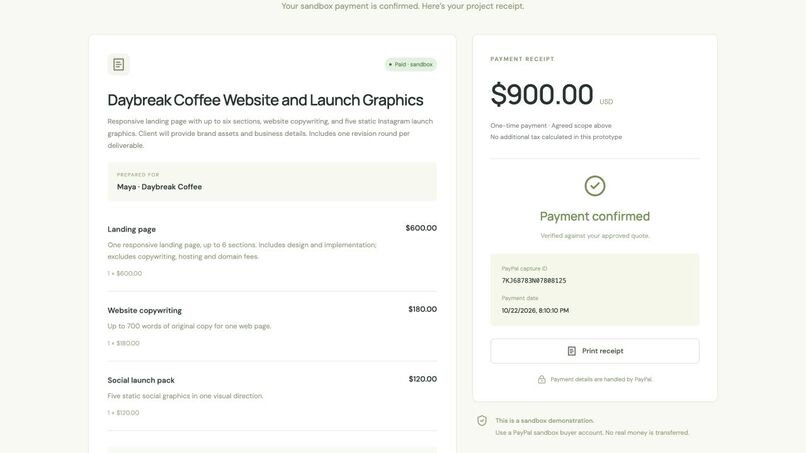
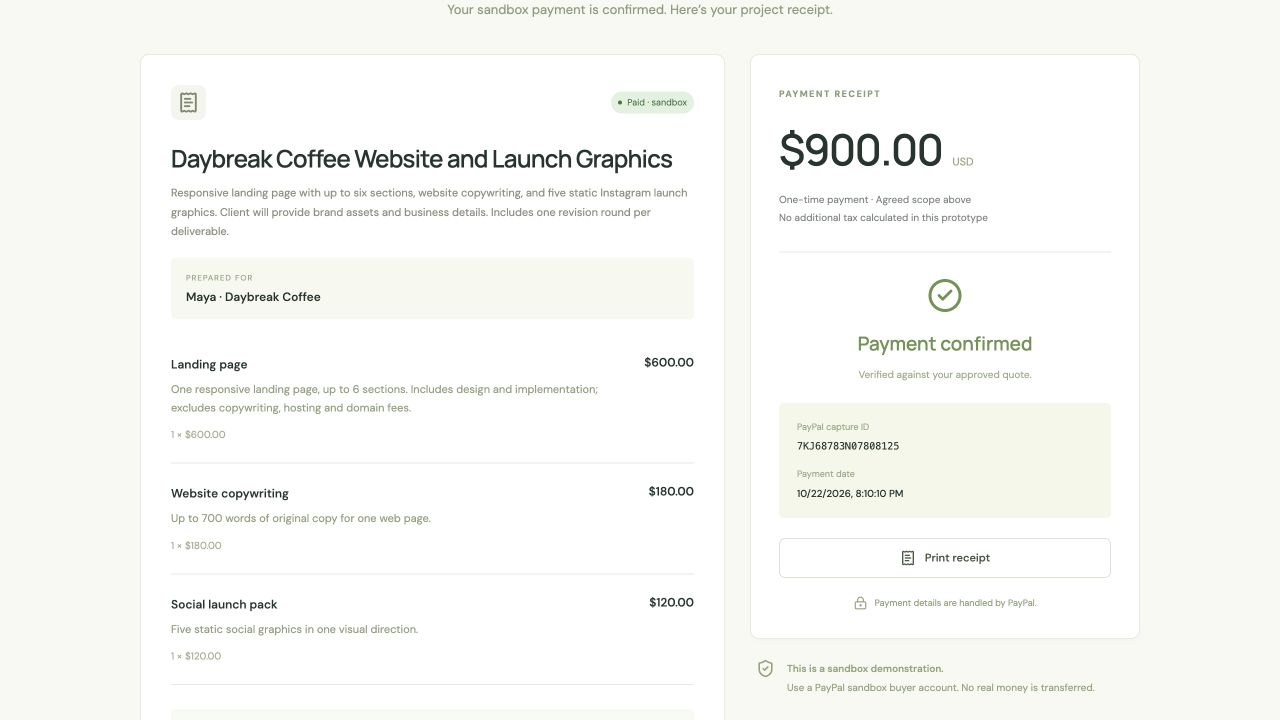
The same AI quote completes one $900.00 USD PayPal sandbox capture, and the application displays the verified receipt.
-
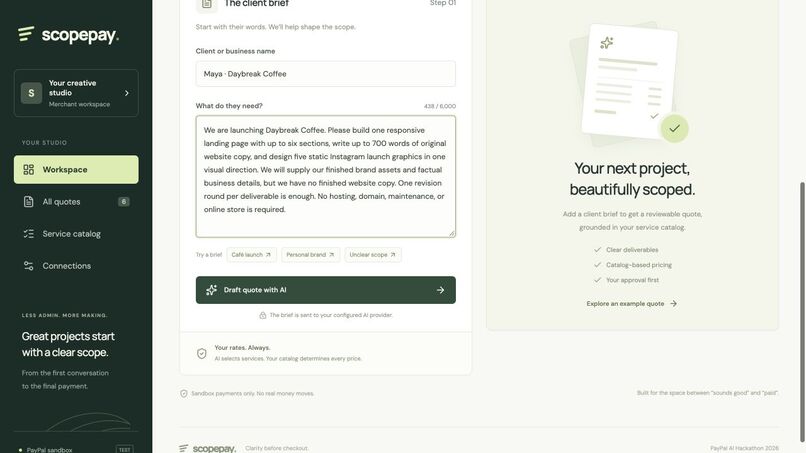
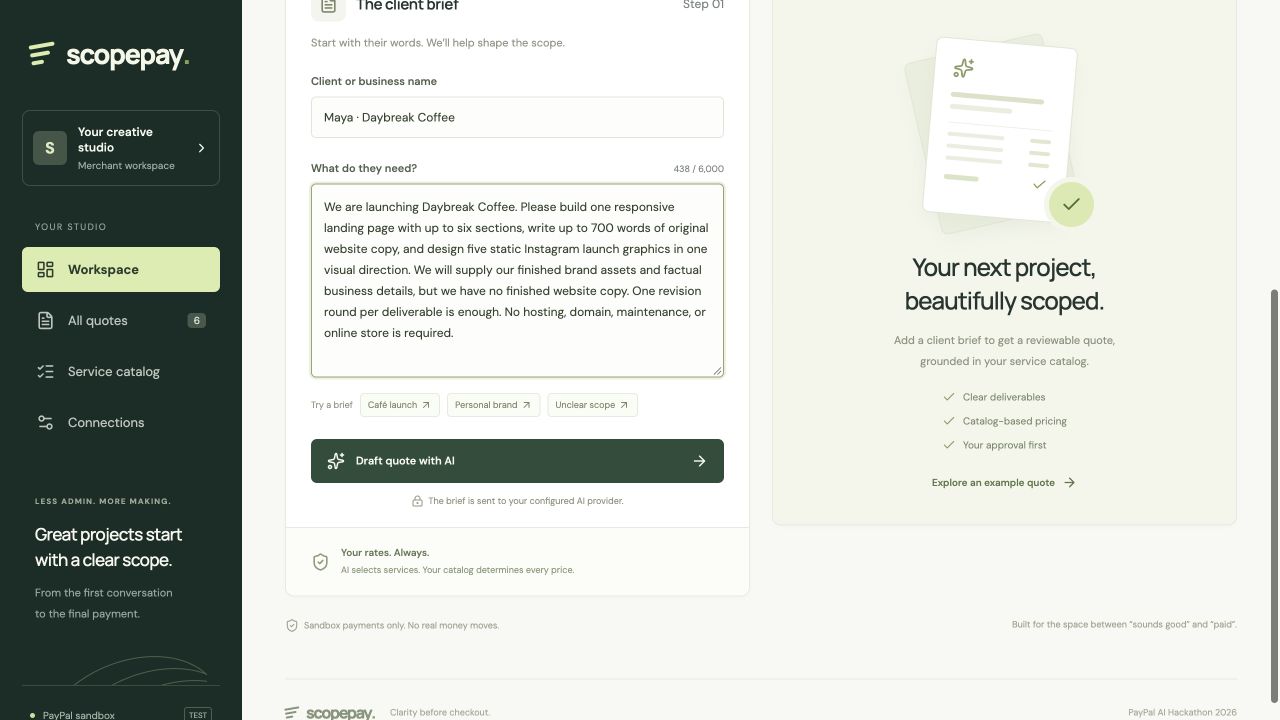
The recorded client brief: one landing page, original copy, five graphics, and one included revision per deliverable.
-
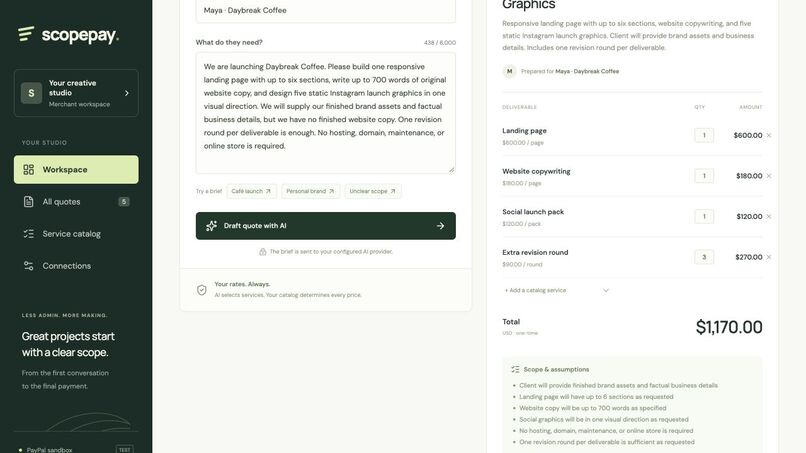
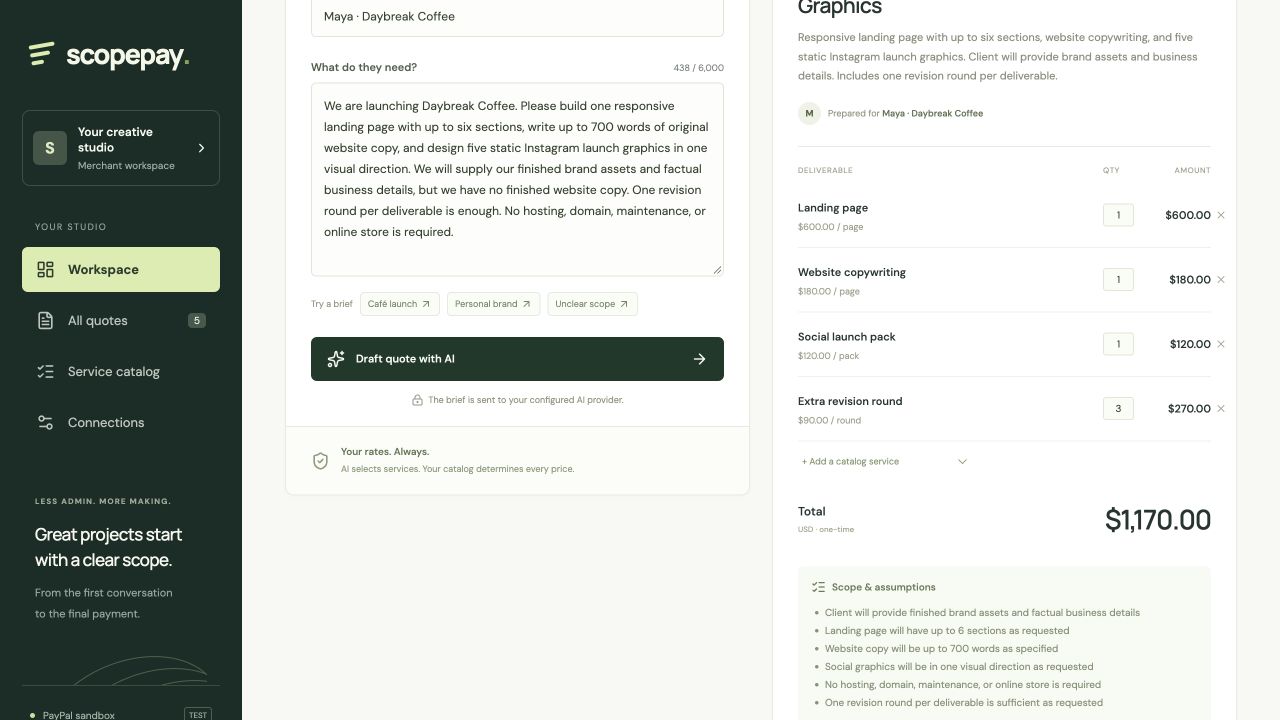
Real Qwen output includes three unnecessary extra revision rounds, producing a $1,170 draft before merchant review.
-
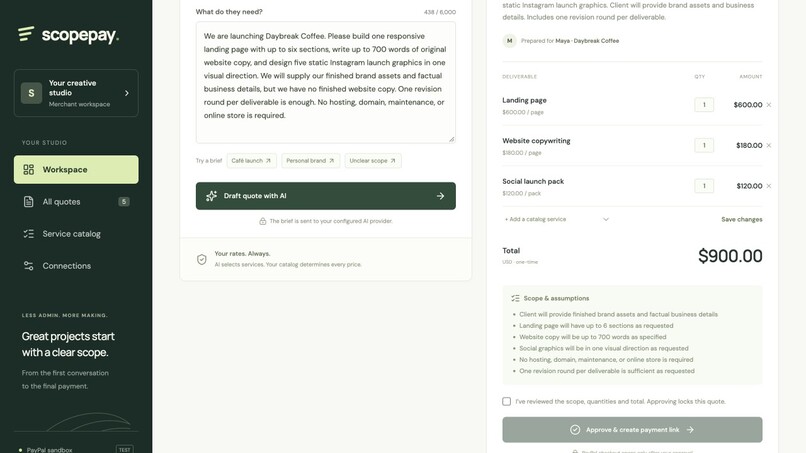
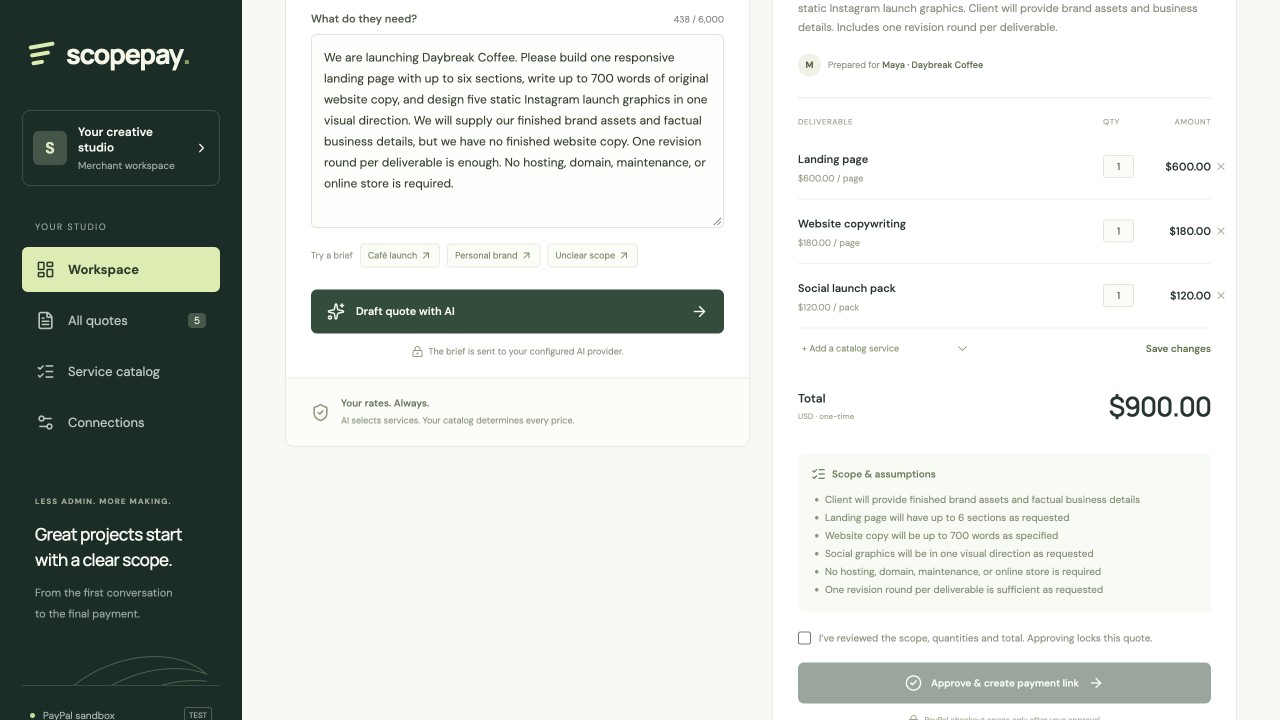
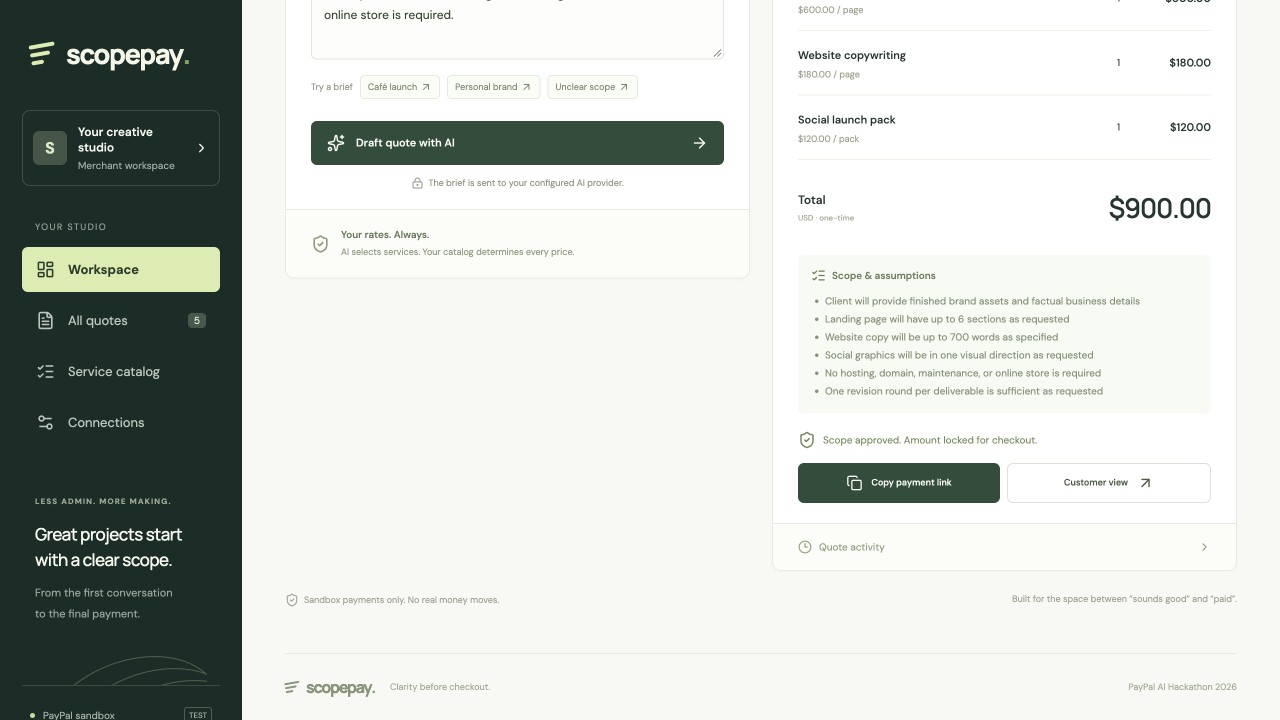
The merchant removes the extra-revision line. Catalog pricing recomputes the reviewed quote to $900.
-
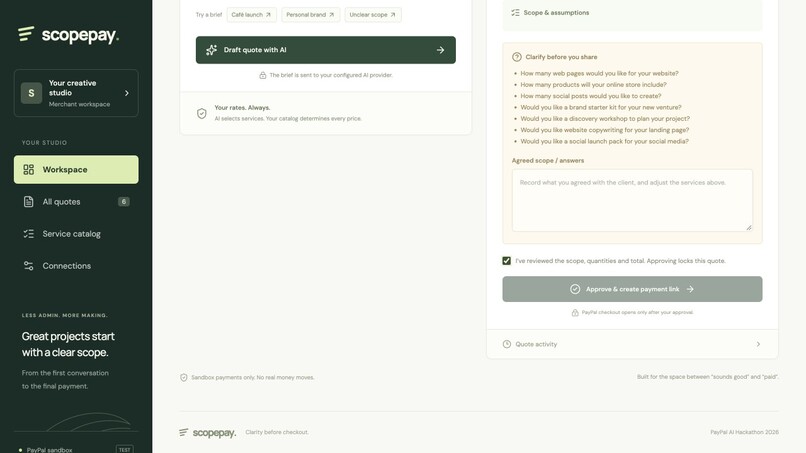
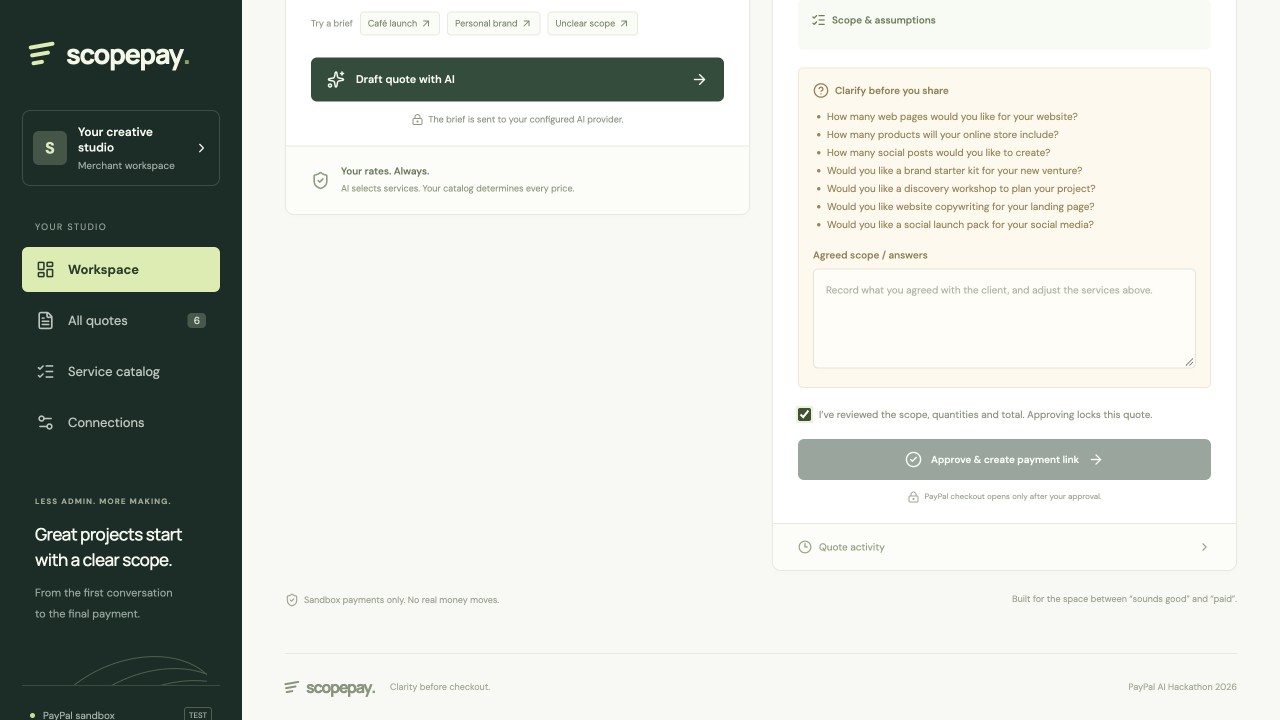
An unresolved request produces questions and no priced items. The approval button remains disabled.
-
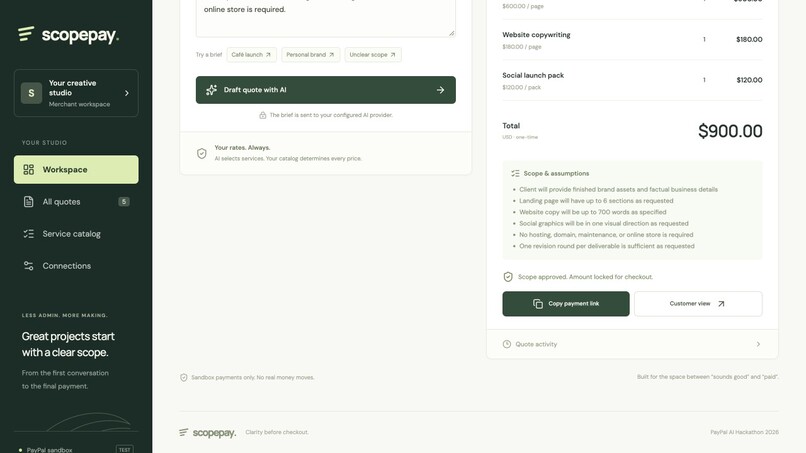
Approval locks the reviewed scope and creates the dedicated customer link.
-
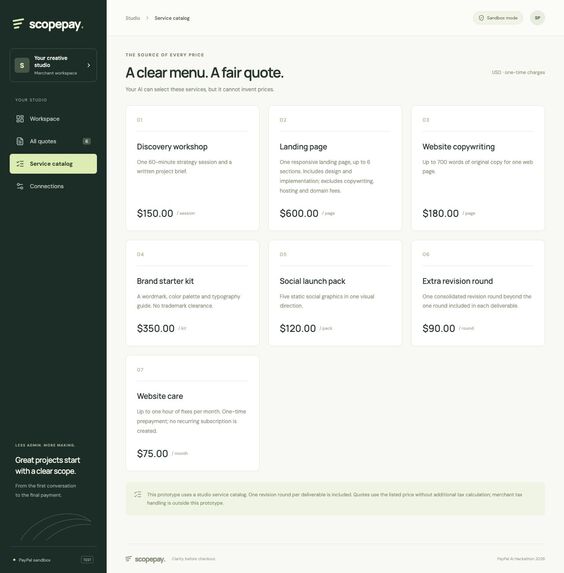
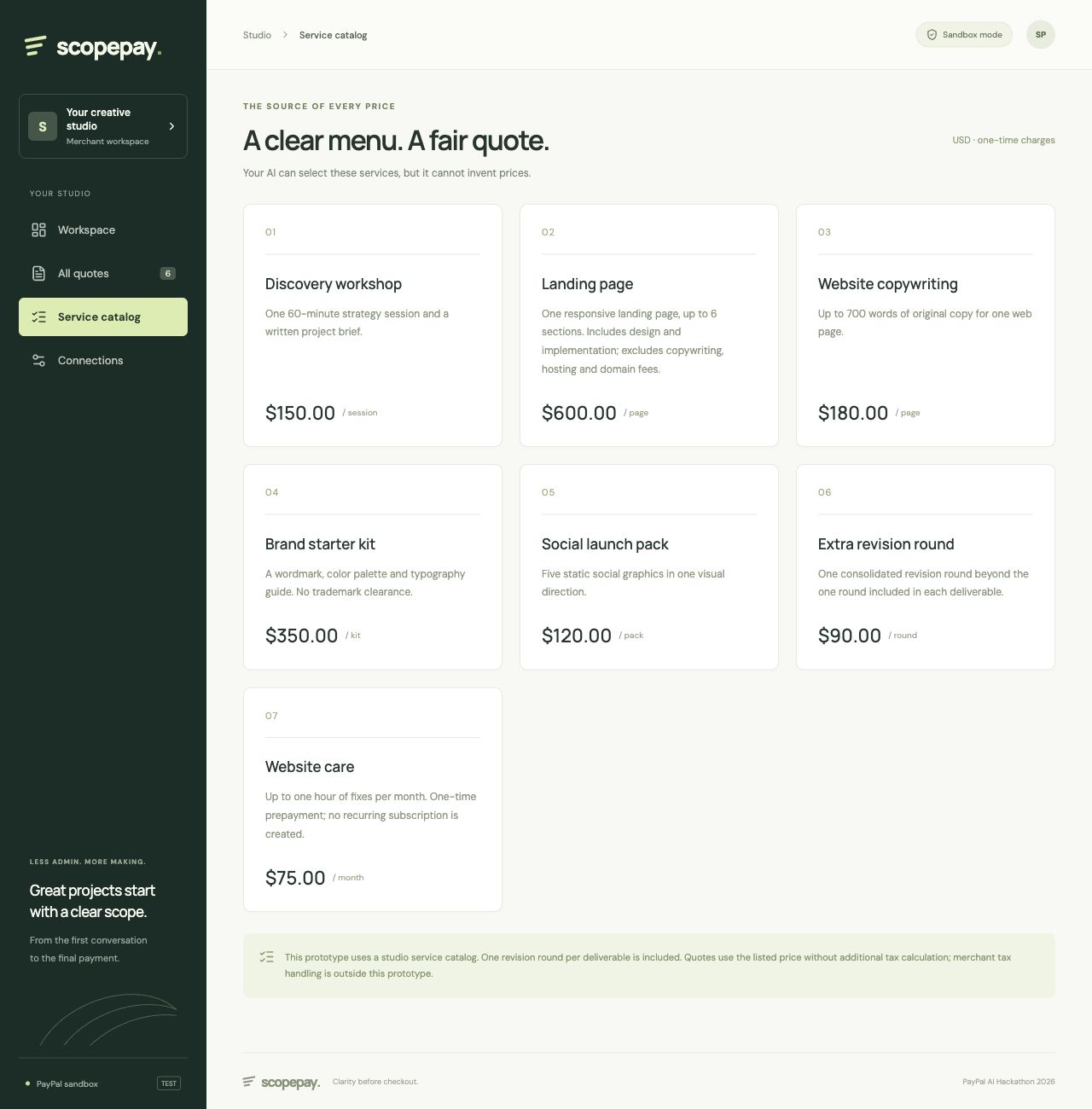
The studio catalog supplies the services and fixed prices used by the server.
Inspiration
For small creative studios, getting paid starts long before checkout. A message such as “we need a website and some social posts” has to become a specific agreement: what is included, how much work it represents, and what it costs. Ambiguity at this step can turn into revisions, awkward conversations, and delayed payment.
We wanted to shorten that gap while preserving the merchant's judgment. ScopePay uses AI to structure the request, a service catalog to determine the price, and PayPal to complete the payment journey.
What it does
The merchant enters a client's brief. ScopePay proposes catalog services, quantities, assumptions, and questions about missing or unsupported scope. It calculates an itemized quote from fixed prices, then asks the merchant to review it.
The merchant can adjust quantities, add or remove services, and document agreed clarifications. Approval locks the scope and creates a customer link. The customer sees the deliverables and total before continuing to PayPal sandbox. The app displays a receipt only after the server verifies a completed capture against the approved quote.
The merchant workspace also provides a quote list, a service catalog, integration status, and an activity history for each quote. Both merchant and customer views adapt to mobile screens.
How we built it
We built the interface with React and Vite, using locally bundled typography and Lucide icons. A Node.js server stores quotes and payment state in SQLite.
The local AI integration uses Qwen through llama.cpp with schema-constrained JSON over an OpenAI-compatible Chat Completions endpoint. An Anthropic Messages adapter is also available. The model first classifies the scope as ready or requiring clarification. The output schema prevents clarification responses from including priced service lines, and Zod independently validates every response. The model can propose service IDs and integer quantities; the server resolves them against the catalog and computes prices in integer cents. The model has no payment tool or authority to approve a quote.
PayPal is central to the workflow. The backend authenticates through sandbox OAuth, creates Orders v2 checkout orders for the locked quote, redirects buyers to PayPal, and captures approved orders on return. Persisted idempotency keys, per-quote operation locks, and strict reference/amount verification protect the application against replay and mismatched payments.
Challenges we ran into
The important boundary was between a plausible AI suggestion and a payable agreement. In the recorded run, Qwen added three extra revision rounds even though one round per deliverable was already included. The merchant removed that $270 line before approving the $900 quote. This correction is visible in the demo because it shows why review is a necessary product step.
We separated those states explicitly: AI can draft, the merchant can approve, and the payment server can verify settlement. Unsupported or unclear scope becomes a question to resolve. Schema validation limits the shape of a response; it does not guarantee that its interpretation of the brief is correct.
Payment retries also need careful state handling. A browser can refresh, cancel checkout, or fail to return after approval. We persist request identities before external calls and check existing PayPal order status before retrying a capture.
Accomplishments we're proud of
- A single workflow connecting a natural-language brief, a reviewed scope, and a PayPal checkout.
- Catalog-based amounts that do not depend on model arithmetic.
- Explicit handling of unclear scope and merchant approval.
- A dedicated customer view that does not expose the raw brief or internal payment state.
- Automated coverage for amount tampering, replay, invalid payment references, missing approval, and authentication.
- A real local Qwen draft carried through merchant correction and a completed PayPal sandbox capture on the same quote.
What we learned
AI is more useful here when it has a narrow responsibility: help translate a request into a reviewable scope. The merchant remains responsible for the agreement, and payment status comes from PayPal. Separating those responsibilities makes the overall product easier to explain, inspect, and test.
What's next
We would add merchant-editable catalogs, quote revisions with client acceptance, webhook reconciliation, and small-studio user testing. We would measure scope-editing time and correction rates before claiming any productivity improvement. Production tax, refund, and dispute requirements would need their own implementation and review.
Built With
- javascript
- llama.cpp
- node.js
- paypal
- qwen
- react
- sqlite
- vite
- zod

Log in or sign up for Devpost to join the conversation.