Inspiration
Every freelance web designer knows the message: "Could we just add one small thing?" Saying yes means working for free. Saying no means an awkward argument about what was agreed. Most freelancers don't have a contract lawyer, a billing system or a project manager to settle it. ScopePay is the tool I wanted for that moment.
What it does
ScopePay turns a "small extra" client request into an approved, paid and scheduled change.
- Review a request. Paste the client's message. AI checks it against the agreed scope and marks each item Included, Additional work or Needs clarity, quoting the exact scope sentence it relied on.
- Send a proposal. For extra work, the hours and extra days are suggested, the price comes from your hourly rate, and the client gets a private link.
- Client approves and pays. The client sees the price and the new delivery date, approves, and pays with PayPal Checkout.
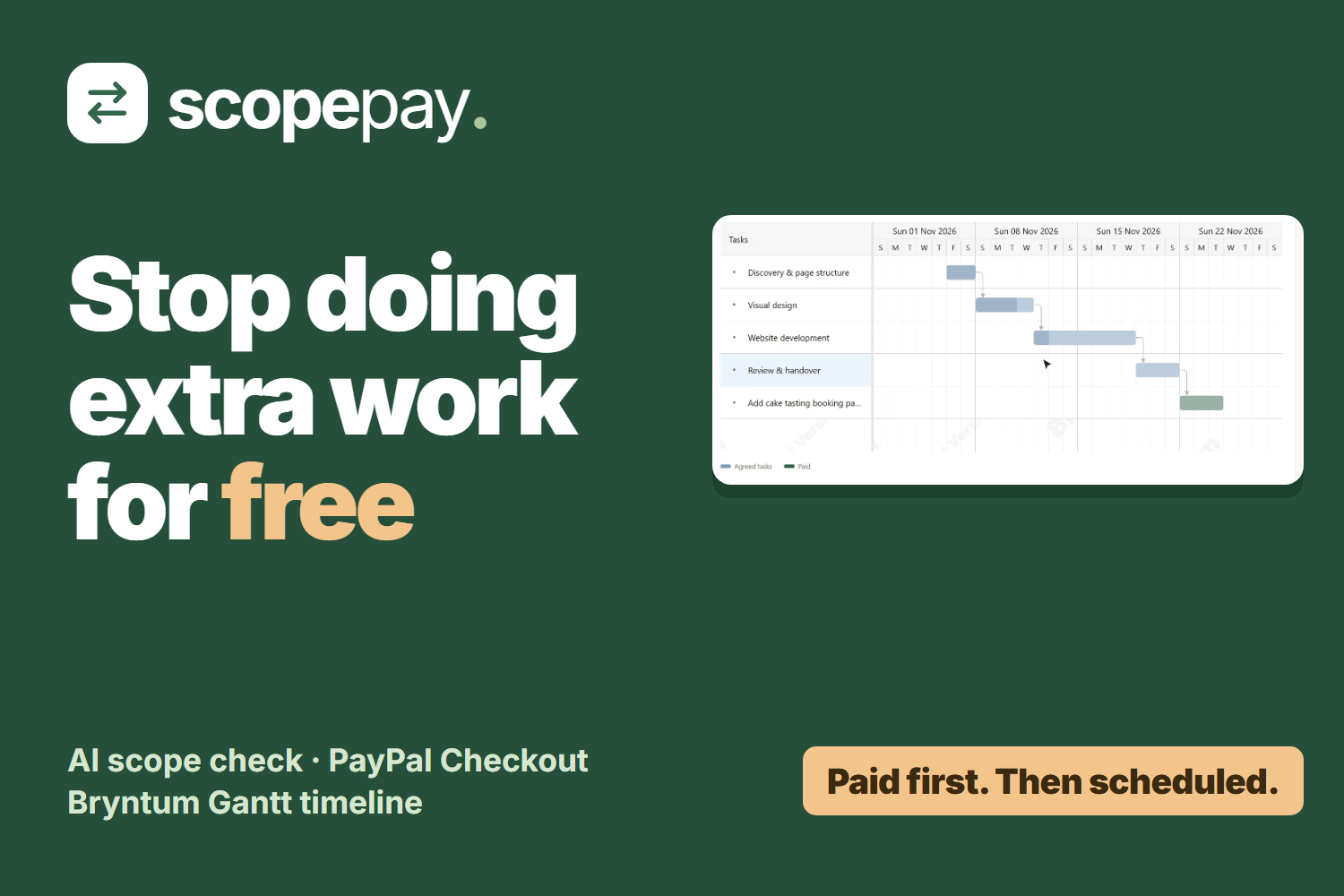
- Work unlocks on the timeline. Until payment, the new task sits on the Gantt chart locked behind a payment milestone. Once PayPal confirms the payment, it is scheduled and the deadline moves.
You never start work you weren't paid for.
How I built it
- Next.js 16, React 19 and TypeScript for the app, with Zod validating every input.
- Groq for the scope analysis, using a strict JSON schema so the reply is always structured.
- PayPal Orders API (Sandbox) for checkout. The client pays on PayPal and is returned to their proposal page.
- Bryntum Gantt for the timeline. The proposed task appears as a locked task behind a payment milestone, then becomes a normal scheduled task once paid.
- Data is a single JSON file, so anyone can clone the repo and run it with no database and no API keys. Without keys it runs a clearly labelled demo mode.
Challenges
- Stopping the AI from inventing scope. Every Included or Additional verdict must quote the scope word for word. If the quote can't be found in the saved scope, the verdict is downgraded to "Needs clarity".
- Never trusting the browser about money. A payment only counts after it is verified with PayPal: order, amount, currency, seller and proposal version must all match, and a payment is never counted twice.
- Clients approving stale proposals. Revising a proposal replaces its link, and an out-of-date delivery date can't be approved.
- Making the Gantt chart tell the payment story. Showing "locked until paid" as a real dependency on a payment milestone took more design work than the chart itself.
What I learned
Wiring an AI model into a product is the easy part; deciding what it is not allowed to decide is the real work. I also learned how much trust a payment flow needs on the server side, and how much a timeline helps a client understand what an extra request really costs in days, not just dollars.
What's next
- Measure the AI's accuracy on a reviewed set of real scope cases (not done yet).
- Move from PayPal Sandbox to live payments.
- Support more than one freelancer per workspace.
Built With
- bryntum
- groq
- next.js
- node.js
- paypal
- radix-ui
- react
- typescript
- zod
