
Inspiration
Freelancers working on fixed-price websites often receive extra pages, revisions, and other requests after the original quote. Public Reddit discussions about unpaid additions suggested a practical problem: keeping the original agreement, proposed extra work, and accepted budget easy to distinguish.
ScopeNote turns that problem into one focused workflow for freelance designers, developers, and small studios.
What it does
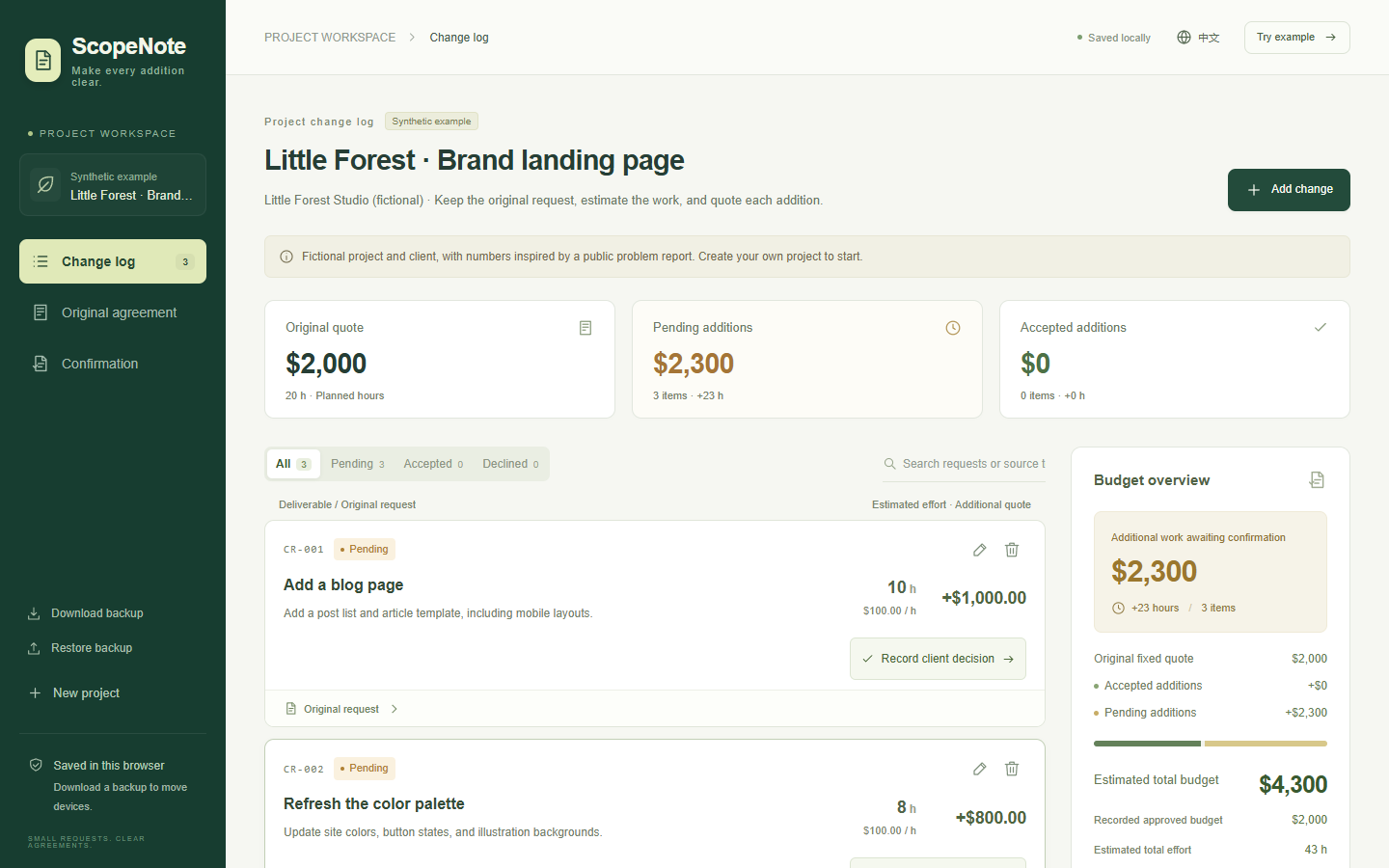
Start with the original agreement and fixed quote. For each addition, record the client's request, the deliverable, estimated hours, and hourly rate. ScopeNote keeps pending, accepted, and declined changes separate and calculates the corresponding budget totals.
A decision received by email, chat, or another channel can be recorded manually with a note. Editing the content or price of an accepted change returns it to pending so the previous decision cannot silently cover a new quote.
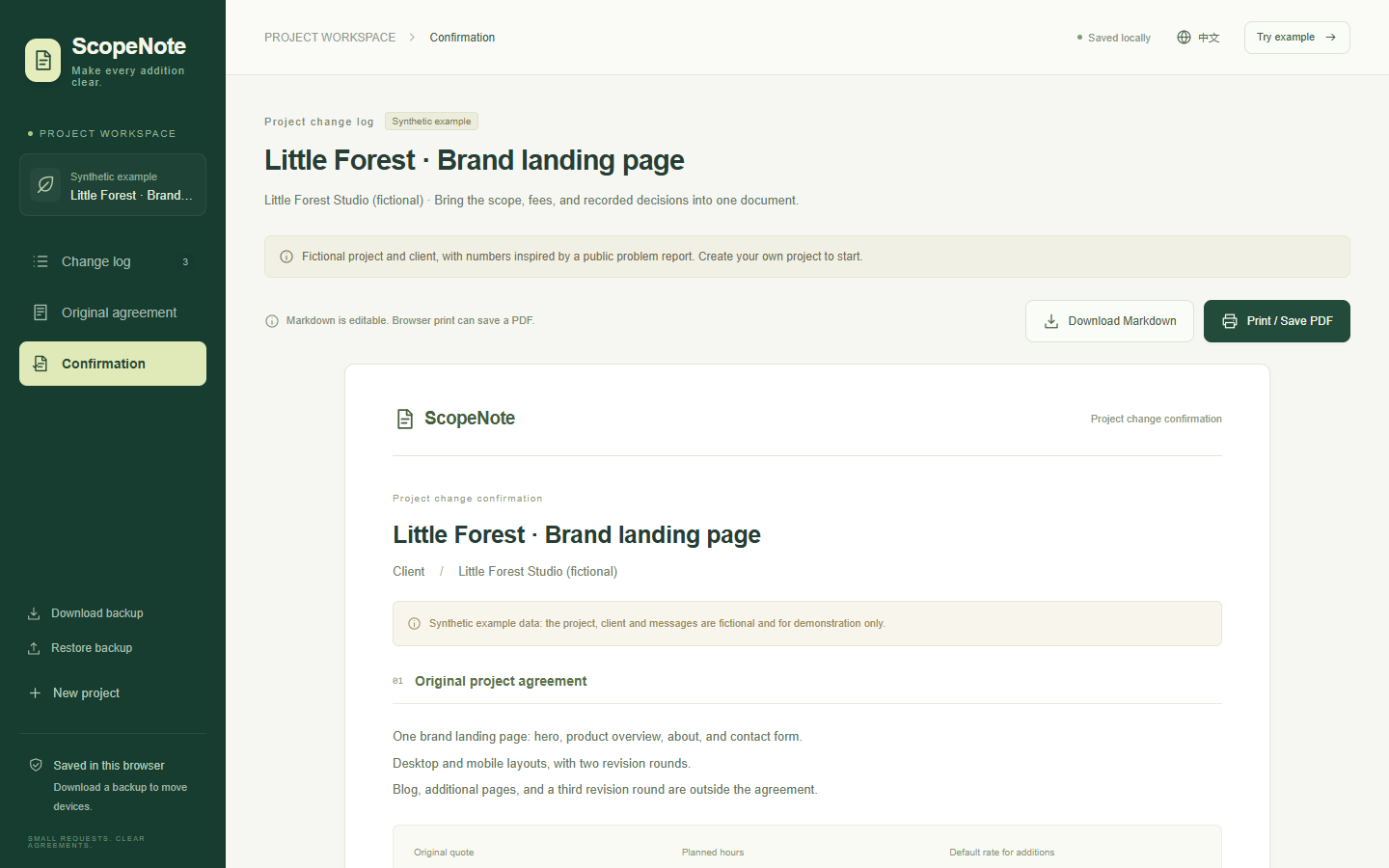
The confirmation view combines the original scope, additions, decisions, and totals. Download it as Markdown or use browser printing to save a PDF. JSON backup and restore support moving a project between browsers or devices. The responsive interface and exported labels support English and Chinese.
The demonstration uses explicitly labeled fictional data: a $2,000 original agreement with $2,300 of pending additions. Recording acceptance of a $1,000 addition raises the recorded approved budget to $3,000 while $1,300 remains pending.
How it was built
This new project was developed during the hackathon with Codex and the official Devpost Learn Skill Pack. The public repository includes the actual scope, PRD, technical specification, build checklist, verification notes, and app map, together with the development history.
The application uses React, JavaScript, Vite, and CSS. A shared calculation module validates amounts and computes both screen and export totals using integer cents. Data is saved in the current browser, and a validated JSON file provides a portable backup. The application runs locally without an account, backend, or API key.
Technical challenges and verification
Key implementation problems included preserving exact monetary totals, rejecting invalid estimates without losing edits, protecting unsaved changes during replacement and undo, keeping accepted edits subject to a new decision, and maintaining a usable mobile layout.
The current application passed 10 domain and export tests, 10 groups of integrated browser checks, and a production build. The English UI video shows the working flow and real exports. Automated checks and participant review are recorded separately in the project documents.
Next steps
The next product step is to gather feedback from freelancers using the full workflow. Shared links and message extraction can then be evaluated against observed needs. The current proof of concept records outside decisions manually and stores one active project per browser origin.
