-
-
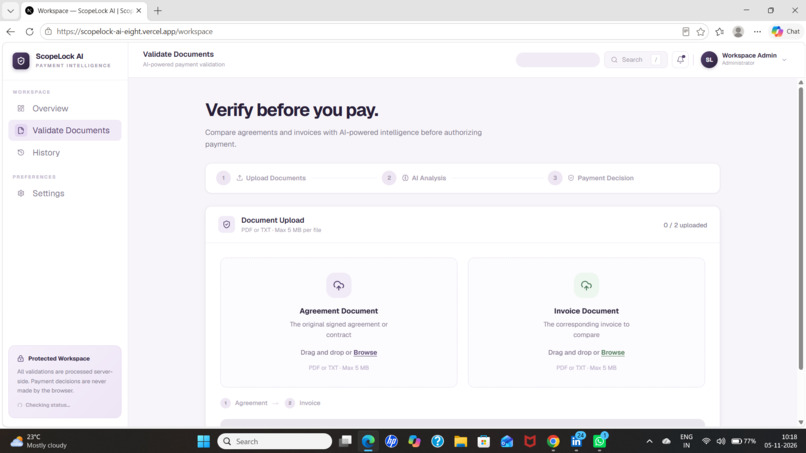
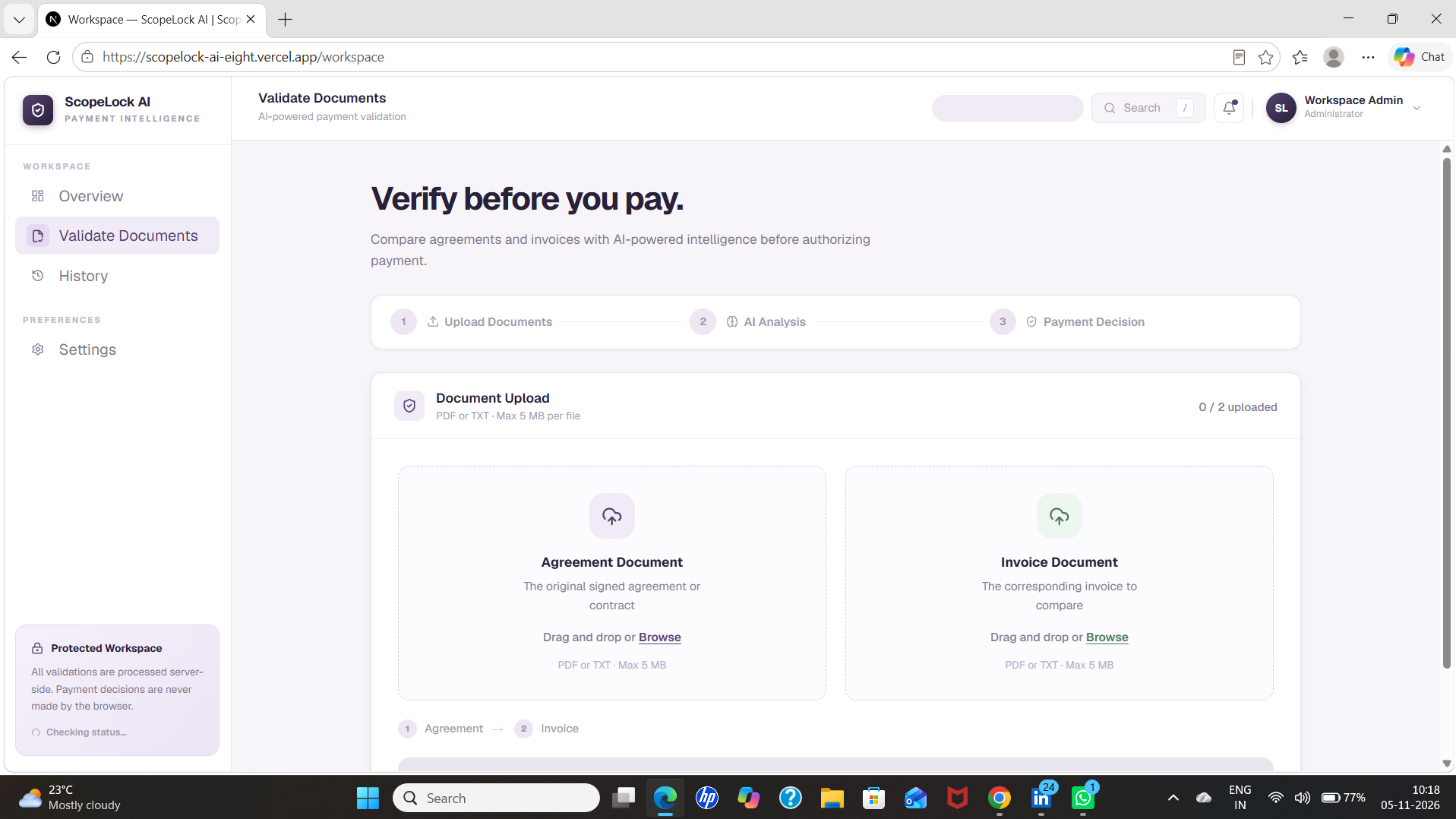
WorkSpace
-
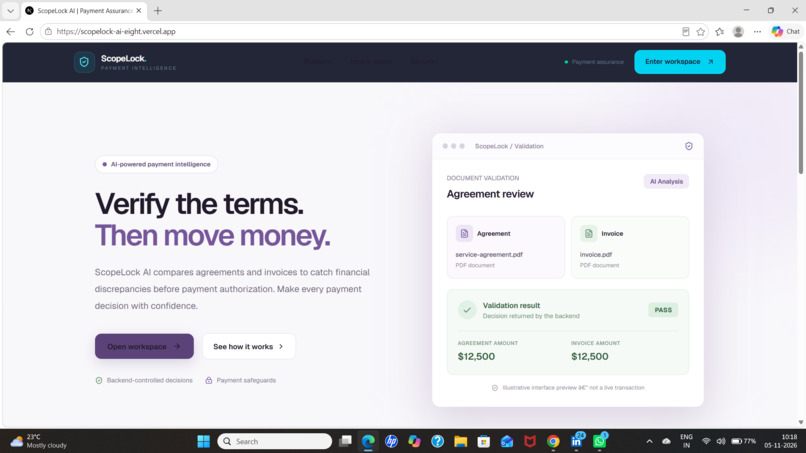
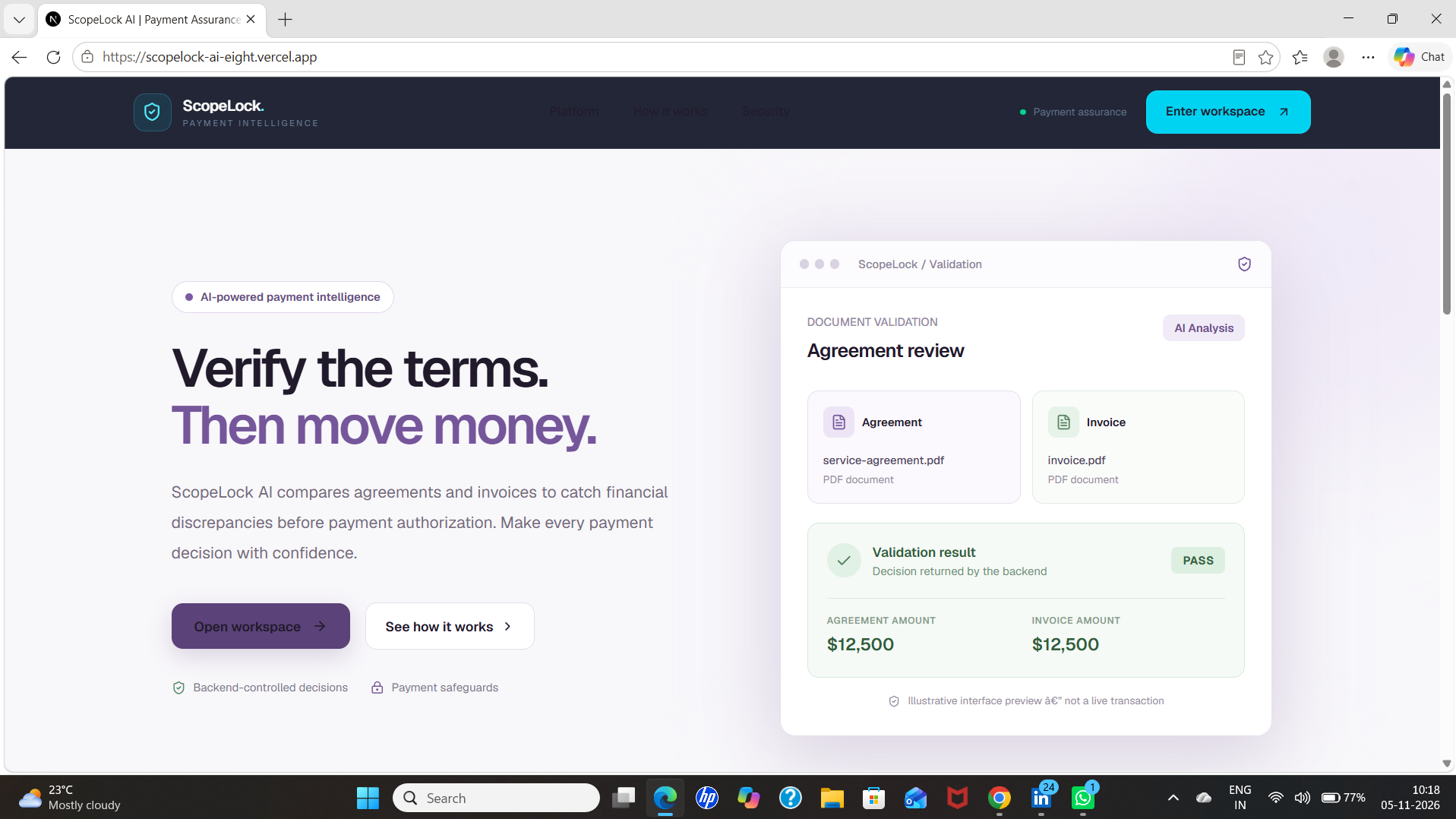
home page
Inspiration
Freelancers, independent developers, and small businesses often work with milestone-based agreements and invoices. However, payment requests do not always match the original agreement. A mismatch in amount, milestone, or payment terms can lead to overpayments, disputes, and financial losses.
We wanted to solve a simple but important problem: What if every payment could be checked against its original agreement before it gets approved?
That idea inspired ScopeLock AI — an intelligent payment validation platform designed to make digital payments safer and more transparent. What it does ScopeLock AI analyzes payment agreements and invoice details to identify discrepancies before a payment is approved.
Key capabilities include:
- AI-powered document understanding: Uses Gemini AI to interpret payment-related information and extract relevant terms.
- Payment validation: Compares requested amounts, milestones, and payment details against expected agreement terms.
- Risk identification: Highlights mismatches and potential payment risks.
- Clear validation outcomes: Provides PASS when details match, BLOCK when critical discrepancies are detected, and REVIEW when additional verification is required.
- PayPal Sandbox integration: Demonstrates a payment workflow where validated payment requests can proceed to PayPal order creation and buyer approval.
- Transaction tracking: Stores payment order details and transaction statuses for traceability.
Our goal is to introduce an additional layer of intelligence and verification before money moves.
How we built it
We built ScopeLock AI using a full-stack architecture combining AI, backend validation, database persistence, and payment integration.
Frontend:
- Next.js
- React
- TypeScript
Backend:
- Python
- FastAPI
- REST APIs
AI Integration:
- Google Gemini API for document understanding and payment information extraction.
Database:
- Neon PostgreSQL for storing payment-related records and transaction information.
Payment Integration:
- PayPal Sandbox REST APIs for creating payment orders, handling buyer approval, and capturing payments.
Deployment:
- Vercel for frontend hosting.
- Render for backend hosting.
A key architectural decision was separating AI-based interpretation from deterministic payment validation. AI helps understand the information, while structured backend rules perform critical consistency checks before a payment proceeds.
Challenges we ran into
Building ScopeLock AI involved several practical engineering challenges:
- Integrating AI document understanding with structured backend validation.
- Handling inconsistent or incomplete payment information.
- Implementing the PayPal Sandbox order creation, approval, and capture workflow.
- Managing transaction states and persisting payment records reliably.
- Configuring frontend-backend communication and production deployment.
- Handling API quota limitations and temporary AI service availability issues.
- Testing the complete workflow across the deployed frontend and backend.
These challenges helped us understand that building a payment-related AI application requires more than generating intelligent responses. Reliability, validation, traceability, and clear transaction states are equally important.
Accomplishments that we're proud of
- Built a working full-stack AI-powered payment validation application.
- Integrated Gemini AI for payment-related document understanding.
- Implemented structured PASS, BLOCK, and REVIEW validation outcomes.
- Integrated PayPal Sandbox payment order creation and buyer approval.
- Implemented backend transaction persistence using PostgreSQL.
- Deployed the frontend and backend publicly.
- Connected AI-based interpretation with deterministic financial validation in one workflow.
We are especially proud of turning a real-world payment trust problem into a functional end-to-end prototype.
What we learned
This project taught us that AI should support critical financial decisions rather than independently control them.
We learned the importance of:
- Combining LLM capabilities with deterministic business rules.
- Designing reliable REST APIs and backend workflows.
- Integrating third-party payment services securely.
- Managing asynchronous payment states and database persistence.
- Debugging real-world deployment, CORS, API quota, and service availability issues.
- Building systems where transparency and traceability matter as much as functionality.
Most importantly, we learned to design AI systems around real user problems instead of simply adding AI as a feature.
What's next for ScopeLock AI – Intelligent Payment Protection
We envision ScopeLock AI becoming a more comprehensive payment protection layer for freelancers, agencies, independent developers, and small businesses.
Our future roadmap includes:
- Support for multiple agreement and invoice document formats.
- More advanced discrepancy detection and risk scoring.
- Improved explanations for every validation decision.
- Secure document storage and audit history.
- Multi-currency payment validation.
- Expanded payment provider integrations.
- Production-ready PayPal integration with stronger security and monitoring.
- A dashboard for tracking agreements, milestones, payment requests, and transaction history.
Our long-term vision is simple: Make every payment informed, verified, and trustworthy.
Built With
- fastapi
- next.js
- typescript
