-
-
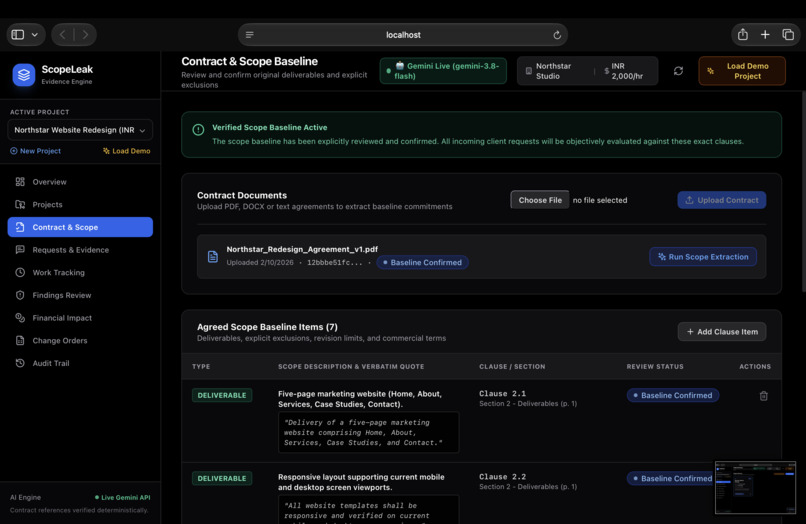
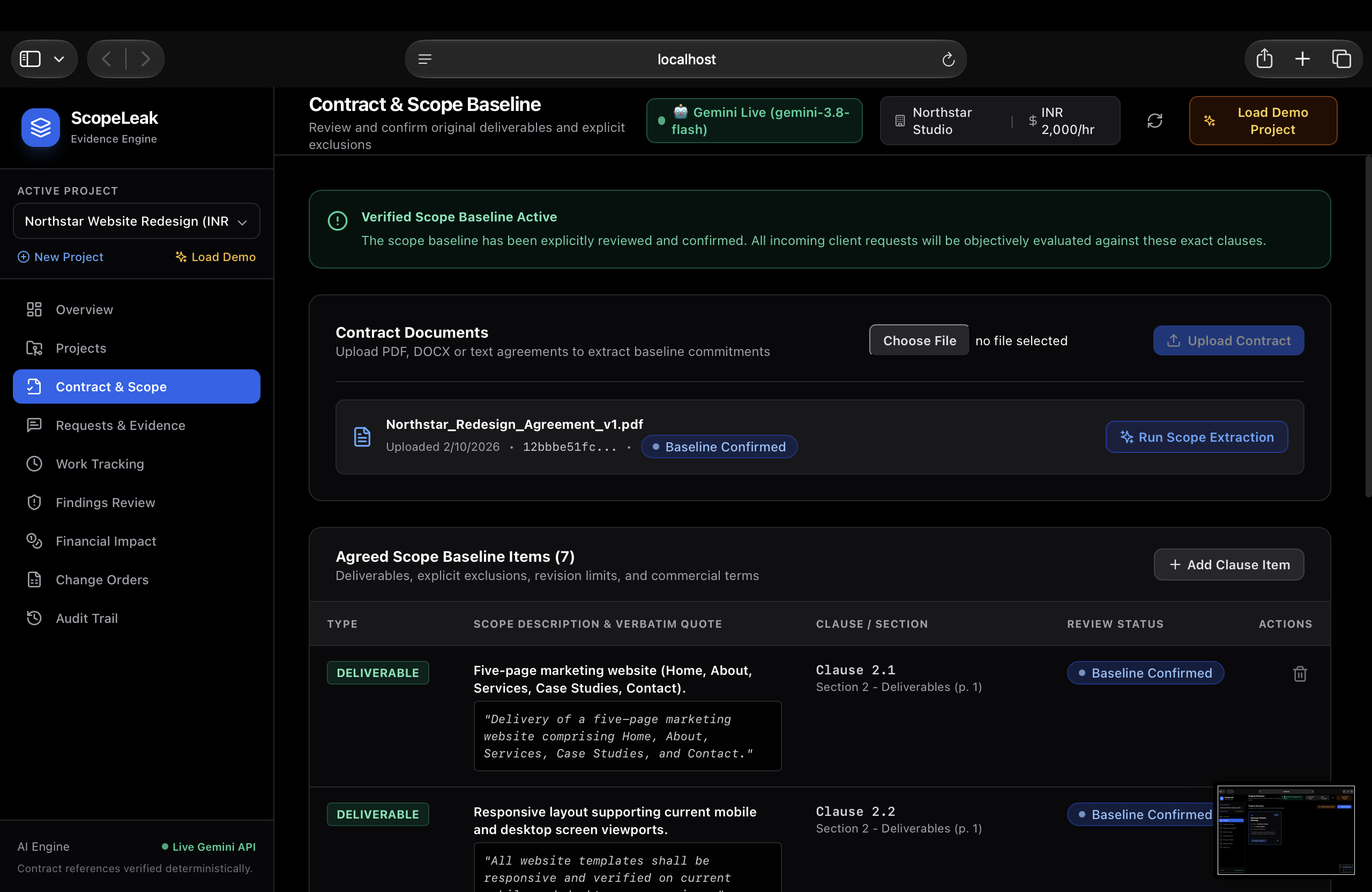
Upload contracts, extract deliverables and exclusions, and confirm the original scope before evaluating incoming requests.
-
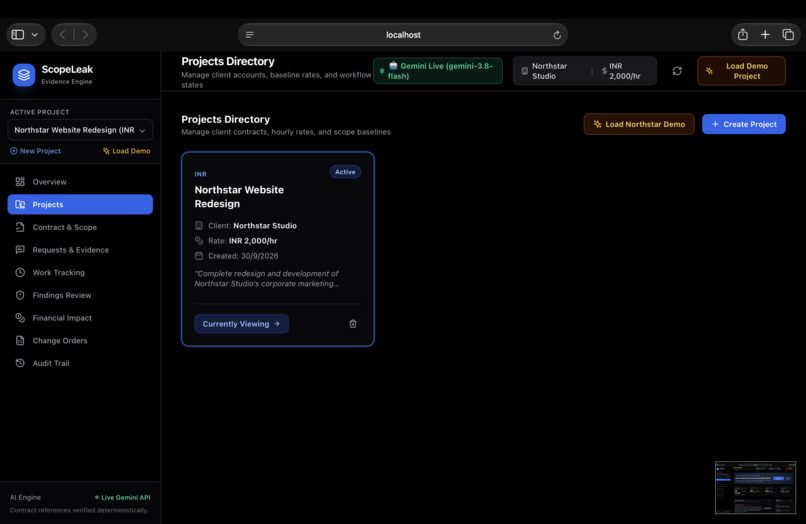
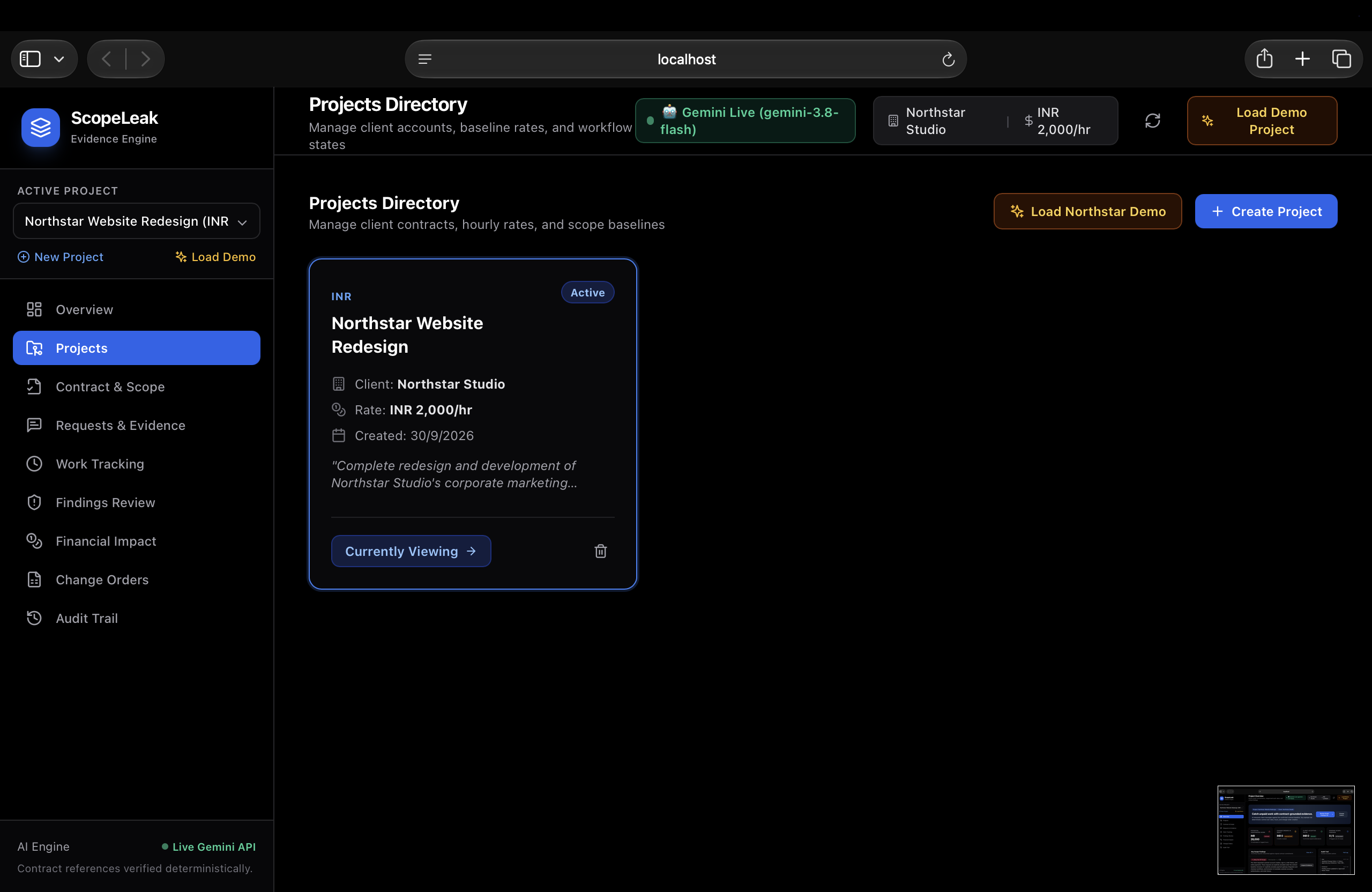
Manage client projects, contract baselines, hourly rates, and project status from a centralized directory.
-
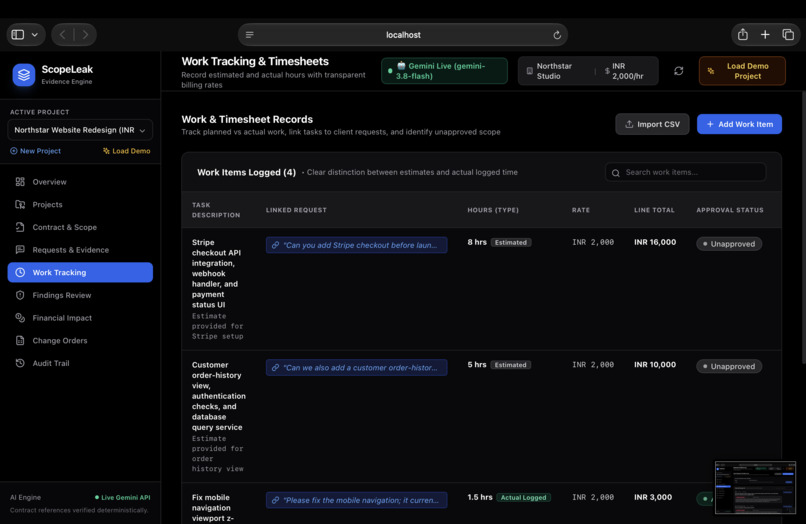
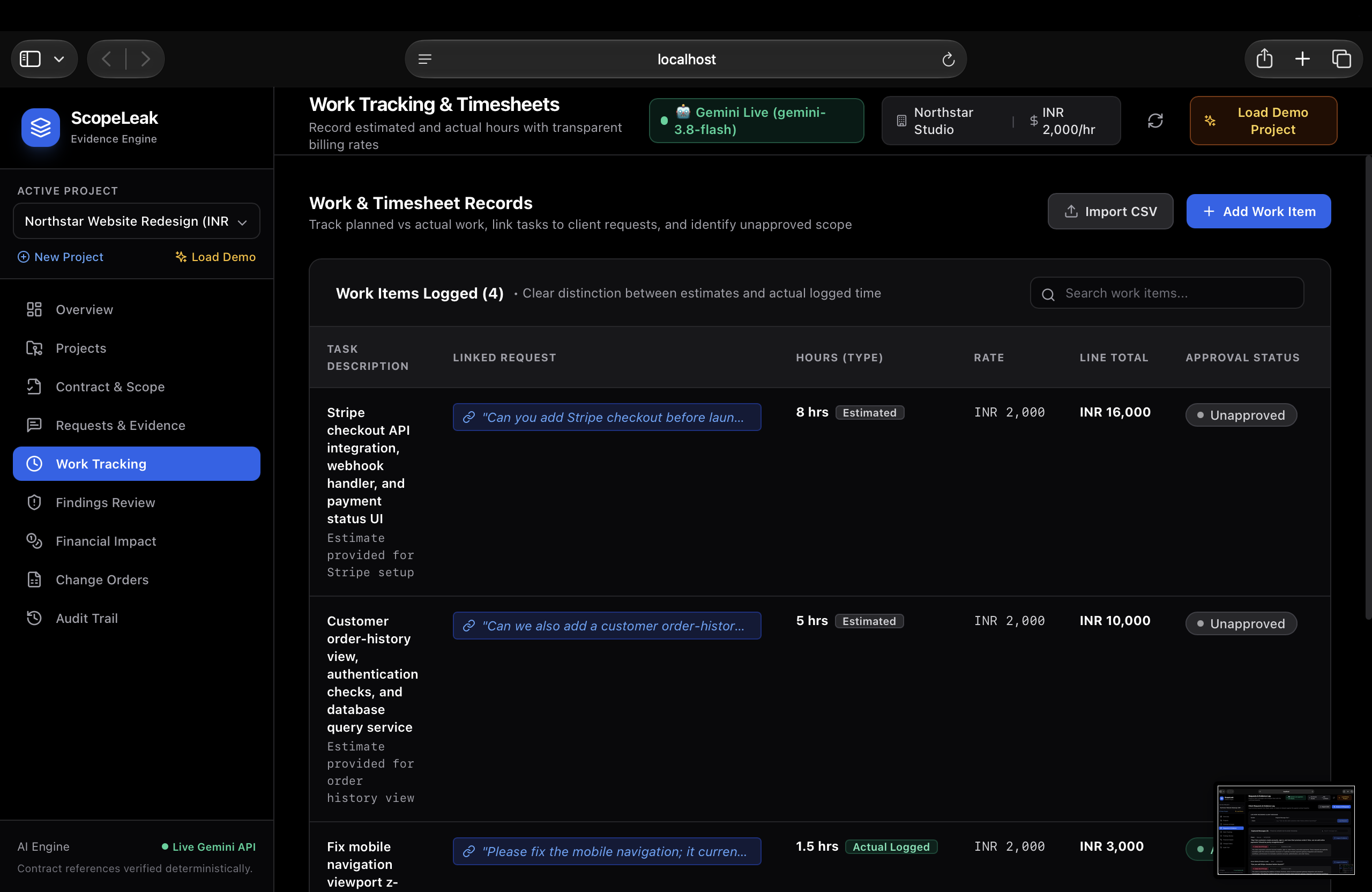
Track estimated and actual hours, link work to client requests, calculate costs using the agreed hourly rate, and monitor approval status.
-
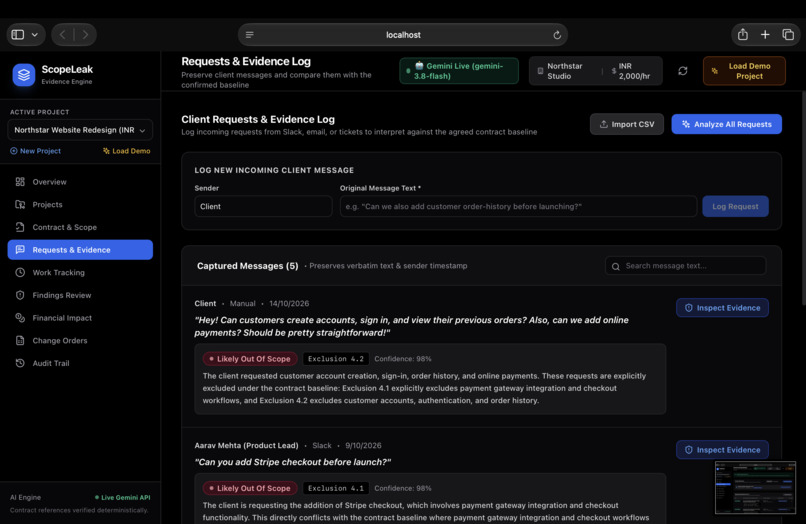
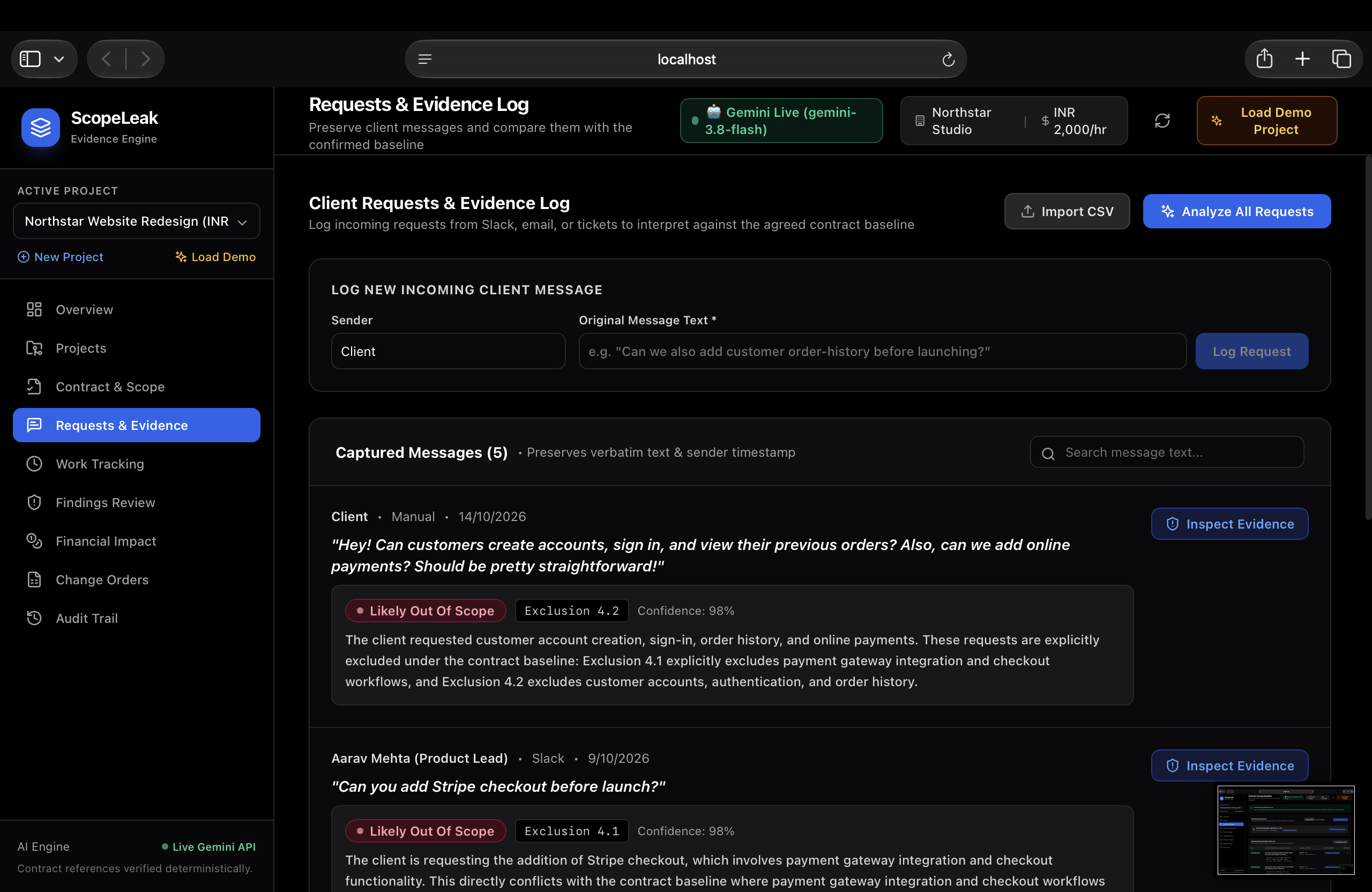
Capture client messages, preserve original request text, and use Gemini AI to analyze requests against contract exclusions
-
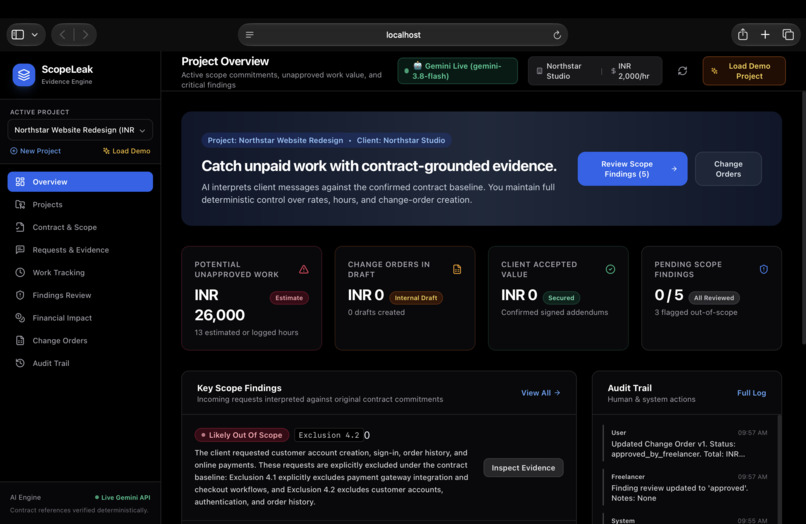
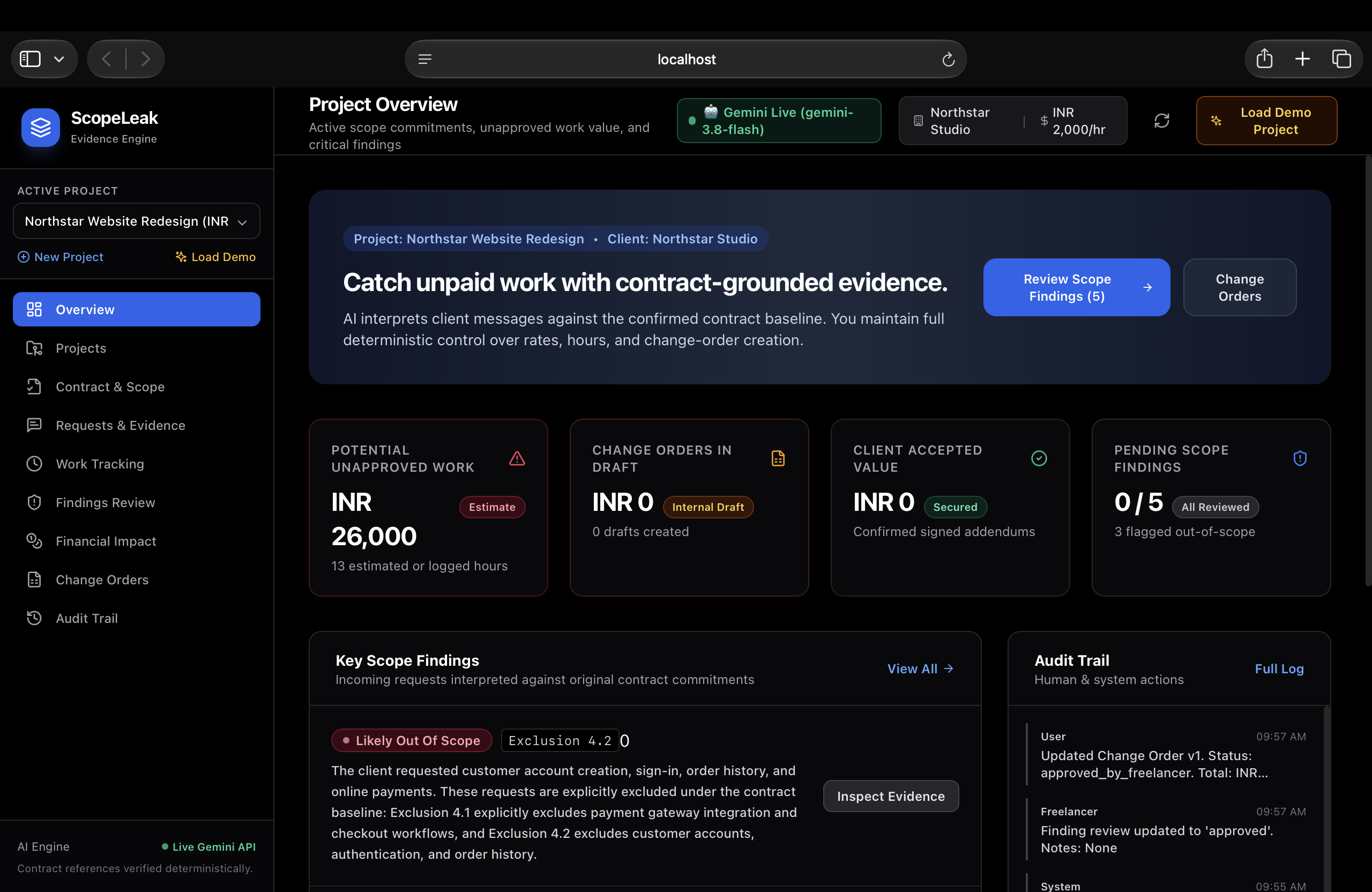
ScopeLeak dashboard showing potential unapproved work, financial exposure, pending scope findings, key evidence, and the audit trail.
💡 Inspiration
“Just one tiny change.” 😅
For freelancers and small agencies, these four words can turn a simple project into weeks of unpaid work. A client asks for a small adjustment, then another feature, then an entirely new workflow—all while expecting the original price and deadline to remain unchanged. 💸
We built ScopeLeak 🛡️ to tackle this frustrating reality. Our goal was to help freelancers protect their time, communicate boundaries professionally, and ensure that additional work is recognized and fairly priced.
🚀 What it does
ScopeLeak is an AI-powered scope-change detection platform that compares incoming client requests against the original project contract.
- 🔍 Detects scope creep: Identifies requests that may fall outside the agreed deliverables.
- 📑 Grounds findings in evidence: Connects potential scope changes to relevant contract clauses and client messages.
- 💰 Estimates financial impact: Helps calculate the potential cost of additional work using project rates and estimated effort.
- 📝 Supports change orders: Helps freelancers turn out-of-scope requests into clear, reviewable change orders.
- 🤝 Keeps humans in control: Freelancers can review findings and decide how to handle each request.
🎯 The mission is simple: turn “just one tiny change” into a clear, evidence-based conversation.
🛠️ How we built it
ScopeLeak combines a React, TypeScript, and Vite frontend with a Python FastAPI backend and SQLite persistence.
🤖 We integrated Google's Gemini API to interpret client requests and assist with scope classification. Deterministic logic handles critical workflow decisions, contract-clause validation, and financial calculations, helping keep the system grounded in recorded project information.
🔄 We also implemented a deterministic fallback path so the application can continue providing analysis when live AI requests encounter connectivity problems, service outages, or quota limits. The interface distinguishes live AI analysis from fallback analysis to make the source of findings transparent.
🧩 Challenges we ran into
One major challenge was making AI-powered analysis useful without allowing it to invent contract terms or treat every request as scope creep. We worked on grounding findings in actual contract clauses and improving classification for requests involving features such as customer accounts, order history, authentication, and payment integration.
🌐 Another challenge was Gemini API reliability. Transient network errors, service overload, and quota exhaustion required more careful retry handling and fallback behavior.
📊 We also had to ensure that financial estimates remained consistent with project-specific rates, that test data did not contaminate normal application data, and that the interface communicated findings clearly enough for a real freelancer to act on them.
🏆 Accomplishments that we're proud of
We're proud to have built a working end-to-end workflow that connects contracts, incoming client requests, evidence-based findings, financial impact estimates, and change-order preparation.
✅ We strengthened the distinction between AI-assisted interpretation and deterministic business logic, added transparent fallback behavior, and improved the grounding of findings in stored contract clauses.
❤️ Most importantly, ScopeLeak focuses on a real problem faced by independent professionals: protecting their time and income without turning every client conversation into a confrontation.
📚 What we learned
We learned that adding AI is only part of building a trustworthy AI product. Reliability also depends on good data grounding, deterministic safeguards, clear error handling, and honest communication about how results were produced.
💭 We also learned that a useful interface should do more than flag a problem. It should provide the evidence, financial context, and next steps needed to help someone make a decision.
💡 Above all, we learned that scope creep is not merely a technical problem—it's a communication and business problem that technology can help make easier to manage.
🔮 What's next for ScopeLeak
Our next steps include improving scope-classification accuracy, expanding integrations with tools where client requests and agreements already live, and strengthening support for complex contracts and multi-stage projects.
📈 We also want to improve estimate calibration using project-specific historical data, add clearer approval and audit trails, and make change-order generation and client approval more seamless.
🌍 Our long-term vision is to make scope management proactive rather than reactive, giving freelancers and small agencies the confidence to protect their boundaries while building stronger client relationships.
🛡️ ScopeLeak: Catch scope creep before it costs you. 💸
Note on Gemini API Availability: The server-side deployment currently uses the free tier of the Gemini API, which may experience frequent rate limits or temporary quota exhaustion during periods of high demand. This can occasionally affect live AI analysis. For local development, users are encouraged to configure their own GEMINI_API_KEY in the environment, subject to Google's applicable API quotas and limits.
Get your API key from Google AI Studio.


Log in or sign up for Devpost to join the conversation.