Inspiration
Software projects rarely drift all at once. A feature gets added, a requirement expands, or an important task quietly receives no implementation evidence. Each change may look small, but together they can create schedule pressure, unexpected engineering costs, and a product that no longer matches what the team originally agreed to build.
Existing project management tools are good at showing tasks and activity, but they do not always answer a more fundamental question:
Are we still building what we agreed to build?
That question inspired ScopeGuard.
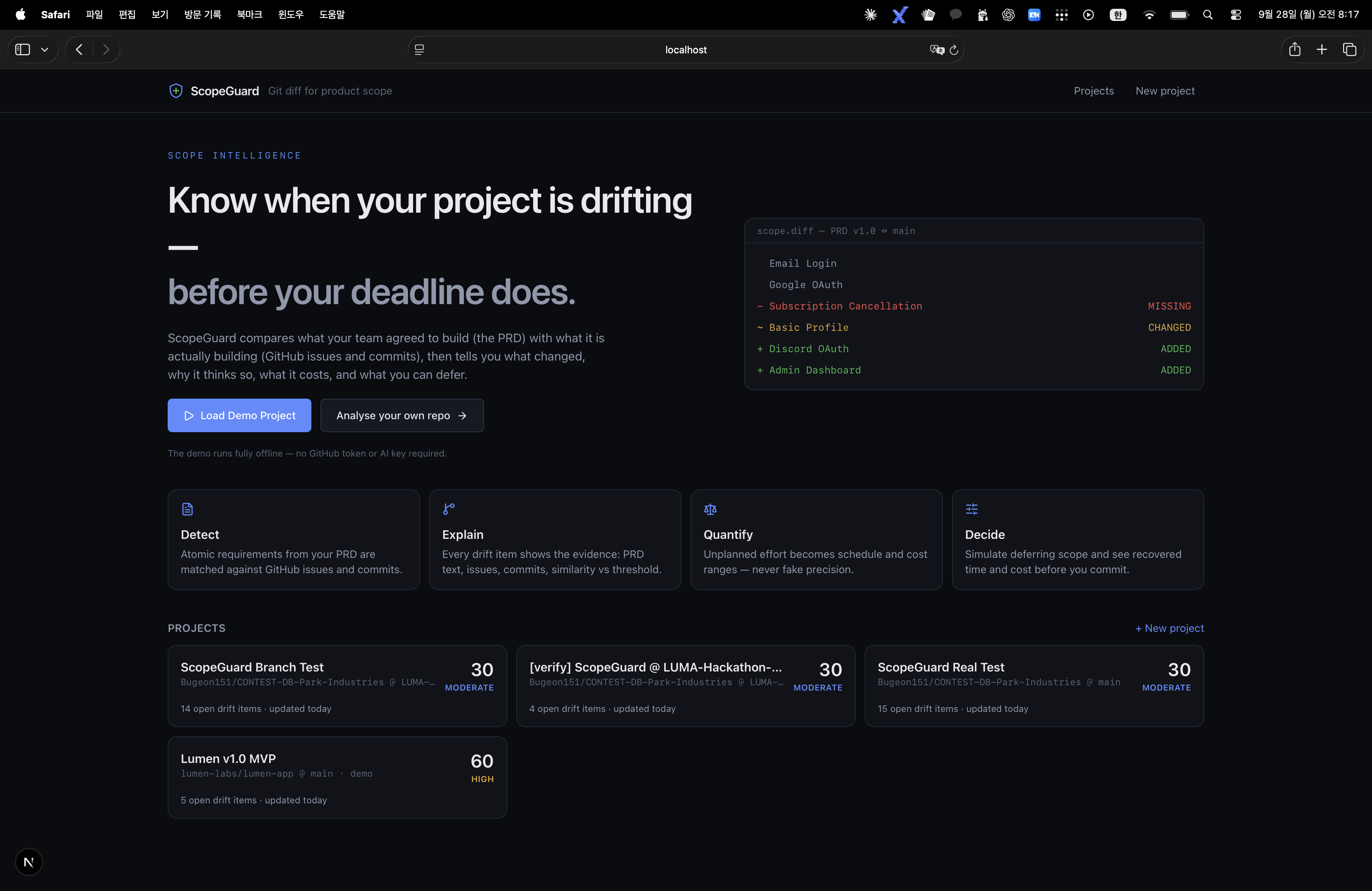
ScopeGuard treats the Product Requirements Document (PRD) as the approved scope and compares it with actual development activity to detect scope drift before it becomes expensive.
What it does
ScopeGuard is a scope intelligence and project risk platform that connects product requirements with GitHub development activity.
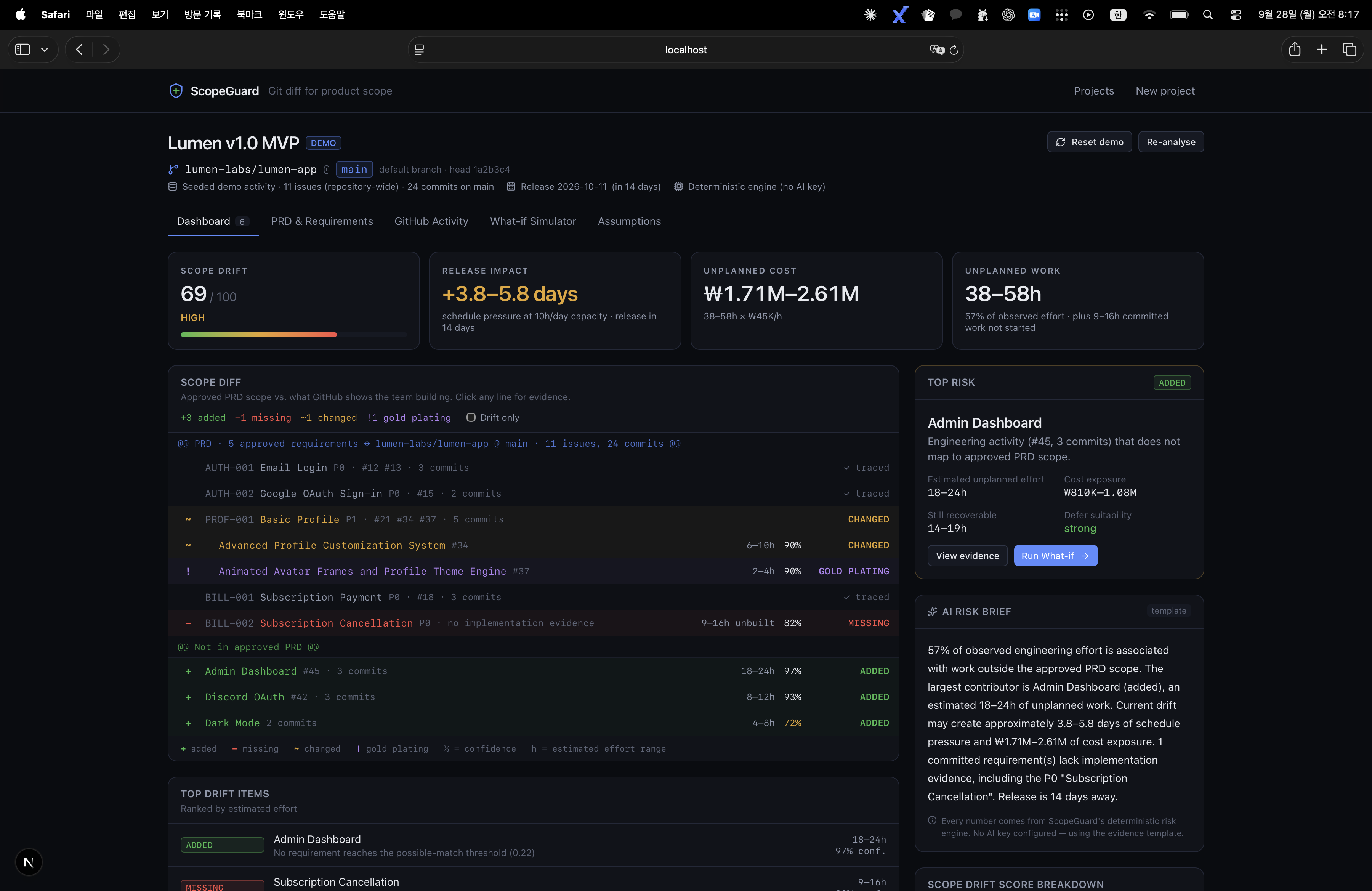
It detects four major types of scope drift:
- ADDED — work appears in development activity but not in the approved PRD
- MISSING — an approved requirement has no matching implementation evidence
- CHANGED — development activity suggests that an approved requirement has expanded or changed
- GOLD PLATING — additional work goes beyond what the approved requirement calls for
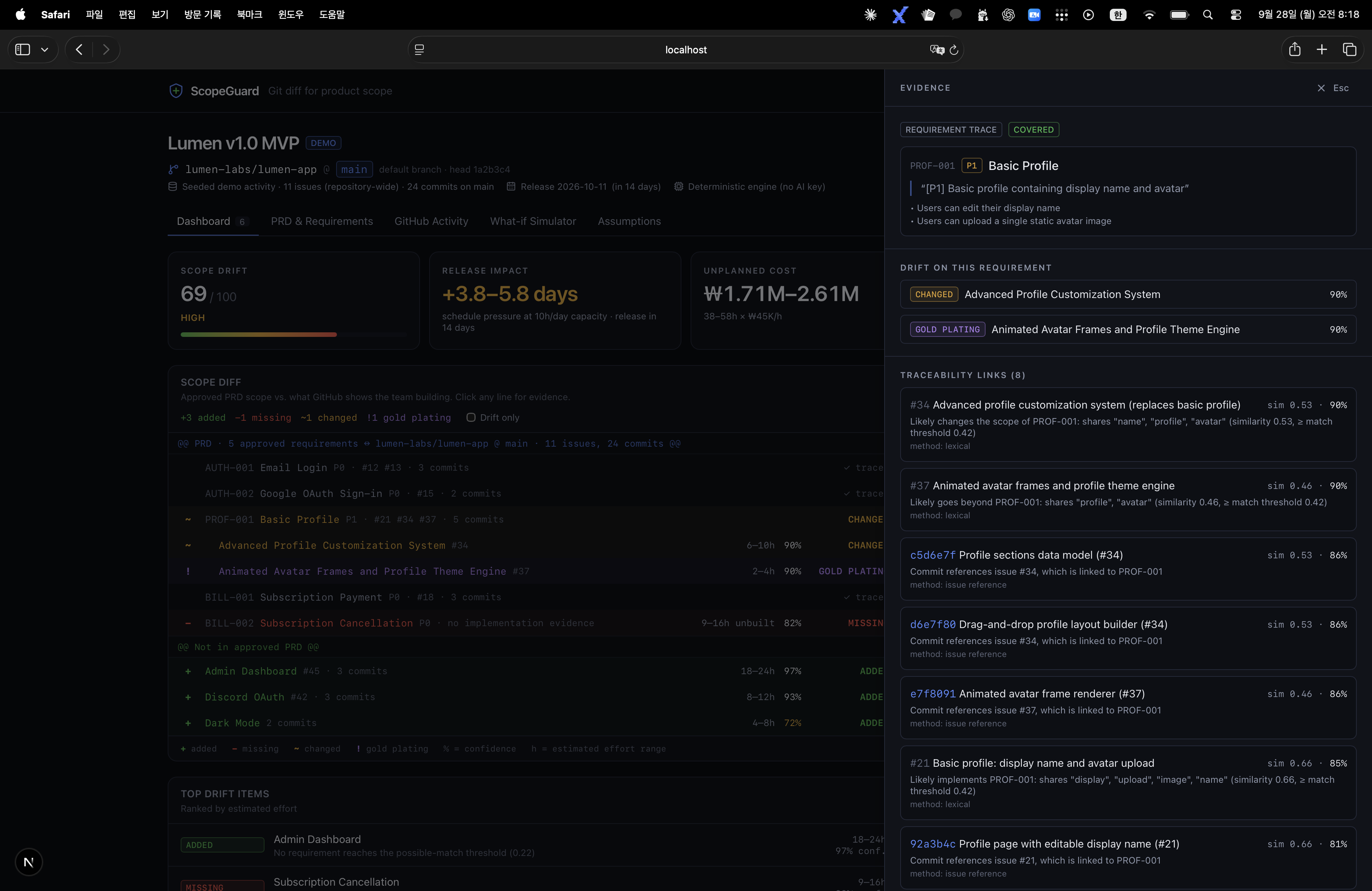
Instead of stopping at classification, ScopeGuard creates an evidence chain behind each finding. Users can inspect the relevant requirement, GitHub issues and commits, matching information, confidence, and estimated engineering effort.
ScopeGuard then translates drift into project-level impact, including:
- Drift risk score
- Unplanned engineering effort
- Schedule pressure
- Cost exposure
- Potentially recoverable effort
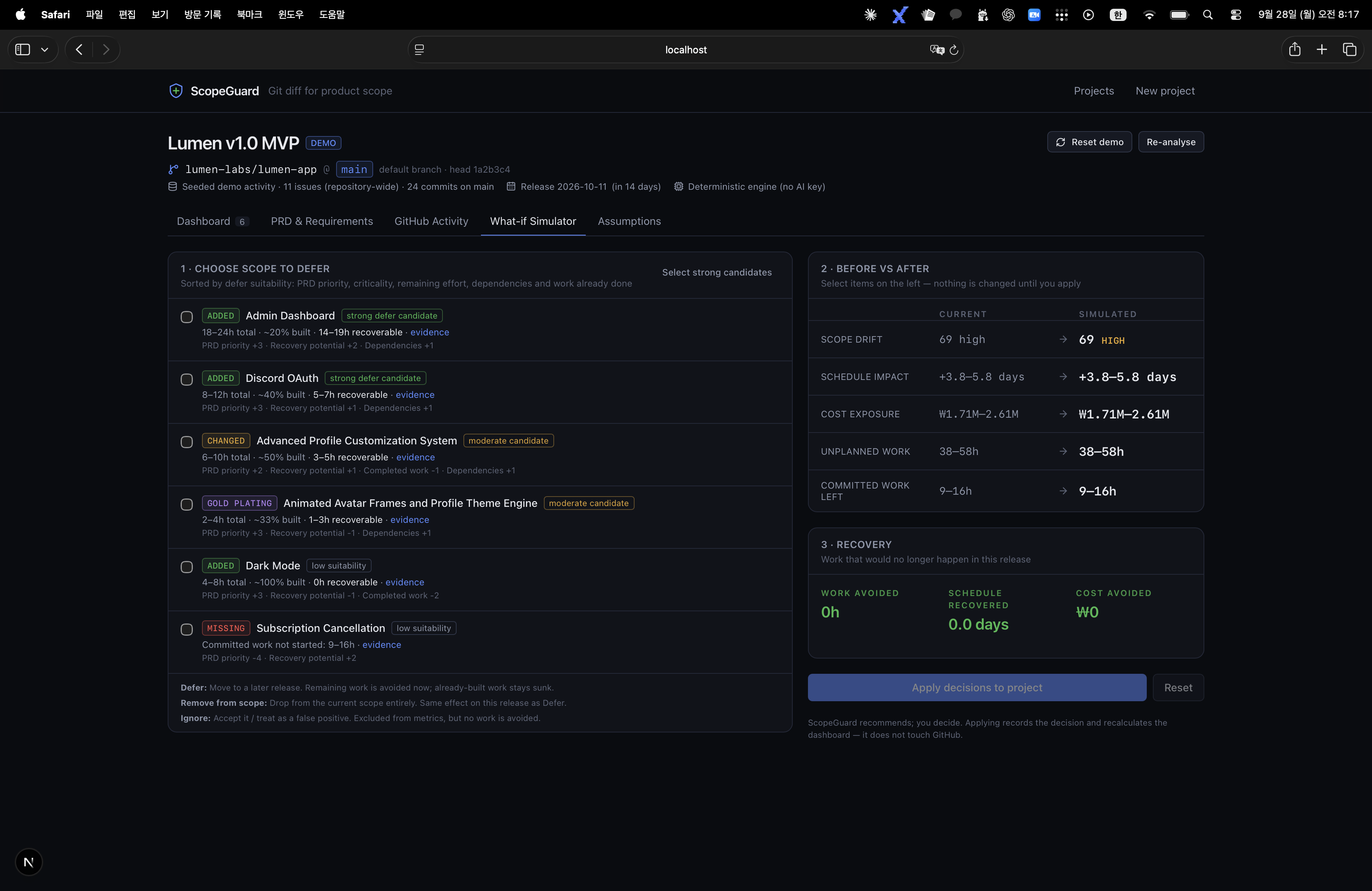
Finally, the What-if Simulator allows a team to simulate decisions such as deferring an unplanned feature before making an actual project change.
ScopeGuard follows one principle:
AI detects. Evidence proves. Models quantify. Humans decide.
How we built it
ScopeGuard was built with Next.js, React, and TypeScript.
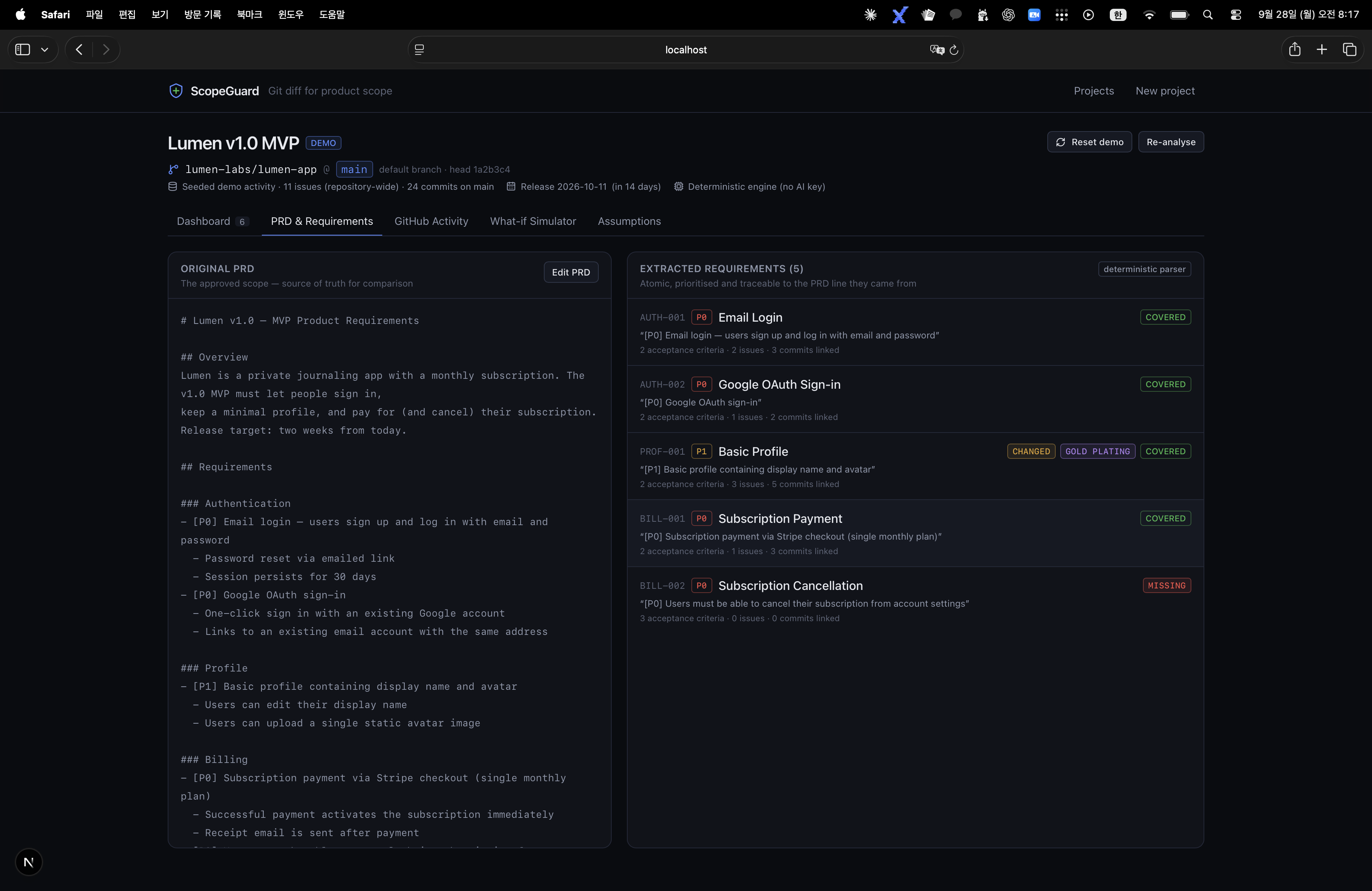
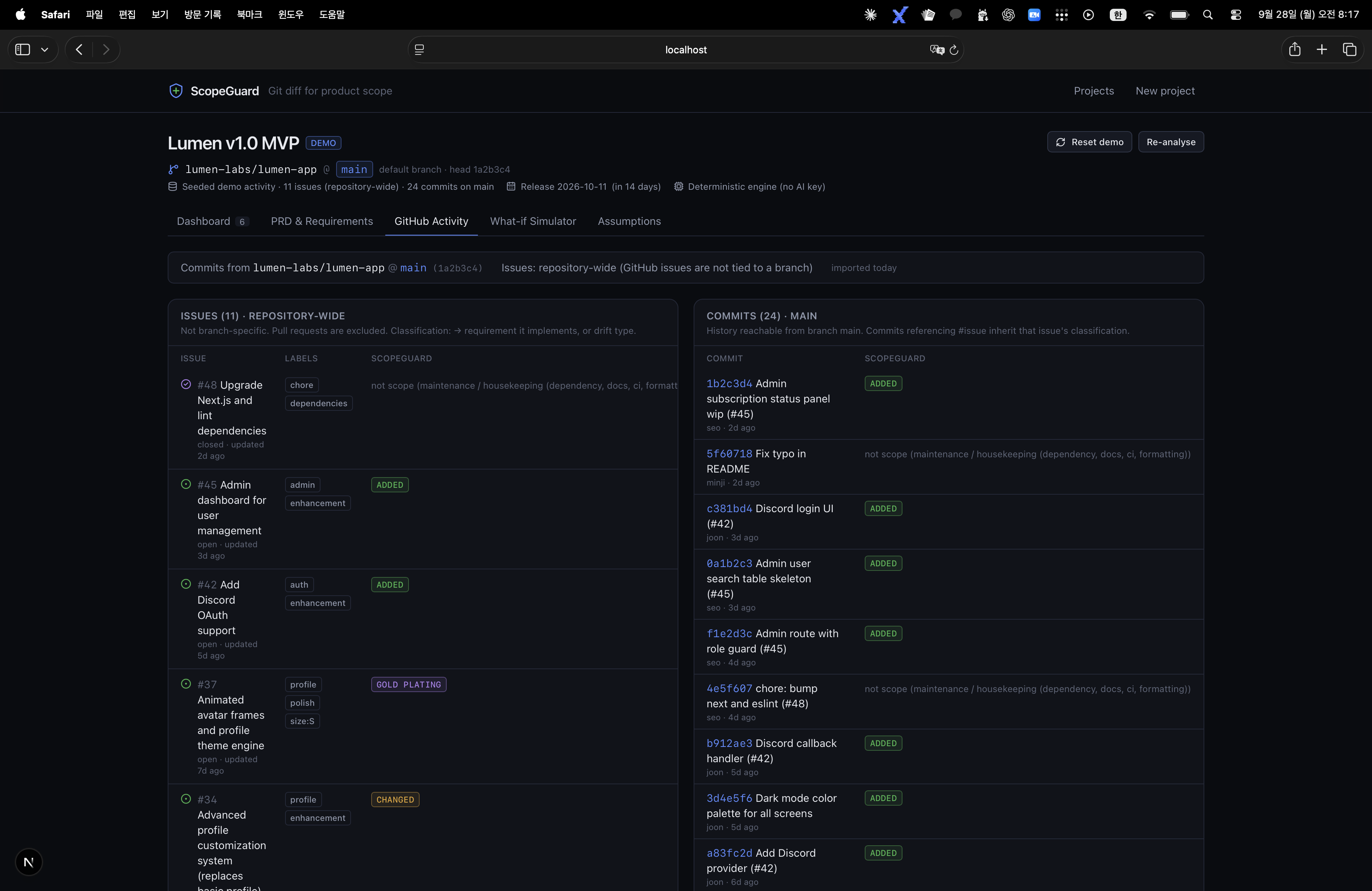
The system processes structured PRD requirements and development evidence from GitHub issues and branch-specific commit history.
Its matching pipeline combines deterministic text similarity and requirement-title coverage to associate engineering activity with approved requirements. These matches are then passed into a deterministic drift and risk engine that classifies scope changes and calculates their impact.
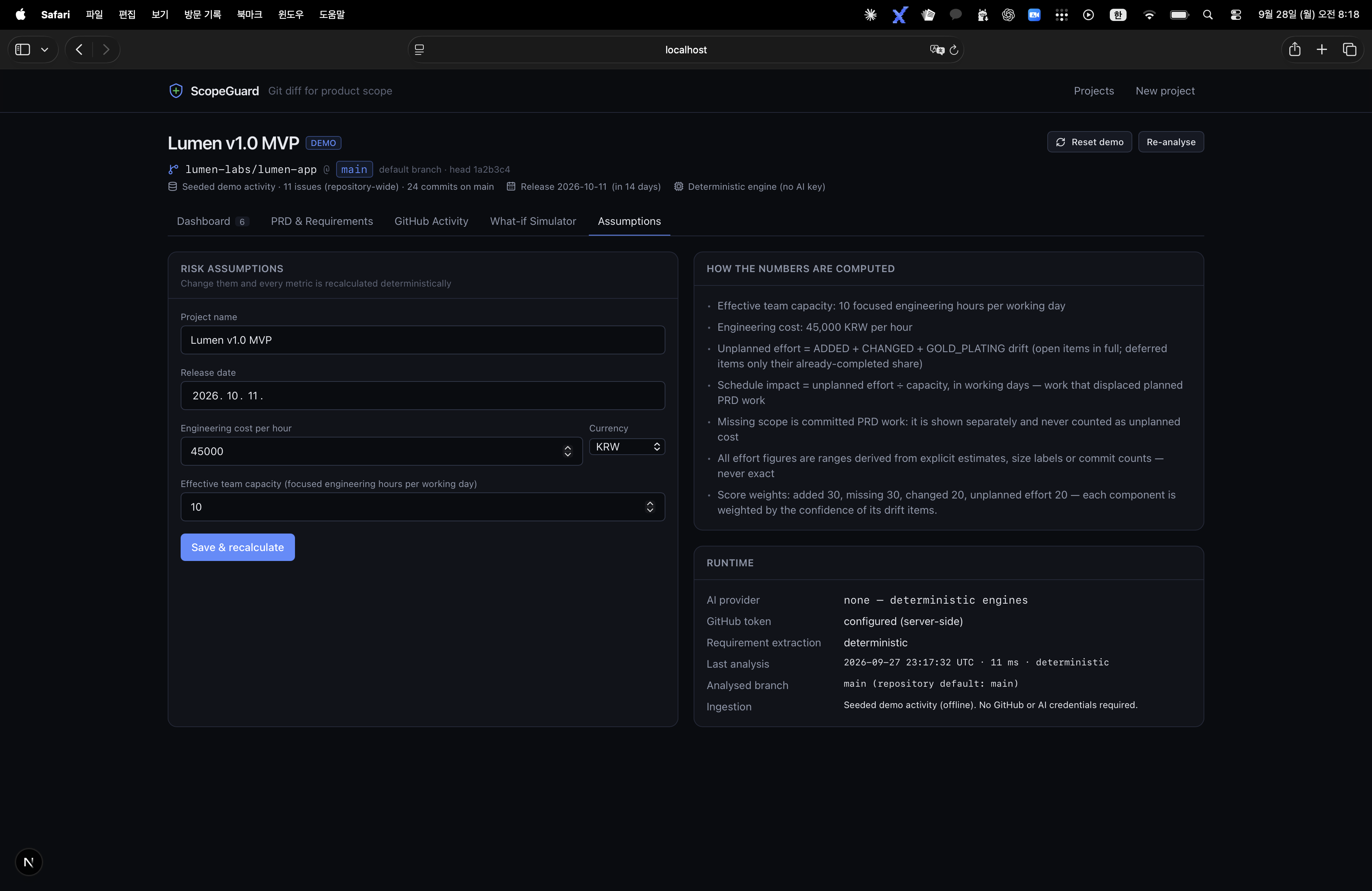
The risk model converts estimated engineering effort into schedule and cost ranges using explicit project assumptions. We intentionally use ranges instead of presenting false precision.
The What-if Simulator is non-mutating: it recalculates the expected impact of a decision without automatically modifying GitHub issues, deleting code, or changing the roadmap.
We also built an offline demo dataset so the complete product experience can be evaluated without requiring a GitHub token or AI API key.
For real repositories, ScopeGuard can analyze GitHub activity while preserving branch context for commits.
The application was deployed on Vercel so judges can interact with the product directly.
Challenges we ran into
One of the hardest problems was distinguishing actual implementation from the evidence available to the system.
A repository may contain working code while having very few GitHub issues or broad commit messages. In that situation, ScopeGuard must not falsely claim that the code does not exist. Instead, it reports that there is insufficient implementation evidence associated with the requirement.
Another challenge was designing risk calculations that were useful without pretending to know more than the available data supports. We therefore separated deterministic calculations from AI-generated explanations and expressed uncertain engineering estimates as ranges.
Branch handling was another important challenge. GitHub issues are repository-wide, while commits belong to branch histories. ScopeGuard therefore preserves the selected branch when analyzing commit activity while treating issues as repository-level evidence.
Finally, we wanted ScopeGuard to help people make decisions without making those decisions for them. This led to the non-mutating What-if Simulator and the human-in-the-loop design.
Accomplishments that we're proud of
We built an end-to-end working MVP that goes beyond simply summarizing project data.
ScopeGuard can:
- Parse and structure product requirements
- Connect requirements with GitHub development evidence
- Detect Added, Missing, Changed, and Gold Plating scope drift
- Show inspectable evidence behind findings
- Quantify engineering effort, schedule pressure, and cost exposure
- Simulate scope decisions before they are applied
- Analyze branch-specific GitHub commit activity
- Run as an interactive web application
We also created a deterministic demo mode that requires no API key, making the core product reproducible and easy to evaluate.
The project passed our automated linting, type checking, test suite, and production build validation before deployment.
What we learned
The biggest lesson was that AI is most useful in project management when it does not replace evidence.
A model can help interpret ambiguous development activity, but project decisions need traceability. Users should be able to understand why something was classified as scope drift and what data supports that conclusion.
We also learned that estimating the business impact of engineering changes is fundamentally uncertain. Showing explicit assumptions and realistic ranges is more useful than producing a single precise-looking number.
Most importantly, we learned that scope management can be treated as an engineering observability problem: compare intended state with observed state, identify the difference, quantify its impact, and let humans decide what to do next.
What's next for ScopeGuard
The current MVP focuses on PRDs, GitHub issues, and commit metadata.
Next, ScopeGuard could expand its evidence graph with:
- Pull request analysis
- Jira and Linear integrations
- Continuous repository monitoring
- Requirement history and version comparison
- Team-level scope drift trends
- Release alerts when risk crosses defined thresholds
- Improved semantic matching using repository and code context
The long-term goal is to make ScopeGuard a continuous scope observability layer for software teams — detecting when the product being built begins to diverge from the product that was approved.
Built With
- anthropic-claude
- github-api
- next.js
- react
- typescript
- vercel

