-
-
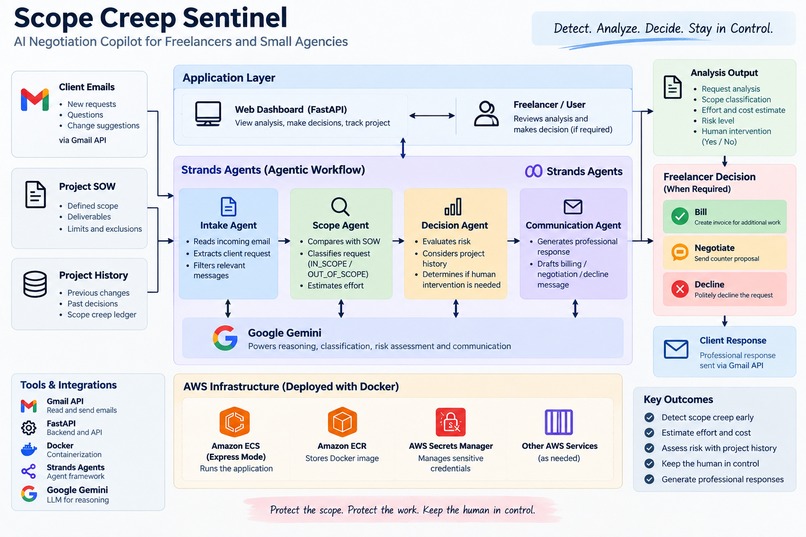
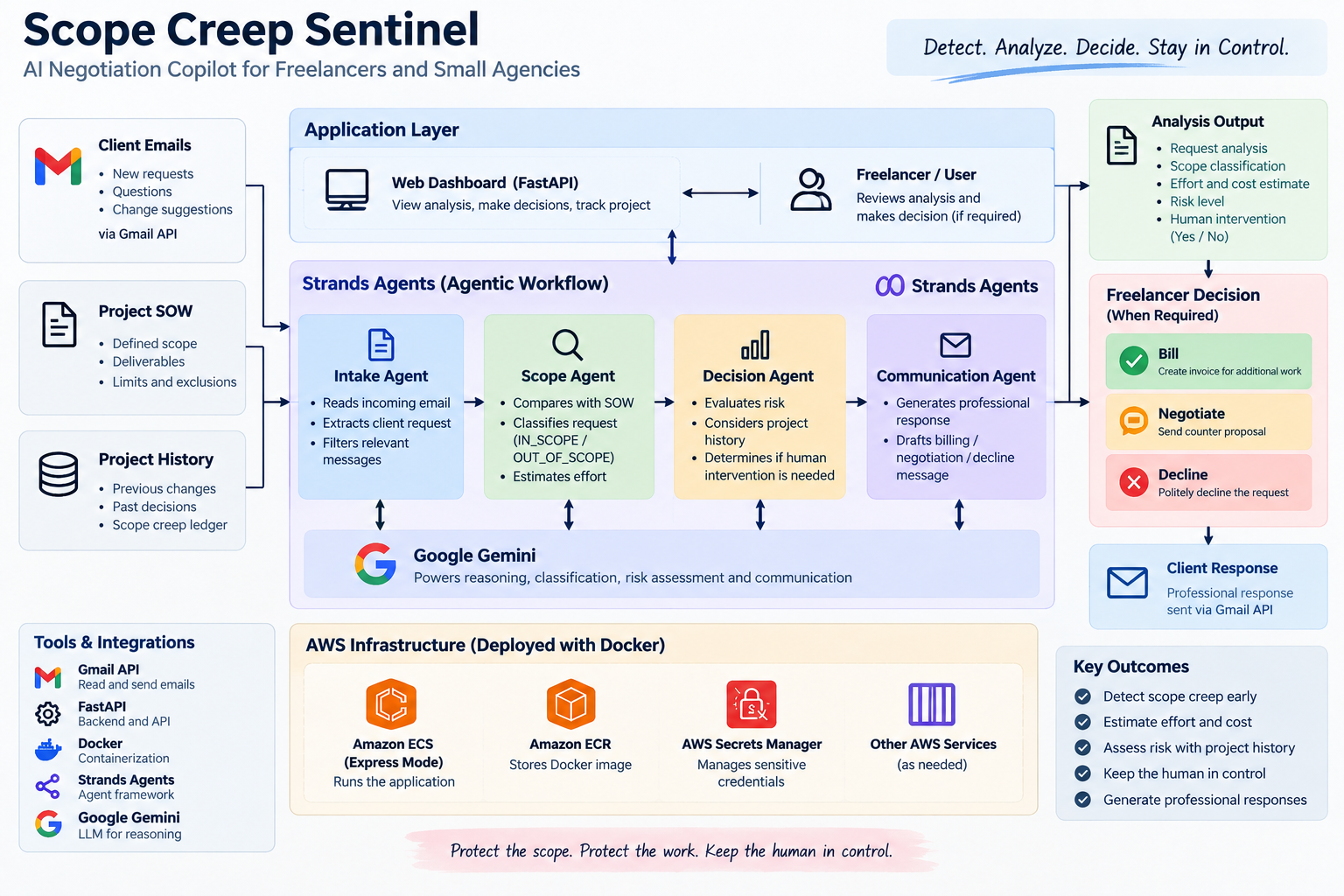
Architecture of Scope Creep Sentinel with Strands Agents, Gemini, Gmail, human decisions, and AWS deployment.
-
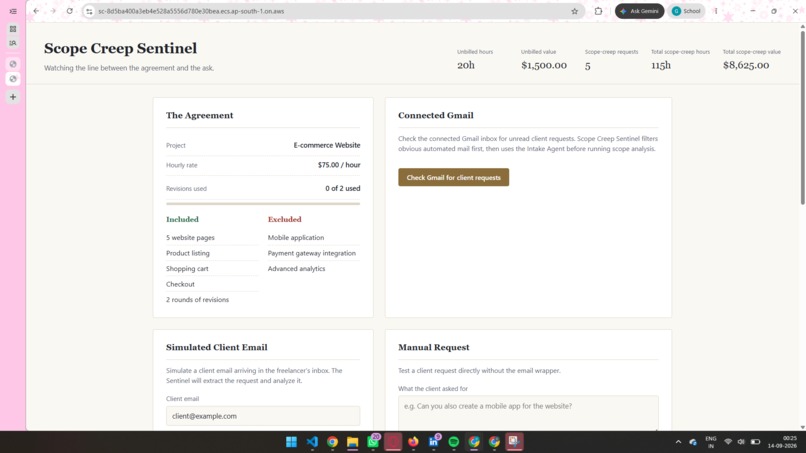
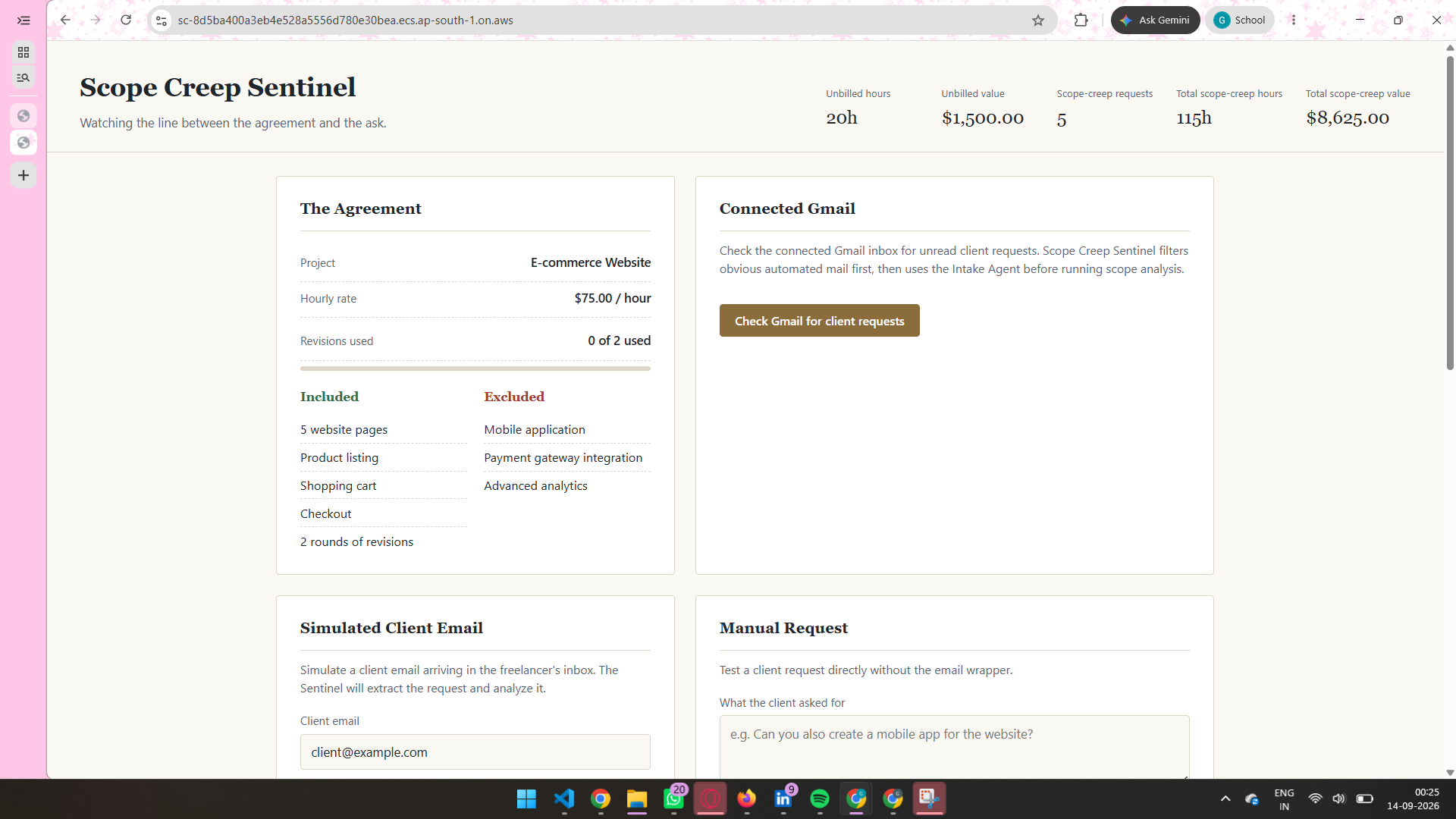
Main dashboard showing SOW, scope limits, Gmail intake, and project tracking.
-
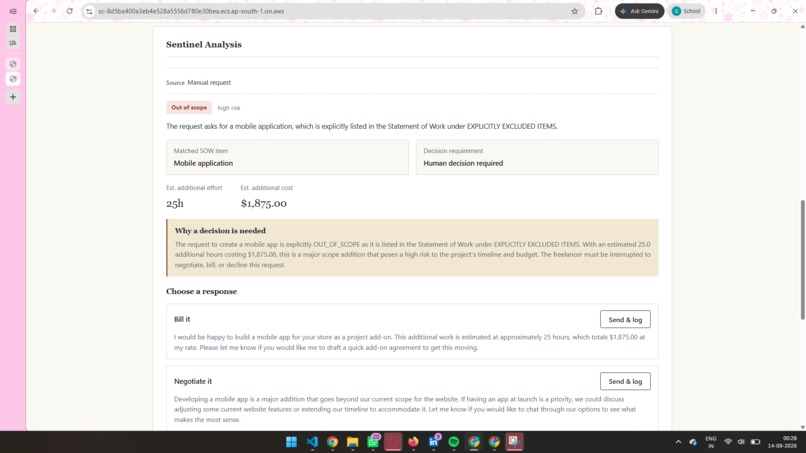
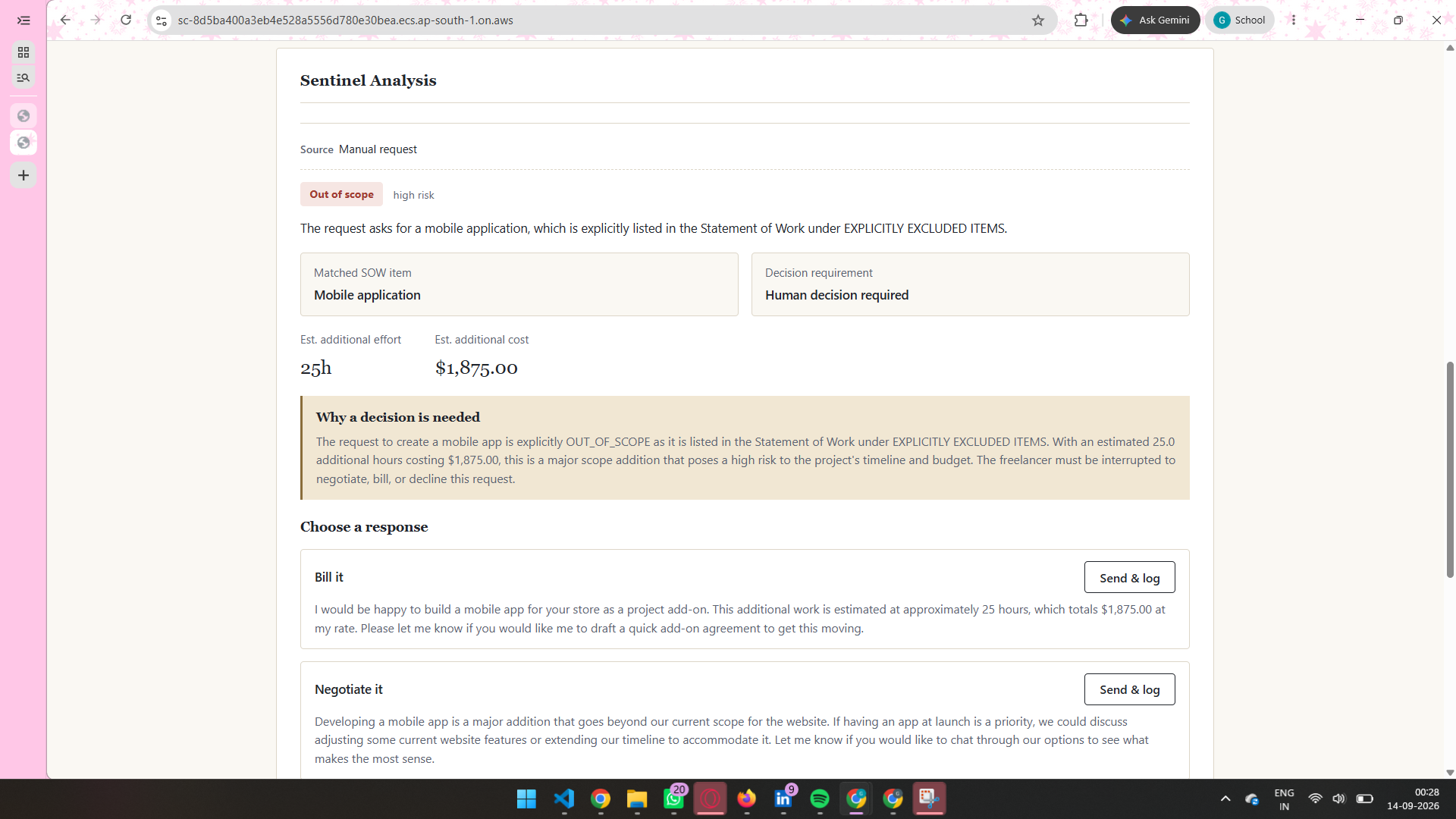
Out-of-scope request analysis with effort, cost, risk, and decision options.
-
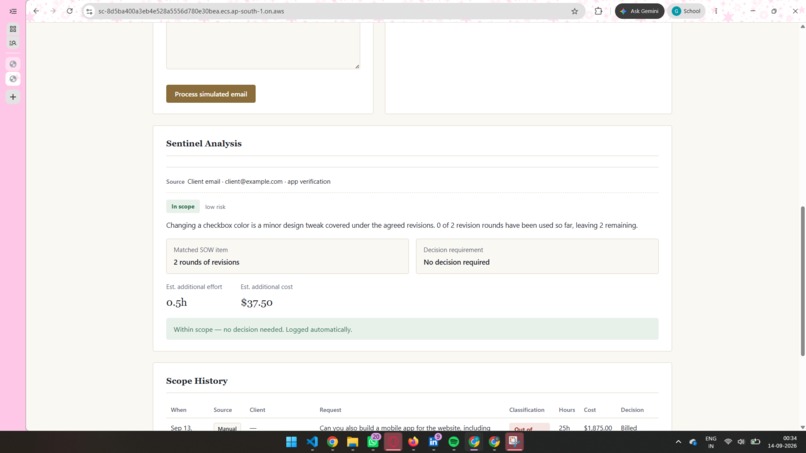
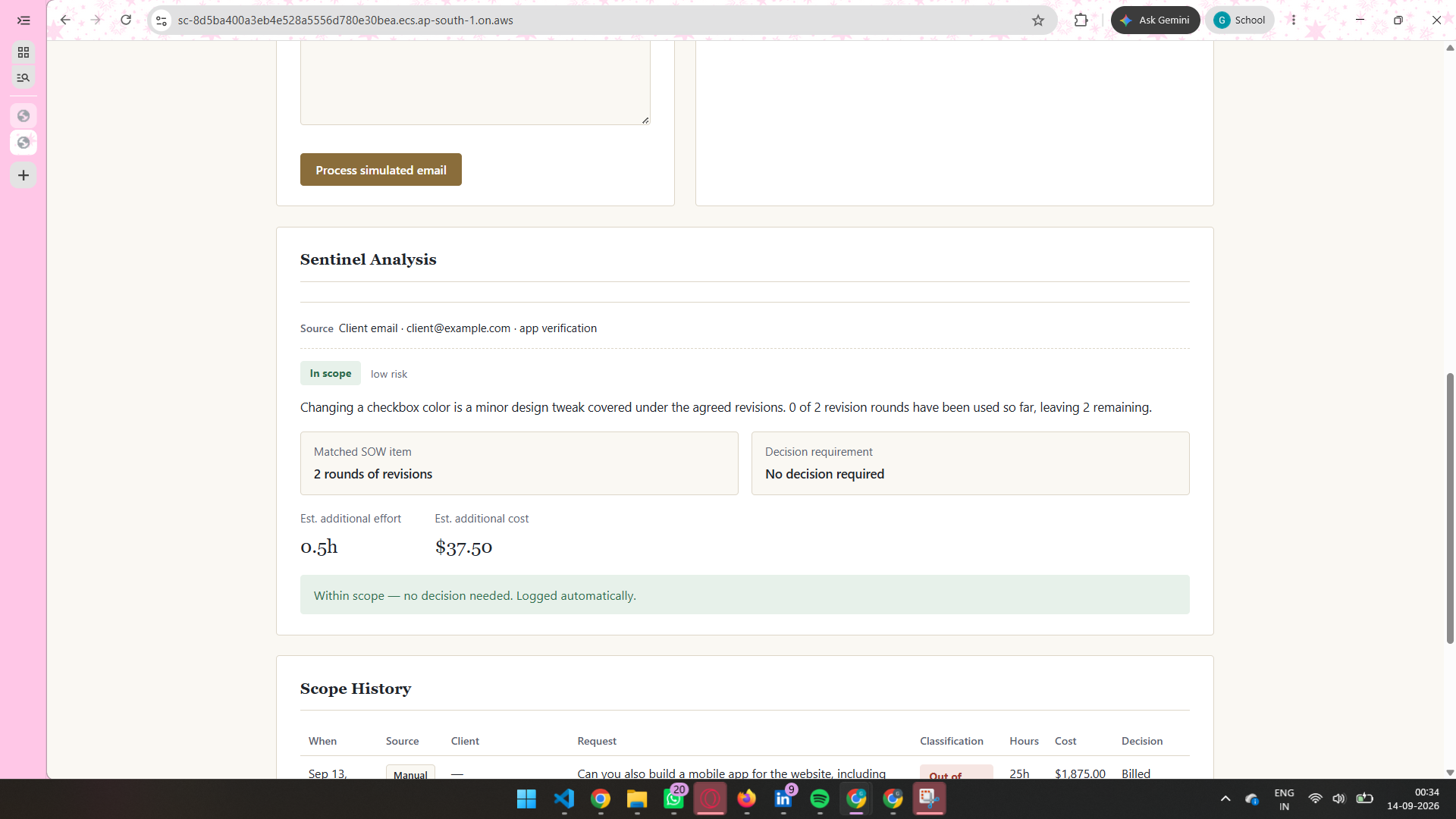
In-scope request handled automatically with low effort, cost, and risk.
-
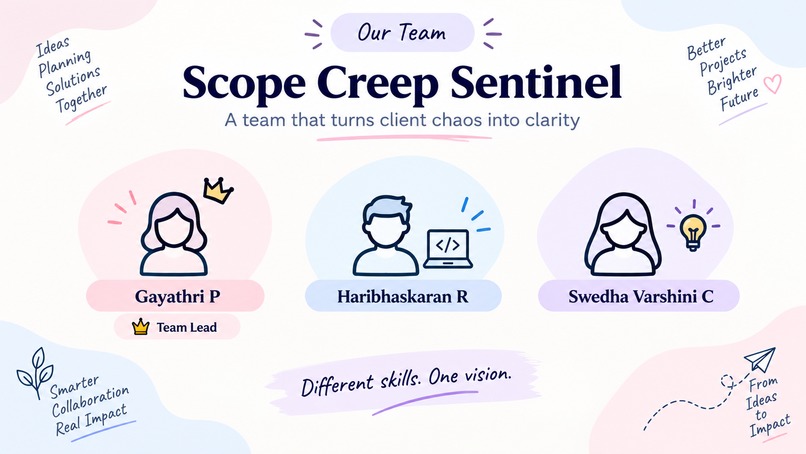
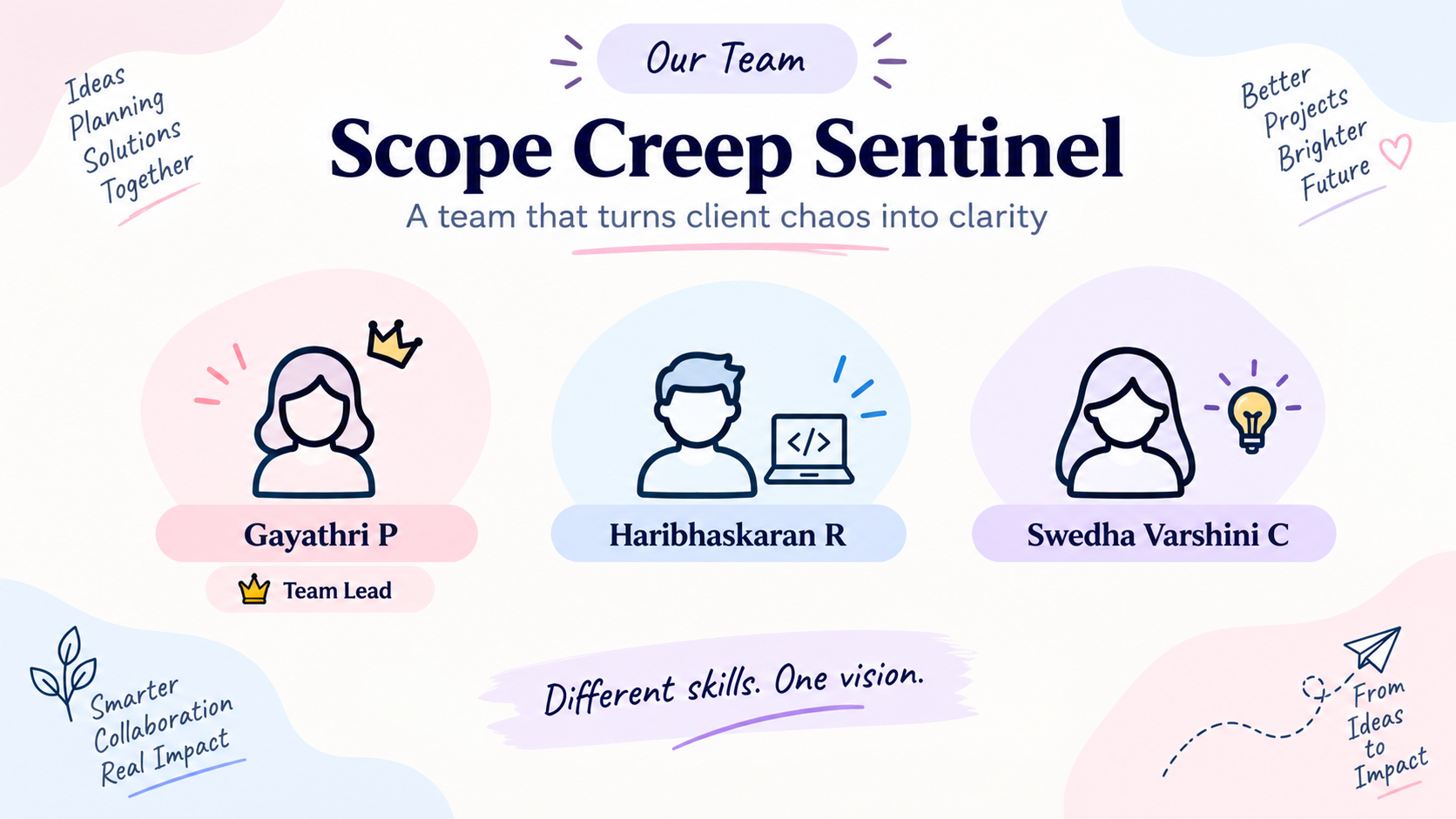
Meet the team behind Scope Creep Sentinel — three minds, one mission to turn client chaos into clarity.
Inspiration
Freelancers and small agencies often start with a project scope. That is a thing. The real trouble begins after the agreement is made.
Clients say things like:
"Can you also add this?”
"Can we make one change?”
These requests may seem harmless at first but they quietly add up.
◆ Hours of work go unpaid
◆ Deadlines get missed
◆ Project margins shrink
◆ Conversations with clients become tense
That is why we built Scope Creep Sentinel.
Scope Creep Sentinel is a decision assistant designed to help freelancers and small agencies stay in control.
When a client asks for a change Scope Creep Sentinel shows what that change could mean in terms of time, cost and project impact. Scope Creep Sentinel helps the freelancer say no with confidence or say yes. On their terms.
No more guessing. No more surprises. Clear informed decisions.
What it does
Scope Creep Sentinel watches client requests. Checks them against the project’s Statement of Work (SOW).
◆ Understands the request
Classifies each request as:
IN_SCOPE · GRAY_AREA · OUT_OF_SCOPE
◆ Measures the impact
Estimates:
** effort + financial impact**
◆ Tracks scope creep
Maintains a running view of how scope‑creep risk and financial exposure build up across the project.
◆ Knows when to involve the
Determines when the freelancer actually needs to step in instead of interrupting them for every small request.
◆ Keeps the human in control
Provides three options:
Bill · Negotiate · Decline
◆ Handles the conversation
Generates client‑ready responses for each decision.
◆ Maintains project memory
Keeps a project history and financial scope‑creep ledger so decisions can be tracked over time.
Scope Creep Sentinel does not make every decision automatically. Its purpose is to protect the freelancer’s time and money while keeping the freelancer in control.
How we built it
The system is built with Strands Agents. Uses specialized agents with clearly separated responsibilities.
◈ Scope Agent
Compares the client request against the SOW. Estimates the additional effort required.
◈ Decision Agent
Evaluates accumulated scope‑creep risk using project ledger information and determines whether human intervention is needed.
◈ Communication Agent
Generates three responses for billing, negotiation or declining the request.
◈ financial logic
Exact financial calculations are handled in Python rather than generated by the LLM keeping cost calculations deterministic.
◈ Cloud deployment
The application is exposed through a FastAPI web interface. Deployed as a Docker container on Amazon ECS Express Mode.
The Gemini API key is securely stored in AWS Secrets Manager.
◈ Client‑email intake
A Gmail integration is also included for client‑email intake allowing incoming messages to enter the scope‑analysis workflow.
Challenges we ran into
⚙ Moving from prototype to production
The biggest challenge was moving the system from a working prototype to a real cloud deployment.
We had to:
◆ manage model credentials
◆ Containerize the application
◆ Deploy the application on AWS ECS
◆ Connect Gemini through Strands Agents
◆ Keep the agent workflow working in the cloud
⚙ Reasoning across project state
Another challenge was making scope decisions depend not only on the current request but also on the project’s accumulated financial exposure.
A single request might be harmless. Several requests together can become a business risk.
Accomplishments that we're proud of
✓ End-to-end agent workflow
Scope Creep Sentinel can take a client request and:
Request → SOW comparison → Classification → Effort & cost → Risk assessment → Human decision → Client response → Project ledger
✓ Human-centered decision making
The system does not blindly automate decisions.
It identifies when the freelancer needs to make the decision and provides options.
✓ Live cloud deployment
The complete application is publicly deployed on AWS ECS allowing the workflow to be demonstrated through an application rather than only a local prototype.
What we learned
💡 Agents need context not prompts
One of our biggest lessons was that an agent should not simply respond to every request.
A useful professional agent should:
◆ Understand context
◆ Use project state
◆ Consider decisions
◆ Know when automatic handling is appropriate
◆ Know when a human decision is necessary
💡 AI judgment and application logic should be separated
We also learned the importance of separating AI reasoning from application logic.
Agents handle:
Reasoning
Classification
Risk assessment
Communication
Application logic handles:
Exact cost calculations
Project state
Ledger tracking
Request history
This separation makes the system easier to reason about and more reliable.
Whats next for Scope Creep Sentinel
We want to expand Scope Creep Sentinel beyond a client channel and make it useful across the tools freelancers already use.
🚀 Future improvements
◆ Deeper Gmail and communication‑platform integrations
◆ Richer project and financial analytics
◆ Stronger historical risk prediction
◆ customizable SOW and pricing models
◆ Broader support, for different freelance workflows
Our long‑term goal is to turn Scope Creep Sentinel into a reliable business decision assistant that helps independent professionals protect their time, revenue and client relationships.
Protect the scope. Protect the work. Keep the human in control.

Log in or sign up for Devpost to join the conversation.