-
-
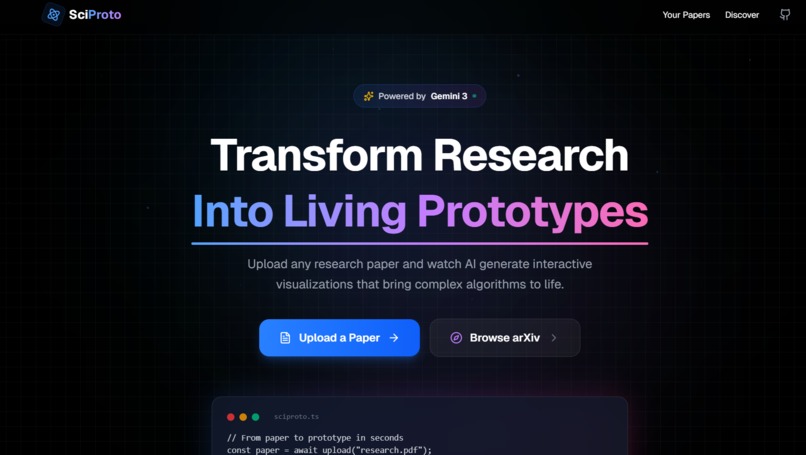
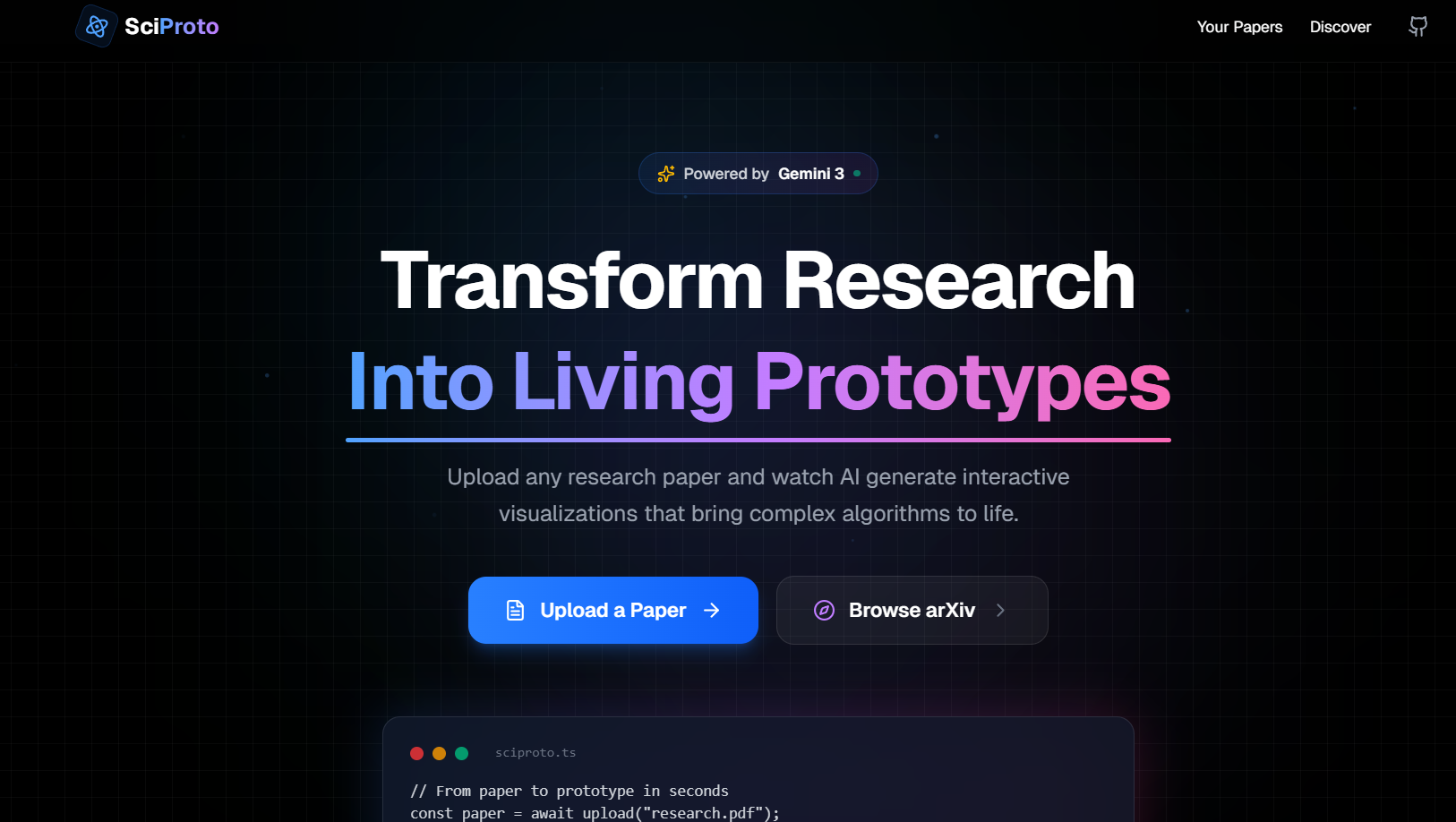
Home page
-
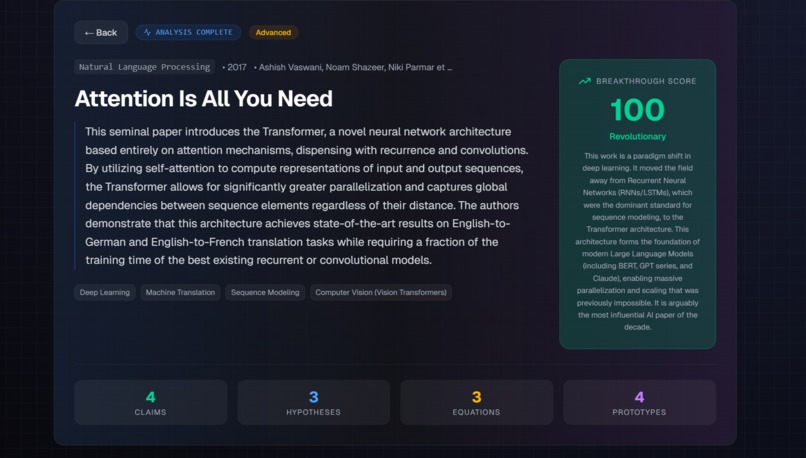
paper analysis
-
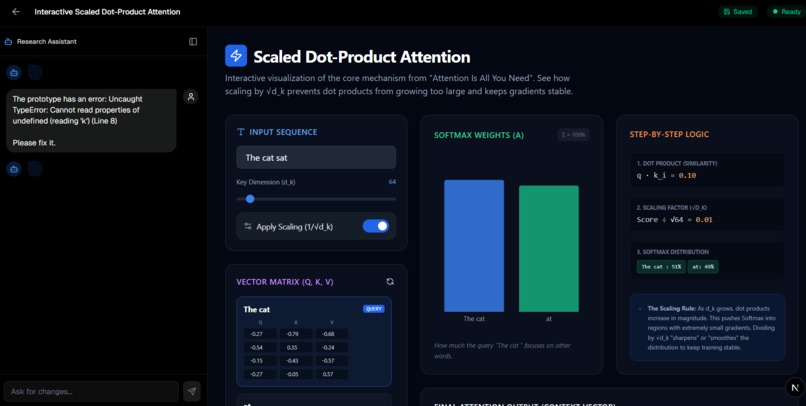
prototype view
Inspiration
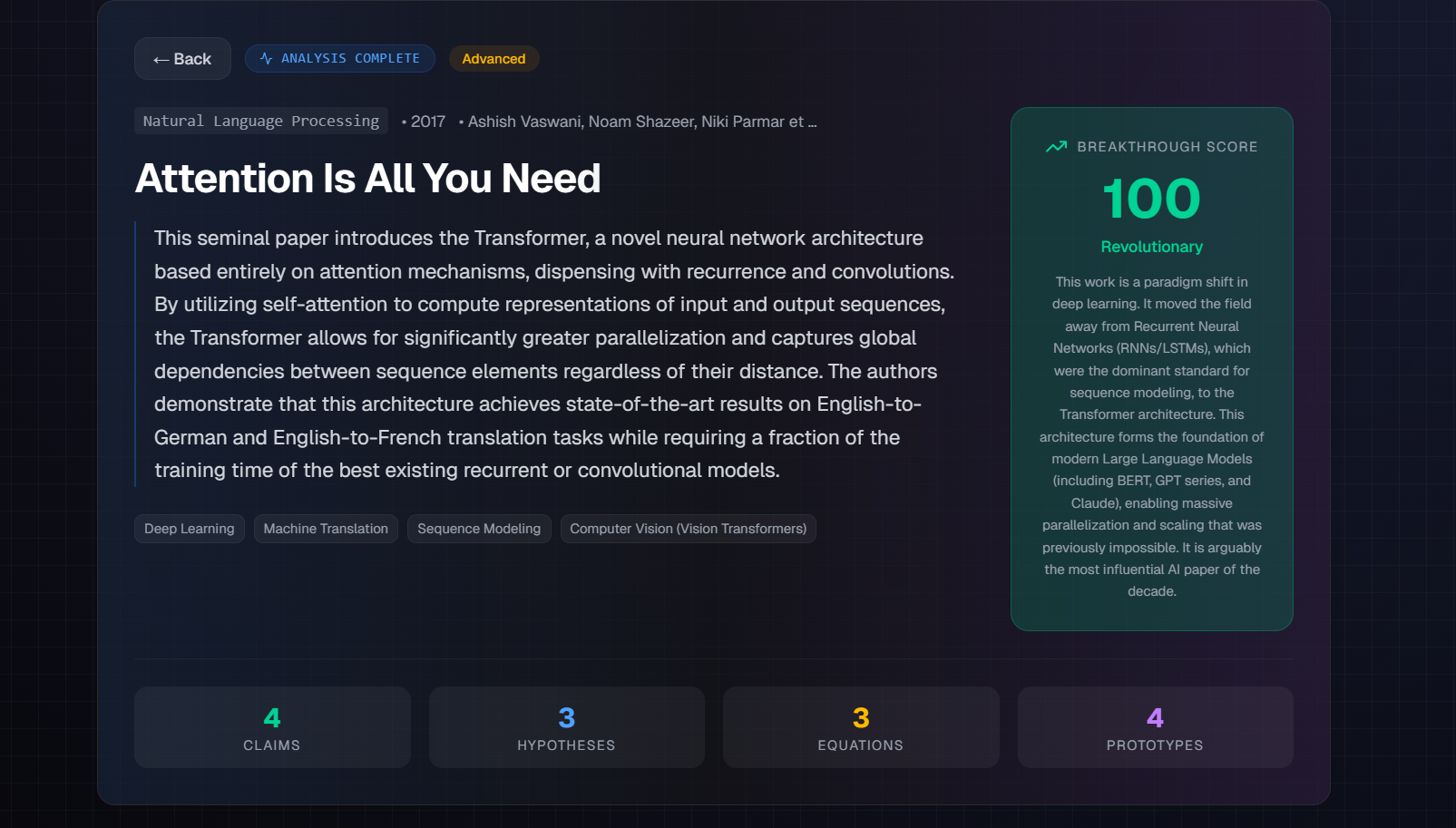
"Attention is All You Need" - a single research paper that sparked the Generative AI revolution. Yet every day, thousands of new papers are published across arXiv, IEEE, and countless journals. Hidden among them could be the next paradigm shift, the key to AGI, or a breakthrough that transforms entire industries.
The problem? Most papers are dense with mathematical notation, domain-specific jargon, and theoretical abstractions that make them inaccessible to non-specialists. Investors miss opportunities. Engineers overlook solutions. Brilliant ideas remain trapped in PDFs.
I envisioned an AI agent system that could autonomously:
- Digest any research paper
- Extract core algorithms and concepts
- Run simulations and test hypotheses
- Generate interactive prototypes you can actually experience
With Gemini 3's breakthrough reasoning capabilities, I built SciProto - a first step toward democratizing access to scientific knowledge and surfacing the hidden gems that could change everything.
What it does
SciProto transforms static research papers into living, interactive experiences powered by Gemini 3.
Upload Any Paper: Drop a PDF or browse the latest from arXiv. SciProto accepts papers from any domain - machine learning, physics, biology, economics.
AI-Powered Deep Analysis: Gemini 3 doesn't just summarize - it extracts:
- Core algorithms and their mathematical foundations
- Key innovations and how they differ from prior work
- Potential applications and real-world impact
- Testable hypotheses and simulation opportunities
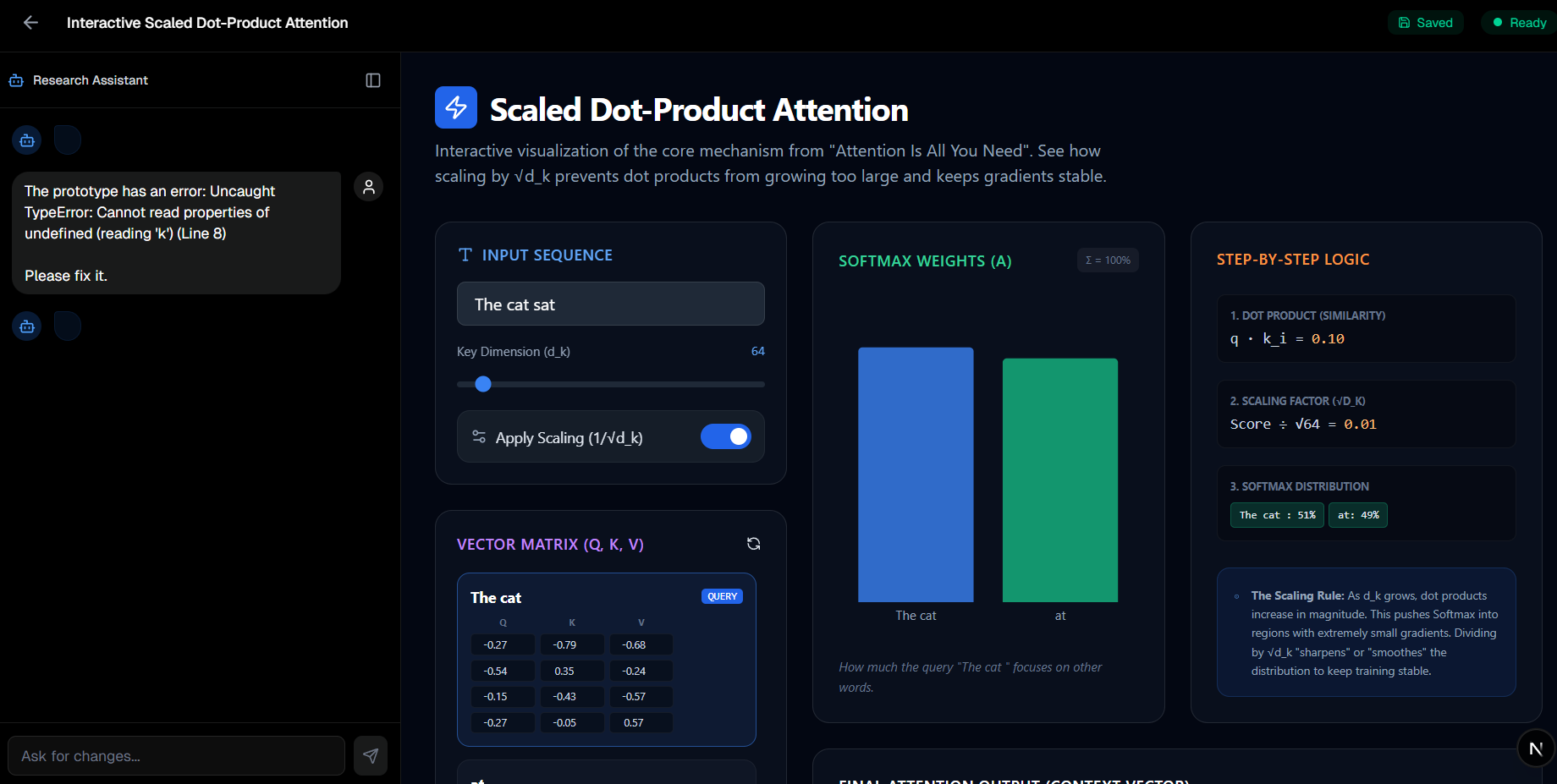
Interactive Prototypes: For each key concept, SciProto generates working React components with:
- Real-time parameter controls (sliders, toggles, inputs)
- Visual demonstrations of algorithms in action
- Explorable parameter spaces to build intuition
Conversational Exploration: Chat with an AI agent that has full context of the paper. Ask "What happens if we double the learning rate?" and watch the prototype adapt in real-time.
Discovery Engine: For researchers hunting the next breakthrough, SciProto surfaces papers that might otherwise take months to find and evaluate - turning weeks of reading into minutes of interactive exploration.
How we built it
Frontend: Next.js 15 with React, Framer Motion for fluid animations, and TailwindCSS for the dark, scientific aesthetic. The prototype renderer uses sandboxed iframes with real-time code injection.
AI Backend: Gemini 3 Pro and Gemini 3 Flash powers the entire system:
Paper Analysis: Gemini 3 Pro for full document comprehension extracts structure, algorithms, math, and insights in a single pass
Function Calling: Gemini 3 Flash uses structured tool calls to generate prototypes, retrieve paper context, and update visualizations based on chat commands
Streaming Responses: NDJSON streaming delivers analysis and chat responses in real-time, keeping the experience fluid
Key Technical Decisions:
- Deterministic prototype IDs: Paper hash + concept index creates stable URLs for sharing and caching
- Smart caching: Prototypes are generated once, reused forever - no wasted API calls
- Markdown-first chat: Agent responses render as rich markdown with code highlighting
- Error boundaries: Iframe sandboxing prevents malformed prototypes from crashing the app
arXiv Integration: Direct search and fetch from arXiv's API lets users discover papers without leaving the platform.
Challenges we ran into
Prototype Regeneration: Early versions regenerated prototypes on every page visit. Solved with content-hash-based IDs and proper cache state management. Streaming Complexity: Handling interleaved text and function calls in NDJSON streams required careful state management to display partial results while accumulating tool calls. Sandbox Security: Running AI-generated code safely required iframe sandboxing with postMessage communication for error boundaries.
Accomplishments that we're proud of
- Zero-to-prototype in seconds: Upload a paper, get interactive demos immediately
- True understanding: Gemini 3 correctly identifies algorithms even from dense mathematical notation
- Conversational iteration: "Add gravity" and watch the physics simulation update
- Beautiful UX: Animations, gradients, and responsive design make complex AI feel approachable
- Production-ready: Caching, error handling, and streaming create a polished experience ## What we learned Gemini 3's function calling is remarkably reliable - complex multi-turn conversations with embedded tool calls just work. The model's code generation quality means generated prototypes often run correctly on first attempt.
Most importantly: the gap between "reading a paper" and "understanding a paper" can be bridged with the right visualization. Interactive exploration builds intuition faster than any amount of passive reading.
What's next for SciProto
Immediate:
- Multi-paper comparison (how does this approach differ from X?)
- Export prototypes as standalone projects
- Collaborative annotations and highlights
Vision:
- Automated paper monitoring: Subscribe to arXiv categories, get daily digests of promising papers
- Impact prediction: Train on citation patterns to surface papers likely to be influential
- Investor pipeline: Match papers with potential commercial applications
- Full hypothesis testing: Move beyond visualization to actual computational validation
The goal: an AI research analyst that never sleeps, reading every paper so humans can focus on the breakthroughs that matter.
Built With
- arxiv-api
- gemini-3
- nextjs
- react
- tailwindcss
- typescript

Log in or sign up for Devpost to join the conversation.