-
architecture
-
dashboard_1
-
dashboard_2
-
performance
Inspiration
Machine-learning research is usually described as a search over models: train one candidate, compare a score, and keep the best checkpoint. We found that the harder problem is the researcher itself.
An autonomous coding agent can run experiments and write impressive reports, but a long-running trajectory gradually accumulates momentum. It remembers unfinished hypotheses, debugging detours, and its own assumptions about what should work. Over time, it may become very good at optimizing one local basin while becoming less willing to explore a different one.
Starting a new agent from zero avoids that lock-in, but also discards valuable evidence, failed experiments, evaluator knowledge, and engineering lessons. We wanted a system that could preserve the science without preserving the trajectory.
That led to our guiding principle:
A fresh Scientist should inherit the experience, not the momentum.
What it does
Our system runs bounded, evidence-driven machine-learning research. It gives an agent enough autonomy to choose hypotheses, modify code, run experiments, and interpret results, while keeping the research world durable between agent trajectories.
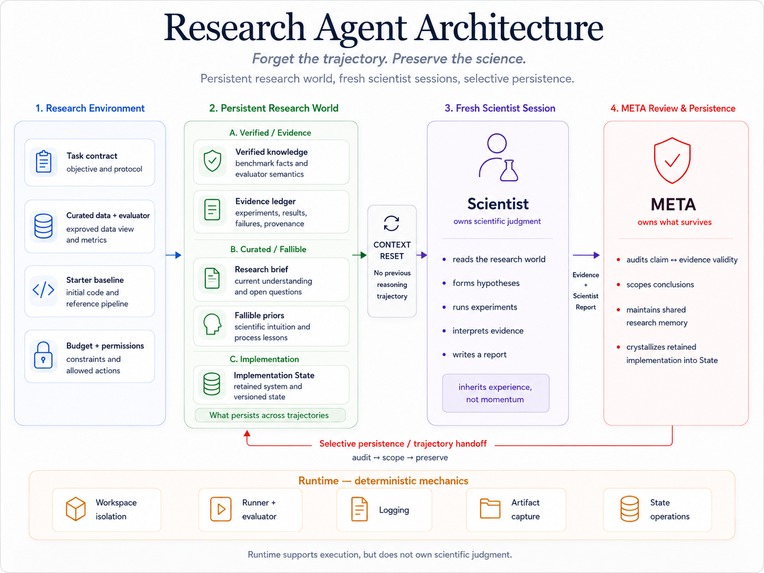
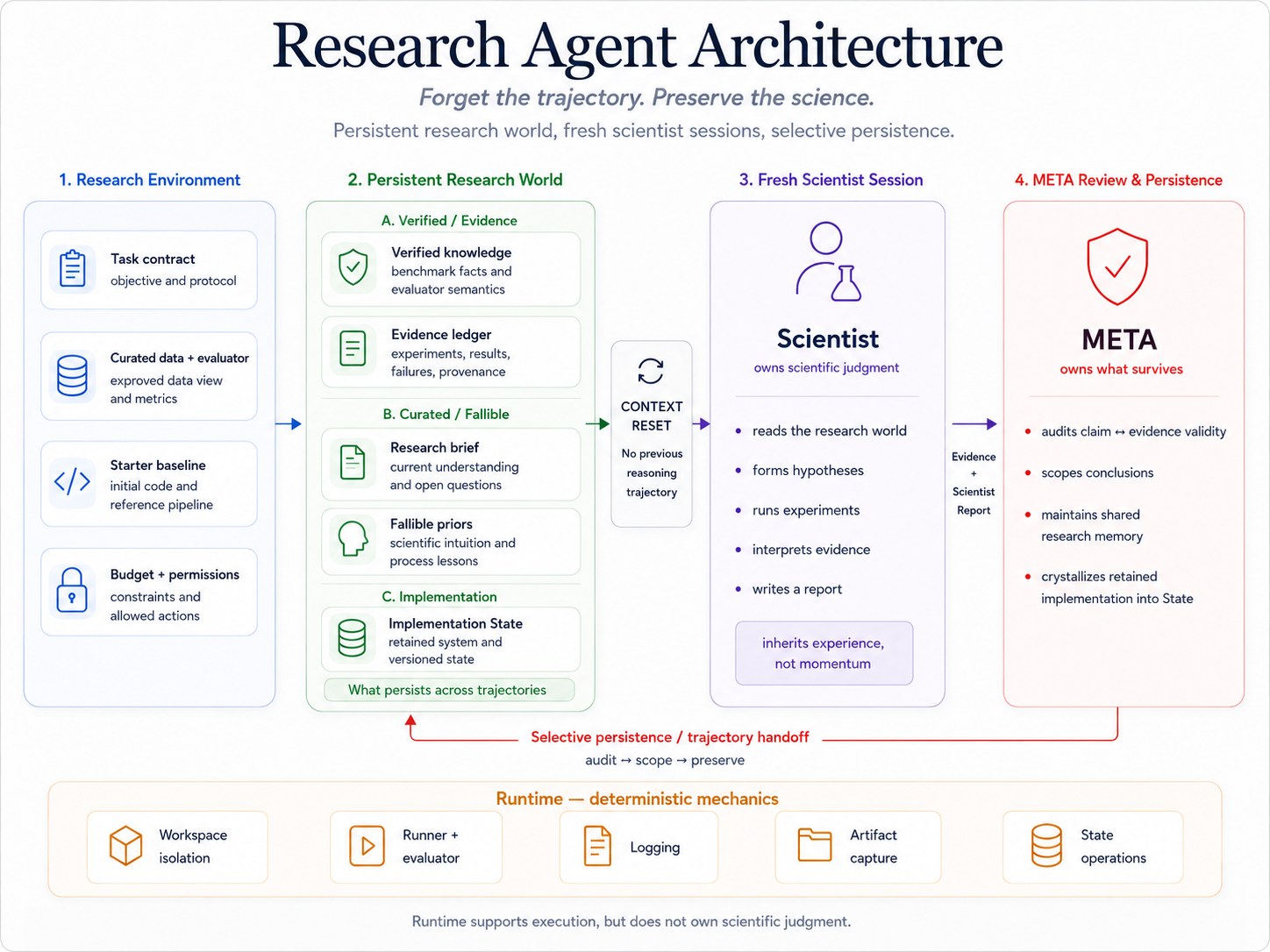
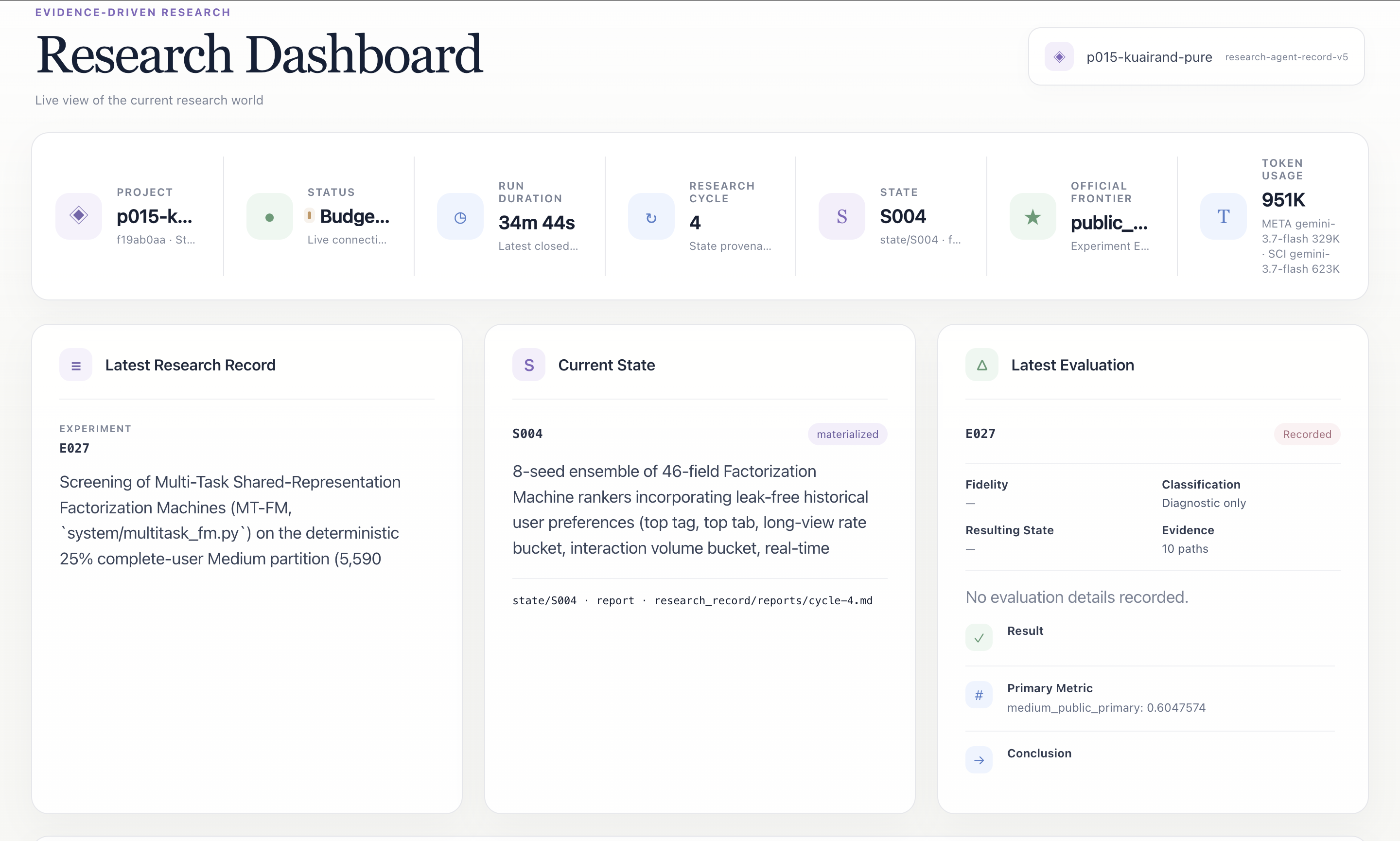
The system has two scientific roles—not three. The critical insight is that Scientist and META operate on fundamentally different time horizons, and that asymmetry is the core of the design:
Scientist lives inside a single research trajectory. Its job is scientific judgment: forming hypotheses, implementing candidates, running experiments, and interpreting the evidence it sees in its session. A Scientist's authority and context are intentionally local—it does not persist across handoffs.
META lives across trajectories. It audits a Scientist's report against actual artifacts, decides what knowledge is durable enough to enter the shared research world, and crystallizes strong implementations into versioned States. Because META spans many sessions, its synthesis horizon is fundamentally longer than any single Scientist's reasoning window.
The temporal asymmetry between META and Scientist is not incidental: a Scientist that ran yesterday appears to the current Scientist only through the research world META maintained—not through shared context, not through inherited reasoning. The deterministic process mechanics—isolation, budgets, provenance, cancellation—are infrastructure, not a third scientific voice. This is what makes trajectory reset safe without losing progress.
When one Scientist stops, the next one can start with the current State, research brief, evidence ledger, negative results, and scientific intuition— without inheriting the previous model's unfinished chain of thought.
How we built it
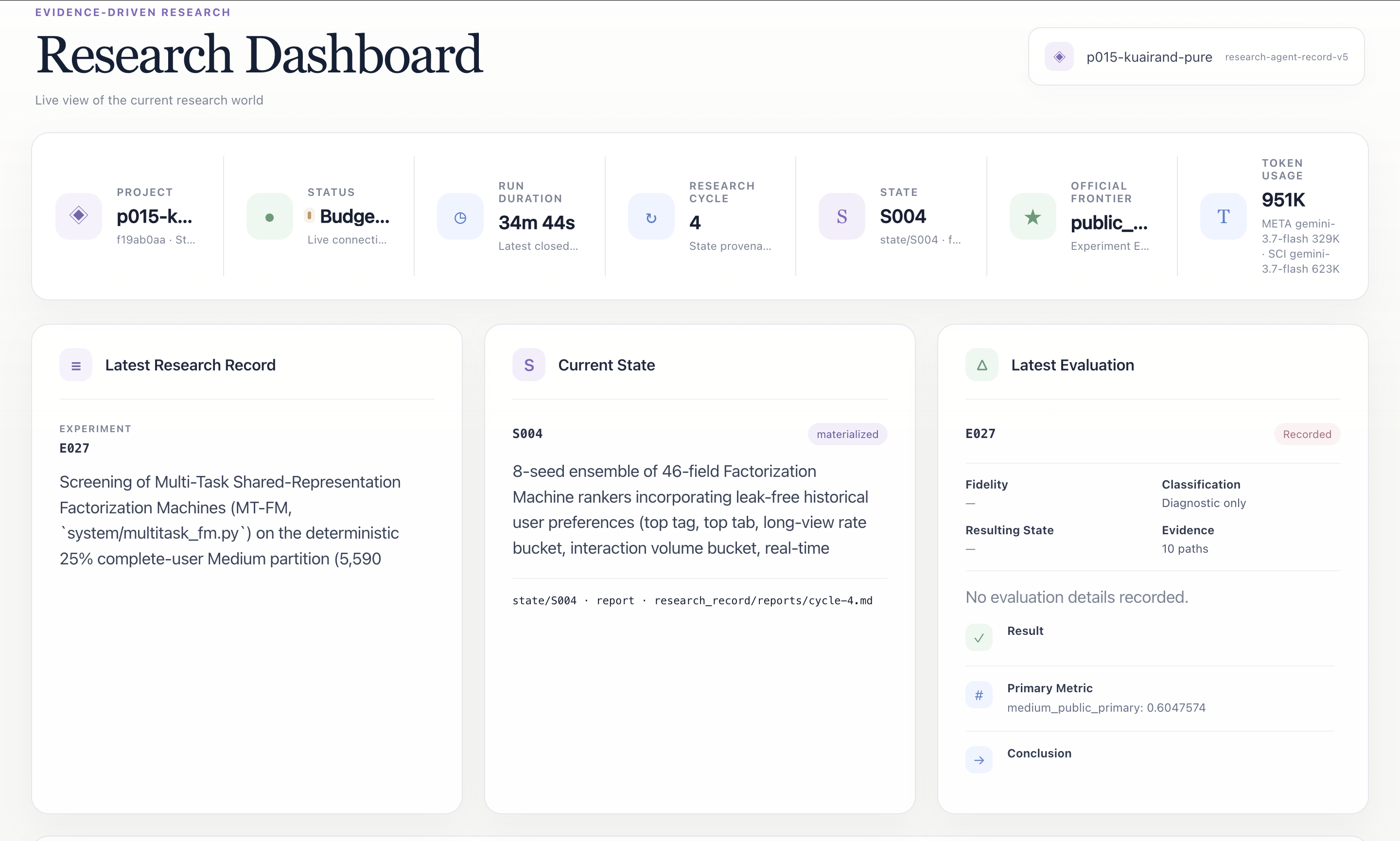
We built a persistence boundary around a simple research loop. Each cycle begins with a fresh Scientist reading the inherited research world, forming hypotheses, implementing experiments, and writing a session report. META then audits the report against actual artifacts, decides what knowledge is durable enough to survive, and updates the world before the next Scientist begins. Evidence is permanent; private reasoning is not.
The research world stores different kinds of information separately:
| Layer | What it stores |
|---|---|
| Evidence | Metrics, logs, code diffs, provenance, and failed experiments |
| Verified knowledge | Dataset facts, evaluator semantics, and reusable environment knowledge |
| Research state | The current understanding, open questions, and strongest checkpoint |
| Scientific intuition | Useful but explicitly fallible hypotheses and process lessons |
| Implementation State | The reproducible code and versioned retained artifact |
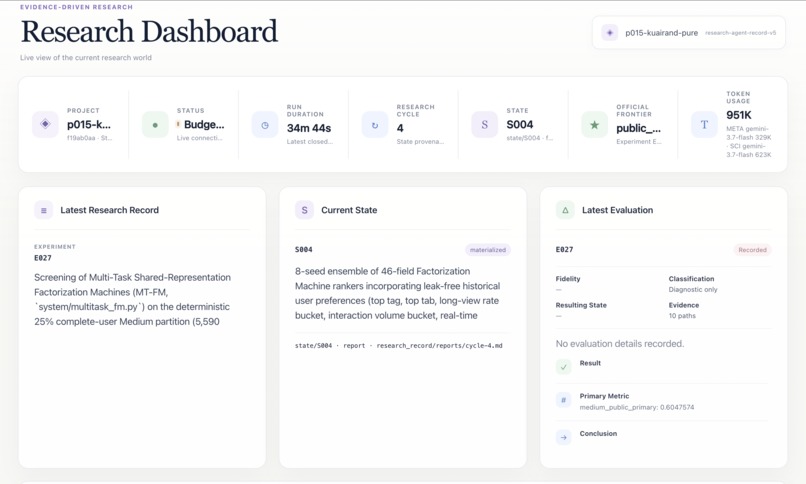
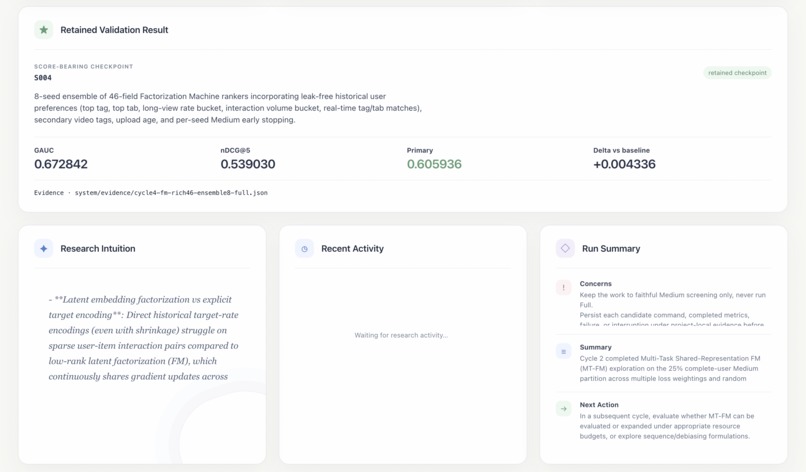
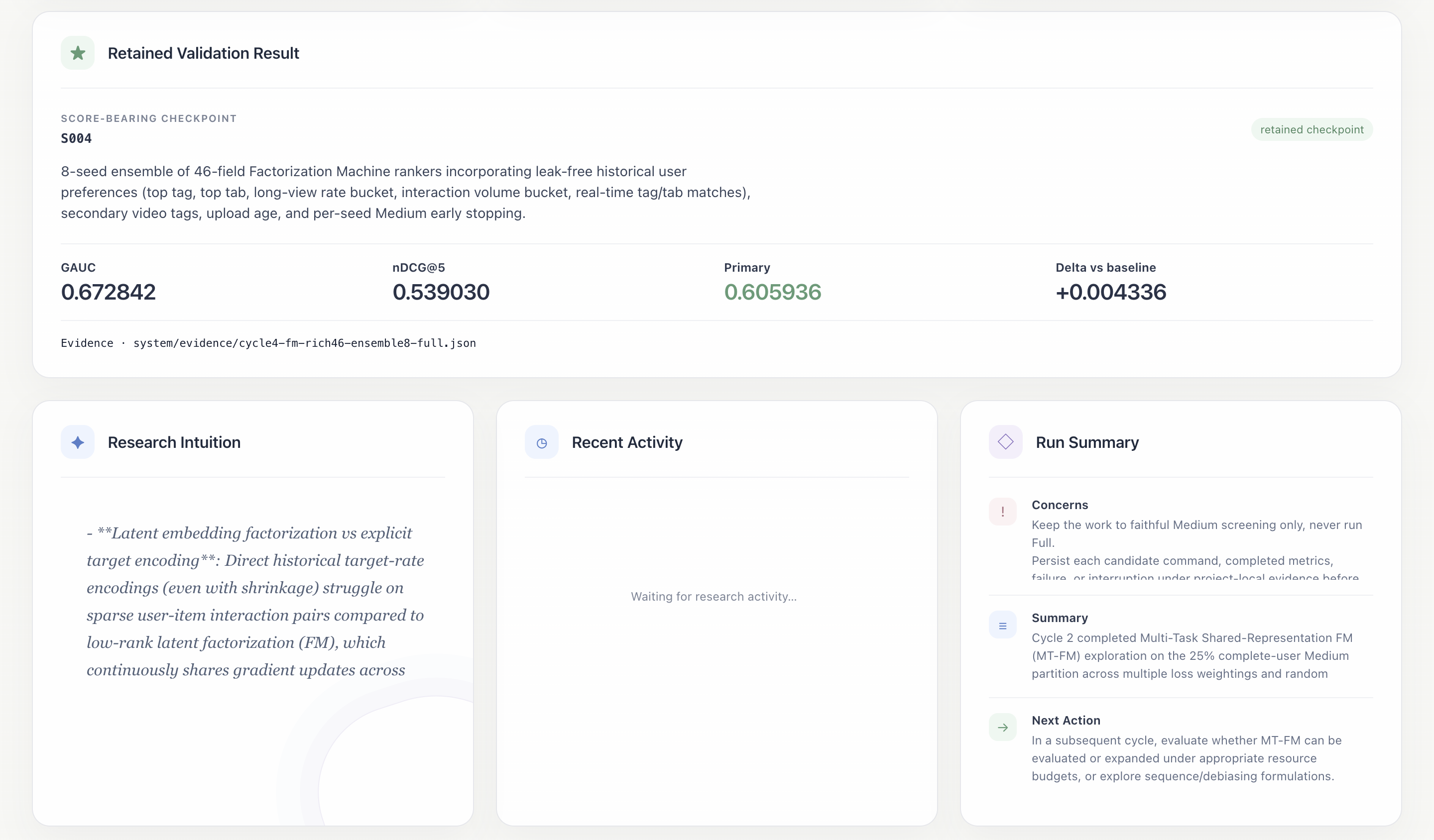
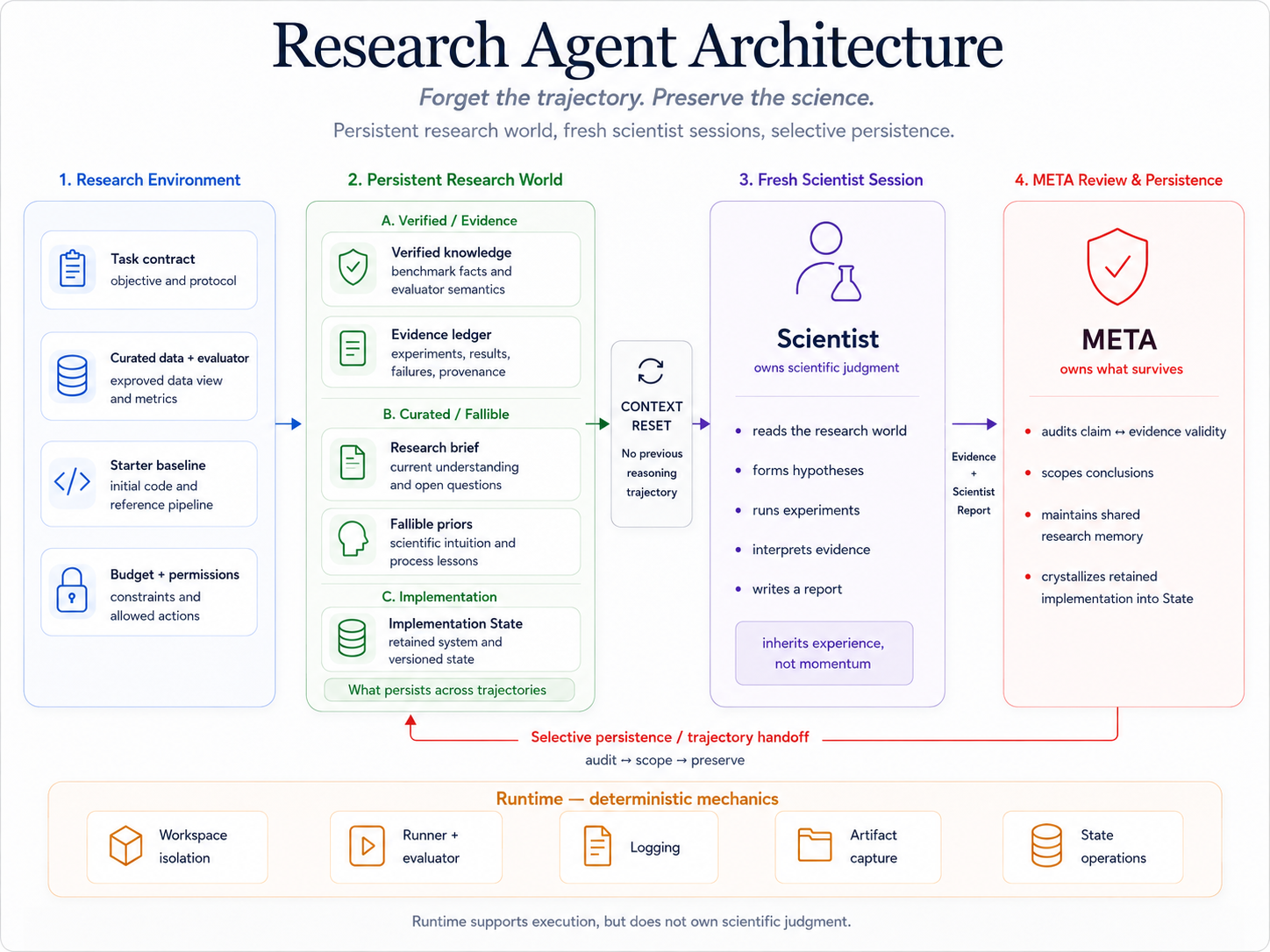
For the benchmark proof point, we evaluated the system on TikTok TechJam 2026 Problem 2 using the required KuaiRand-Pure dataset. The final submitted ranker is a CPU-only NumPy ensemble of eight Factorization Machines. It uses 46 categorical fields: 38 baseline demographic, video, and context fields plus 8 leakage-safe historical preference, affinity, matching, interaction-volume, and video-age features.
The research protocol enforced a strict public-validation boundary. The organizer's Starter Kit evaluator was unchanged, hidden/test labels were not used for development or model selection, and the final prediction file passed the official alignment checker.
The development stack was Python 3.12, NumPy, uv, and Git, with Research
Agent orchestrating authenticated AGY, Codex, and Gemini coding-agent CLIs. The
only training data was the organizer-provided KuaiRand-Pure split; no external
training data or pretrained weights trained on benchmark test labels were used.
No application API was integrated directly; LLM access was mediated by those
authenticated CLI tools.
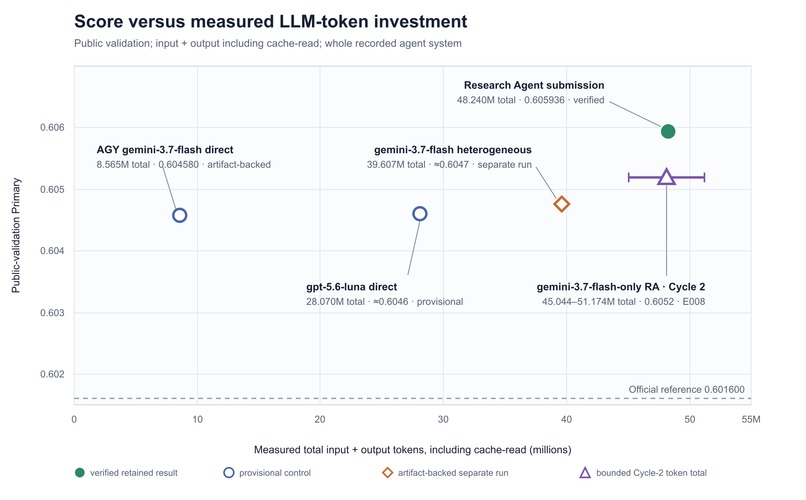
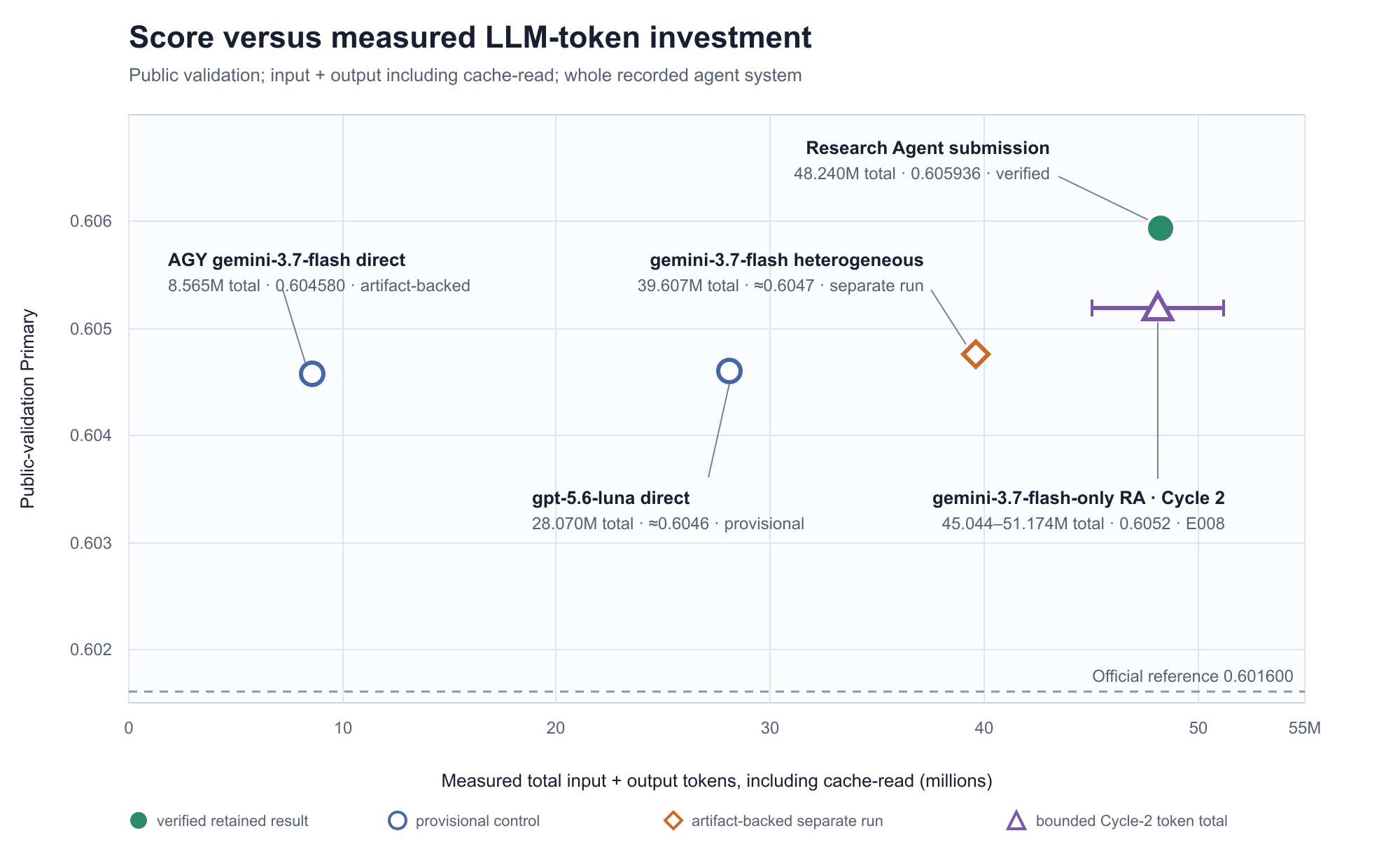
Across the four retained cycles, measured LLM consumption was 48,240,128 total input + output tokens including cache-read input (4,020,880 excluding cache-read). Combined agent wall-clock was 1h 55m 29s, and training and evaluation used 0 GPU-hours. These are telemetry measurements rather than claims about subscription pricing or plan quotas.
Challenges we ran into
Persistence is not automatically memory. If we preserve an entire conversation, we also preserve its biases and unfinished commitments. If we preserve nothing, every new trajectory wastes time rediscovering the evaluator and repeating failed experiments. We had to decide what should survive, who should curate it, and what evidence each claim actually supports.
Scientific validity is harder than a passing metric. A higher score can come from a real improvement, leakage, an evaluation mismatch, or an implementation that does not match its report. We therefore treated every score as an evidence object: the implementation, data split, command, metrics, and interpretation had to remain connected.
Operational fragility in long-horizon runs. Long-horizon agents use heterogeneous CLIs, finite token budgets, and imperfect workspace tooling. In one baseline attempt, the CLI silently fell back to a global scratch workspace. The run returned a plausible score, but the artifacts were not in the requested target. We fixed this by explicitly binding each run to a new target project, adding independent post-run scoring, and excluding results that could not be attributed to the correct workspace.
Parallelism at the wrong granularity is expensive and unrewarding. We explored both task-level and trajectory-level parallelism. Task-level parallel runs—multiple agents working within the same research cycle simultaneously— consumed tokens at a much higher rate without producing proportionally better results. The diversity was not there: agents sharing the same current context tend to converge on similar directions regardless of their model family. In contrast, trajectory-level parallelism—independent Scientist sessions each starting from the same research world but developing entirely separately— produced meaningfully different approaches and better exploration. The right level to parallelize is the trajectory, not the task.
Accomplishments that we're proud of
We are proud that the system improved both the research process and the benchmark result.
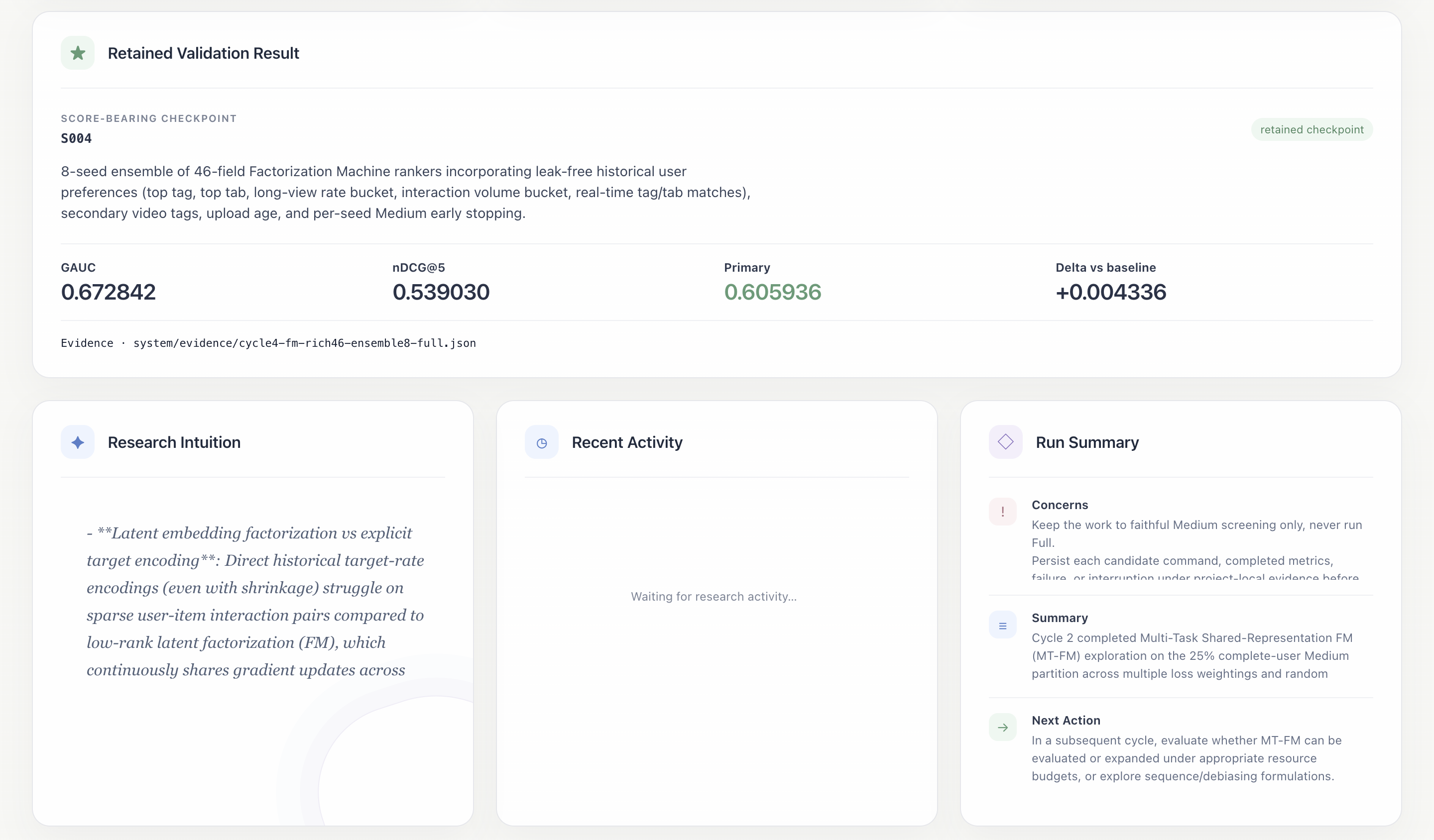
| Checkpoint | GAUC | nDCG@5 | Primary |
|---|---|---|---|
| Official five-field FM | 0.6674000 | 0.5357000 | 0.6016000 |
| Final retained submission | 0.6728421 | 0.5390304 | 0.6059363 |
| Improvement | +0.0054421 | +0.0033304 | +0.0043363 |
The retained trajectory reached this result through four autonomous META–Scientist cycles and 13 named experiments, with zero post-launch manual scientific interventions, 48,240,128 total input + output tokens including cache-read input, and zero GPU-hours. The submitted implementation runs with NumPy on CPU, uses eight Factorization Machine seeds, and includes the evidence needed to reproduce and audit the final checkpoint.
The highest-scoring trajectory was also the most heterogeneous one. The
Scientist role rotated across model families across four cycles—gpt-5.6-sol
in cycle 1, gemini-3.7-flash in cycles 2 and 4, and gpt-5.6-luna in
cycle 3—while META used gemini-3.7-flash throughout. We believe the rotation
mattered: different model families appear to have different internal blind
spots, and switching the Scientist at trajectory boundaries may sample from
parts of the hypothesis space that a single model family would consistently
underweight.
What we learned
Autonomy is not a context-window problem. The quality of autonomous research depends on the boundary between temporary reasoning and durable knowledge—not on how much the agent can hold in memory at once.
Models have distinct research personalities, and those personalities have consequences. We observed consistent behavioral differences across model families when used as Scientist:
gpt-5.6-lunatends to be conservative and depth-first. It deepens the current direction rather than pivoting broadly—strong at exploitation, weaker at exploration when the current basin is nearly exhausted.gemini-3.7-flashtends toward breadth-first traversal. It explores more alternatives within a trajectory and is more willing to try qualitatively different directions, but without supervision it is more likely to introduce subtle coding errors—a failure mode that compounds over long sessions.
This suggested a natural pairing: gpt-5.6-luna as META (conservative,
good at auditing evidence, resistant to plausible but unsupported claims) and
gemini-3.7-flash as Scientist (exploratory, willing to challenge the
current framing). The roles are matched to the behavioral priors of each
model family.
Model-switching at the Scientist level may help overcome internal blind spots. Our best result came from a trajectory that rotated the Scientist role across model families. A single model's persistent search bias—whatever it reliably overlooks or underweights—becomes a real constraint over many cycles. Switching models at trajectory boundaries appears to be a practical way to sample different parts of the hypothesis space without requiring a formal diversity mechanism.
Negative results are first-class research assets. A failed feature family or an invalid run can save future trajectories from repeating the same mistake— provided the failure is recorded with the right scope and provenance.
Evaluation discipline is part of the model. Public validation, unchanged tooling, explicit artifact paths, and independent re-scoring made it possible to distinguish a promising idea from a merely plausible narrative. The system's best result became more valuable because we could explain not only what improved, but why we trusted the improvement.
What's next: Autonomous ML Discovery through Pure Evidence
The most important open question is whether model-switching at the Scientist level is a reliable diversity mechanism. Does rotating model families systematically explore different research basins, or was the gain in our trajectory attributable to other factors? We want to run controlled studies that vary model assignment across otherwise identical research worlds.
We also want to understand when trajectory-level parallelism is worth its budget: how much exploration does each independent branch add, and which branching conditions produce the most complementary evidence?
More broadly, we plan to measure the quality of knowledge handoff. Which kinds of scientific intuition survive a reset intact? Which get compressed into anchors that constrain the next Scientist as much as momentum would have?
The long-term goal is a research system that gets better over time without requiring one agent to think forever—and without inheriting the search biases of any particular model family that thought along the way.
Links
Built With
- antigravity
- claude
- cli
- codex
- multiagent


Log in or sign up for Devpost to join the conversation.