## Inspiration
Scientific research is advancing at an unprecedented pace, with millions of new papers published every year across disciplines. Yet many groundbreaking discoveries remain hidden because valuable connections between fields are overlooked. Existing AI tools primarily help researchers search, summarize, or analyze literature, but few actively assist in discovering what hasn't been explored. We were inspired to build a platform that goes beyond information retrieval—one that acts as an autonomous scientific collaborator capable of identifying research gaps, generating novel hypotheses, and accelerating interdisciplinary innovation.
What it does
The Scientific Discovery Operating System (SDOS) is an AI-powered platform designed to automate and enhance the scientific discovery process.
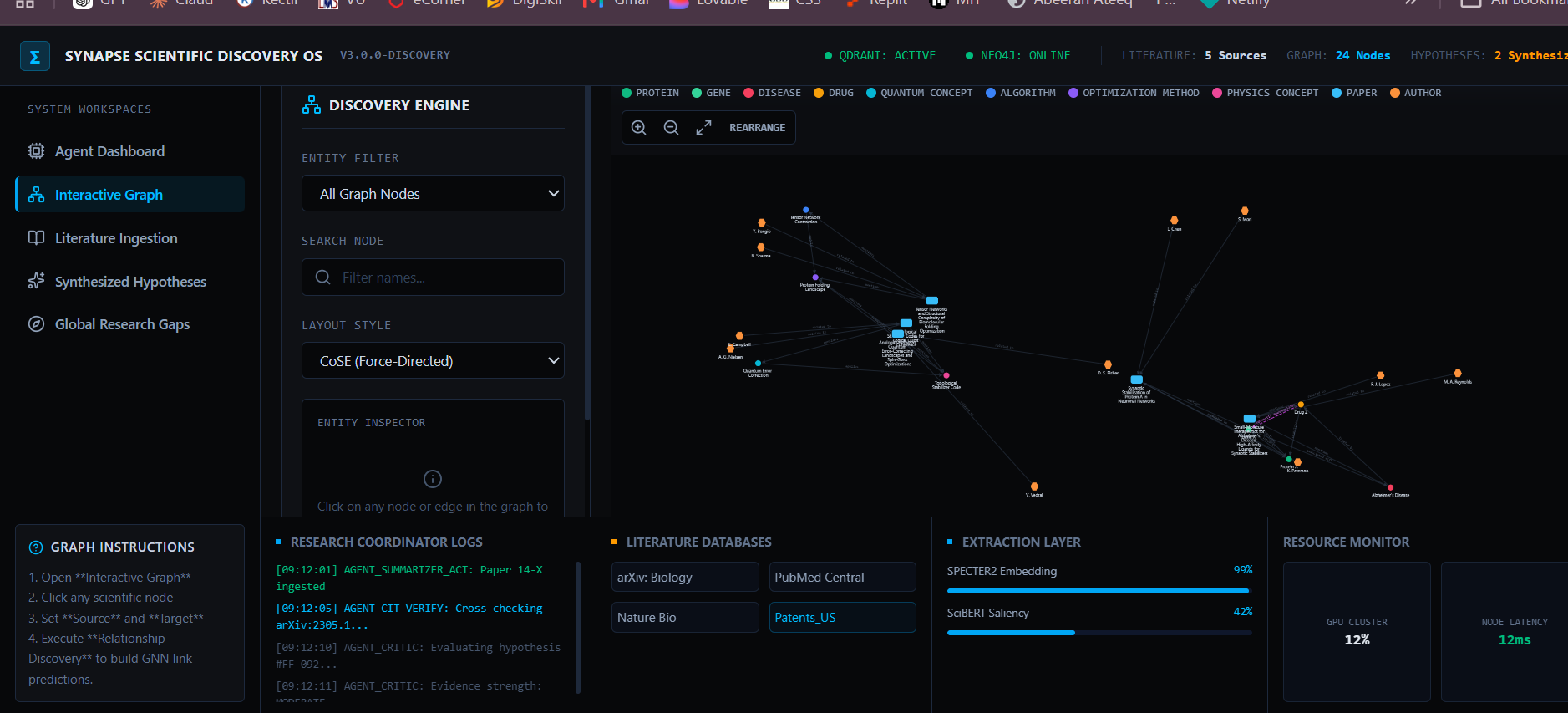
SDOS ingests scientific papers, extracts structured knowledge, and builds dynamic knowledge graphs that evolve over time. It identifies unexplored interdisciplinary research opportunities, predicts missing relationships using graph intelligence, generates multiple research hypotheses through a multi-agent reasoning pipeline, and ranks them using a proprietary Discovery Value Score (DVS) based on novelty, feasibility, impact, cost, and scientific potential.
The platform also resolves contradictory findings in literature, generates experimental validation protocols, tracks the lifecycle of discoveries through a Living Scientific Memory, and autonomously analyzes newly published research to deliver an overnight Morning Scientific Briefing highlighting potential breakthroughs.
How we built it
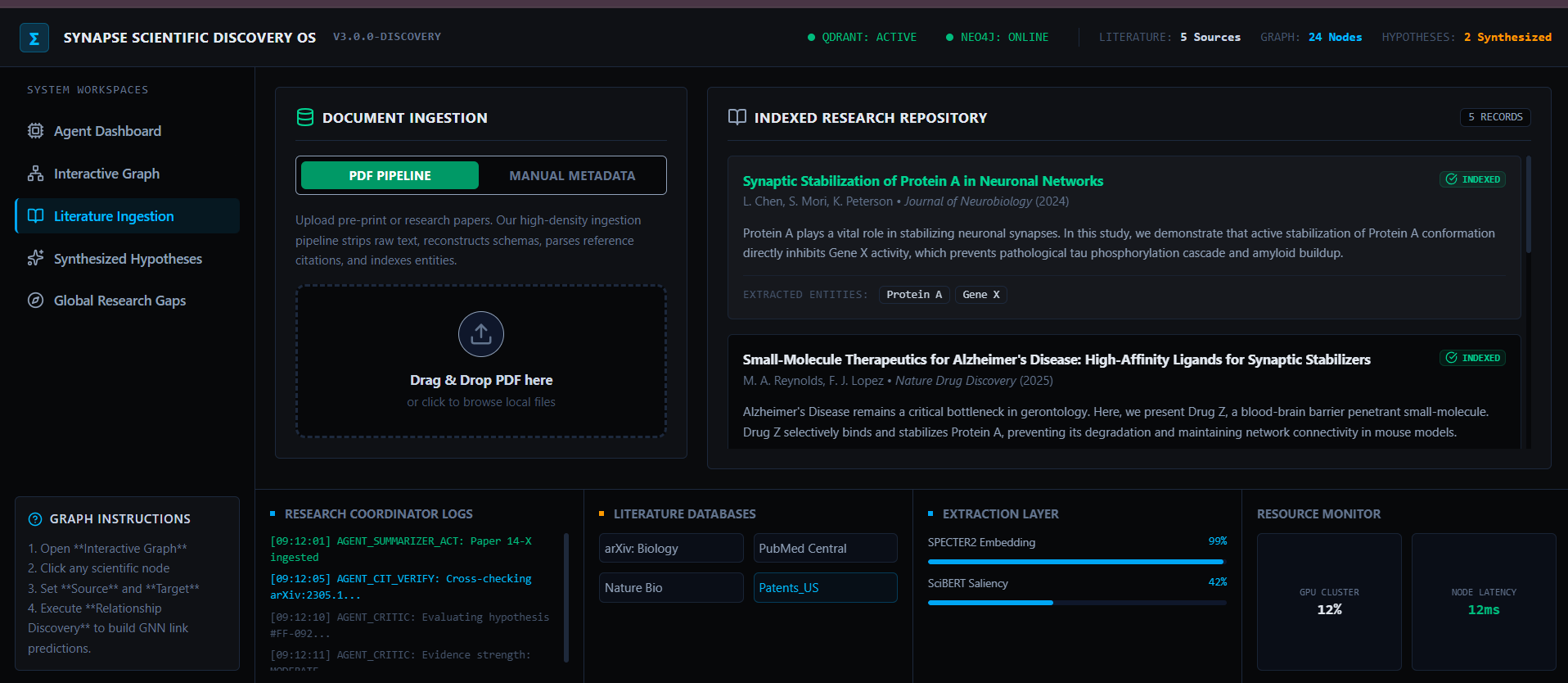
We built SDOS as a full-stack AI platform using React, TypeScript, Tailwind CSS, Cytoscape.js, Node.js, Express, and Google Gemini. Scientific literature is processed through a document ingestion pipeline capable of extracting metadata, references, and entities from research papers.
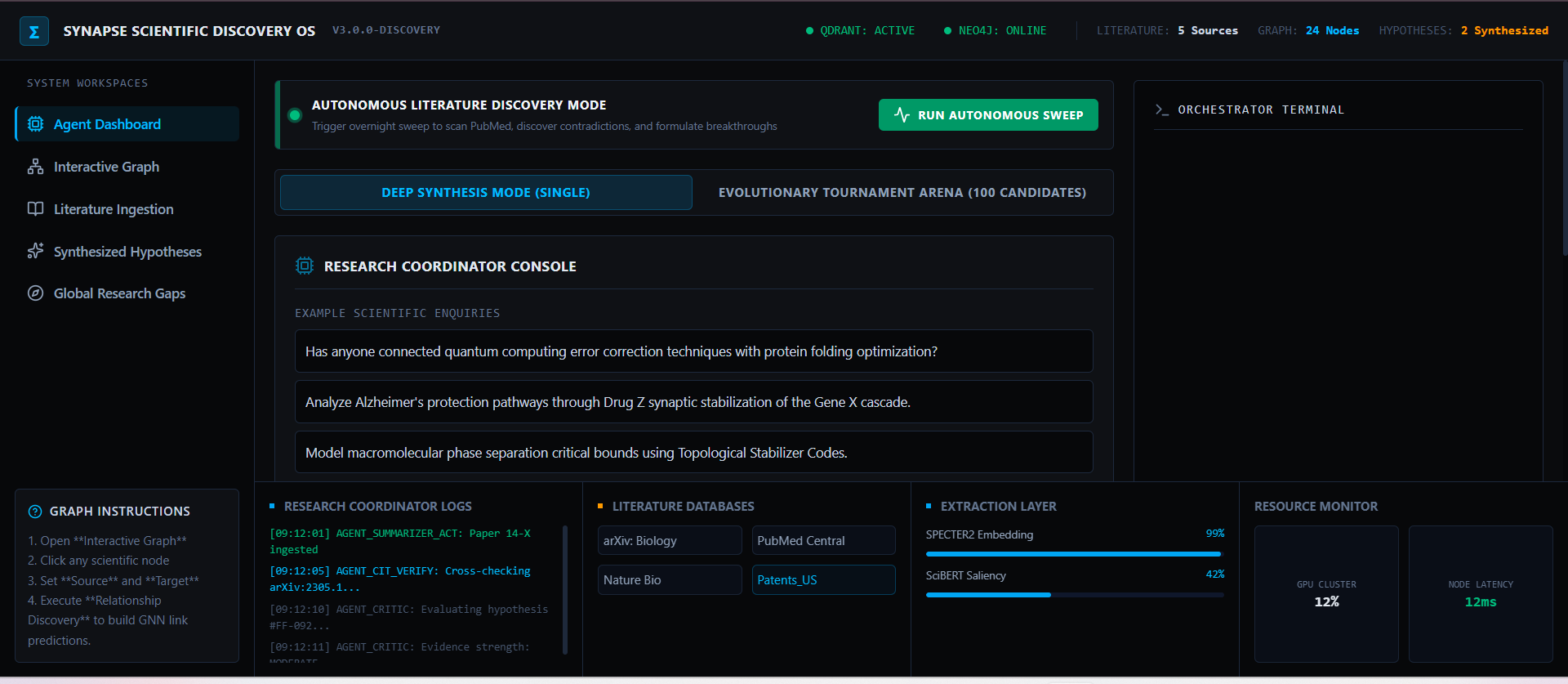
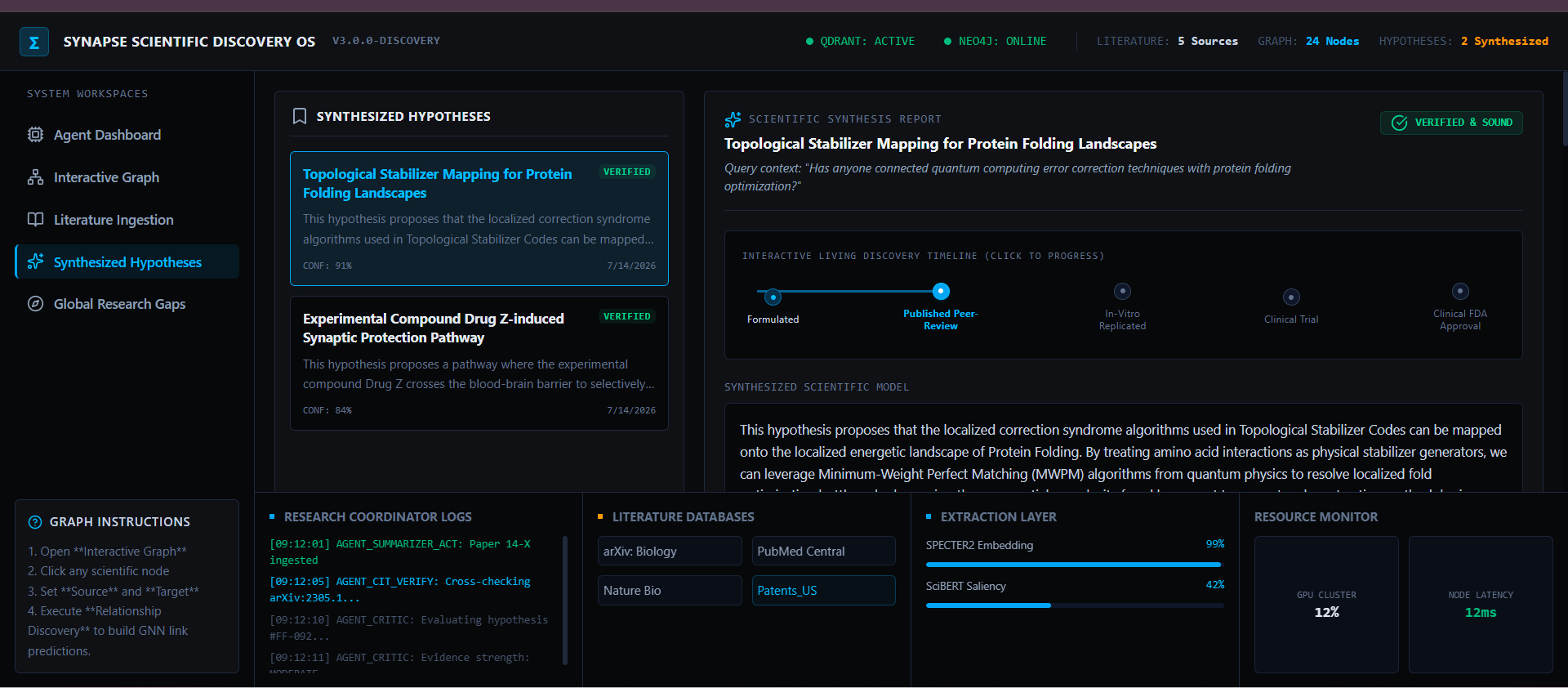
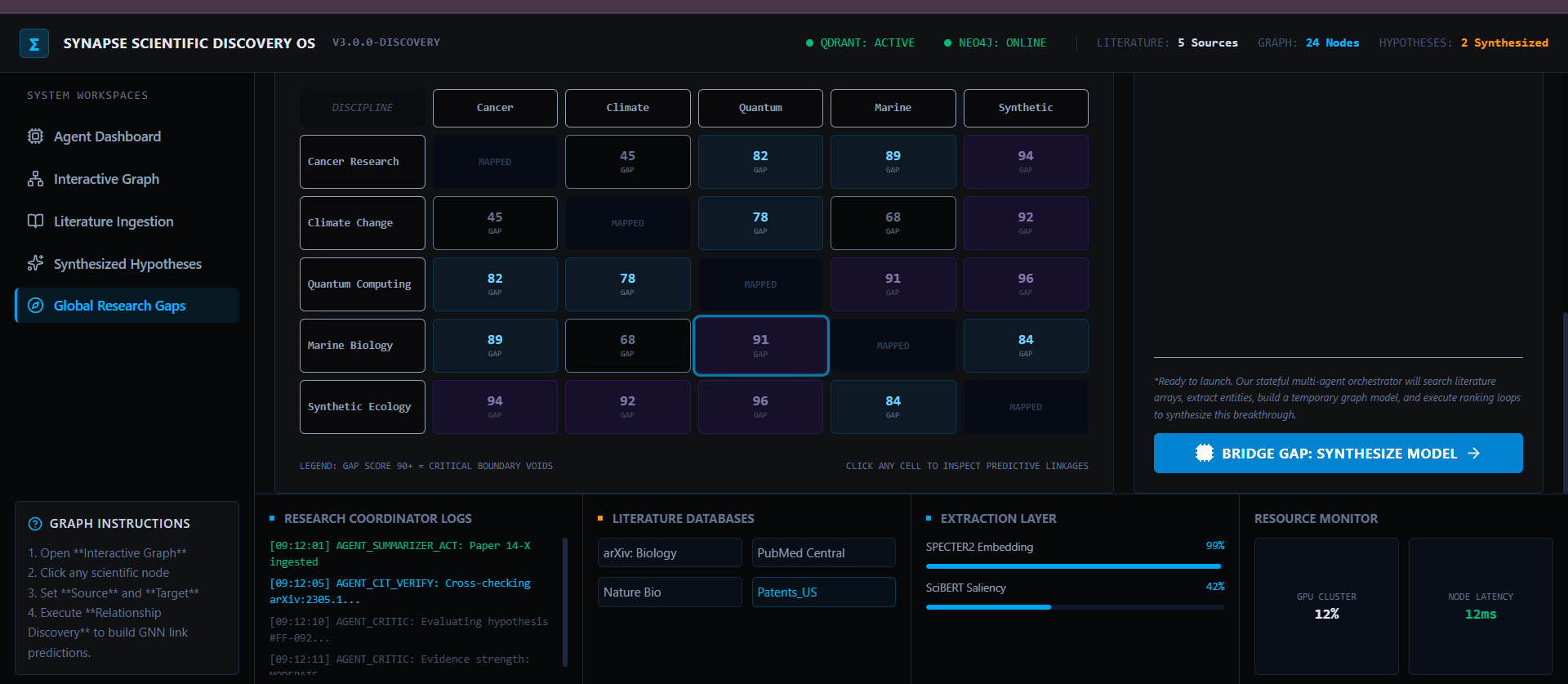
The extracted information is organized into a knowledge graph, enriched with graph-based relationship analysis and AI reasoning. A multi-agent orchestration workflow coordinates specialized agents responsible for literature analysis, hypothesis generation, contradiction detection, ranking, and scientific evaluation. Interactive dashboards visualize knowledge graphs, discovery timelines, literature gaps, experimental protocols, and autonomous research progress in real time.
Challenges we ran into
One of the biggest challenges was designing an architecture capable of modeling the scientific discovery process instead of simply building another AI chatbot. Creating meaningful interactions between knowledge graphs, hypothesis generation, contradiction analysis, and autonomous workflows required significant system design.
Another challenge was balancing scientific complexity with usability. We wanted researchers to interact with sophisticated AI reasoning while maintaining an intuitive and information-dense interface. Designing explainable outputs, prioritization metrics, and interactive visualizations also required careful iteration.
Accomplishments that we're proud of
We're proud of transforming the project from a literature analysis tool into a comprehensive Scientific Discovery Operating System.
Some of our favorite achievements include:
- Autonomous literature ingestion and knowledge graph generation.
- Multi-agent hypothesis generation with evolutionary tournament evaluation.
- Discovery Value Score (DVS) for prioritizing research opportunities.
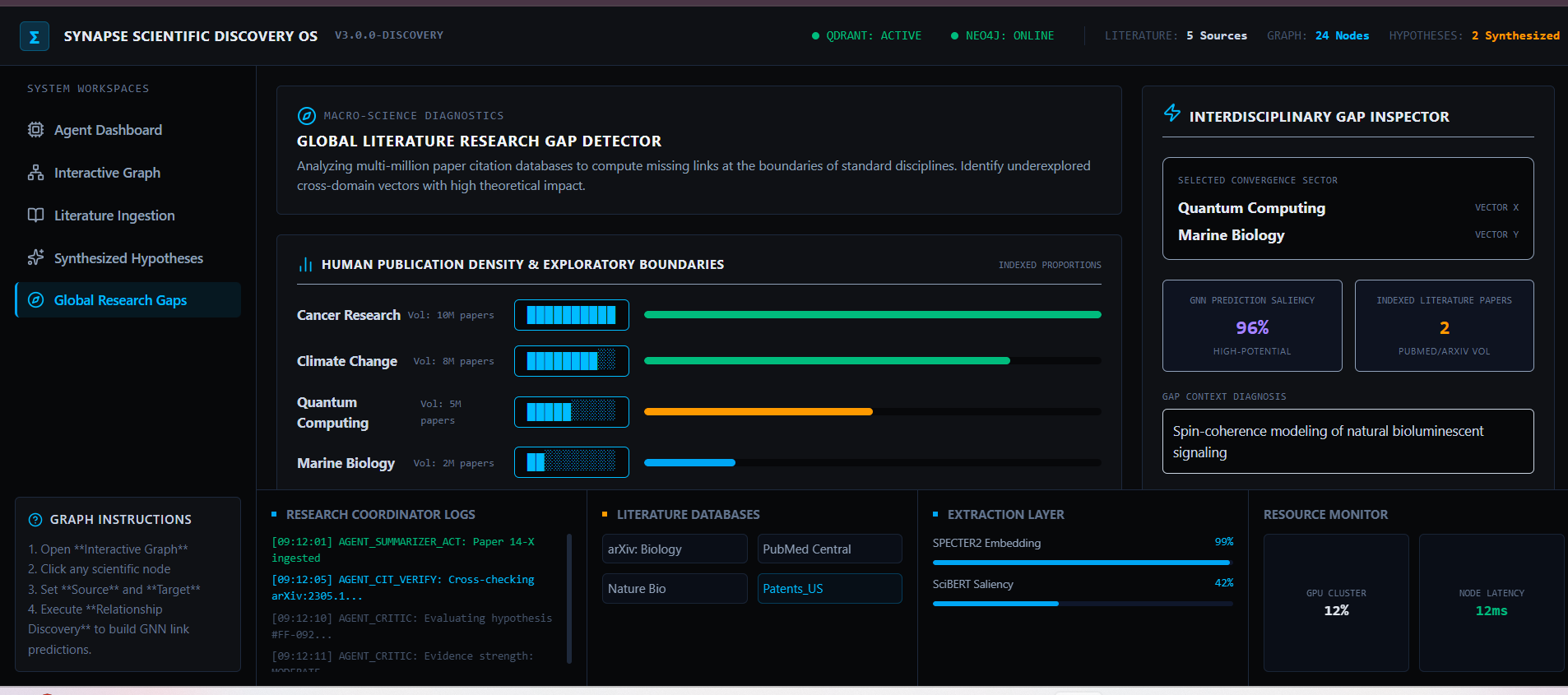
- Interactive Global Research Gap Detector for identifying underexplored scientific intersections.
- Contradiction Engine with "If This Is True..." implication analysis.
- Living Scientific Memory that tracks discoveries from hypothesis through validation.
- Autonomous Discovery Mode that performs continuous literature analysis and produces a Morning Scientific Briefing.
Together, these components create a unified platform that supports the complete scientific discovery lifecycle rather than isolated research tasks.
What we learned
This project taught us that scientific discovery is not a single AI problem—it is an orchestration problem involving knowledge representation, reasoning, graph intelligence, explainability, and human-AI collaboration.
We also learned the importance of designing AI systems that provide transparent reasoning rather than only generating answers. Combining knowledge graphs with large language models produces more explainable and actionable insights than relying on language models alone.
What's next for Scientific Discovery Operating System (SDOS)
Our vision is to evolve SDOS into a true autonomous scientific collaborator.
Future development includes integrating real-time scientific databases such as PubMed and arXiv, deploying graph neural networks for advanced missing-link prediction, incorporating laboratory simulation environments for experiment validation, and enabling collaborative research workspaces where teams can co-develop and evaluate AI-generated hypotheses.
We also plan to benchmark SDOS against real scientific discoveries, continuously improve its reasoning using validated outcomes, and expand it into a cross-disciplinary platform capable of accelerating breakthroughs in healthcare, climate science, materials engineering, biotechnology, and beyond.
Built With
- css
- cytoscape.js
- fastapi
- langgraph
- llm
- next.js
- node.js
- react
- react-flow
- tailwind
- typescript


Log in or sign up for Devpost to join the conversation.