Inspiration
Reproducing a scientific result should not require reconstructing a maze of model files, scripts, solver settings, and screenshots. Computational model developers need to know not only what a simulation produced, but whether the implementation can be traced, rerun, and checked against an independent reference.
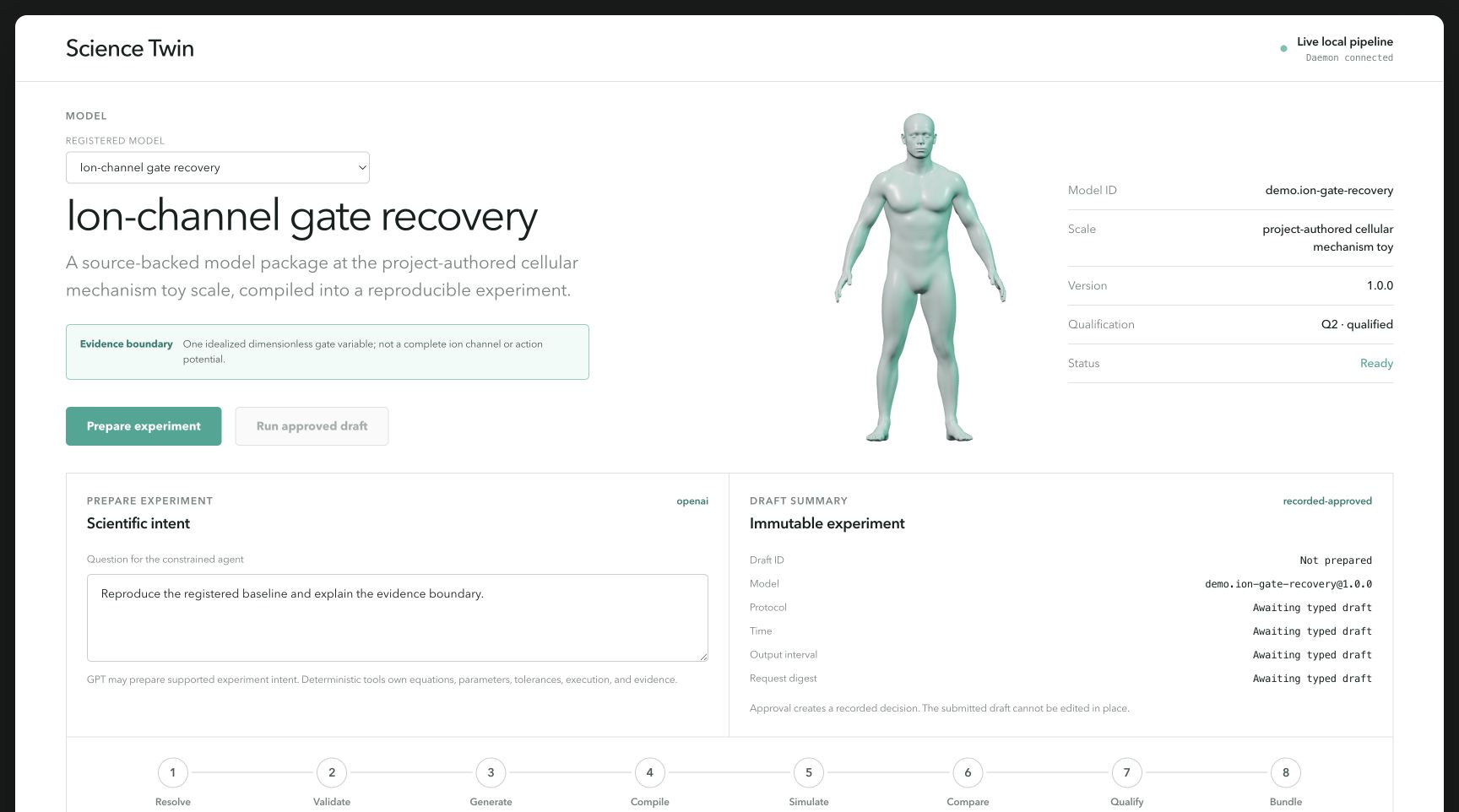
Science Twin turns that workflow into a developer tool: a supported physiological model and a plain-English question become an inspectable, user-approved experiment with a reproducibility package.
What it does
A developer selects a registered model and describes a bounded experiment. GPT-5.6 interprets the request through seven constrained tools and prepares a typed draft. The developer approves that exact immutable draft.
Deterministic code then:
- imports the CellML source;
- validates units, equations, dependencies, and initialization;
- generates traceable Rust;
- compiles it inside a policy-bound Docker environment;
- executes the simulation;
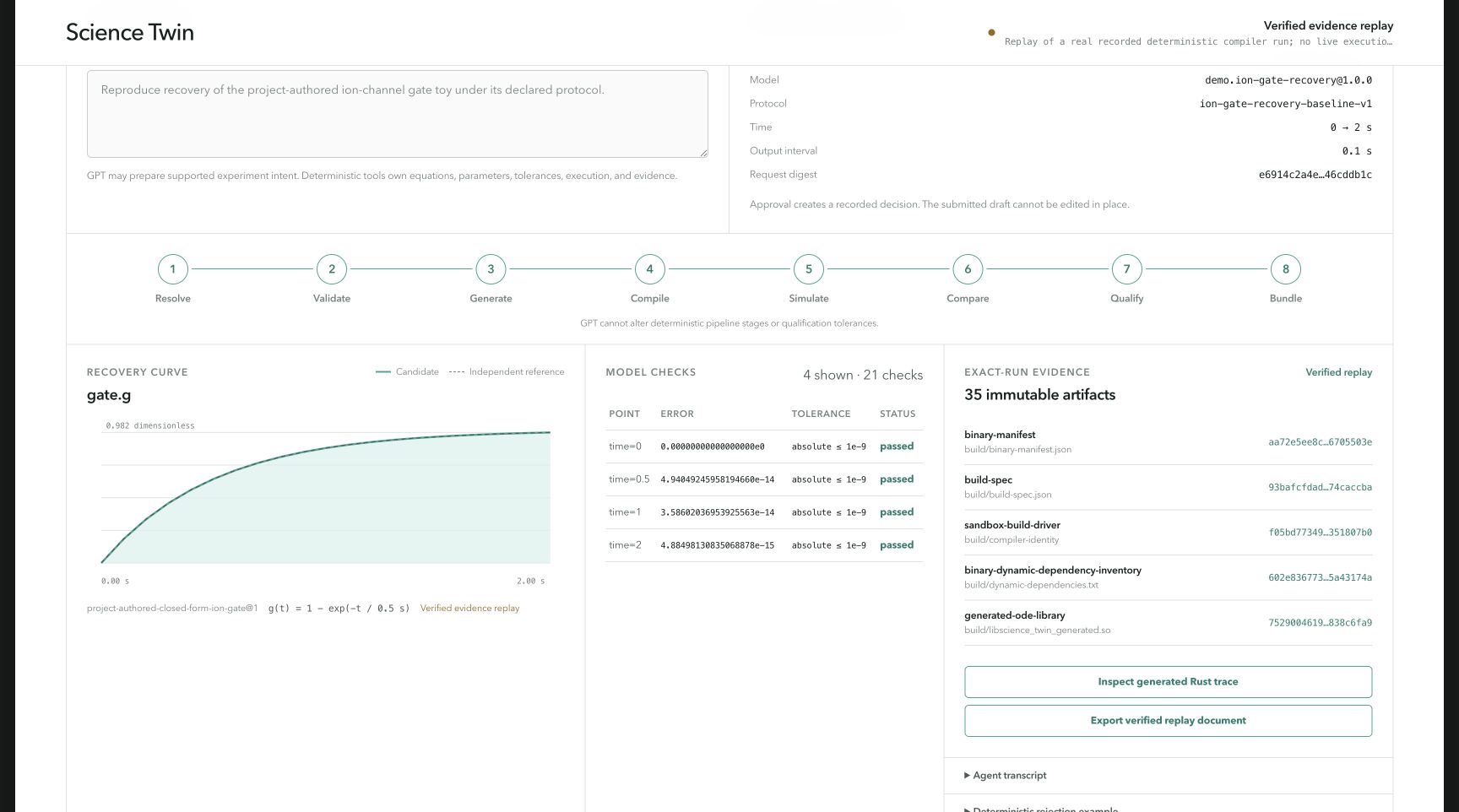
- compares the result with an independent numerical reference;
- constructs a five-axis qualification report; and
- publishes a digest-bound evidence bundle.
The Build Week proof uses a project-authored cellular gate-recovery mechanism toy. Its recorded compiler evidence matches a closed-form numerical reference at 21 of 21 comparison points and contains 35 immutable artifacts.
This proves numerical implementation fidelity for one bounded cellular mechanism. It does not prove biological validation, patient or whole-heart simulation, drug safety, clinical utility, or regulatory validity. Four of five qualification axes remain not assessed.
How we built it
The scientific core uses Rust, CellML and libCellML, Diffsol, Arrow, Docker, and content-addressed artifacts. The workbench uses React, TypeScript, Vite, Bun, SQLite, OpenAPI, and Zod.
GPT-5.6 is integrated through the OpenAI Agents SDK for model inspection, typed experiment preparation, run and evidence inspection, and diagnostics. It cannot author equations, choose scientific parameters or tolerances, bypass failures, or turn missing evidence into a pass.
Codex was the primary engineering collaborator during Build Week. It helped implement and review the Model IR, CellML importer, generated Rust pipeline, sandbox, daemon, agent tools, evidence projection, browser workflow, and adversarial release tests. Architectural and scientific decisions remained explicit in the repository documentation and commit history.
Challenges
The hardest problem was preventing a result from being shown for a different experiment than the one the user approved. Charts, metrics, generated source, qualification, provenance, and export all derive from the exact completed run's evidence graph.
The second challenge was preventing an AI interface from implying more scientific validity than its evidence supports. Science Twin keeps implementation fidelity separate from calibration, biological validation, present applicability, and regulatory context.
What is next
Next, Science Twin will add independently qualified model packages and typed biological ports one at a time. The goal is a composable physiological-modeling foundation, not a claim that this cellular proof represents a complete human.
Built With
- bun
- cellml
- codex
- docker
- gpt-5.6
- openai-agents-sdk
- openapi
- react
- rust
- sqlite
- typescript

Log in or sign up for Devpost to join the conversation.