-
-
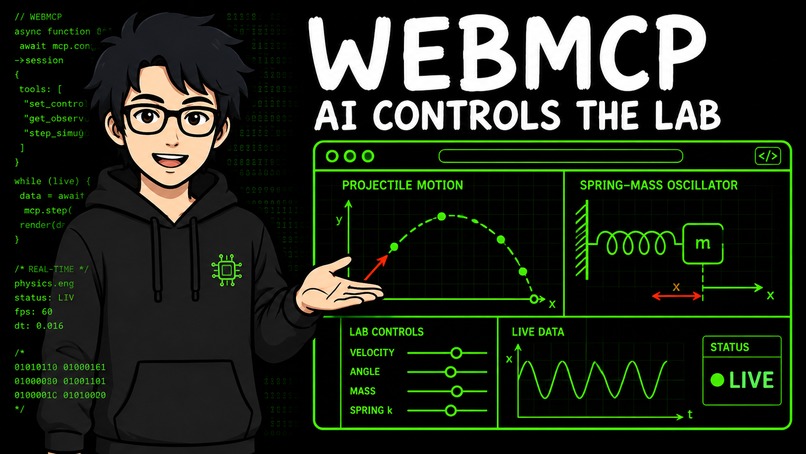
An AI-controllable physics lab built with WebMCP.
Inspiration
Physics is easier to understand when you can change conditions, run an experiment, and see evidence instead of only reading formulas. We wanted to explore how WebMCP could make a learning website agent-native, allowing both people and AI agents to investigate the same live physics simulations.
What it does
Science Lab is an interactive physics experiment platform with:
- Projectile motion experiments with launch angle, speed, height, gravity, range, peak height, and flight-time measurements.
- Mass–spring experiments with ideal and damped oscillation modes.
- Live visual aids for velocity components, spring force, and motion.
- Recorded trial notebooks and comparison tools.
- Native WebMCP tools so an AI can configure, run, pause, measure, and compare experiments.
How we built it
We built Science Lab with HTML, CSS, and JavaScript, then deployed it on Vercel.
The physics engine calculates projectile trajectories and mass–spring motion from the current configuration. The UI provides live simulation views, experiment controls, measurements, and trial history. We exposed the important lab actions through WebMCP so an agent and a human can control the same shared experiment state.
Challenges we ran into
The biggest challenge was keeping the simulation, animation, UI, measurements, and WebMCP responses consistent. The values shown visually had to match the precise data returned by the agent tools.
We also had to design meaningful scientific actions instead of simple button automation. For example, the lab can pause a projectile at its apex or an oscillator at equilibrium, letting an agent inspect an important physics event.
Accomplishments that we're proud of
We are proud that Science Lab is not just an educational simulation—it is a shared experimental environment for both humans and AI.
The AI can run real trials, compare ideal and damped oscillations, inspect velocity components, pause at physics events, and explain the evidence using actual measurements from the lab.
What we learned
We learned that WebMCP can make websites interactive environments that agents can investigate instead of only pages they can read.
We also learned that agent tools are most useful when they map to real concepts: configuring conditions, running trials, recording evidence, pausing at meaningful events, and comparing results.
What's next for Science Lab
Next, we want to add more experiments, such as pendulums, collisions, waves, and electric circuits.
We also want to add richer graphs, downloadable experiment reports, guided learning challenges, and AI-generated explanations that adapt to each user’s trial results.
Built With
- codex
- css3
- html5
- javascript
- vercel

Log in or sign up for Devpost to join the conversation.