Schwing: AI-Powered Debt Payoff Roadmap Generator
TRY IT OUT! - https://schwing.onrender.com/
Presentation - https://drive.google.com/file/d/14kY_WxvtWcunR1Poa8e79mVjZ1Fc__Nl/view?usp=sharing
Inspiration
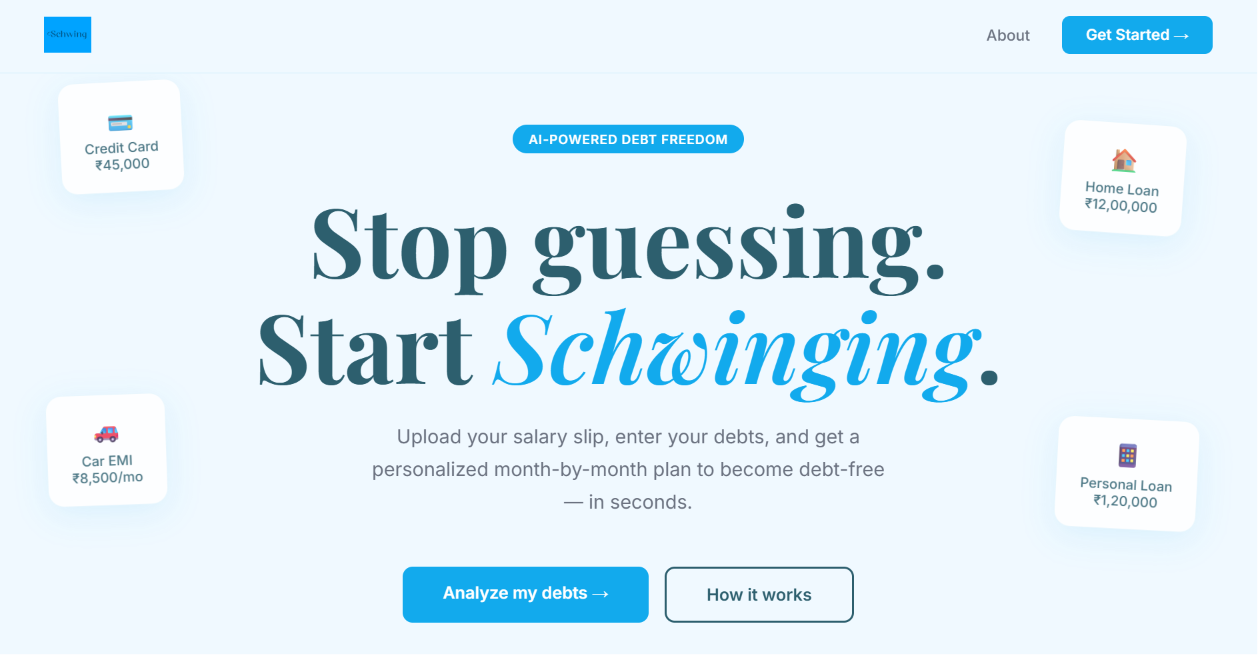
Millions of salaried Indians are quietly drowning in debt — not because they can't afford to pay it off, but because nobody ever told them how. They juggle credit card bills, car EMIs, home loans, and personal loans simultaneously, paying minimums on everything, watching interest compound, and making zero real progress. Financial advisors charge fees most people can't justify. Spreadsheets require expertise most people don't have. So they guess — and stay in debt years longer than they need to.
We built Schwing because the math to escape debt isn't complicated. It just needs to be done for you — instantly, accurately, and in plain language anyone can act on.
What It Does
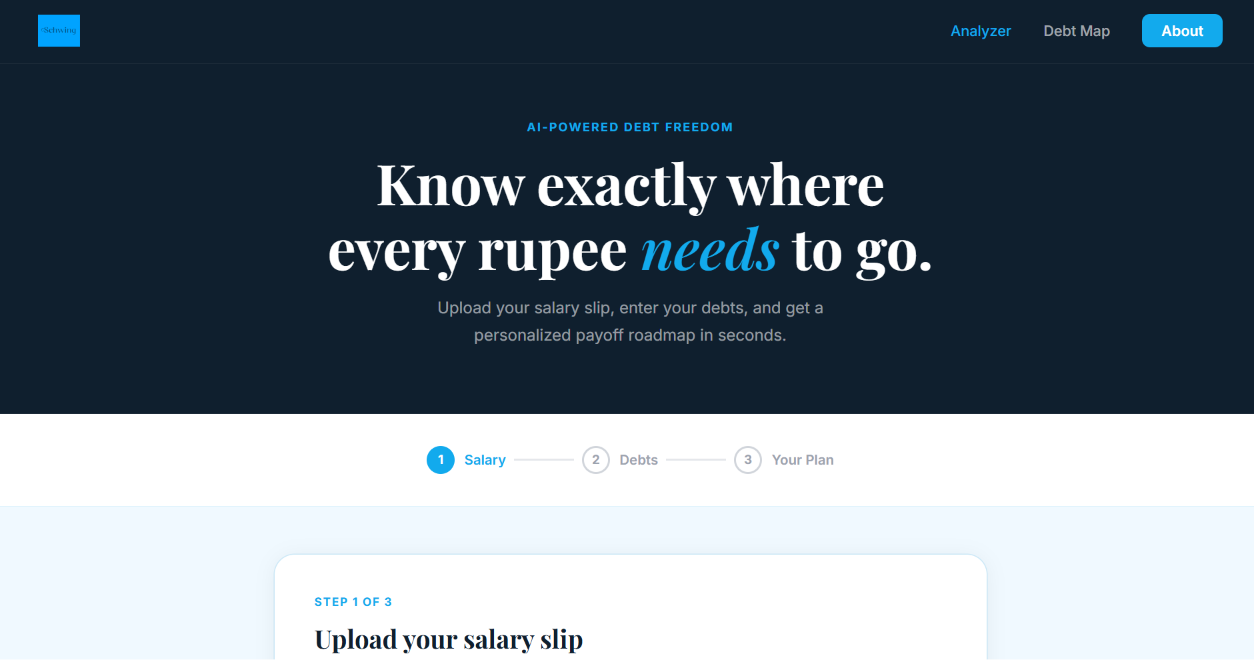
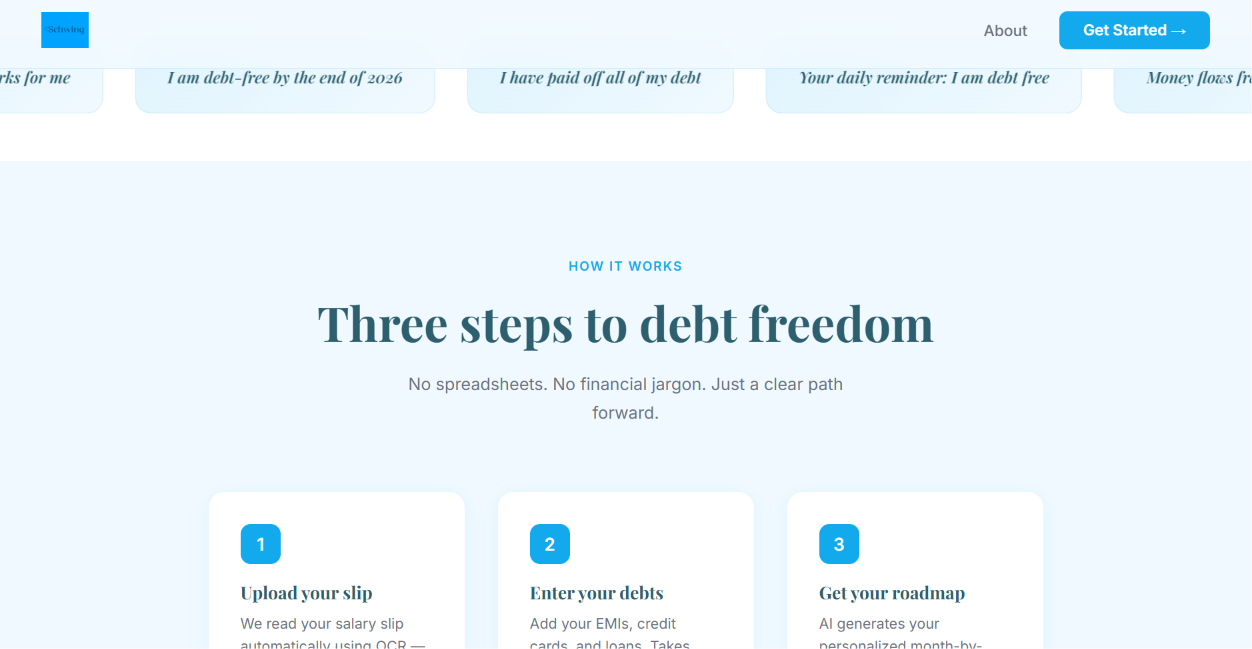
Schwing is a three-step debt-to-freedom roadmap generator that turns a salary slip and a list of debts into a personalized, month-by-month payoff plan in under 8 seconds.
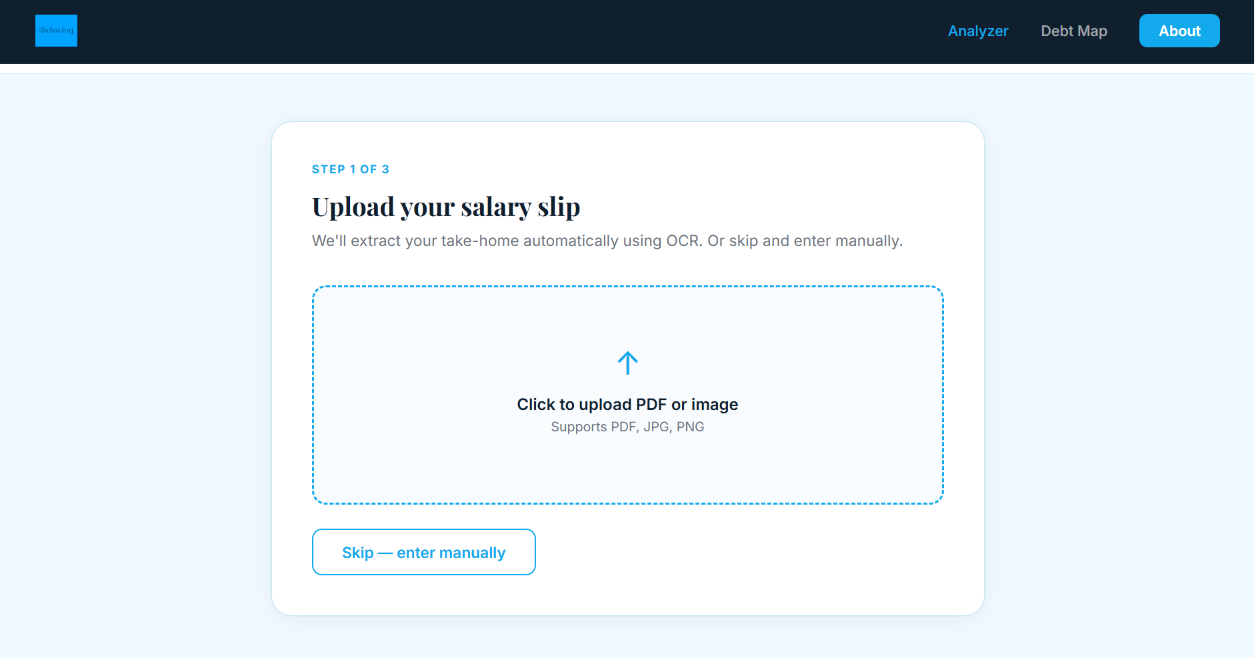
- Upload your salary slip (PDF or image) → AI extracts your take-home pay automatically via OCR — no manual entry needed
- List your debts → Enter each EMI, credit card, or loan with its amount, interest rate, and current monthly payment
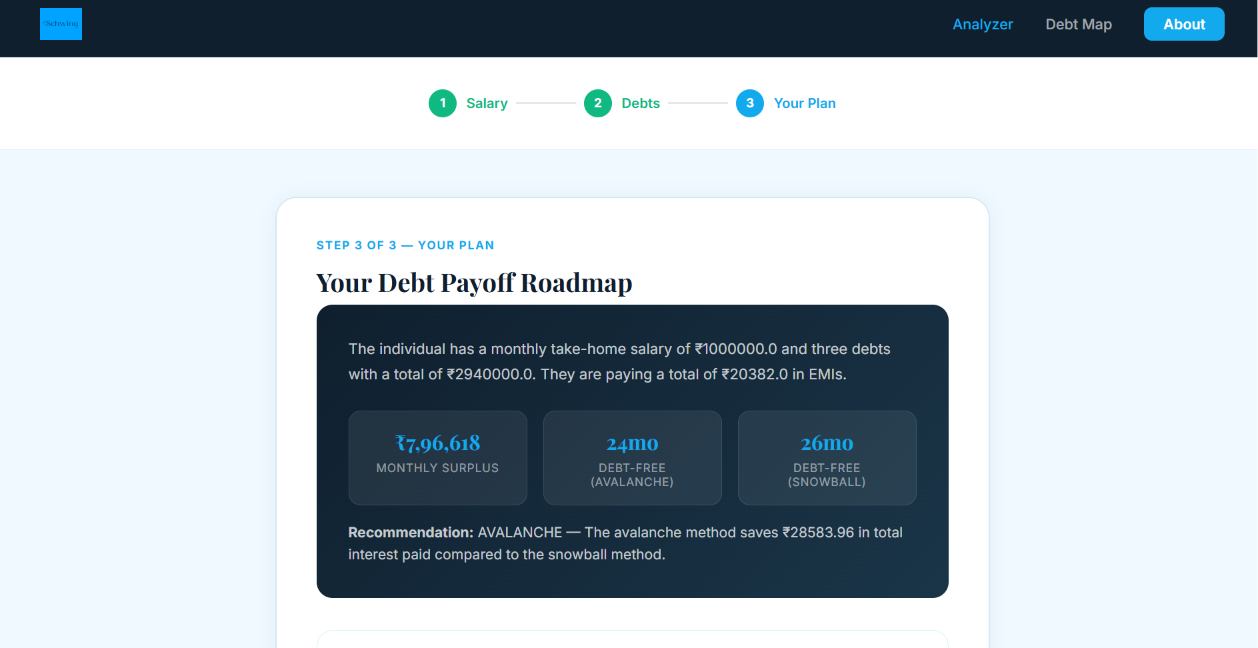
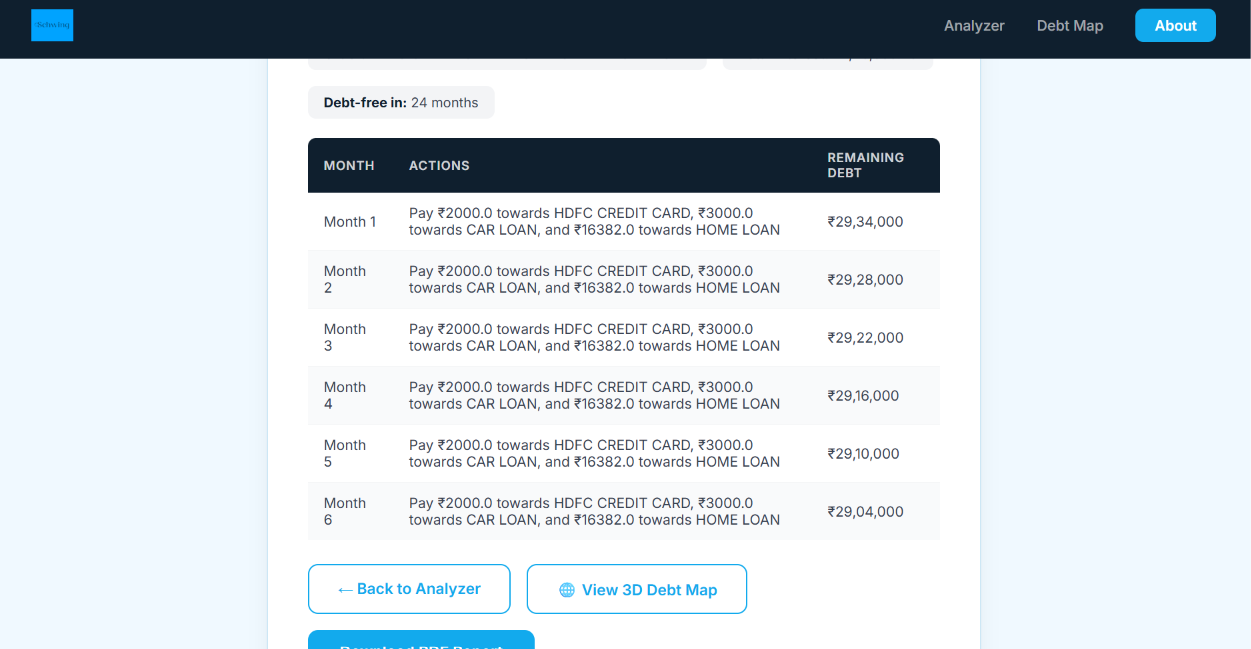
- Get your roadmap → AI generates a month-by-month breakdown showing exactly what to pay on each debt, in what order, and why
You also get:
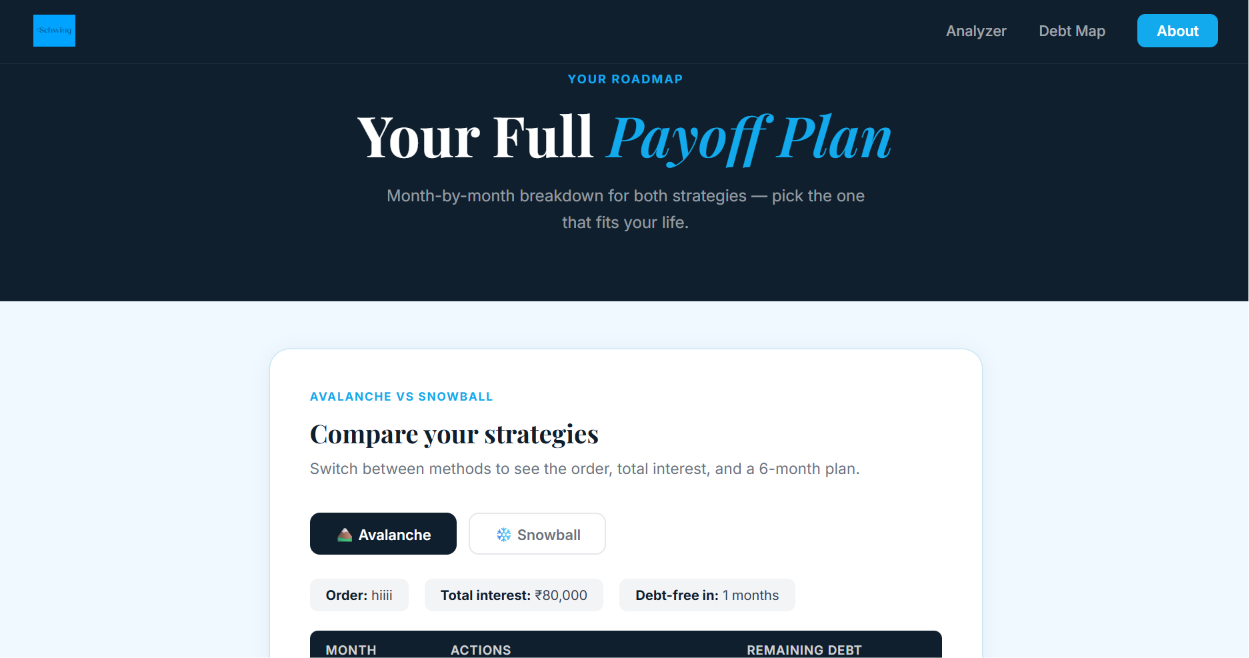
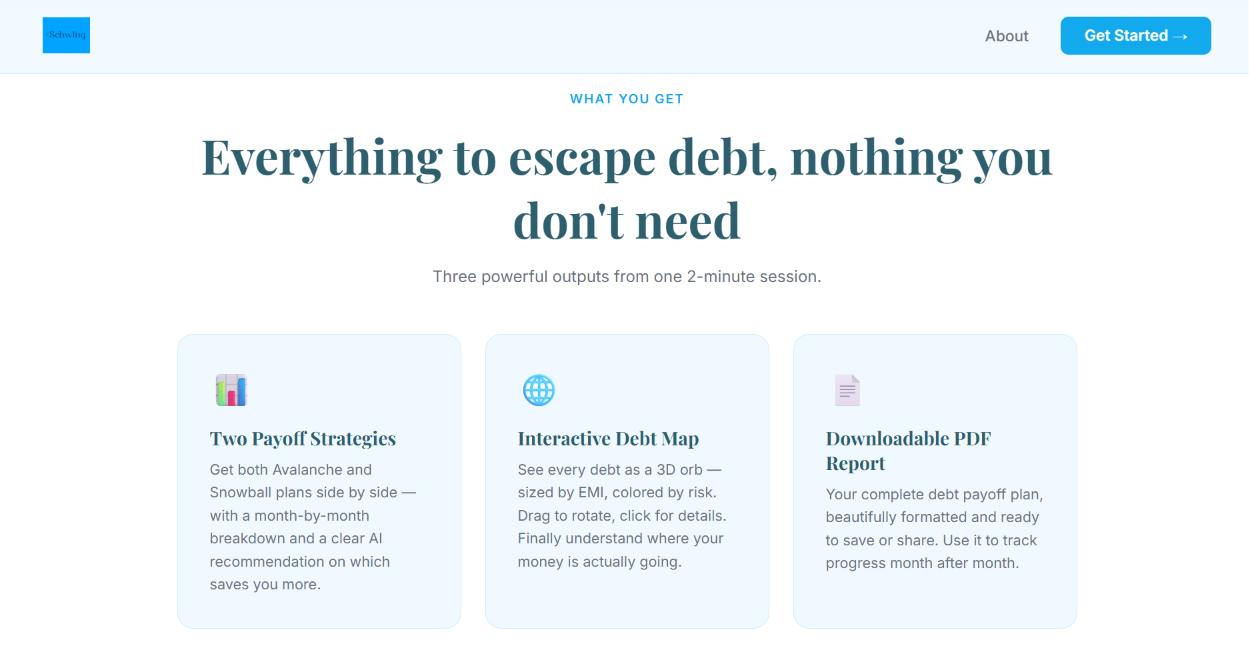
- Avalanche vs Snowball comparison — Both strategies calculated and compared side by side, with a clear recommendation on which saves you the most money
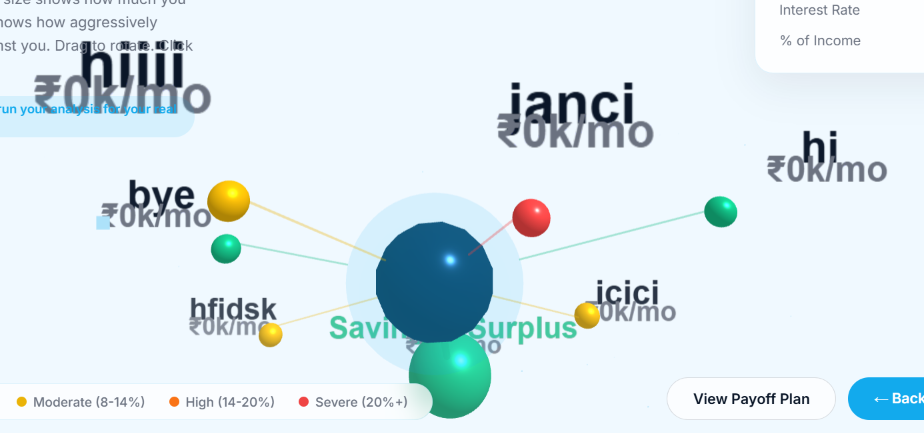
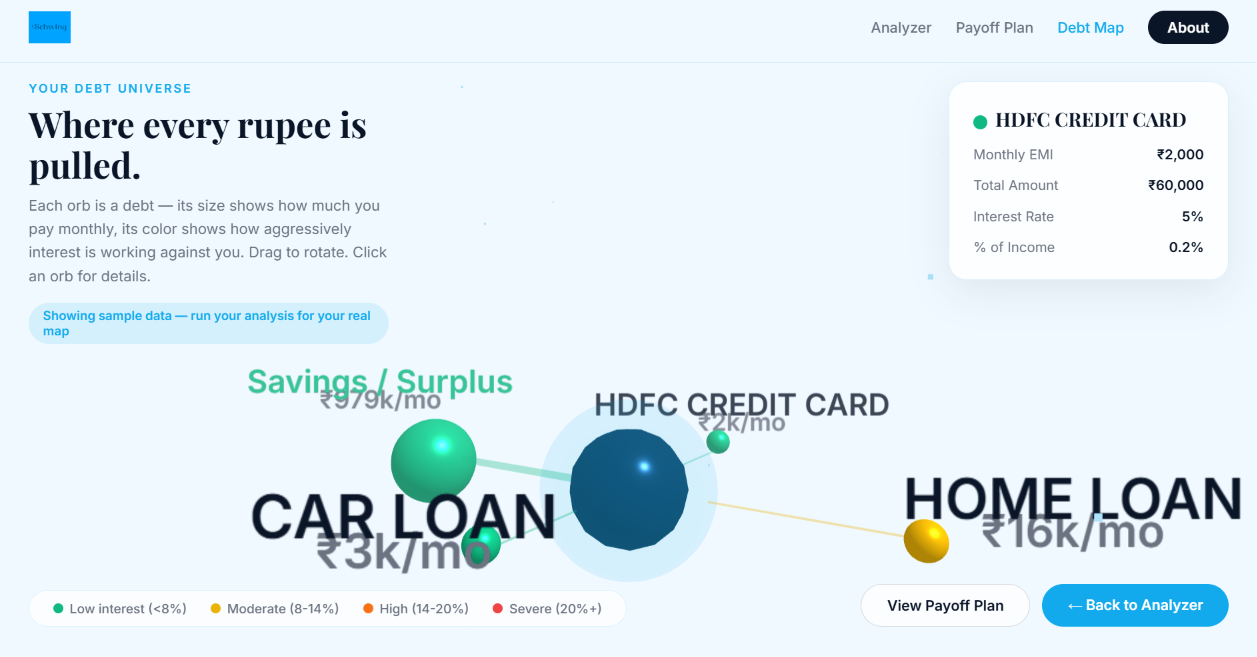
- 3D Interactive Debt Map — Every debt rendered as a glowing orb orbiting "YOU" in a Three.js visualization — sized by EMI, colored by interest-rate severity — so you can see exactly where your money is being pulled
- Downloadable PDF report — A professional, shareable payoff plan formatted to the standard of a financial advisor's output
- AI-powered reasoning — Plain-English explanations of every recommendation, powered by Groq's LLaMA 3.3 70B
How We Built It
Backend: FastAPI (Python) for secure, fast API routing and AI orchestration
AI Engine: Groq API (LLaMA 3.3 70B) — handles both salary slip data extraction and full debt payoff analysis with human-readable reasoning
OCR Pipeline: PyTesseract + pdf2image — parses salary slips across PDF and image formats, with manual fallback for ambiguous reads
Financial Modeling: Custom Avalanche and Snowball algorithm implementations with monthly surplus allocation, interest rate factoring, and 6-month projected action plans
3D Visualization: Three.js — a real-time orbital debt map with drag-to-rotate, animated pulsing orbs, and click-for-details interaction
PDF Generation: ReportLab — professional report generation with branded formatting and month-by-month breakdowns
Frontend: HTML, CSS, and vanilla JavaScript with Jinja2 templating — designed for frictionless UX across mobile and desktop
Challenges We Ran Into
OCR reliability at scale. Salary slips vary wildly in format across employers, industries, and payroll systems. We built intelligent validation and fallback logic to flag ambiguous extractions and let users confirm or override the detected take-home before proceeding. Real-world PDFs don't follow templates — graceful degradation beats perfection.
Groq API migration mid-build. We initially integrated Google Gemini, ran into quota exhaustion and deprecation issues with the generativeai SDK, and had to pivot mid-hackathon to Groq's API with the new google-genai client. Rewriting both OCR and analysis routers under time pressure was the most stressful part of the build — and Groq turned out to be faster anyway.
Python 3.14 dependency hell. Several packages — Pillow, pdf2image — didn't yet support Python 3.14 at build time. We resolved this by unpinning versions in requirements.txt and letting pip resolve compatible builds rather than fighting pre-compiled wheels.
Three.js orbital grouping. Getting the 3D debt map to rotate as a single cohesive unit — orbs, connecting tubes, and text sprites all together — required restructuring the scene graph from individual scene.add() calls into a unified rotatingGroup, so drag rotation applied correctly to everything.
Accomplishments We're Proud Of
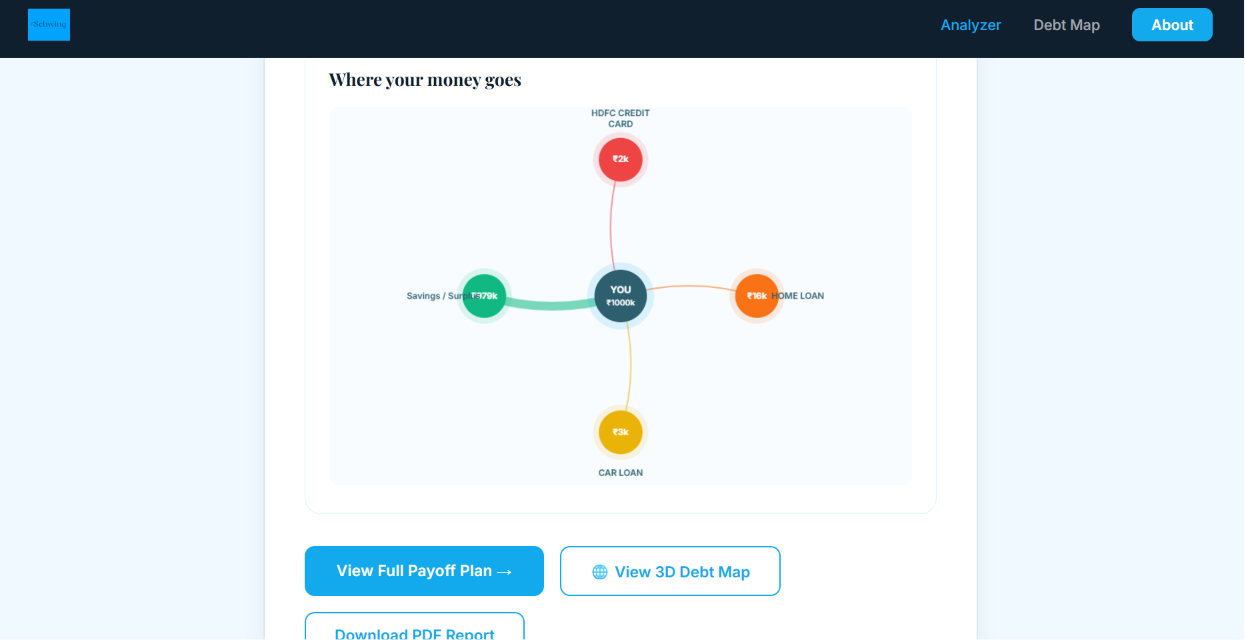
- End-to-end pipeline working in production — upload → OCR → Groq analysis → 2D debt map → 3D orbital visualization → downloadable PDF — all in under 8 seconds
- Real financial modeling — not a calculator, an intelligent advisor that compares strategies, calculates total interest across the full payoff horizon, and explains why each recommendation is mathematically optimal
- Three.js Debt Universe — a live 3D visualization that makes abstract debt feel visceral and real; when you see a giant red orb dominating your orbital map, you understand that credit card needs to die first
- Professional PDF output — reports polished enough that users can share them with family members or use them as a baseline for conversations with financial advisors
- Zero signup, zero friction — everything runs in-session with no accounts, no data storage, no reason not to try it
What We Learned
Trust is everything in fintech. The credibility of the math and the clarity of the reasoning matters more than any visual flourish. Users need to feel like the numbers are right before they'll act on them.
OCR is messier than expected. We spent more time on salary slip parsing edge cases than on any other single feature. Fallback UX — letting users correct a wrong reading without starting over — was the right call and saved the whole flow.
Groq is genuinely fast. After the Gemini migration, LLaMA 3.3 on Groq returned full debt analysis in under 2 seconds. For a real-time financial tool, that speed difference is the product.
Perceived clarity beats technical complexity. The step indicator, the plain-English AI summary, and the color-coded interest legend in the 3D map — none of these are technically impressive, but they're what made the product feel trustworthy and usable rather than overwhelming.
What's Next for Schwing
- Bank and NBFC partnerships — white-label deployment to give millions of customers a personalized payoff tool inside their existing banking app
- Credit bureau integration — automated debt discovery so users don't have to manually list every loan
- Mobile app — on-the-go access with push notifications for monthly payment reminders
- Gamified progress tracking — visual debt payoff streaks and milestone celebrations to keep users motivated across a multi-month journey
- EMI restructuring advisor — AI recommendations on when it's worth prepaying, refinancing, or negotiating a lower rate based on current market conditions

Log in or sign up for Devpost to join the conversation.