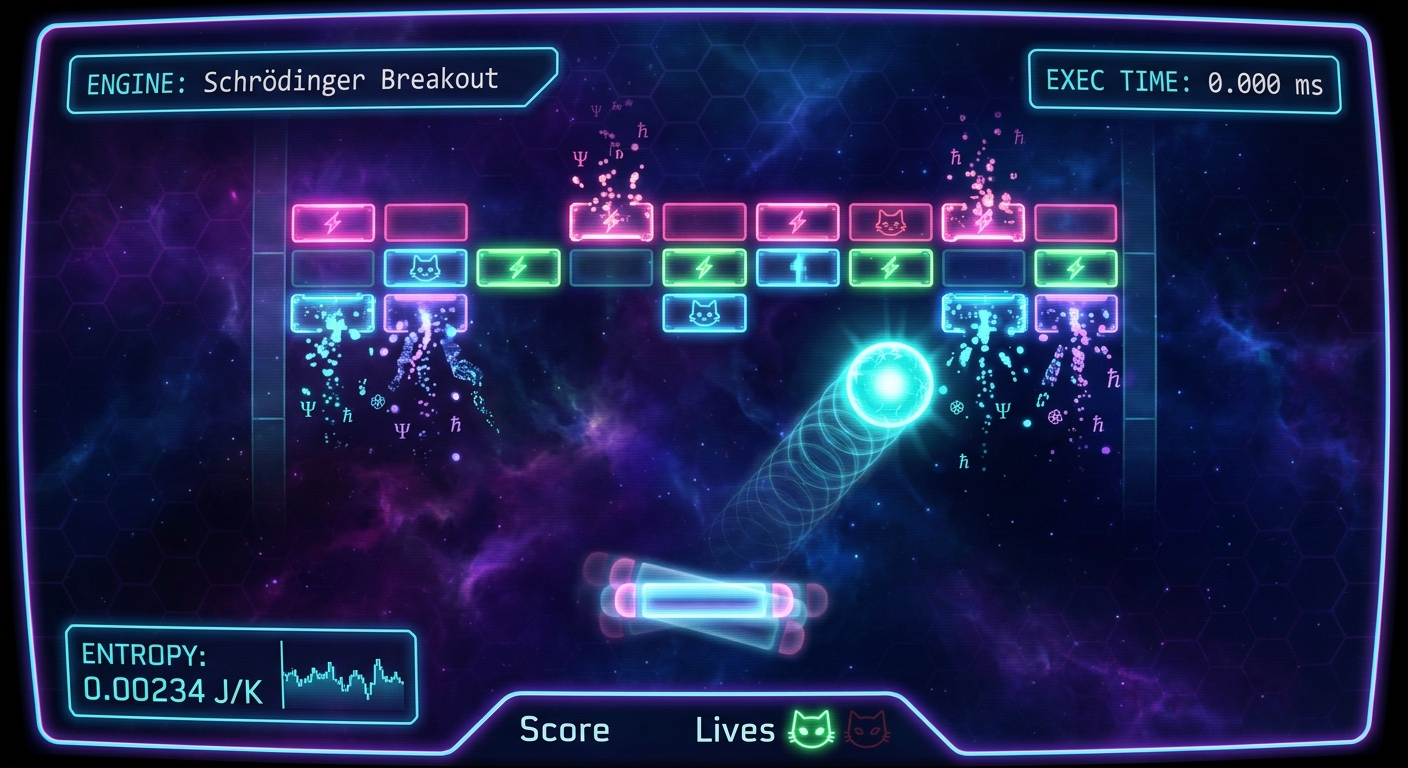
What it does Schrödinger's Breakout reimagines the classic brick-breaker through the lens of quantum mechanics:
Superposition Balls: The ball does not travel along a single deterministic trajectory. Instead, it expands as a probability cloud across the board.
Wave-Function Collapse: The moment a probability wave touches a paddle or brick, the system performs a "measurement," instantly collapsing the ball into a single concrete coordinate.
Quantum Tunneling: Balls have a calculated probability of passing directly through impenetrable defense barriers, turning potential dead-ends into high-risk plays.
Entangled Bricks: Bricks can become quantum-entangled; destroying one instantly triggers a state collapse that breaks its partner on the opposite side of the board.
How we built it Core Physics Engine (Rust & WebAssembly): Built entirely in Rust to execute probability density functions, vector matrices, and collision sweeps with zero runtime allocation overhead. Compiled directly to WebAssembly (wasm-bindgen).
Frontend Architecture (Next.js & React): Built a high-performance HUD and game frame wrapper using Next.js and Tailwind CSS.
Zero-Copy Canvas Rendering: The HTML5 Canvas reads position vector arrays directly from WebAssembly's shared linear memory buffer, maintaining a locked frame rate without garbage collection spikes.
Challenges we ran into The Frustration of Randomness: True quantum randomness can feel deeply unfair to a player. Balancing mathematical fidelity with satisfying player agency required painstaking tuning so that "probability" felt like a skill to master rather than an arbitrary penalty.
Wasm Memory Boundaries: Passing complex particle state arrays back and forth between JavaScript and WebAssembly created frame stutter. We solved this by keeping the entire state array inside Rust's memory space and handing the JS Canvas a direct pointer to render.
Accomplishments that we're proud of Translating abstract theoretical physics equations into an intuitive, visually clear game mechanic that anyone can grasp within five seconds of play.
Delivering a sub-millisecond execution loop inside WebAssembly that handles multi-particle probability collapses smoothly.
Creating a dynamic lighting and particle rendering engine in HTML5 Canvas that vividly displays probability density fields in real time.
What we learned Designing for Human Intuition: Players don't need to understand wave equations to feel when a mechanic is fair. Designing around human cognitive load and emotional response yields far better game feel than strict mathematical realism alone.
Rust-to-Wasm Memory Optimization: Direct linear memory sharing is critical for high-frequency game loops where JS serialization latency would otherwise break immersion.
What's next for schrodingers-breakout Co-Op Entanglement Mode: Multi-paddle rooms where Player A’s measurements instantly collapse probability states on Player B’s board.
Custom Potential Well Editor: Allowing players to build custom levels with gravity wells, double-slit barriers, and phase-shifting obstacles.
WebGL Shader Pipeline: Migrating the probability cloud rendering from Canvas 2D to custom WebGL shaders for richer visual feedback.
Built With
- async-rust
- axum
- backend
- concurrency
- frontend
- fullstack
- game-development
- game-engine
- high-performance
- html5
- low-latency
- multiplayer
- netcode
- nextjs
- physics-engine
- react
- real-time
- rust
- server-authoritative
- tailwindcss
- tokio
- typescript
- web-development
- websockets

Log in or sign up for Devpost to join the conversation.