-
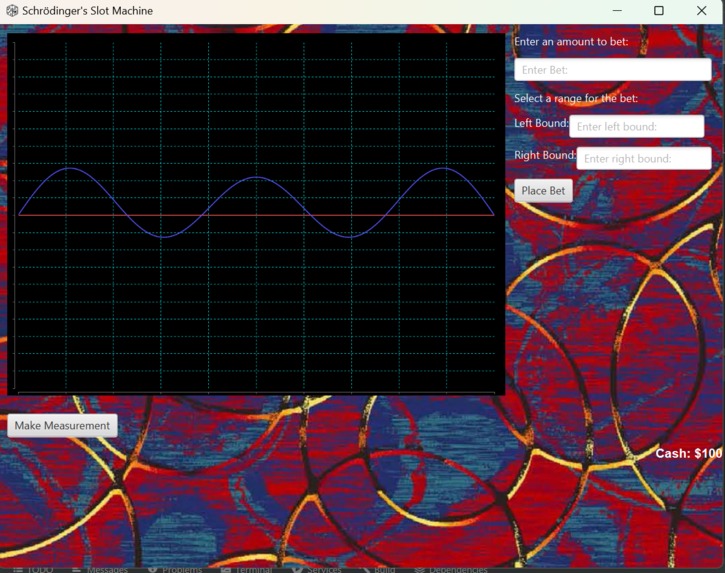
Snapshot of the game interface.
Inspiration
Quantum mechanics is notoriously unintuitive for our human brains. We asked ourselves: what else is probabilistic in nature that humans like to do? Gambling, of course.
What it does
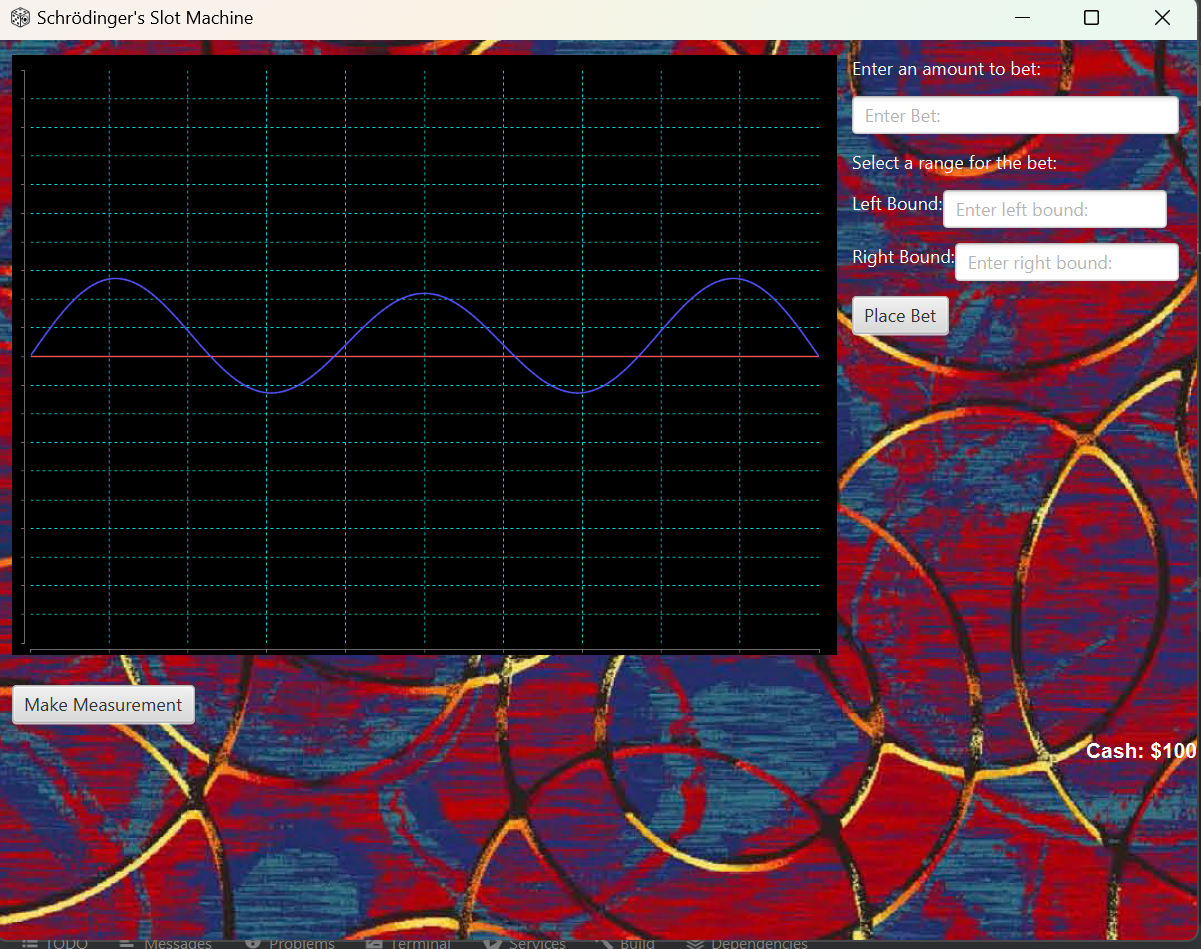
With the wave function of a quantum particle in front of you, take a guess where the particle is. Taking a measurement is like pulling the slot machine handle. The smaller the range that you predicted the particle would fall into, the bigger the jackpot.
How we built it
We implemented classes in Java to represent the reward system, potential functions and controllers. Then, we implemented a GUI using JavaFX, and used javascript to tie user input to the backend.
Challenges we ran into
GUIs, operating systems and project configurations are more difficult than quantum mechanics, hands down.
Accomplishments that we're proud of
We left ourselves most of the hackathon time to tackle the GUI. This required us to have a strong understanding of the underlying physics and fluency in backend development out of the gate. We persisted through the GUI struggle by pooling our knowledge of Javascript, HTML and other graphical frameworks.
Behind the scenes, we delegated according to who was interested/experienced in what all while accommodating schedules (and living 2 hours away). Teamwork like this is as big of an accomplishment as our game. We also took the opportunity to interact with mentors and organizers to get their input and have a user perspective for our game.
What we learned
Plotting in Java, the interplay of the components of the wave function, generating HTML files from a template, using Java abstract classes and interfaces in a completely new context. Many of us learned a ton of git along the way, too.
What's next for Schrödinger's Slot Machine
Besides the obvious of wanting a gorgeous GUI, we also have the framework to add more complex potential configurations for the particle.
Built With
- css
- html
- java
- javascript
- maven
- springboot
- thymeleaf


Log in or sign up for Devpost to join the conversation.