-
-
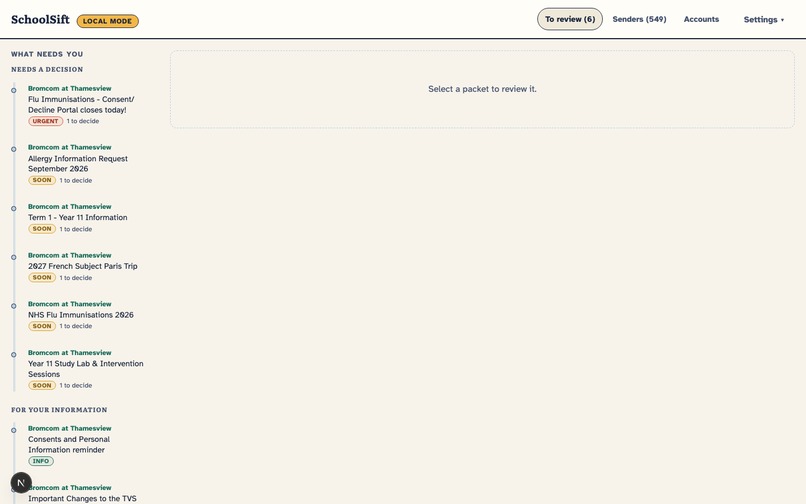
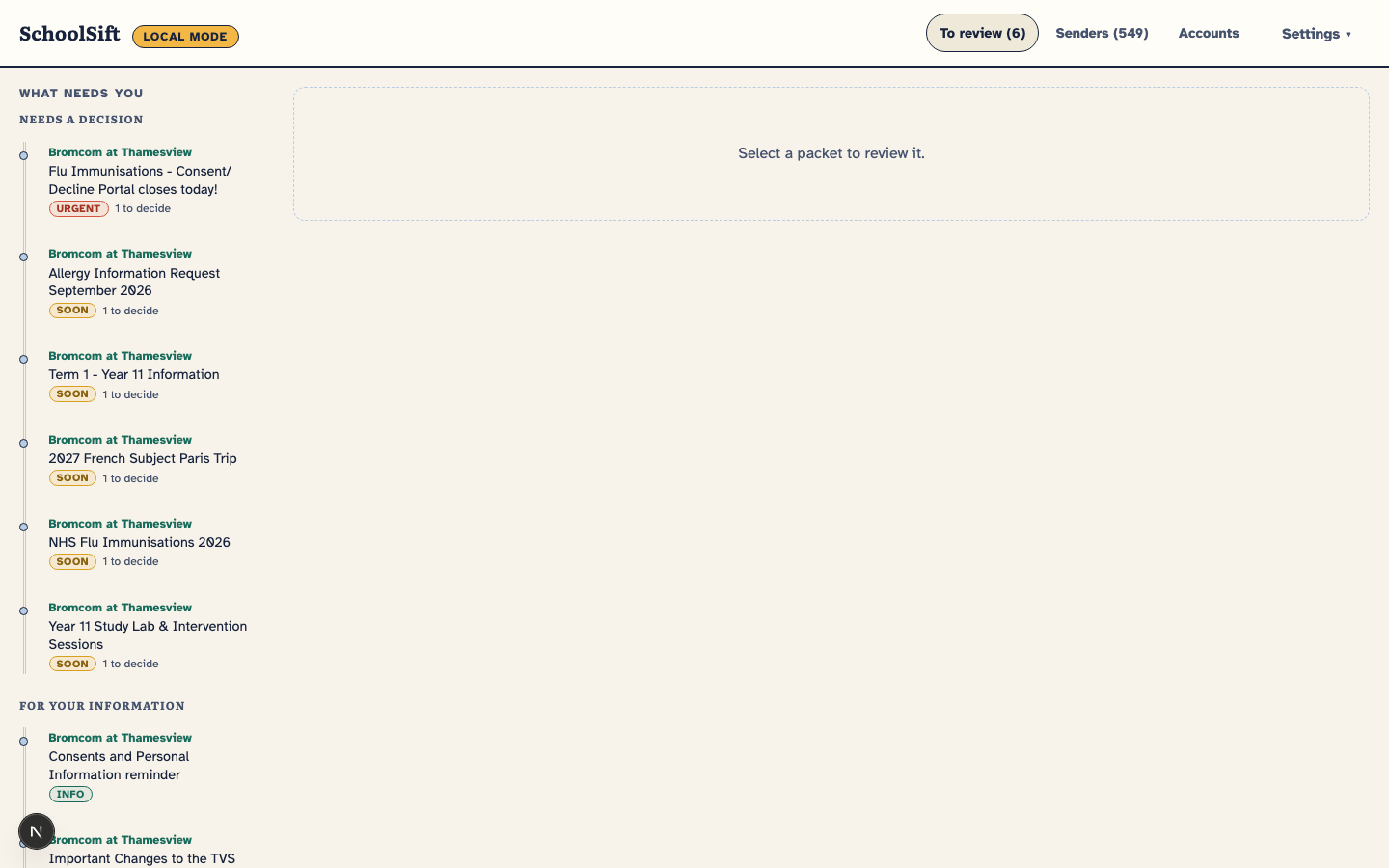
What needs you: real school letters grouped into decisions and information
-
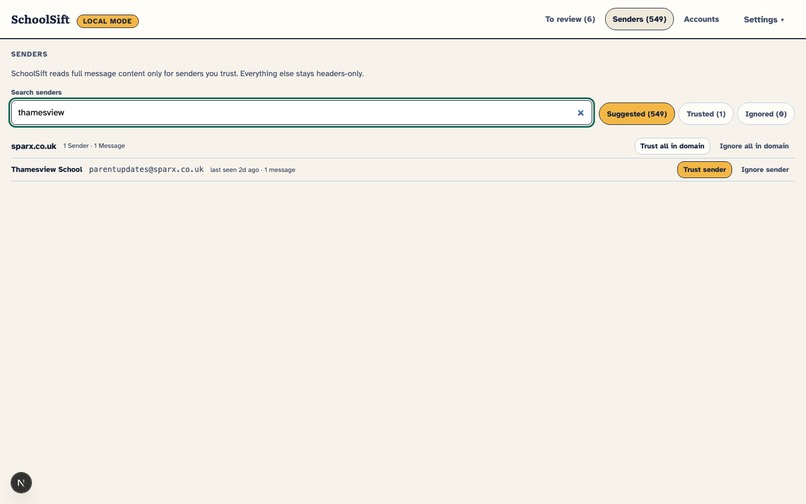
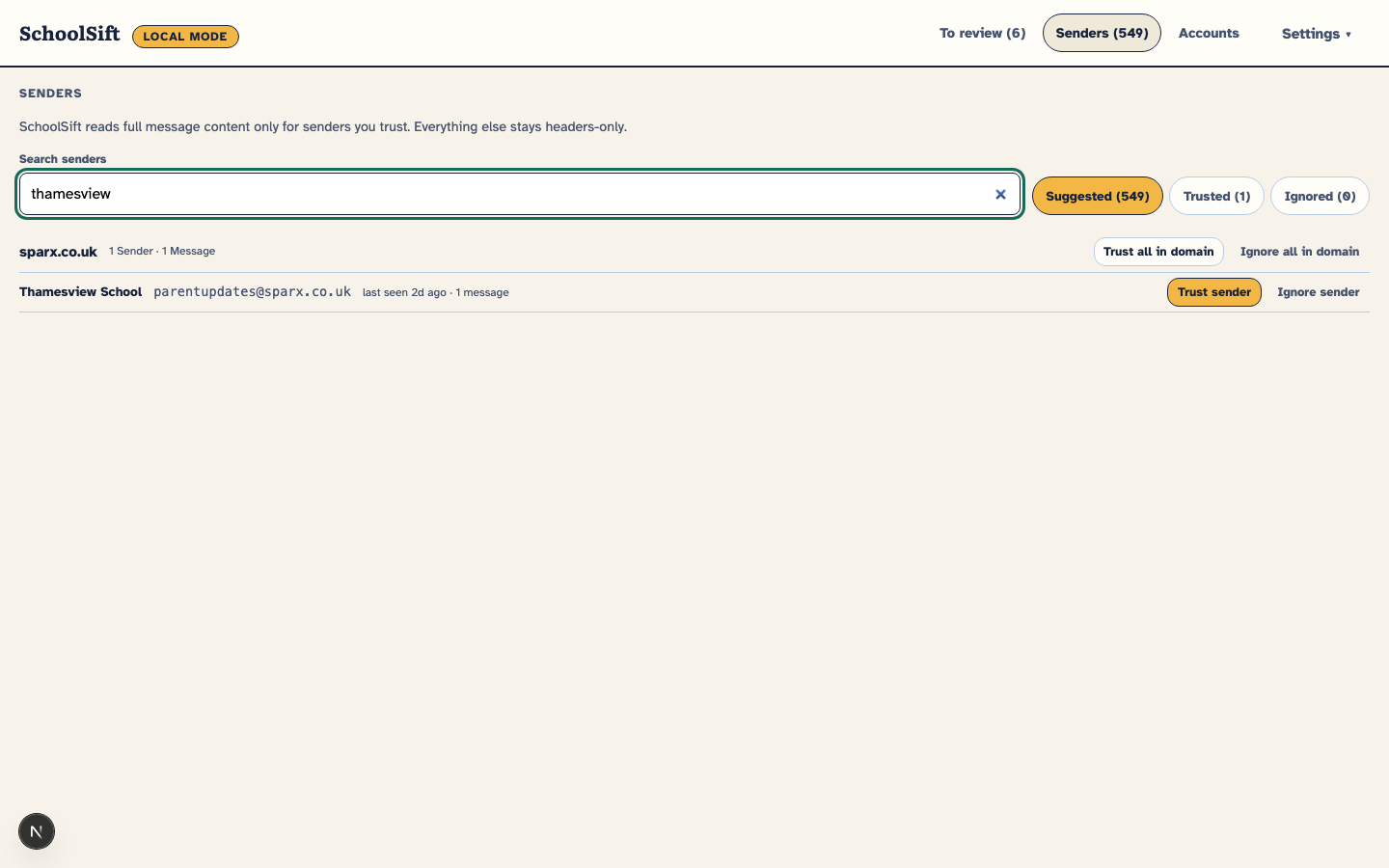
Senders: hundreds of senders grouped by domain; trust only the school
-
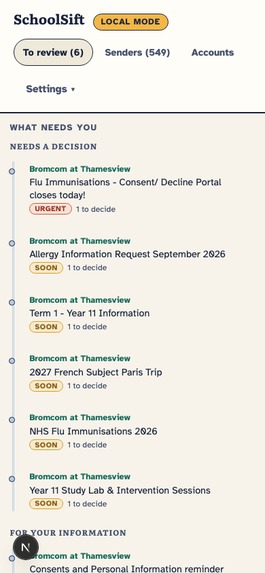
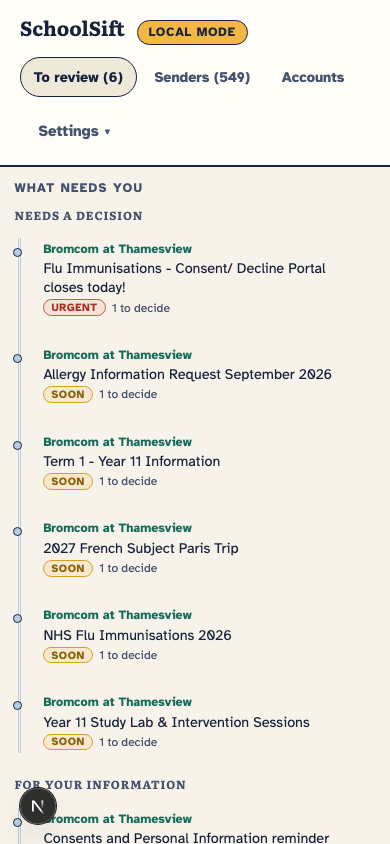
Mobile queue at 390px
-
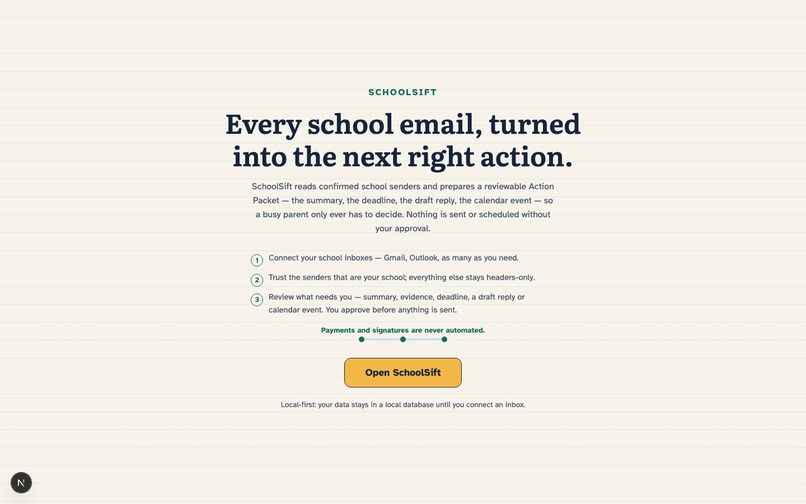
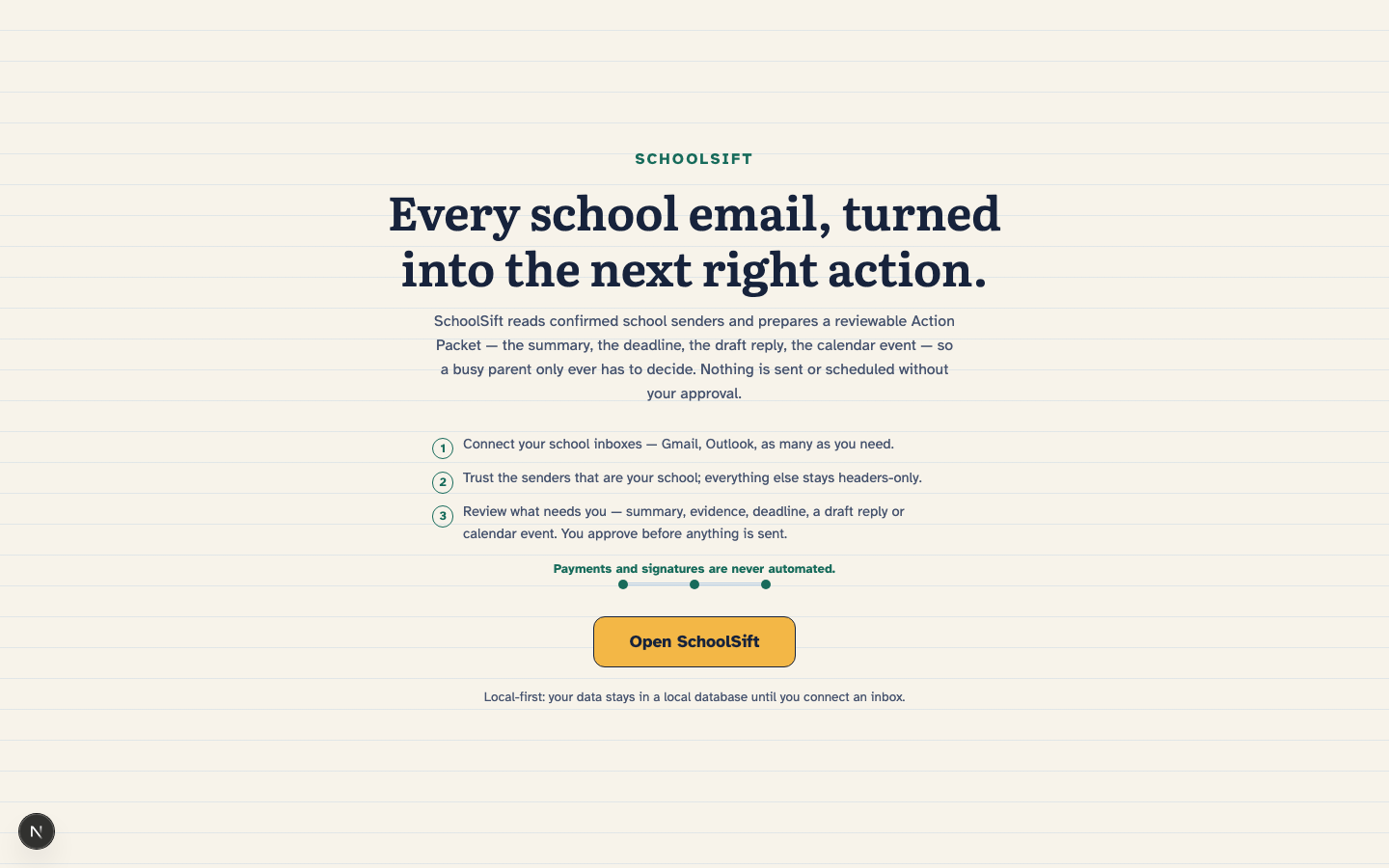
Landing page
-
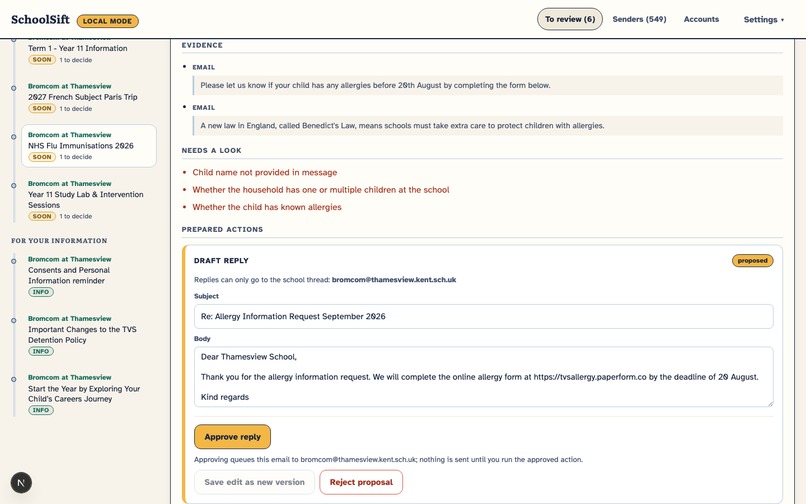
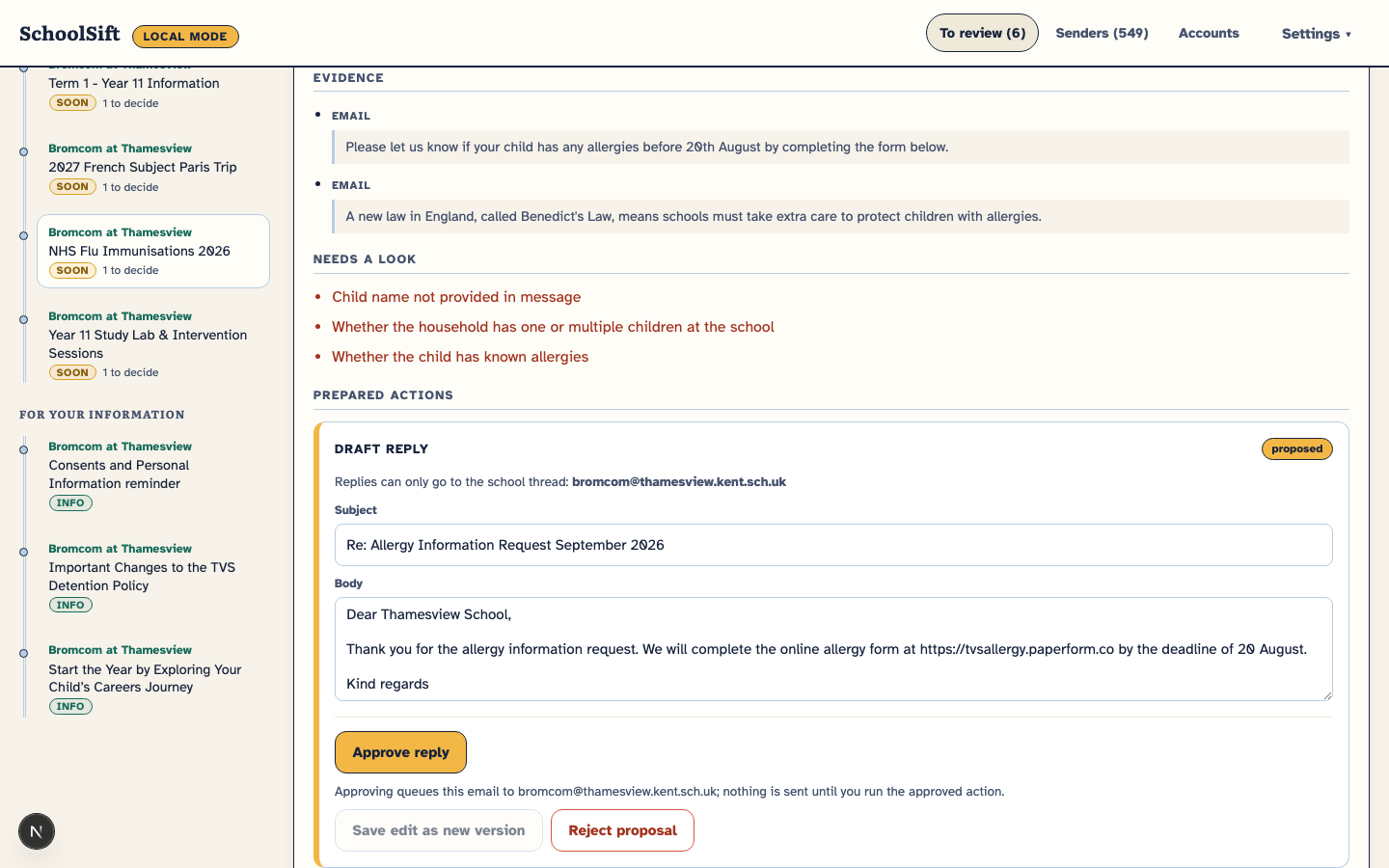
Allergy request: draft reply to the school, waiting for approval
-
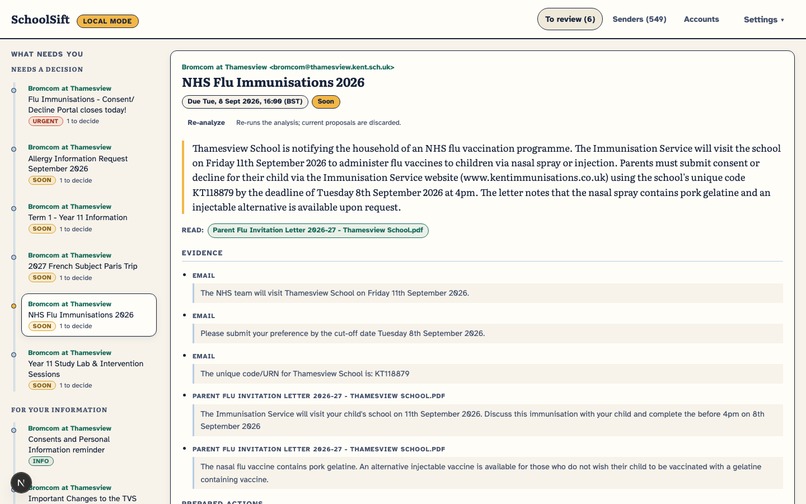
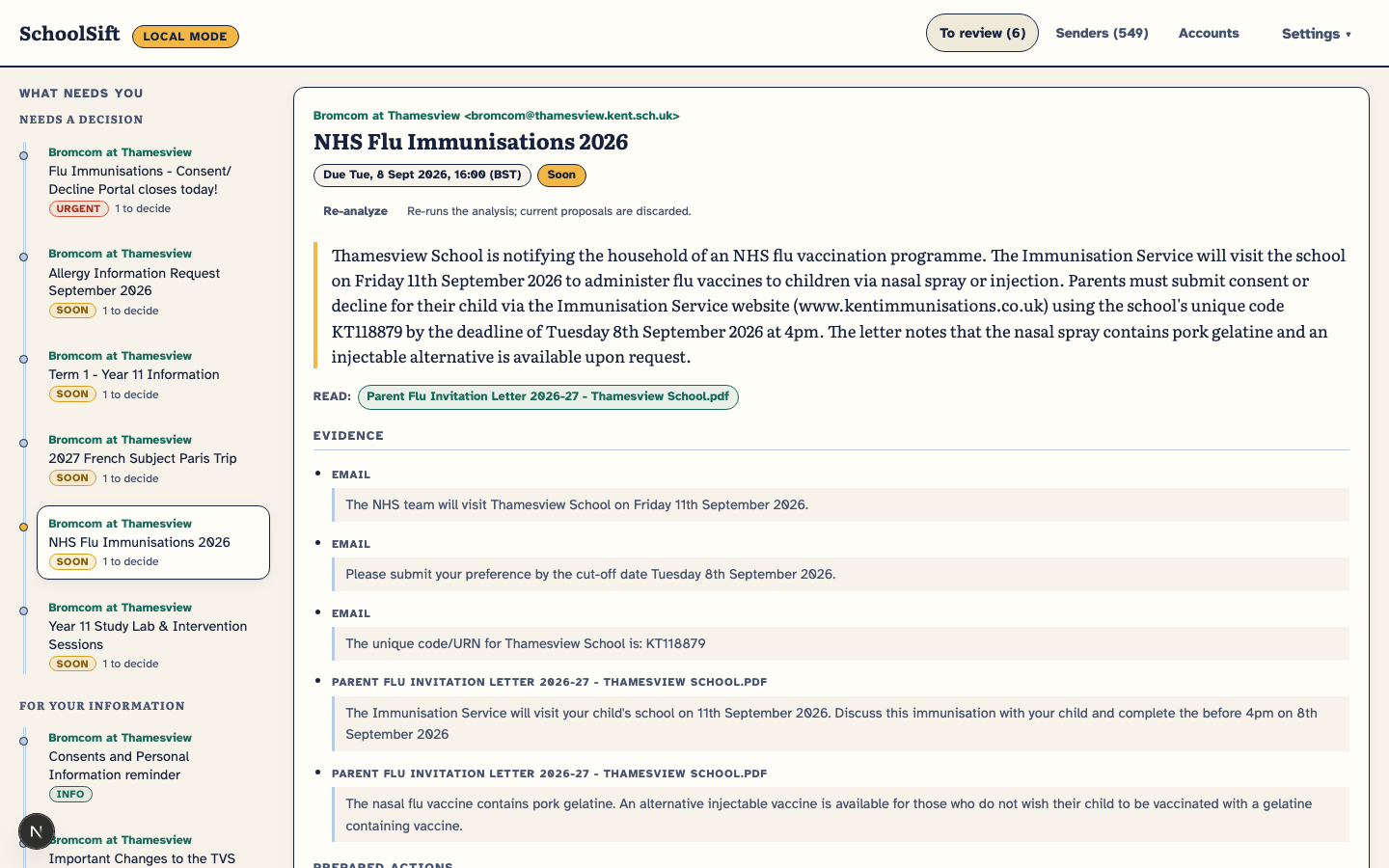
NHS flu letter: the PDF was read, evidence cited, calendar event proposed
-
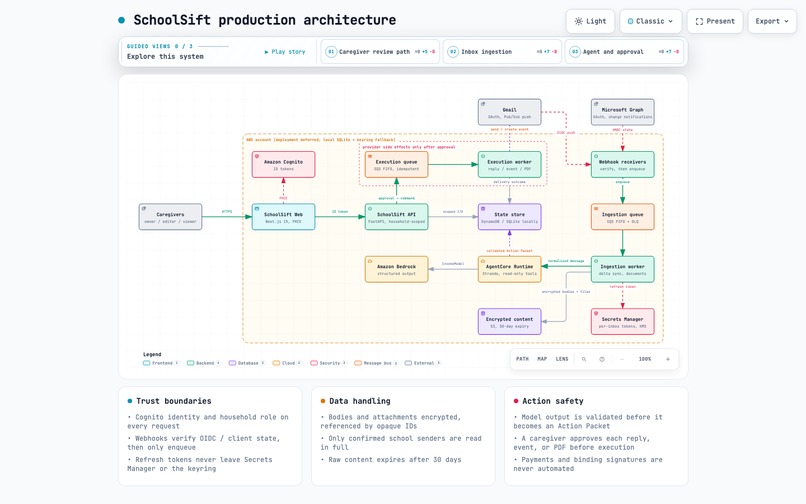
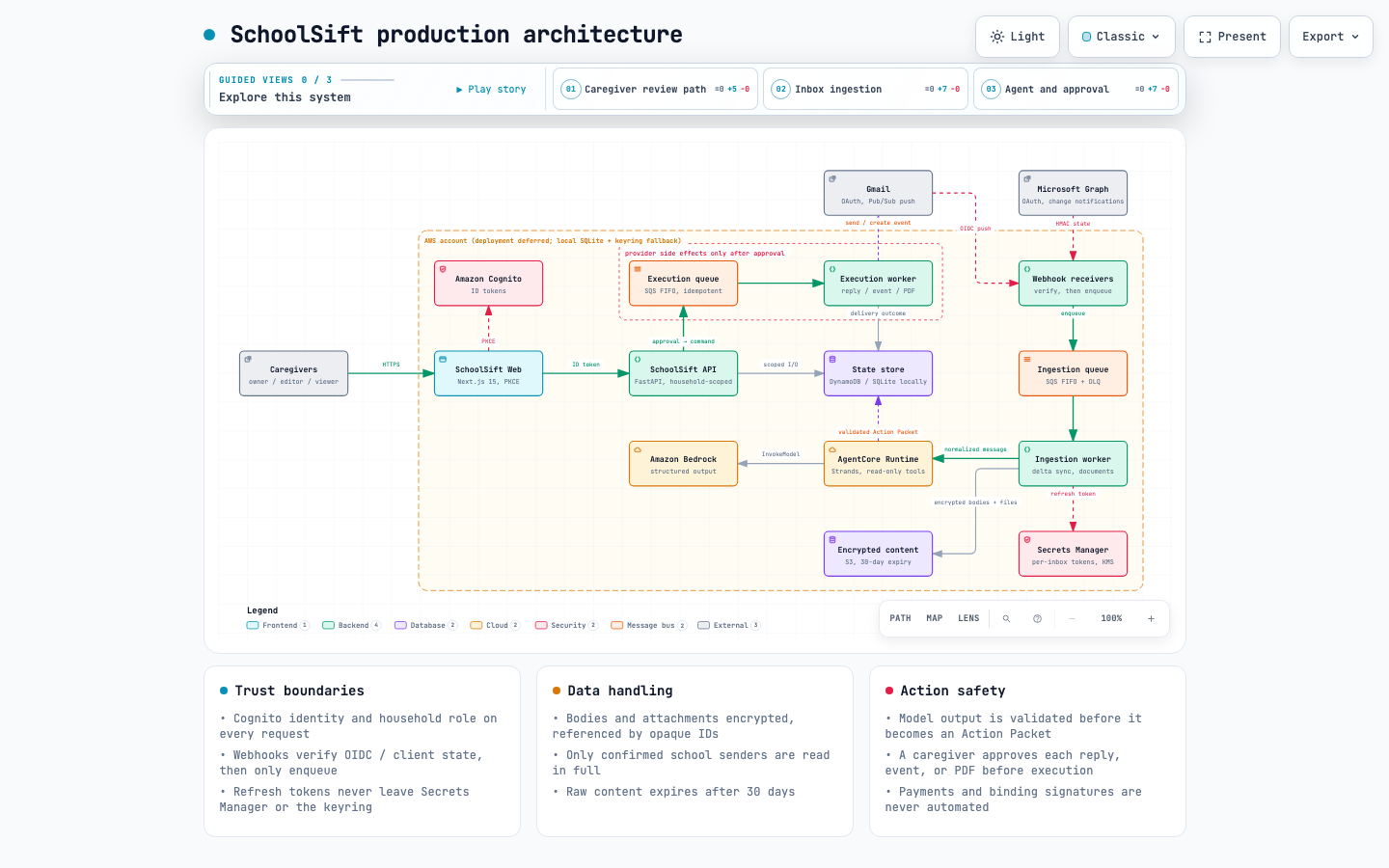
Architecture: Strands agent on AgentCore, SQS, DynamoDB, S3, Cognito, KMS
-
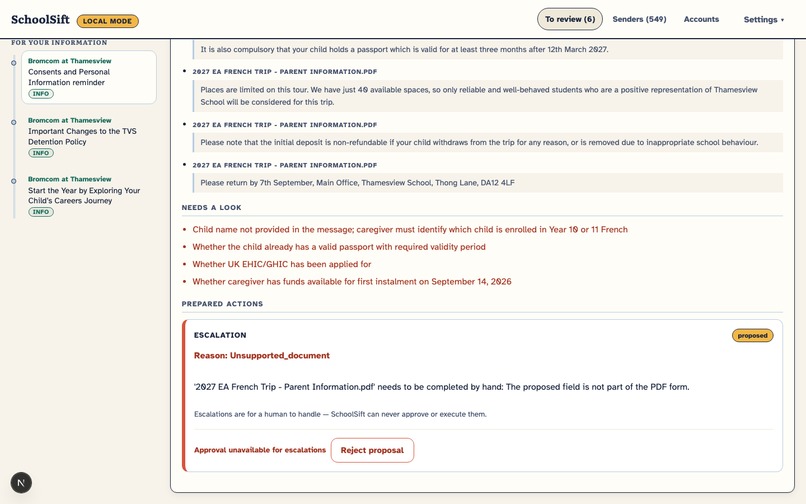
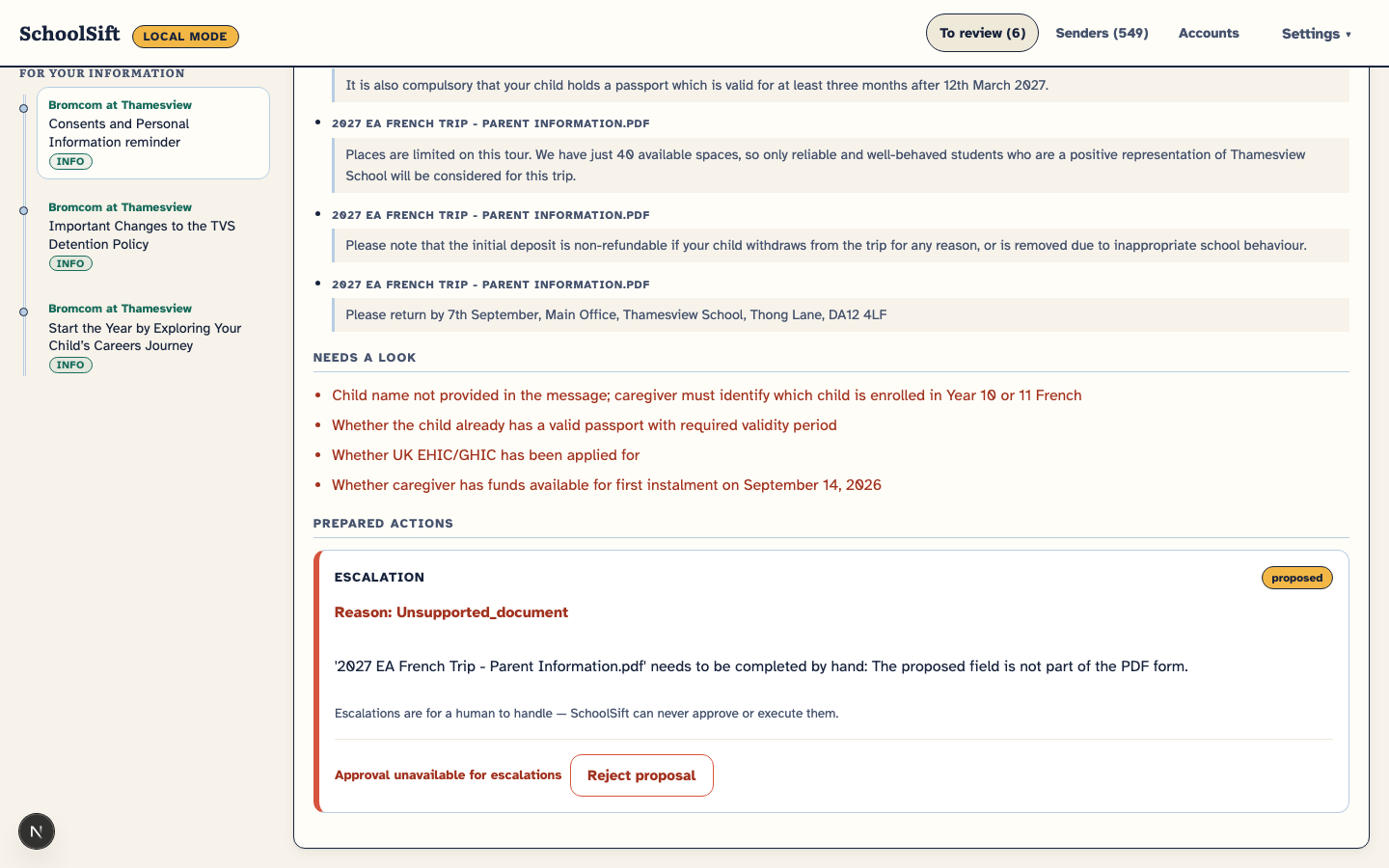
Paris trip: payment summarised, never automated; unfillable form escalated
-
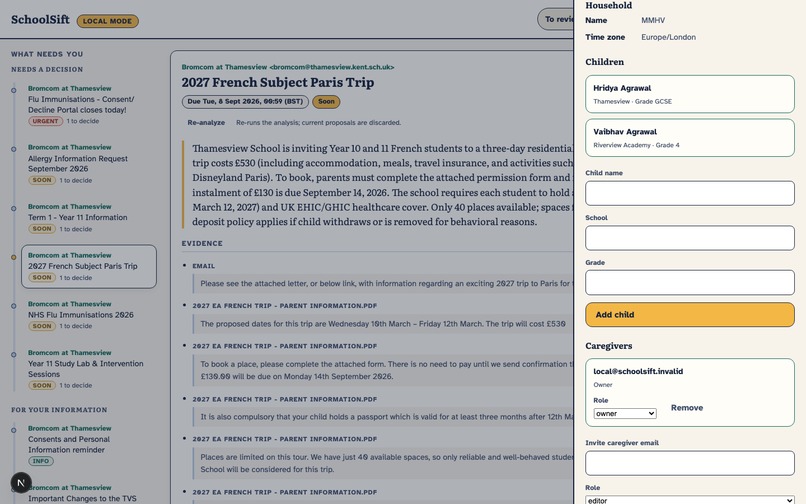
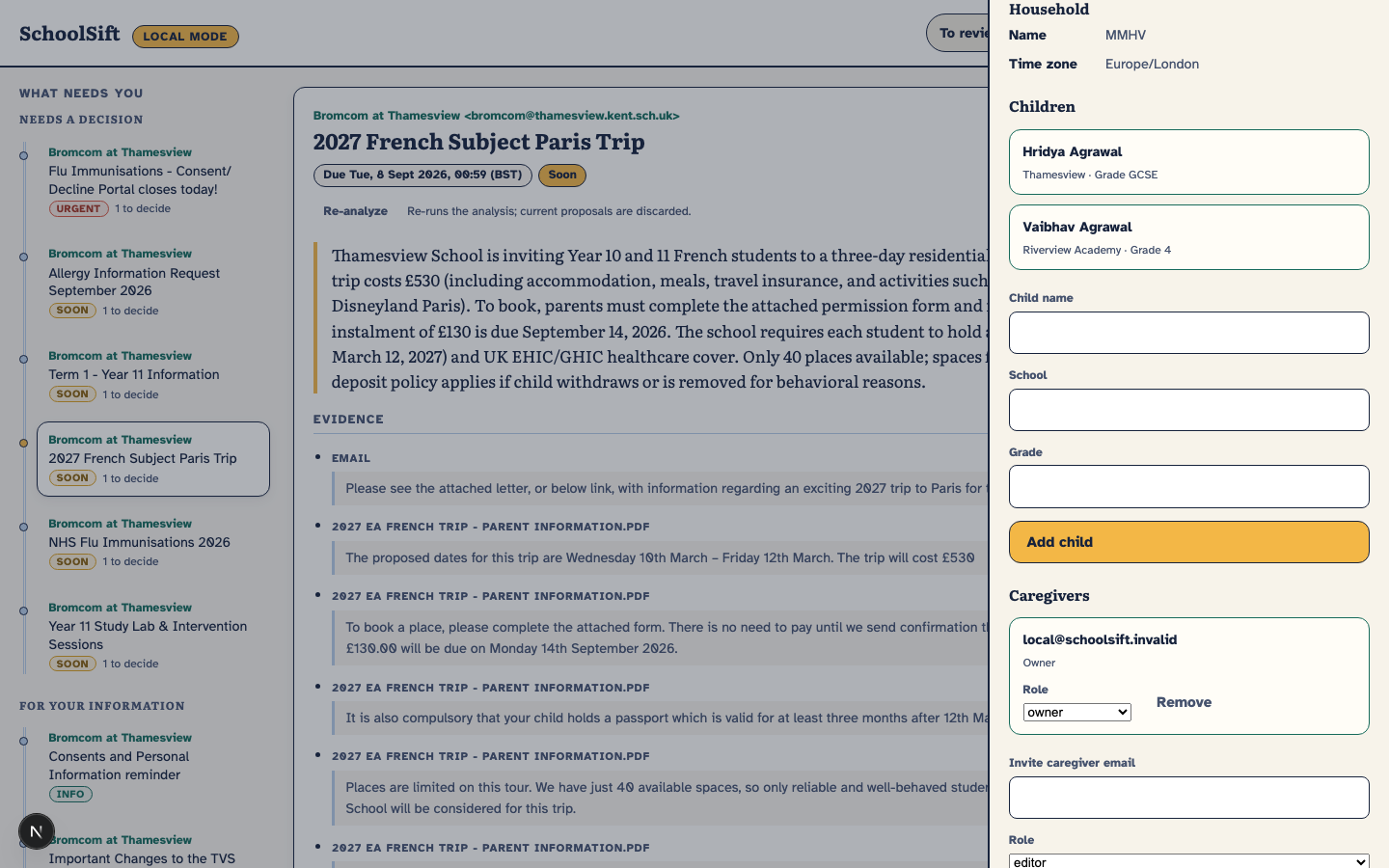
Settings: children and caregivers with owner, editor, viewer roles
Inspiration
What it does
How we built it
Challenges we ran into
Accomplishments that we're proud of
What we learned
What's next for SchoolSift
Inspiration
Our household gets school mail from a management system that sends a letter for everything: allergy forms, flu consent, a Paris trip, detention policy changes, term dates. Each one is a PDF attached to a two-line email. The information is real and often has a deadline, but it arrives in the same inbox as newsletters and receipts, so the deadline gets found the day it passes. We wanted an agent that does the reading and the drafting, and leaves the deciding to the parent.
What it does
SchoolSift connects to the Gmail and Outlook inboxes a family uses for school (as many as they need), and asks the parent to confirm which senders are the school. Only those senders are read in full. For each school message the agent produces an Action Packet:
- a short summary and which child it concerns
- the deadline and urgency
- evidence quotes, each labelled with where it came from (the email or a named attachment)
- prepared actions: a draft reply to the school, a calendar event, or a filled PDF form
- escalations when a person has to act: payments, signatures, portals, forms that cannot be filled safely
Nothing is sent or scheduled until a caregiver approves the exact version they reviewed. Households can have several caregivers with owner, editor, and viewer roles, so both parents (or a grandparent) see the same queue.
What it did on a real inbox
We connected a real Gmail account through Google OAuth, synced 3,000 message headers, trusted the school's sender, and processed nine real letters. Examples of the output:
- Allergy Information Request: deadline found, urgency soon, draft reply to the school ready to approve.
- NHS Flu Immunisations: vaccination day read from the attached PDF letter and proposed as a calendar event; the consent request itself was escalated because it lives on an external NHS portal.
- 2027 Paris trip (£530): deadline and payment schedule summarised; payment never automated; the permission form escalated because the PDF has no fillable fields.
- Term 1 letter: return day and time read from the uniform-letter PDF and proposed as a calendar event for the right child.
- Detention policy, careers, consents reminders: correctly marked information-only with no proposed action.
How we built it
- Agent: Strands Agents SDK with Pydantic structured output, running on Amazon Bedrock (Claude Haiku 4.5 via a cross-region inference profile). The agent has read-only tools scoped to the household (children, calendar, documents) and receives attachments as Bedrock document blocks. Email content is treated as untrusted data; a policy layer validates every proposal (recipients limited to the school thread, calendar windows must be well formed, PDF fields must exist and may not be payment or signature fields) before anything is stored.
- Backend: Python 3.12, FastAPI, SQLite locally with ordered migrations; encrypted content store; OAuth tokens in the OS keychain locally and Secrets Manager in AWS.
- Ingestion: Gmail history sync and Microsoft Graph delta sync; Gmail Pub/Sub and Graph change-notification webhooks that verify and enqueue only; SQS FIFO queues with dead-letter queues.
- Execution: approval creates one idempotent execution; a worker sends the reply or creates the event with deterministic ids so retries cannot double-send; ambiguous outcomes are surfaced as "delivery uncertain" rather than retried.
- Cloud: AWS CDK stack (KMS, S3 with 30-day expiry, DynamoDB, SQS, Cognito, ECR, CloudWatch alarms, EventBridge Scheduler) deployed to us-east-1, and the agent packaged for Amazon Bedrock AgentCore Runtime by direct code deployment (aarch64 zip), deployed and READY behind a Cognito JWT authorizer.
- Web: Next.js 15, plain CSS, Zod at the API boundary, Playwright and Vitest tests.
- Quality: 484 backend tests, 68 web tests, 17 infrastructure assertions, strict mypy and TypeScript, secret scan, and validated architecture diagrams (Archify) with an editable Excalidraw export.
Challenges we ran into
- Real school PDFs arrive labelled
application/octet-stream; we now sniff the content instead of trusting the declared type. - The model drifts on small things (drops a dot in a filename, writes "Email body" instead of the exact source label, omits a time zone). We normalise those instead of failing the whole message, while keeping the hard rules (recipients, payments, signatures) strict.
- A brand-new AWS account needs the Anthropic use-case form and cross-region inference profiles before Bedrock will answer; we surface those as clear, retryable errors instead of "could not process".
- Multiple accounts per provider do not fit the AgentCore Identity vault's one-user-one-provider model, so credentials live per connected inbox in Secrets Manager and the agent never sees a token.
Accomplishments we're proud of
A parent can connect a real inbox and get real, evidence-backed packets from real school letters, with the agent refusing to do the things it should not do (pay, sign, fill a form it cannot verify) and saying so.
What's next
- Wire the DynamoDB store and host the API and workers in AWS so the deployed AgentCore runtime processes messages instead of the local agent.
- First live approved send and calendar insert on the real account.
- Outlook end to end, Gmail push notifications, invitation emails, digests.
- Google restricted-scope verification so families beyond our test users can connect.
Links
- Code (MIT): https://github.com/mukeshkbj/schoolsift
- Pitch and demo video: https://www.youtube.com/watch?v=3seZeoErrOk
- Build story on AWS Builder Center: https://builder.aws.com/content/3JJrjwp1ua3qPA6TGCBDgLQi4S3/agents-for-humans-building-schoolsift-an-agent-that-reads-school-letters-so-parents-dont-miss-the-deadline
Built during the submission period; no pre-existing code. AI coding assistants were used during development.
Built With
- amazon-bedrock
- amazon-bedrock-agentcore
- amazon-cognito
- amazon-dynamodb
- amazon-sqs
- amazon-web-services
- aws-cdk
- aws-kms
- fastapi
- gmail-api
- httpx
- microsoft-graph
- next.js
- outlook
- playwright
- pypdf
- python
- sqlite
- strands-agents
- typescript

Log in or sign up for Devpost to join the conversation.