-
-
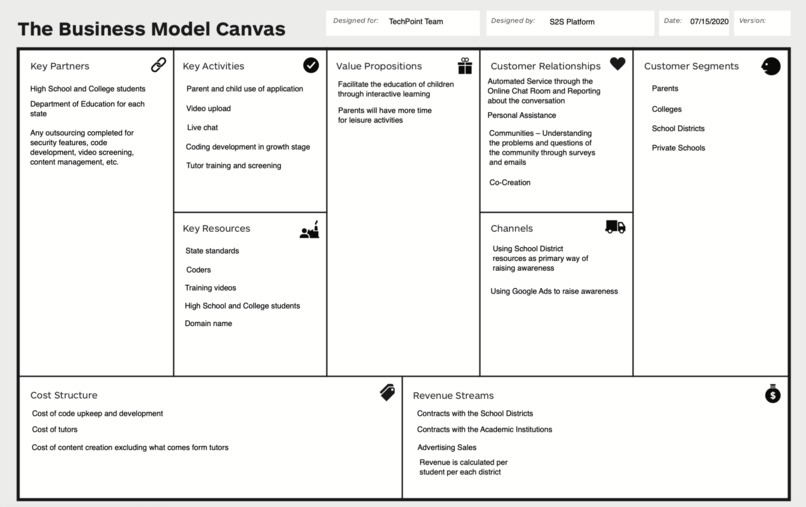
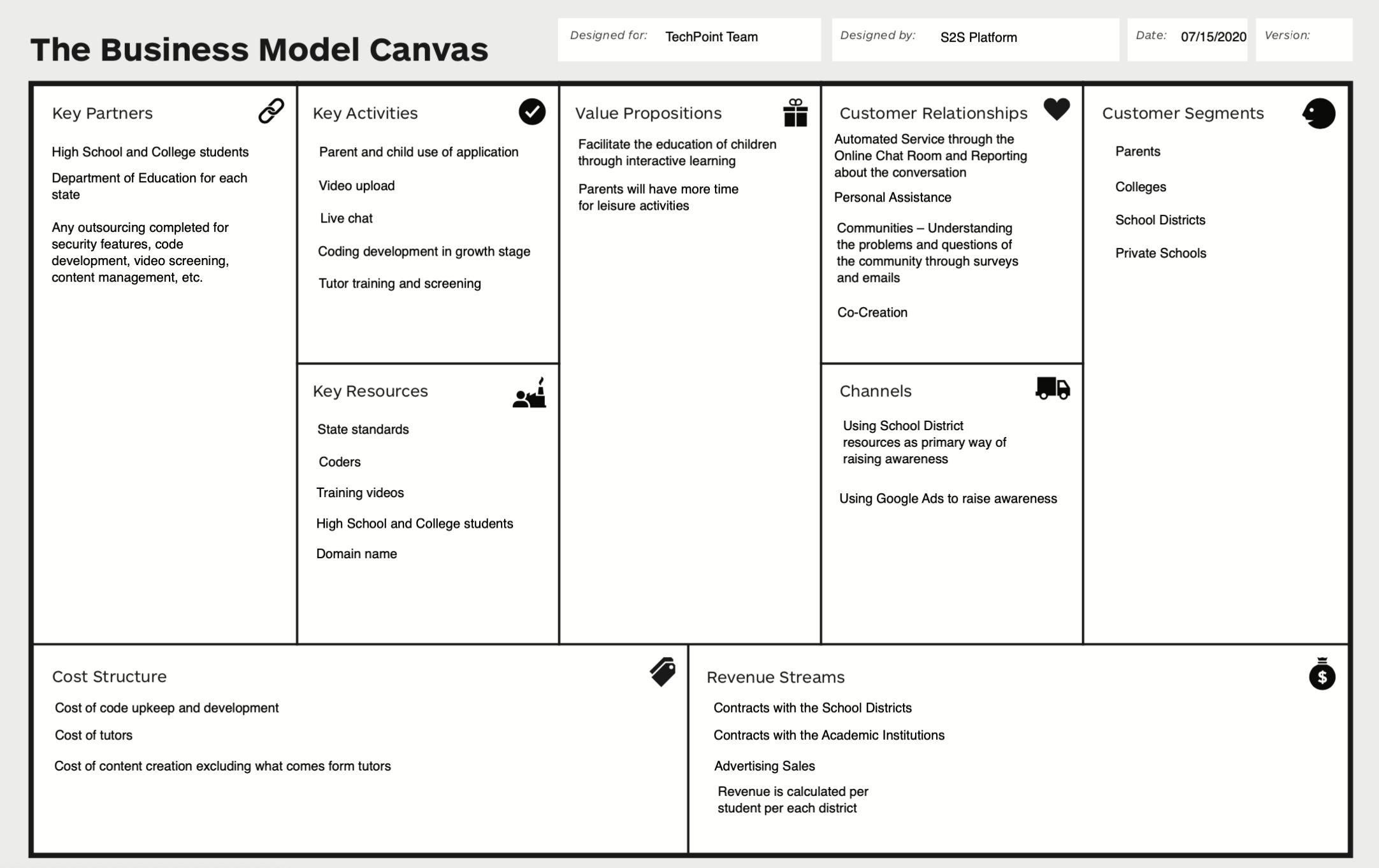
Student2Student's Business Model Canvas
Overview
Mission
We exist to engage young learners and promote independence, so today’s students become tomorrow’s success.
Summary of the Market
The state of Indiana has 420 school districts with a total of 1,050,614 K-12 students. Public schools have an average of 561 students each, and there are a total of 545,025 K-6 students making up 51.87% of students in the state. According to our research, there is an average of 1,298 K-6 students per school district.
Since the pandemic has started, many school districts and elementary schools have experienced major difficulties in providing ample resources for our students. There is a student to teacher ratio of 17:1 and a student to administrator ratio of 333:1, demonstrating a shortage of teachers in the state and an emergency need for a new product that can ease the burdens of teachers.
Problem
Based on news articles and surveys, many elementary school students are facing major challenges in their education due to the impact of the COVID-19 pandemic. With the limited resources school districts were able to provide to facilitate education in a remote setting, many fear that elementary students’ comprehension levels did not progress after schools migrated to e-learning at the end of the 2019-2020 school year.
A large number of elementary schools will be continuing in this format for at least the first half of the upcoming school year. There are limited opportunities for teachers and entire classes to join a video call together while working in this remote manner. Therefore, most of the students' learning occurs through online resources provided by teachers. Young students are struggling with the lack of interaction. Teachers may hold office hours a few times a week, but students do not have the same access to help from their teachers or peers as they would in a typical classroom setting. Because of this, students are leaning more on their parents, and parents are left working from home while helping their children with schoolwork.
Solution
Our team is introducing a website called Student2Student (S2S). We are developing a platform where high school and college student tutors can help elementary students. Students or their parents can request help from tutors through live chat, and tutors can respond with recorded videos, chat, or live video. When tutors upload recorded video responses to the website, they will be added to the student portal organized by state standards, and this will serve as a growing repository of resources. A separate set of tutors will be creating videos for our website that cover specific state standards with examples.
School districts will sign contracts with S2S to provide our platform to their students. The contracts allow for the financing of tutors as well as covering overhead costs. Contract pricing with districts will be based on the number of students in the district. We are currently focusing on introducing this new product to the state of Indiana with plans to expand nationally.
Team Members
Alyssa Kane (Project Manager, Senior, Finance @ IUPUI)
Alyssa was responsible for scheduling all meetings, setting agendas, and communicating with community contacts. She ran planning meetings at the beginning of each week and collaboration meetings each Wednesday. Alyssa conducted market interviews to inform the decision-making process throughout product development.
Nariman Mammadli (Business Analyst, Senior, Finance & Informatics @ IUB)
Nariman was responsible for creating infographics of the BMC, Empathy Map, and Environmental Analysis. He collaborated with Alyssa in making primary research surveys along with learning more about the platform through customer feedback. He ensured that the go-team delivered high-quality research for the judges.
Lauren Sailor (Designer, Master’s student, Mechanical Engineering @ Purdue)
Lauren researched platforms for web apps and then focused on the layout and flow of the website the team created. Learning Figma along the way, she designed the low fidelity prototype that the team modeled the website functionality and structure after.
Veronica Kleinschmidt (Software Engineer, Sophomore, International Computer Science @ Rose-Hulman Institute of Technology)
Veronica designed the logo and created a color palette for the website. She collaborated with Caleb in setting up and writing the code for the website, working mainly on the student page and providing the content for the state standard implementation. She also helped shape the low-fidelity prototype in Figma with Lauren.
Caleb Powell (Software Engineer/Web-Design, Junior, Physics and Computational Mathematics @ Wabash College)
Caleb coded the main structure of the website, including the student portal, login page, navigation bar, video, games, and chat embedding, as well as the Javascript for receiving and reviewing tutor submissions. He was assisted by Veronica in the additions of the Tutor Portal submission section, website footer, team logo, and state standard implementation.
How did you decide on this customer segment, problem, and solution?
After we completed our environmental analysis of industry forces, key trends, macro economic forces, and market forces, we started learning more about our target customer segment. As a team, based on the environmental analysis and the purpose of the product, we identified that our primary end-user consumer will be elementary students and their parents. However, the customer segment for this product is school districts. The local school districts will invest in this product when they see the ways we are benefiting our end users (parents & children). We plan to illustrate the success of our platform by selecting three districts to pilot our program as we expand to new state markets.
After we identified the customer segment, we performed primary and secondary research to understand the pains and issues that our target consumers face. We created a survey and distributed it among parents from multiple school districts to hear their perspective. In addition, we also completed 15-20 minute interviews with 5 parents of elementary school students to understand how we are solving their problems. Finally, we also performed secondary research by visiting online university libraries.
After we synthesized this research, we were able to identify the pains/problems, customer segment, and our solution. Below are the key findings from our research:
Findings across all age groups:
- Competition is important and addicting
- Gaming components keep students engaged
- Trouble organizing class assignments
- Desire for a personalized platform that tracks progress, connects to classes, and displays student name
Young (K-2nd)
- More emotional with competition
- Parents are much more engaged in learning process
- Parents are more likely to be present for live calls with tutor
Old (3rd-6th)
- Most are okay with competition, but some still have an emotional response
- Students are taking the responsibility to problem solve and find resources
- Parents are more likely to trust child alone with live chat tutor
Possible features presented by parents:
- Standard oriented games
- Leaderboards/ Point systems
- Supplemental articles for parents that outline child development, media warnings for age-appropriate content, healthy lunch ideas, etc.
- Connecting student accounts with the classroom so students can message other classmates and teachers.
- Reports to parents and teachers about child progress
- Icons that encourage kids to take a break from the screen by doing a physical exercise
- Talks out loud to student
- Creating an animated character to guide them through the website, give reminders, etc.
How did your team build and iterate on the solution?
After our team determined the problem our product would solve and the target customers, we began prototyping the website in Figma. Given the interaction between elementary students/parents and tutors, the website is very naturally split into two portals. Our solution primarily aids elementary students and their parents, so developing the elementary student and parent portal was the main priority. Within Figma, the student portal lands on a page for searching published content, which can be sorted by the student’s grade, subject, and state standard. Once the search is completed, results appear as well as an opportunity to request live help from a tutor. The color scheme on Figma includes S2S’s key colors of orange and purple, which represent confidence and creativity, but is otherwise relatively plain.
From interviews conducted with parents of elementary-aged students, the team was reminded of the importance of having an engaging website to keep children’s attention. This feedback guided some of the improvements incorporated in the development of the website. The student portal on the website is very colorful with each subject having a different bright background color. Additionally, instead of searching for content by particular tags, the videos explaining state standards are divided by subject, and each subject is divided with tabs for each grade. This way, students can easily navigate to relevant videos. So that it is always easy to find, a “chat” tab is available on each subject page for live help from tutors.
Key Metrics
Marketing
20 new leads
100 new videos shared
4000 social media impressions
1000 landing page views
Customer Discovery & Product Development
5 interviews conducted
2 districts to beta test
7 user tests
Technical Architecture
GitHub repo, Website Home Page

Key Tools, Libraries, and Frameworks
- Heroku - We used Heroku to host our website. It is a free and easy to use hosting service that also includes a database service
- GitHub - GitHub was used for version control and as a repository for our code
- Figma - We used Figma to collaborate on the low-fidelity prototype of our website
- Discord - Used for communication between tutors and students as it is easy to use and well-known, so it requires a very low learning curve
- Discord Bots - WidgetBot and Mee6 for chat management and chat widget plugins
If you had another 5 weeks to work on this, what would you do next?
- We would build additional features to complement the core business already represented in the prototype. Currently, we have built out paths for students to obtain video help based on subject and grade level and for tutors to provide video and text help to students. Additional work would include:
- Creating student login functionality
- Expanding our video database
- Adding educational games to help students learn
- Enabling an email function to report weekly summaries of subjects studied, chat history, and basic user statistics
- While we completed five interviews in our target market, additional research would be vital for further decision making and refinement. Specifically, interviews with school district decision-makers will be essential. Our team would like to conduct 20 more interviews for the next phase of build-out.
- We completed secondary research on how to market our product to school districts but primary research would be a good next step. Primary research would allow us to accurately determine a more precise marketing budget by determining the most responsive marketing channels for school district leaders.
Checklist of Completed Items


Log in or sign up for Devpost to join the conversation.