Inspiration
Leadership means making decisions where every option has a cost, and I wanted to give people a way to practice those decisions before facing them in real life. I built a short simulation that combines a realistic workplace scenario with multilingual media, branching outcomes, and reflection.
What it does
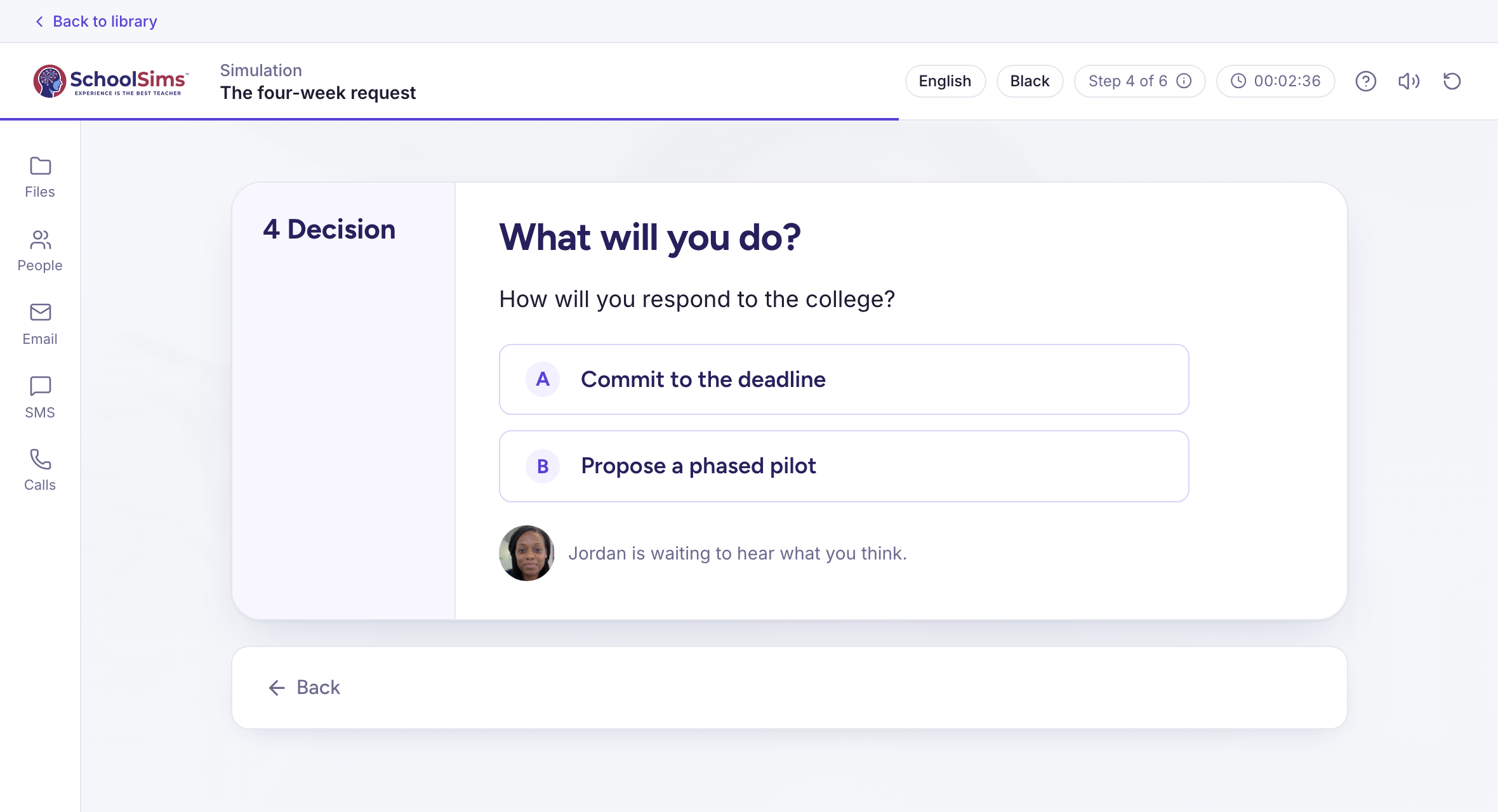
School Sims puts you in charge of a company facing a difficult request: a college wants a new feature in four weeks, but your developers already have commitments to other customers.
Jordan, your partnerships lead, explains the situation through a simulated video call. You choose whether to commit to the deadline or propose a phased pilot, then see the consequences for revenue, team capacity, and customer trust.
The simulation supports five languages and five character appearances, with captions, transcripts, and supporting emails and messages. After making a decision, learners can explain their reasoning and request AI coaching in their selected language.
Additional features include saved progress within the browser tab, a downloadable practice certificate, and presenter controls with a QR code for audience participation.
How we built it
I built the application with Next.js, React, TypeScript, and CSS, and deployed it on Vercel.
The scenario uses JSON to define steps, choices, and outcomes. Separate translation files and character configurations allow the same simulation to work across different languages and appearances.
I used ElevenLabs for multilingual speech, Hedra for character images, and OmniHuman 2.0 through Hedra for talking videos. These assets are generated in advance.
Optional coaching uses a server-side Anthropic API route. Claude receives the learner’s reflection and chosen scenario path, then returns brief feedback and a follow-up question.
Challenges we ran into
Coordinating dialogue, audio, captions, and video across languages and character appearances was the biggest challenge. Each version needed to communicate the same situation without changing the decision paths.
Video generation also required balancing coverage and cost. Some combinations use a portrait with audio instead of a talking video.
Another challenge was presenting meaningful consequences without reducing the scenario to a simple right or wrong answer.
Accomplishments that we're proud of
I completed a playable experience from setup through reflection, including five languages, multiple character appearances, and branching outcomes.
I’m especially proud of the incoming video call and the coaching feature, which connects feedback to the learner’s own reasoning. Presenter controls also make it easy to demonstrate different parts of the experience during a short pitch.
What we learned
I learned how to coordinate generated images, speech, and video within an interactive application. Separating scenario logic from translations and media made the different versions easier to manage.
I also learned how prepared content and live AI can work together: the scenario follows consistent paths, while coaching responds to each learner’s reflection.
What's next for School Sims: Leadership Simulation
I’d like to add more leadership scenarios, have fluent speakers review the translations, and expand talking-video coverage across all language and character combinations.
I also want to test the prototype with learners and educators to understand which parts best support reflection and discussion.
This is an unofficial SchoolSims prototype built at YCP Hacks.
Built With
- anthropic-api
- claude
- css
- elevenlabs
- hedra
- next.js
- omnihuman
- react
- typescript
- vercel
