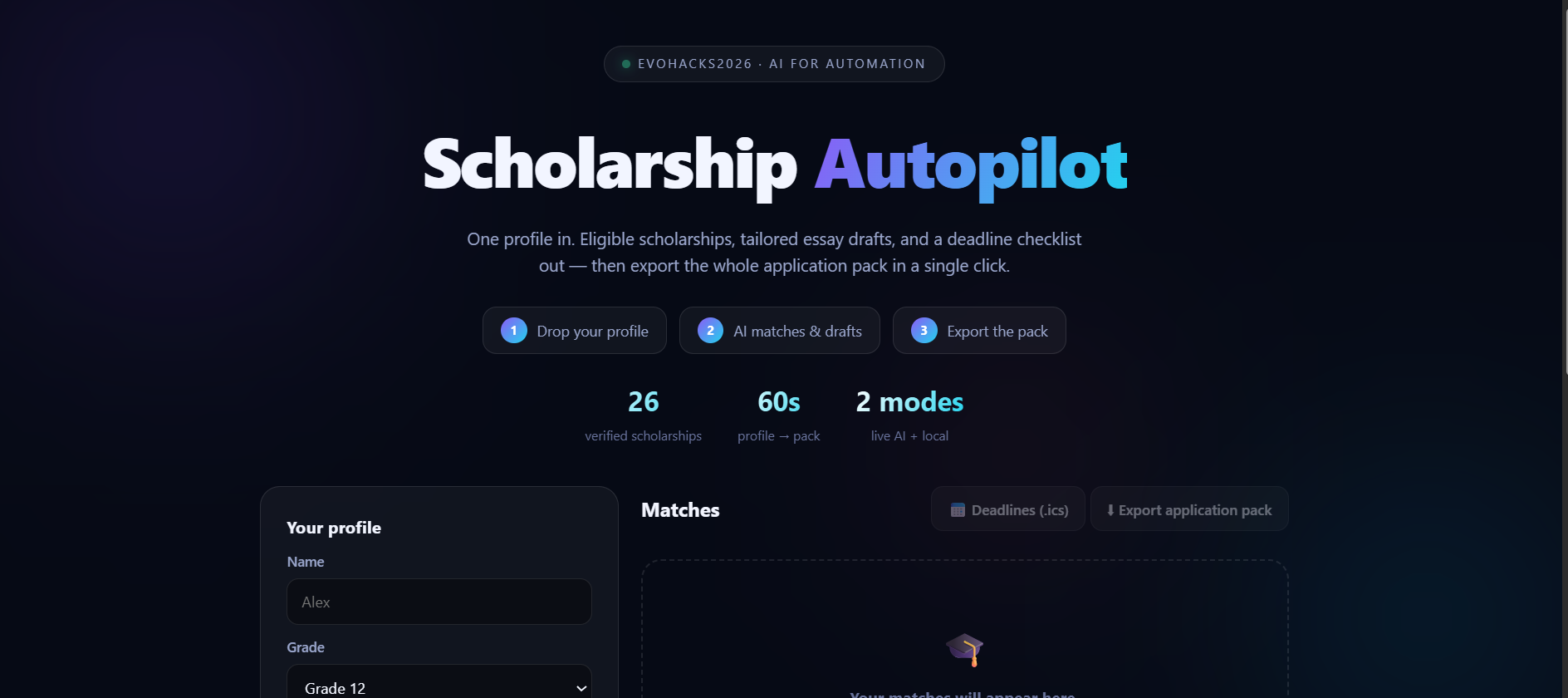
Inspiration: Students miss out on thousands in scholarship money every year — not because they don't qualify, but because they never find the programs. Discovery is scattered across dozens of sites, eligibility rules are buried in PDFs, and deadlines pass silently. We wanted a student to go from "I don't know where to start" to a personalized shortlist in two minutes.
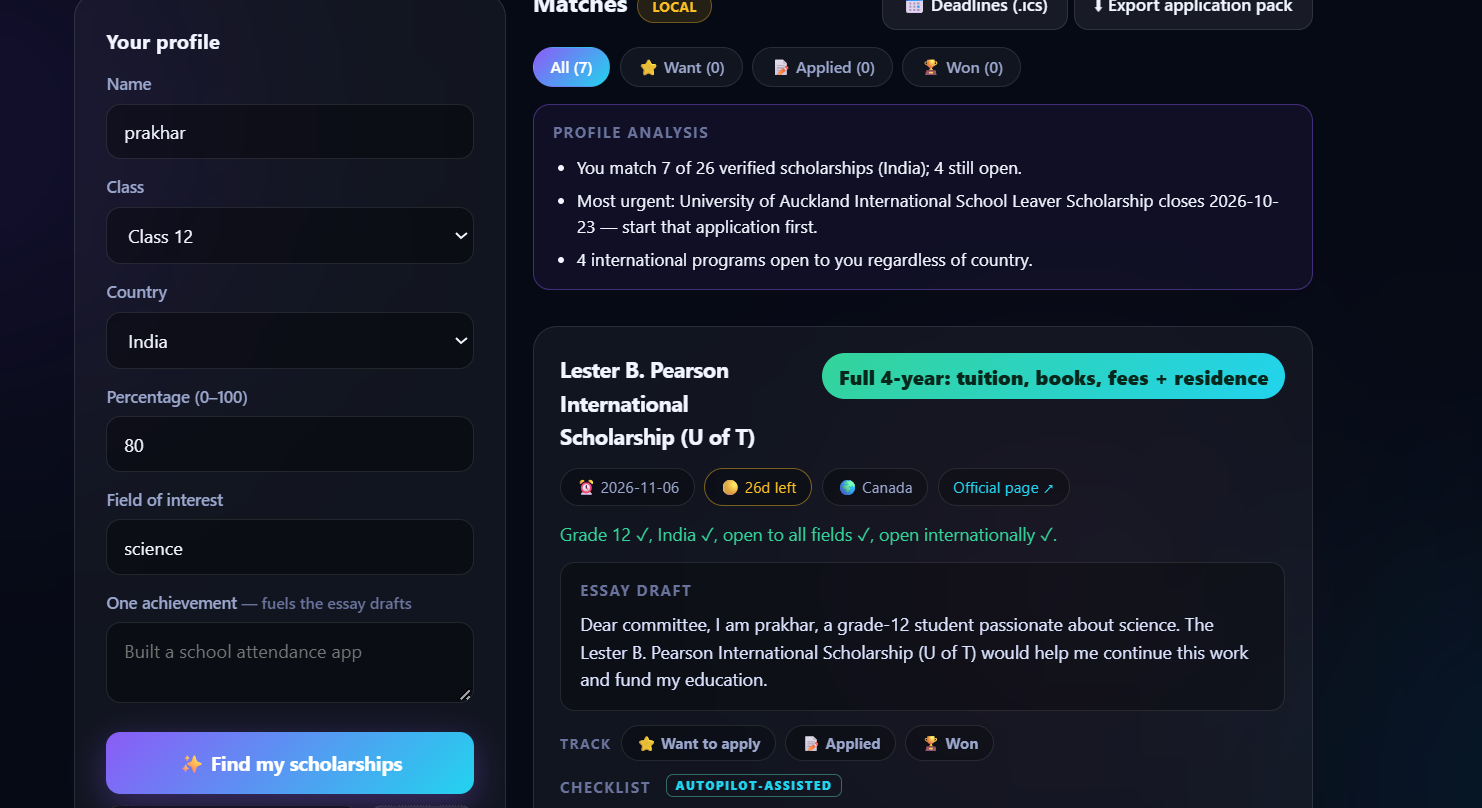
What it does: Scholarship Autopilot takes a student's country, grade level, academic score, and subjects, then matches them against 26 hand-verified scholarships across the US, UK, Canada, Australia, India, Japan, and New Zealand. Each match shows exactly why it fits — grade eligibility, GPA cutoff, subject alignment — with country chips, open/closed status, award amounts, and deadlines. A smart checklist tracks each application: eligibility is pre-verified by the app's rules, copying an essay draft marks that task done, and adding a deadline to your calendar downloads an ICS file and checks it off. An AI layer (Gemini) reasons over the matches and explains them in plain language.
How we built it: Vanilla JavaScript + HTML/CSS frontend, with a Vercel serverless function (api/match.js) that calls Gemini using a server-side API key — so the deployed demo needs no visitor API key. The dataset was the hard part: every scholarship was verified against its official source for award amount and deadline, and 10 candidates were dropped for unverifiable data. Matching filters on three real criteria — grade vs. eligible grades, score vs. published minimums, subjects vs. fields — plus country (a program only matches your country unless marked international). Grade levels and scoring adapt per country: GPA for US/Canada, percentage for India/UK/Australia/Japan/NZ, with the conversion shown honestly in explanations. The AI deliberately never browses the web — it reasons only over the verified dataset, so it cannot invent scholarships or deadlines.
Challenges we ran into: Verifying 26 scholarships from official sources was slow, manual work — and throwing out 10 we'd already researched hurt. Education systems don't map cleanly across countries: "Grade 11" means different things in India vs. the UK, and half the programs publish no GPA cutoff at all. The biggest design fight was the AI: letting it browse the web would make it sound smarter but let it hallucinate fake deadlines — so we constrained it to reason over verified data only, which is less flashy but trustworthy.
Accomplishments that we're proud of: 26 verified scholarships across 7 countries, every one traceable to an official source. A deployed demo that needs no API key from visitors. Country-aware matching that respects how each education system actually works. And an honest touch we're proud of: instead of inventing GPA cutoffs where programs publish none, the app shows a clear "long shot" warning below 2.0 GPA and tells students to confirm on the official page.
What we learned: No published cutoff doesn't mean no filtering — it means being honest about uncertainty instead of faking precision. Constraining AI to verified data makes it less impressive in demos and far more useful in reality. And "one global form" is a myth: grade names, scoring, and eligibility all change by country, so localization isn't a feature, it's the product.
What's next: More countries and more scholarships, deadline reminder notifications, AI-assisted essay drafting from the checklist, and saved profiles that track a student across application seasons.
Built With
- css3
- google-gemini-api
- html5
- javascript
- vercel-serverless-functions


Log in or sign up for Devpost to join the conversation.