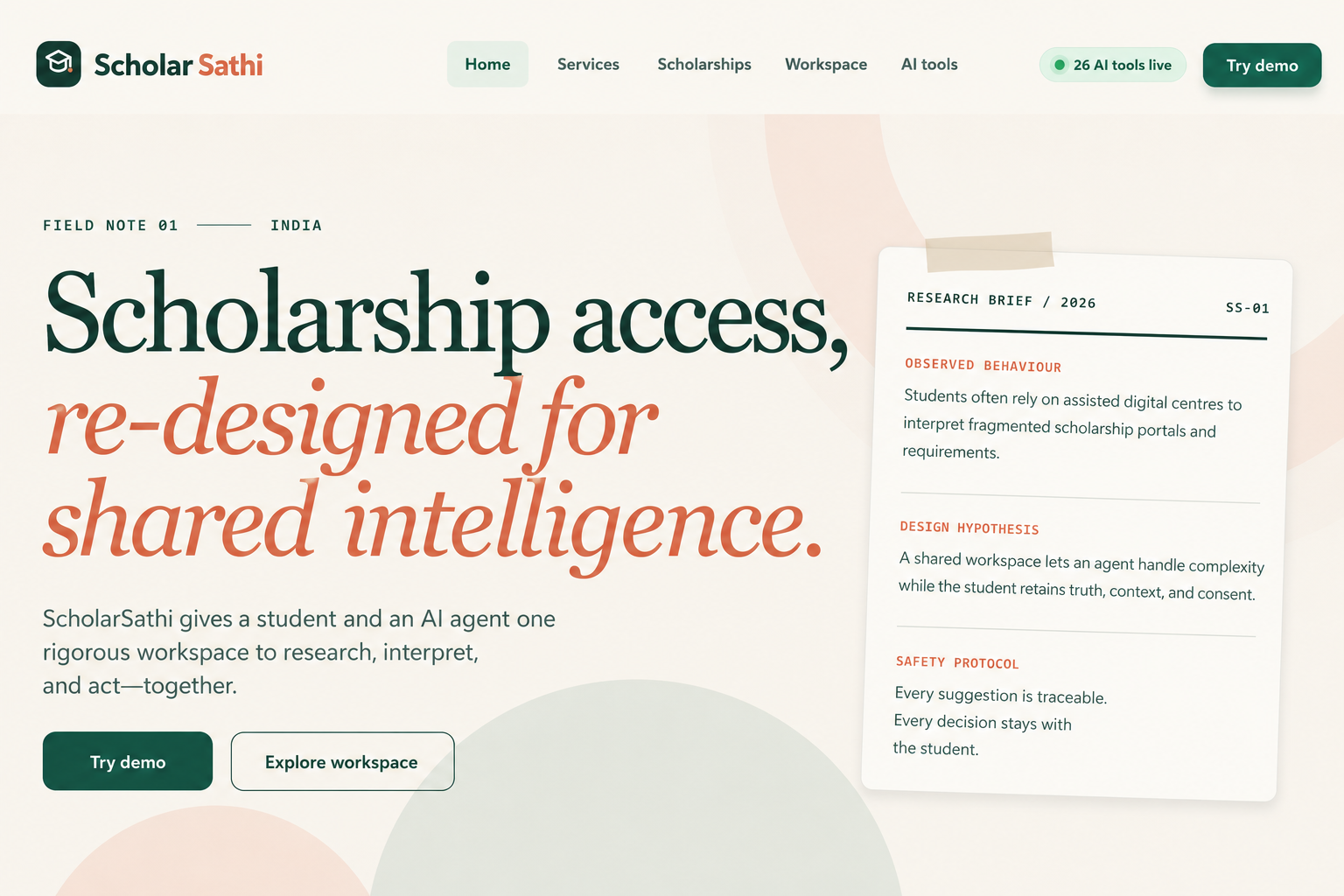
In India, many students depend on cybercafes , jan suvidha kendra to complete scholarship applications. Government portals can involve confusing eligibility rules, long document checklists, repeated data entry, and multiple application stages. Students pay for assistance 50 inr to 100 inr and still not understand why they qualify, what is missing, or what happens next.
We wanted to create a safer alternative: a shared workspace where an AI agent can handle the complicated preparation work while the student remains informed and in control.
## What we built
ScholarSathi helps students:
- discover representative scholarship programs;
- assess eligibility using deterministic rules;
- identify missing information and documents;
- prepare and validate an application draft;
- request explicit human approval;
- submit and track a simulated application.
WebMCP is fundamental to the product. ScholarSathi exposes focused tools that an AI agent can discover and compose, rather than forcing the agent to guess how buttons and forms work. Tool calls update the same visible interface the student uses, creating shared state between the human and the agent.
## How we built it
ScholarSathi is a static application built with semantic HTML, modern CSS, vanilla JavaScript ES modules, and local JSON-style data. It uses browser localStorage for privacy-safe demo persistence and requires no backend, account, external API, or LLM service.
The application includes:
- a deterministic eligibility engine;
- shared profile, document, application, and civic-service state;
- validation and readiness checks;
- a two-phase human approval workflow;
- idempotent simulated submission;
- responsive and accessible UI;
- 26 imperative WebMCP tools with strict schemas and structured results.
Built With
- and
- browser-localstorage
- deployment
- html5
- json-seed-data
- modern-css
- netlify/vercel/github
- static
- vanilla-javascript-es-modules
- via
- webmcp-imperative-api

Log in or sign up for Devpost to join the conversation.