Inspiration
Writing a top-tier academic paper is a daunting and time-consuming process. Researchers and students often spend dozens of hours structuring drafts, formatting complex LaTeX templates (IEEE, CVPR, Elsevier), and manually synthesizing experimental source code into formal scientific methodology sections. We built ScholarlyForge AI to eliminate this friction. We wanted to create an intelligent bridge between raw research implementation and formal academic publication.
What it does
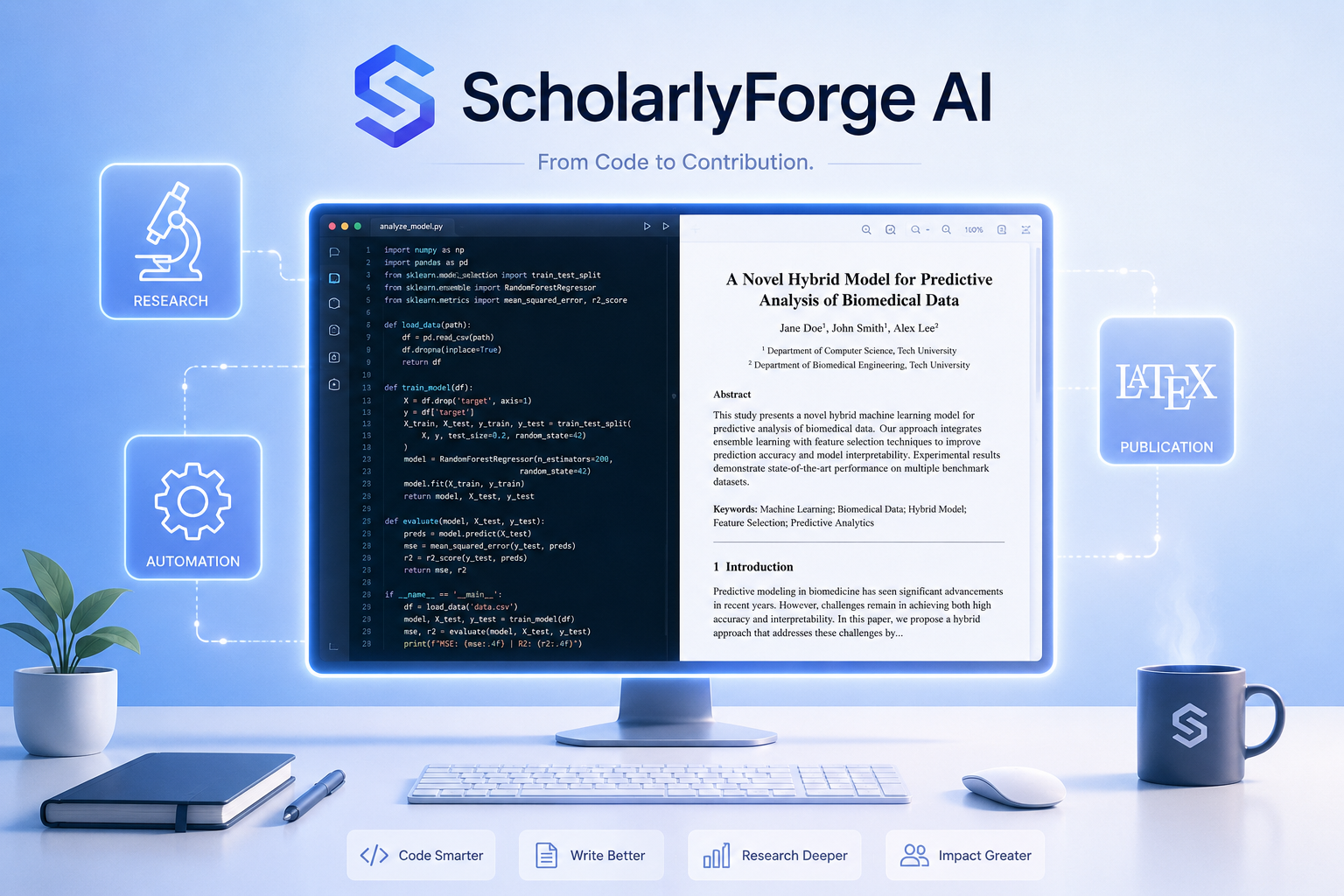
- ScholarlyForge AI is a specialized multimodal academic drafting assistant.
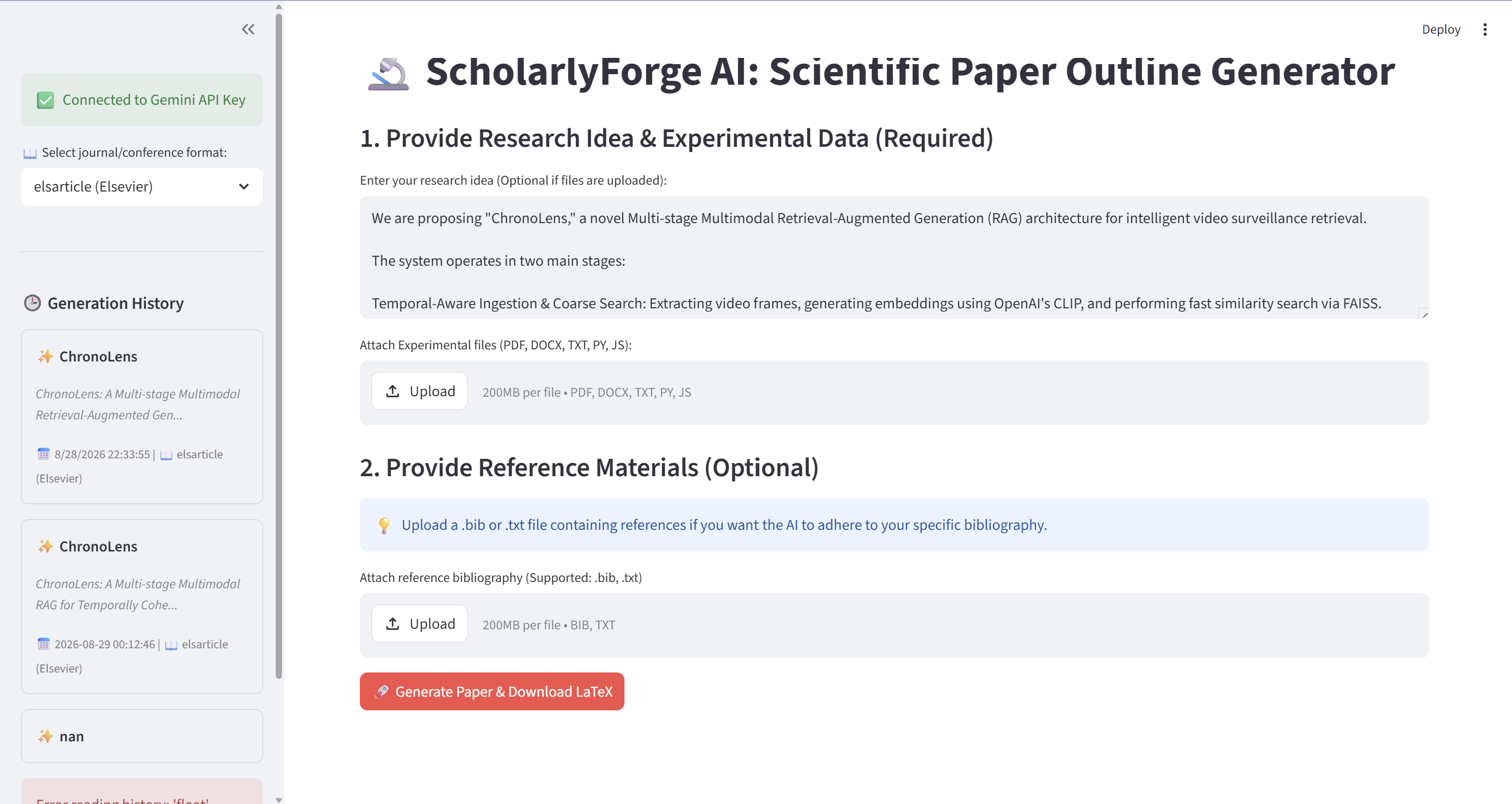
- Multimodal Ingestion: Users input their core research hypotheses and upload raw experimental files (Python/JS scripts, PDFs, DOCX).
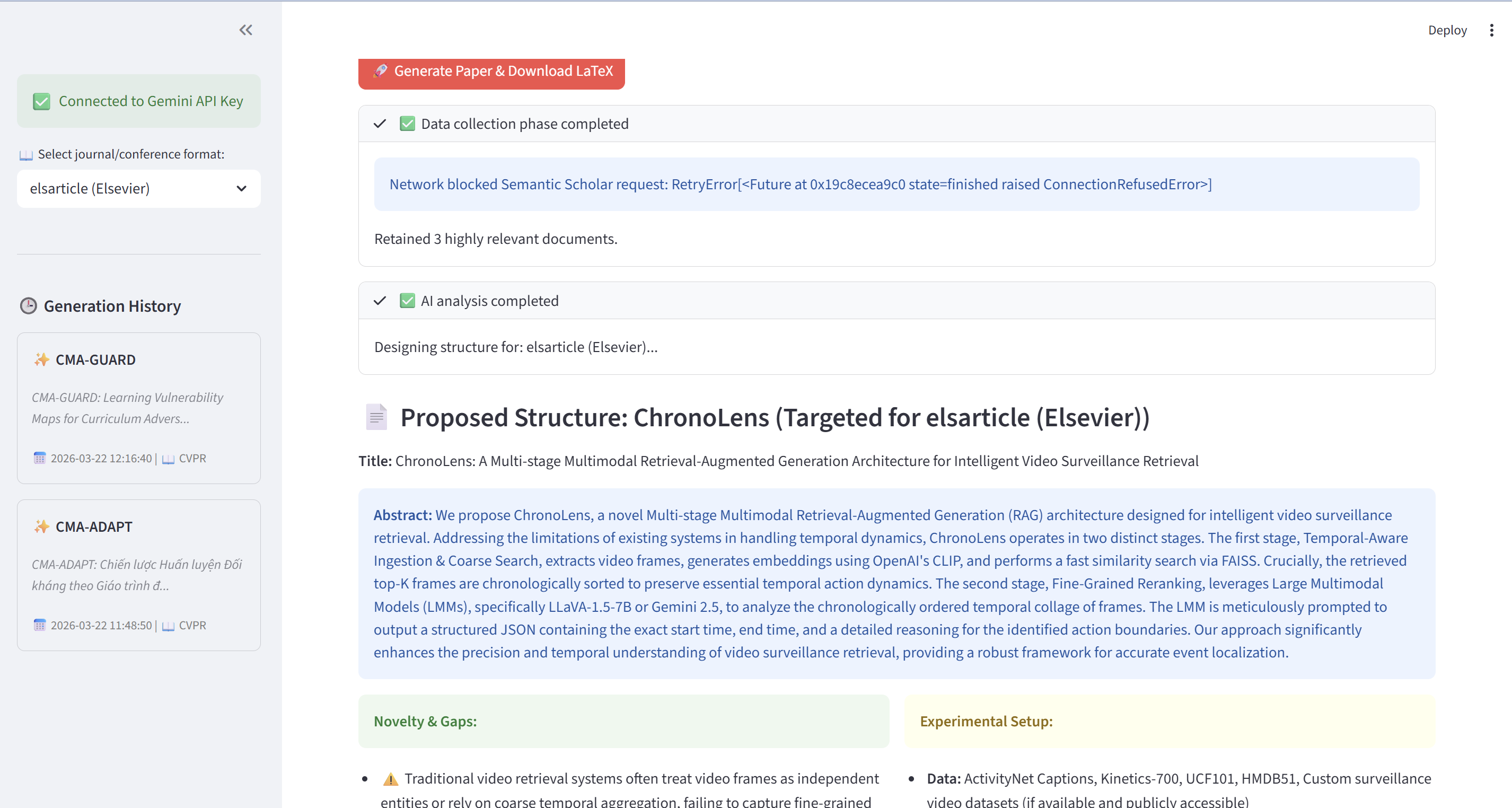
- Code-to-Methodology: The system analyzes the actual source code logic to draft realistic "Methodology" and "Experimental Setup" sections.
- Template-Specific LaTeX Generation: It generates compilable LaTeX source code strictly adhering to selected journal standards (IEEE, ACM, Elsevier, Springer).
- Literature Grounding: It can search for recent papers via Semantic Scholar/arXiv to identify research gaps and format citations.
How we built it
- Frontend: Built with Streamlit for a responsive, fast-to-deploy user interface.
- AI Engine: Powered by Google's Gemini API (Gemini 2.5 Flash/Pro), leveraging its long-context window to parse thousands of lines of code alongside text.
- Template Engine: Used Jinja2 to dynamically map AI-generated content into strict, conference-specific LaTeX structures without hardcoding. ## Challenges we ran into One major challenge was ensuring the generated $\text{\LaTeX}$ matched the specific journal selected by the user. Initially, our template was hardcoded to IEEE. We had to refactor our prompt engineering and Jinja2 pipeline to dynamically inject the correct \documentclass and bibliography styles based on user selection.
Accomplishments that we're proud of
We are incredibly proud of the "Code-to-Methodology" feature. Watching the AI read a raw PyTorch script and accurately write an academic section explaining the model architecture and evaluation metrics (like mIoU and Recall) is truly magical.
What we learned
- Direct Overleaf Integration: A one-click export button via Overleaf API.
- Interactive LaTeX Preview: Rendering the compiled PDF directly alongside the chat interface for side-by-side editing.
What's next for ScholarlyForge AI
- Live Overleaf Integration: One-click export directly to Overleaf via API/Webhook.
- ArXiv & Semantic Scholar Auto-Search: Automatic discovery and citation suggestion of relevant state-of-the-art papers.
- Interactive Section Editing: Conversational refinement of individual sections directly inside a built-in LaTeX previewer.


Log in or sign up for Devpost to join the conversation.