-
-
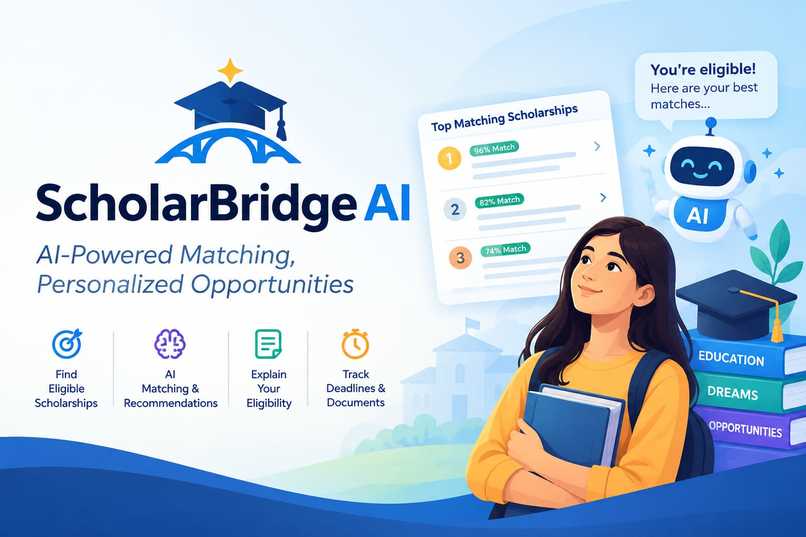
AI powered scholarship matching that connects students with personalized opportunities based on their eligibility
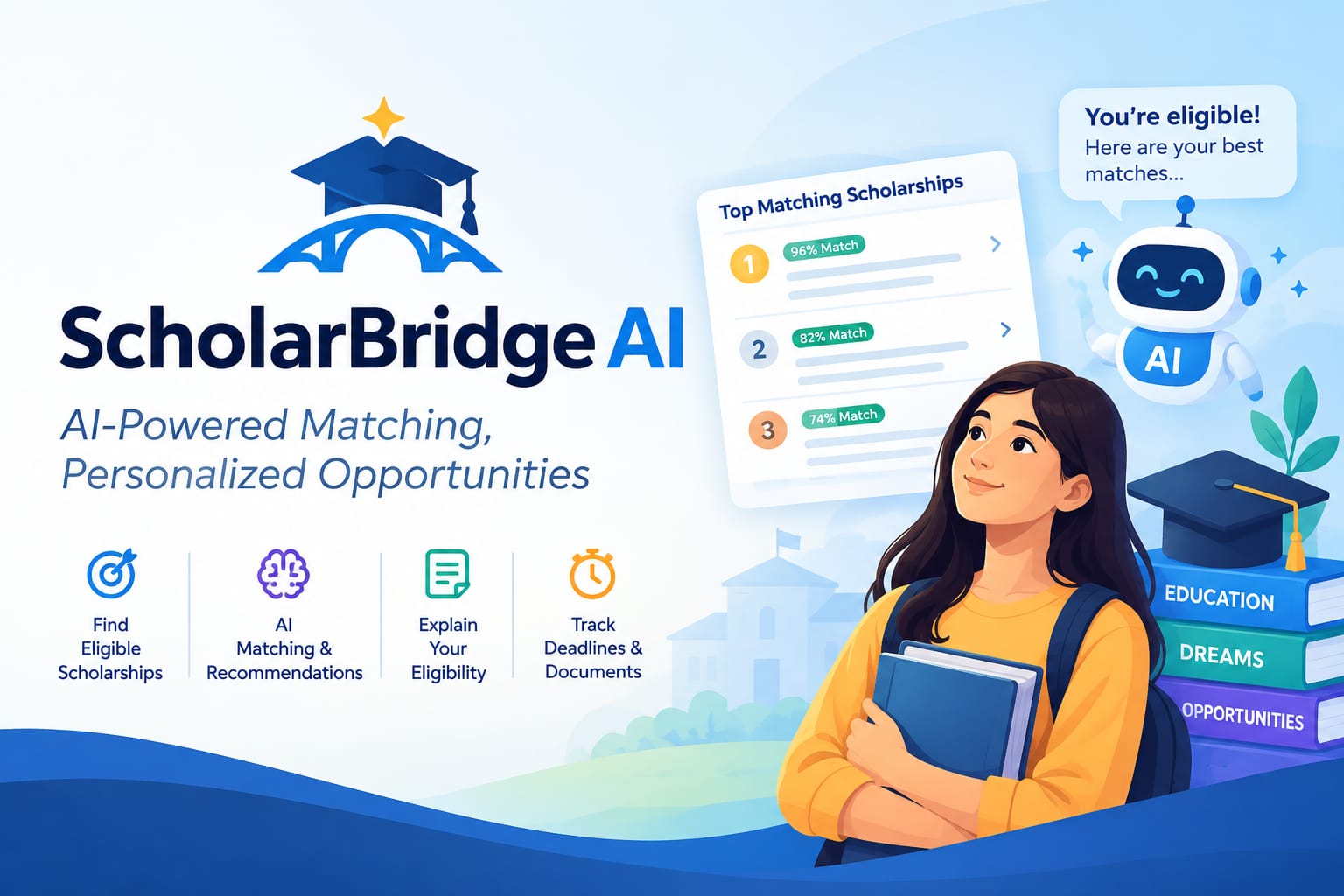
🎓 ScholarBridge AI — Intelligent Scholarship Matching
💡 Inspiration
Scholarships can make a huge difference in a student's education, but finding the right scholarship is often harder than it should be.
Students usually have to search through multiple websites, college announcements, portals, and other sources. They then have to manually compare criteria such as:
- Academic performance / CGPA
- Family income
- Category
- Gender
- Course and branch
- Age
- State or district
- Required documents
- Application deadlines
The problem is not necessarily the lack of scholarship opportunities. The problem is finding the opportunities that actually match a student's profile.
This inspired us to build ScholarBridge AI, an intelligent web-based scholarship discovery and recommendation platform designed to simplify this process.
Our idea was simple:
Instead of making students search endlessly for scholarships, help scholarships find the students who match them.
🚀 What is ScholarBridge AI?
ScholarBridge AI is an intelligent scholarship matching and recommendation system that allows students to enter their profile information once and discover scholarships that may match their eligibility.
The platform focuses on transforming:
Search → Compare → Check Eligibility → Repeat
into:
Create Profile → Match → Understand → Apply
ScholarBridge AI combines rule-based eligibility checking, AI/NLP-based matching, data processing, personalized recommendations, and explainable results to make scholarship discovery easier and more transparent.
The overall concept is:
\text{Student Profile} + \text{Scholarship Requirements}
\rightarrow
\text{Eligibility Matching}
\rightarrow
\text{Personalized Recommendations}
🎯 Problem We Are Solving
In the existing approach, scholarship information is often distributed across different sources.
Students may have to manually check:
| Requirement | Example |
|---|---|
| CGPA | ≥ 7.5 |
| Family Income | ≤ ₹2,50,000 |
| Course | Engineering |
| Category | Eligible category |
| Gender | Applicable category |
| Location | Tamil Nadu |
| Age | Within specified range |
| Documents | Income certificate, marksheet, etc. |
| Deadline | Application closing date |
This creates several problems:
- Scholarship information is scattered.
- Students spend significant time searching.
- Eligibility criteria can be difficult to interpret.
- Students may miss suitable opportunities.
- Important documents may be overlooked.
- Application deadlines can be forgotten.
- Generic search results are not personalized.
ScholarBridge AI aims to reduce this manual effort.
🧠 How ScholarBridge AI Works
The system can be viewed as a pipeline:
                 STUDENT
                    |
                    v
          +-------------------+
          |   Student Profile |
          +-------------------+
                    |
                    v
          +-------------------+
          | Scholarship Data  |
          +-------------------+
                    |
          +---------+---------+
          |                   |
          v                   v
 +----------------+   +----------------+
 | Eligibility    |   | AI / NLP       |
 | Engine         |   | Matching       |
 +----------------+   +----------------+
          |                   |
          +---------+---------+
                    |
                    v
          +-------------------+
          | Match Calculation |
          +-------------------+
                    |
                    v
          +-------------------+
          | Explainable       |
          | Recommendations   |
          +-------------------+
                    |
                    v
              STUDENT RESULTS
⚙️ How We Built It
1. Student Profile
Students provide relevant academic and personal information such as:
- Name
- Age
- Gender
- State
- District
- Category
- Family income
- CGPA
- Course
- Branch
- Year of study
- Institution information
This profile becomes the basis for scholarship matching.
2. Scholarship Database
Scholarship information is organized into structured records.
Important information includes:
- Scholarship name
- Provider
- Description
- Eligibility criteria
- Minimum CGPA
- Maximum income
- Category
- Gender
- Course
- Branch
- Location
- Age requirements
- Required documents
- Scholarship amount
- Application deadline
- Application link
This converts scattered scholarship information into data that can be processed systematically.
🔍 3. Rule-Based Eligibility Engine
One of the important components of ScholarBridge AI is the Eligibility Engine.
It compares the student's profile against explicit scholarship requirements.
For example:
Student CGPA       = 8.8
Required CGPA      = 7.5

✓ Academic requirement satisfied
Another example:
Student Income     = ₹4,00,000
Required Income    ≤ ₹2,50,000

✗ Income requirement not satisfied
The engine can evaluate conditions such as:
CGPA ≥ Minimum CGPA
Income ≤ Maximum Income
Age within required range
Course matches
Category matches
Gender matches
Location matches
This gives us a deterministic foundation before applying intelligent matching.
🤖 4. AI / NLP-Based Matching
Scholarship requirements are not always presented as structured fields.
Sometimes they appear in natural language, for example:
"Students pursuing undergraduate engineering programs with good academic performance may apply."
An AI/NLP-based component can identify concepts such as:
- Undergraduate
- Engineering
- Academic performance
This allows the system to work with scholarship descriptions that are less structured.
The AI component contributes to the overall matching process rather than relying only on simple keyword searching.
📊 5. Match Score
ScholarBridge AI can represent how closely a student's profile matches a scholarship using a match score.
Conceptually:
M(s_i,h_j)=
\frac{\text{Satisfied Relevant Criteria}}
{\text{Total Relevant Criteria}}
\times 100
For example:
Scholarship A → 92%
Scholarship B → 84%
Scholarship C → 67%
The purpose of the score is to help students understand the degree of profile compatibility and prioritize which opportunities to investigate.
💬 6. Explainable Recommendations
A recommendation should not simply say:
"92% Match"
The student should also understand why.
For example:
92% Match

✓ CGPA requirement satisfied
✓ Course requirement satisfied
✓ Income requirement satisfied
✓ State requirement satisfied

⚠ Income certificate required
This makes the recommendation more transparent and useful.
Instead of treating AI as a black box, ScholarBridge AI focuses on giving students understandable reasons behind the results.
📄 7. Missing Requirements and Documents
Scholarship applications often require multiple documents.
Examples include:
- Aadhaar card
- Income certificate
- Community certificate
- College ID
- Mark sheets
- Bank details
- Bonafide certificate
ScholarBridge AI can identify relevant document requirements and highlight information or documents that still need attention.
For example:
Eligibility Status: Partially Eligible

Missing:
⚠ Income Certificate
⚠ Community Certificate
This helps students understand what they need before beginning an application.
⏰ 8. Deadline Awareness
Deadlines are another major part of scholarship discovery.
A scholarship may be suitable for a student, but missing the deadline makes the opportunity unusable.
ScholarBridge AI therefore incorporates deadline information so students can identify scholarships that require timely action.
For example:
Deadline: 5 days remaining
Status: Apply Soon
📊 9. Personalized Dashboard
The planned dashboard brings important information together in one place:
- Recommended scholarships
- Match scores
- Eligibility status
- Upcoming deadlines
- Saved scholarships
- Missing documents
- Application status
This reduces the need to repeatedly search through different pages.
🛠️ System Modules
The overall system is organized into modular components.
Module 1 — Authentication
Handles:
- Registration
- Login
- Logout
- Authentication
- Password management
Module 2 — Student Profile
Handles:
- Academic information
- Personal information
- Eligibility-related information
- Profile updates
Module 3 — Scholarship Database
Stores:
- Scholarship information
- Eligibility criteria
- Deadlines
- Required documents
- Application links
Module 4 — Eligibility Engine
Performs rule-based eligibility checking.
Student Profile
       +
Scholarship Criteria
       ↓
Eligibility Result
Module 5 — AI/NLP Matching Engine
Processes natural-language scholarship information and identifies relevant concepts and requirements.
Module 6 — Recommendation Engine
Combines eligibility and matching results to generate personalized scholarship recommendations.
Student Profile
       ↓
Eligibility Check
       ↓
AI/NLP Matching
       ↓
Match Score
       ↓
Ranking
       ↓
Recommendations
Module 7 — Explainability Engine
Converts matching results into understandable explanations.
Module 8 — Document Management
Identifies and tracks scholarship document requirements.
Module 9 — Deadline Tracker
Highlights upcoming scholarship deadlines.
Module 10 — Dashboard
Provides students with a centralized view of their scholarship opportunities.
Module 11 — Admin Panel
Allows authorized administrators to manage scholarship information and eligibility criteria.
🏗️ High-Level Architecture
                  STUDENT
                     |
                     v
             +---------------+
             | Web Interface |
             +---------------+
                     |
                     v
             +---------------+
             | Backend / API |
             +---------------+
                /    |    \
               /     |     \
              v      v      v
       +---------+ +------+ +-------------+
       |Eligibility| AI/NLP| Scholarship |
       |  Engine   |Matching|  Database  |
       +---------+ +------+ +-------------+
               \      |      /
                \     |     /
                 +----+----+
                      |
                      v
             +------------------+
             | Personalized     |
             | Results &        |
             | Explanations     |
             +------------------+
🧮 Example
Consider a student with:
CGPA        = 8.8
Income      = ₹2,00,000
Course      = B.Tech AI & DS
State       = Tamil Nadu
Category    = Eligible Category
And a scholarship requiring:
Minimum CGPA       = 7.5
Maximum Income     = ₹2,50,000
Course             = Engineering
State              = Tamil Nadu
The matching process identifies:
✓ CGPA requirement satisfied
✓ Income requirement satisfied
✓ Course requirement satisfied
✓ State requirement satisfied
The resulting recommendation can then communicate the student's compatibility and the reasons behind it.
💻 Technology
The project architecture can be implemented using technologies such as:
Frontend
- HTML
- CSS
- JavaScript
- React.js
- Tailwind CSS
Backend
- Python
- FastAPI
AI / ML
- Natural Language Processing
- Machine Learning / AI models
- Semantic matching
- Rule-based eligibility engine
Database
- MySQL / PostgreSQL / MongoDB
Development
- VS Code
- Git
- GitHub
Deployment
The project is deployed as a web application and can be accessed through a browser.
Live Demo: ScholarBridge AI — Live Demo
🧠 What We Learned
Building ScholarBridge AI taught us that developing an intelligent system is about much more than simply adding an AI model.
1. Data quality matters
An intelligent matching system is only as useful as the information it processes.
Scholarship eligibility criteria can be complicated, inconsistent, and sometimes difficult to represent in structured form.
We learned that clean, organized data is the foundation of meaningful recommendations.
2. Matching is more than keyword search
A student's eligibility depends on multiple factors.
A scholarship might require a combination of:
- Course
- Academic performance
- Income
- Category
- Location
- Age
- Documents
This taught us to approach scholarship discovery as a multi-criteria matching problem rather than a simple keyword search problem.
3. Explainability matters
An AI system should not simply produce an answer.
Students need to understand:
Why was this scholarship recommended?
and:
What do I still need to provide?
This led us to focus on explainable recommendations.
4. User experience is important
The underlying system can be complex, but students should not have to understand that complexity.
The interface should make the final result simple and actionable.
5. Iteration is part of development
During development, we had to test different approaches, identify problems, improve the matching logic, and refine the user experience.
We learned that building a useful product is an iterative process:
Build → Test → Learn → Improve
⚡ Challenges We Faced
1. Complex Eligibility Criteria
Scholarships rarely use one simple condition.
Multiple requirements can interact with one another, making it challenging to convert real-world eligibility rules into machine-readable conditions.
2. Unstructured Scholarship Information
Scholarship descriptions can be written in natural language rather than standardized fields.
For example:
"Students pursuing undergraduate engineering programs
with good academic performance may apply."
Extracting useful eligibility concepts from such descriptions is more difficult than processing structured data.
3. Avoiding Irrelevant Recommendations
A large list of scholarships does not necessarily help a student.
The challenge was to focus on relevance and explainability, rather than simply showing more results.
4. Balancing AI and Rule-Based Logic
Some requirements are best handled using deterministic rules.
For example:
CGPA >= 7.5
Income <= ₹2,50,000
Other information may require natural-language understanding.
Combining these approaches into one meaningful recommendation system was an important design challenge.
5. Keeping Information Current
Scholarship deadlines, eligibility requirements, and application links can change.
This means that maintaining accurate scholarship information is an ongoing challenge and an important consideration for a real-world deployment.
🏆 What We're Proud Of
We are proud that ScholarBridge AI turns a complicated scholarship-search process into a more structured and personalized experience.
Instead of:
Search
   ↓
Open multiple websites
   ↓
Read requirements
   ↓
Compare manually
   ↓
Check documents
   ↓
Repeat
our vision is:
Create Profile
      ↓
Find Matches
      ↓
Understand Eligibility
      ↓
Check Requirements
      ↓
Prepare Documents
      ↓
Apply
The project allowed us to bring together AI, NLP, data processing, rule-based reasoning, web development, and user-centered design to address a real problem faced by students.
🌱 Future Enhancements
ScholarBridge AI can be expanded into a complete scholarship assistant.
🔄 Real-Time Scholarship Updates
Automatically collect and update newly available scholarships and changing deadlines.
📄 Automated Document Verification
Use AI to verify uploaded documents and identify missing or potentially invalid documents.
🌐 Multilingual Support
Provide scholarship information and guidance in regional languages.
🔔 Deadline Notifications
Send:
- Email notifications
- SMS alerts
- Push notifications
before important deadlines.
🤖 AI Application Assistant
Help students:
- Understand application questions
- Prepare answers
- Create application checklists
- Navigate the application process
🗺️ Personalized Scholarship Roadmap
A future version could guide students through:
Scholarship Found
       ↓
Check Eligibility
       ↓
Collect Documents
       ↓
Complete Application
       ↓
Submit Before Deadline
❤️ Our Vision
Education should not be limited by a student's ability to discover opportunities.
There are many scholarship and financial-aid opportunities, but discovering the right one can itself become a barrier.
With ScholarBridge AI, our goal is to reduce that barrier and make scholarship discovery:
Simpler. Smarter. Transparent. Personalized. Accessible.
We envision ScholarBridge AI becoming a personal scholarship assistant that helps students not only discover opportunities, but also understand their eligibility, prepare their documents, track deadlines, and take the next step toward applying.
Find the opportunity. Understand the eligibility. Take the next step.
🎓 ScholarBridge AI — Connecting Students to Opportunities.
Built With
- ai
- ai/ml
- api
- artificial
- cloud
- css
- data
- deployment
- design
- development
- generative
- html
- intelligence
- javascript
- learning
- machine
- processing
- python
- recommendation
- responsive
- rest
- system
- web


Log in or sign up for Devpost to join the conversation.