-
-
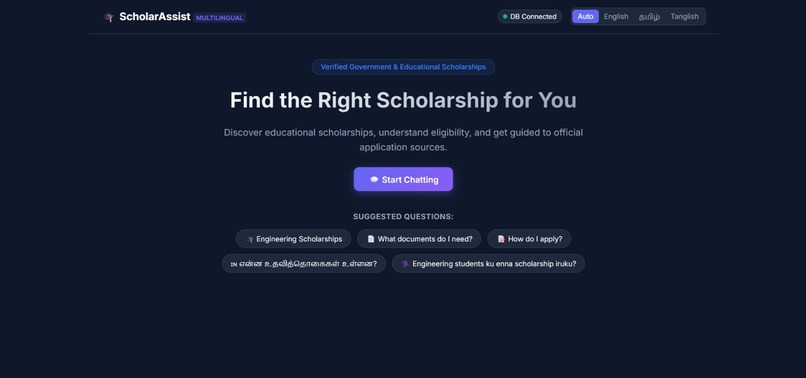
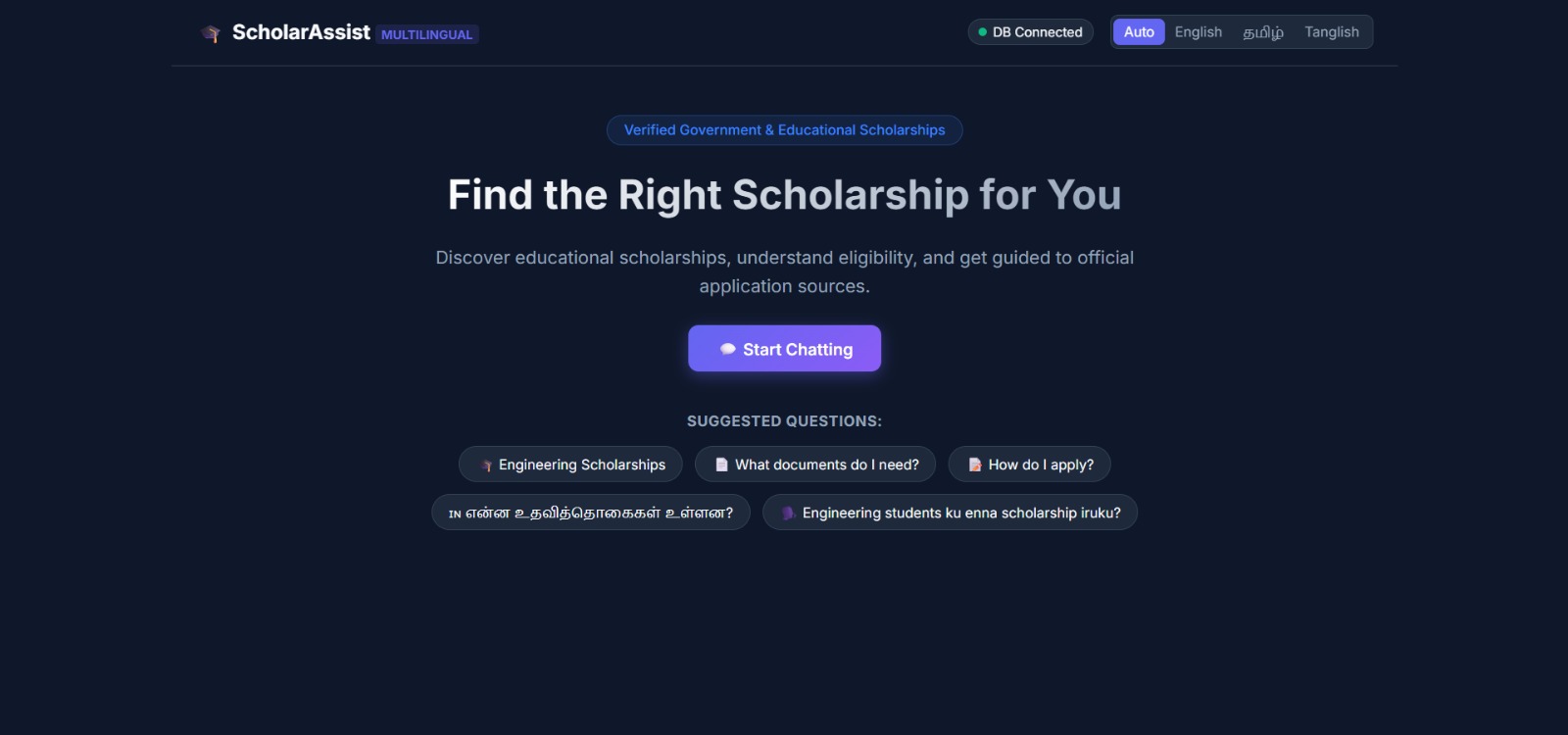
HOME PAGE
-
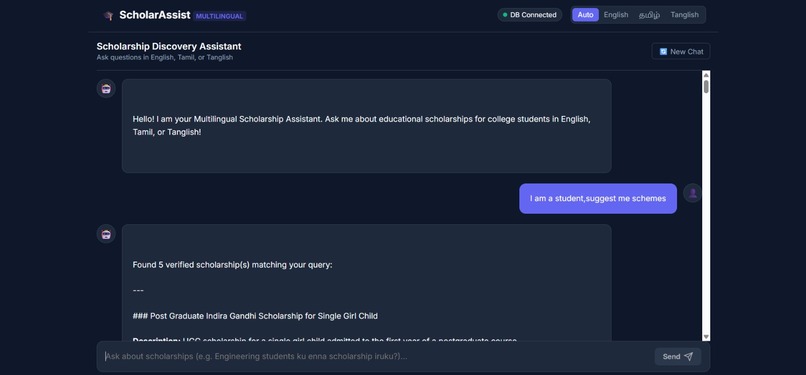
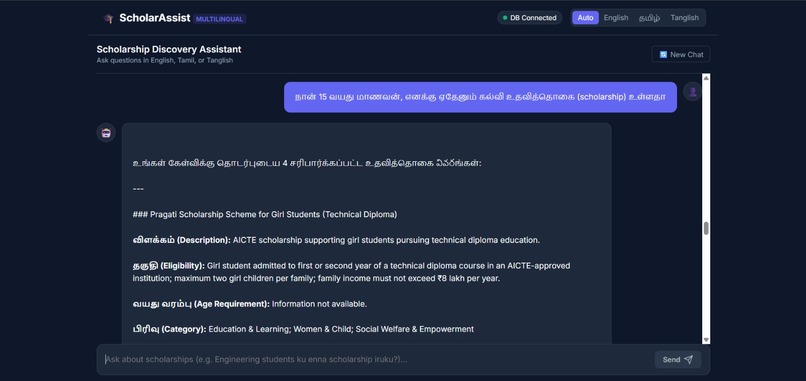
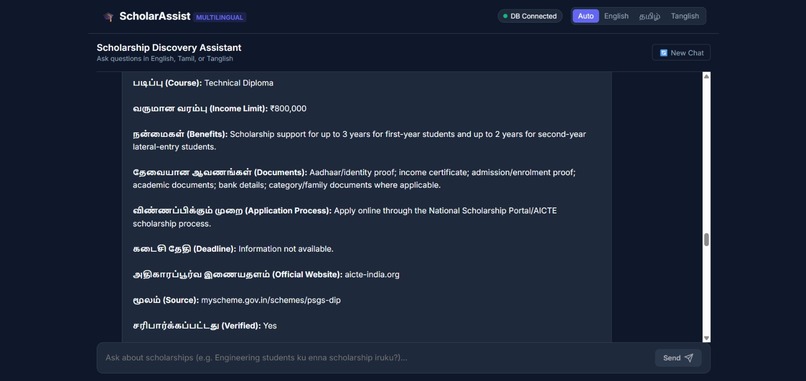
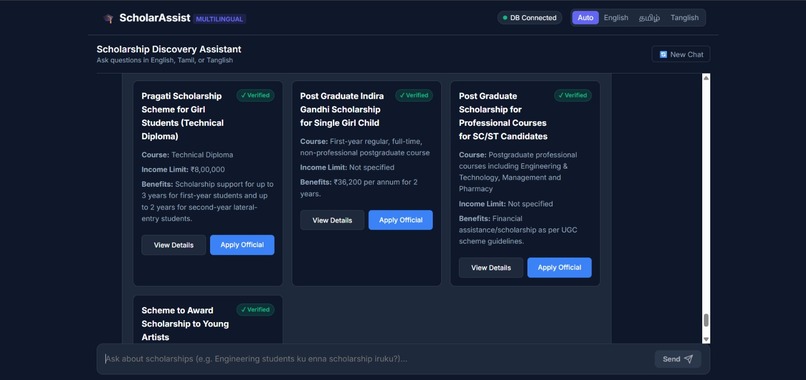
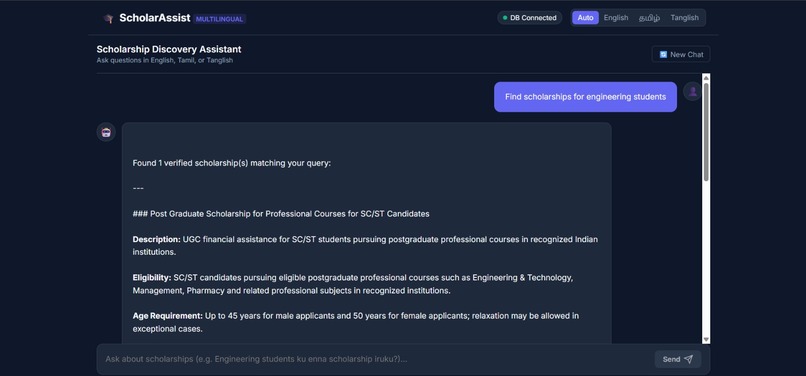
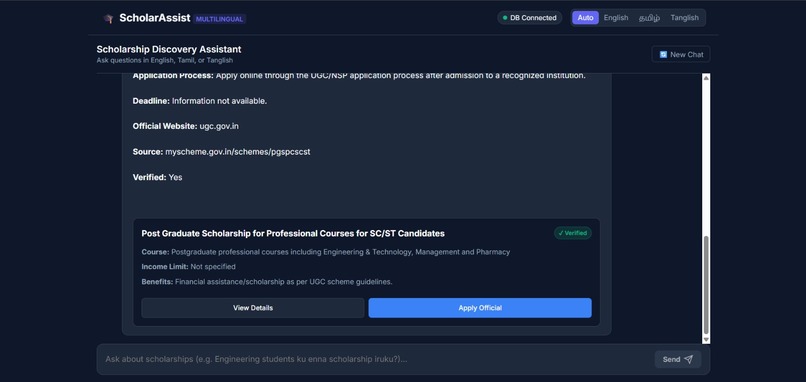
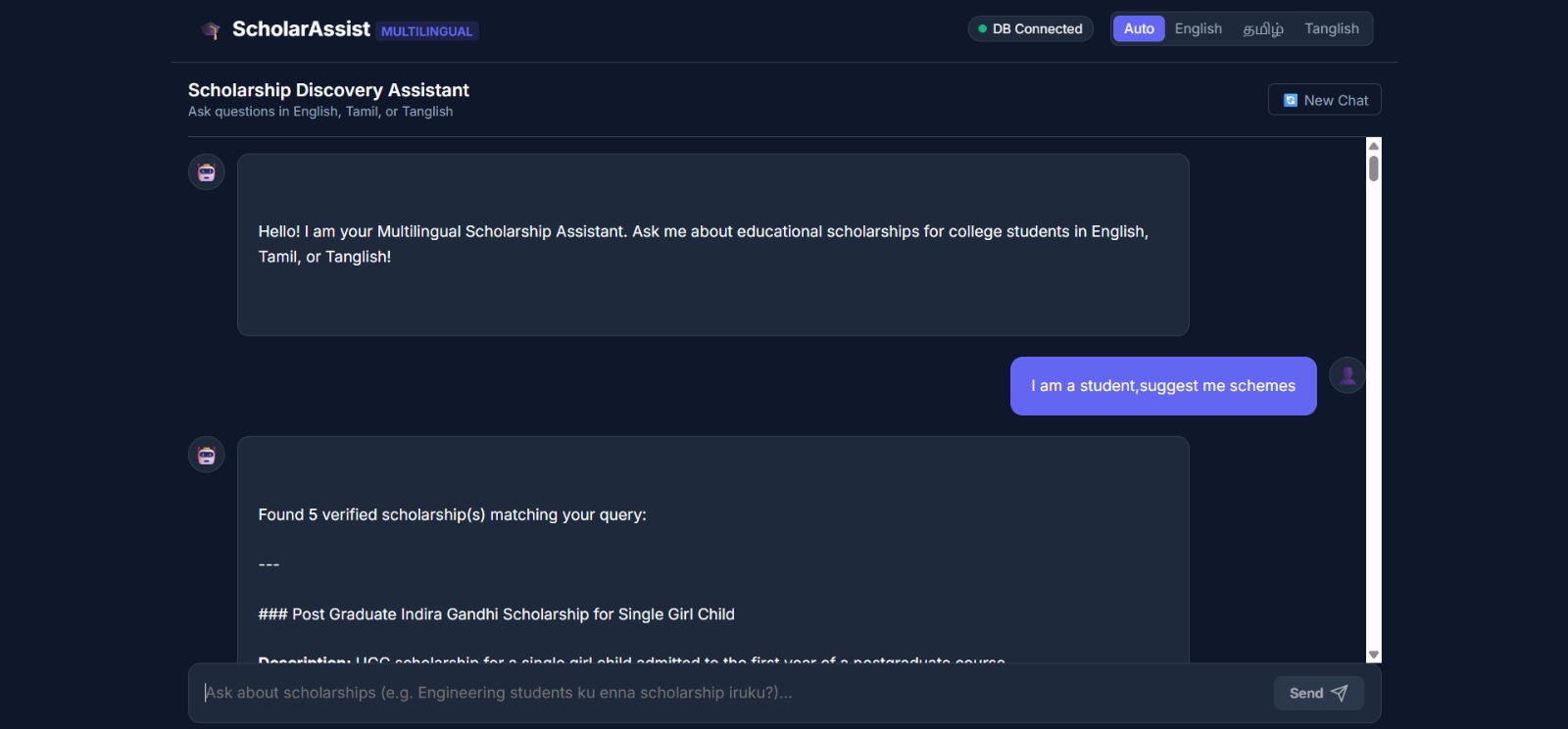
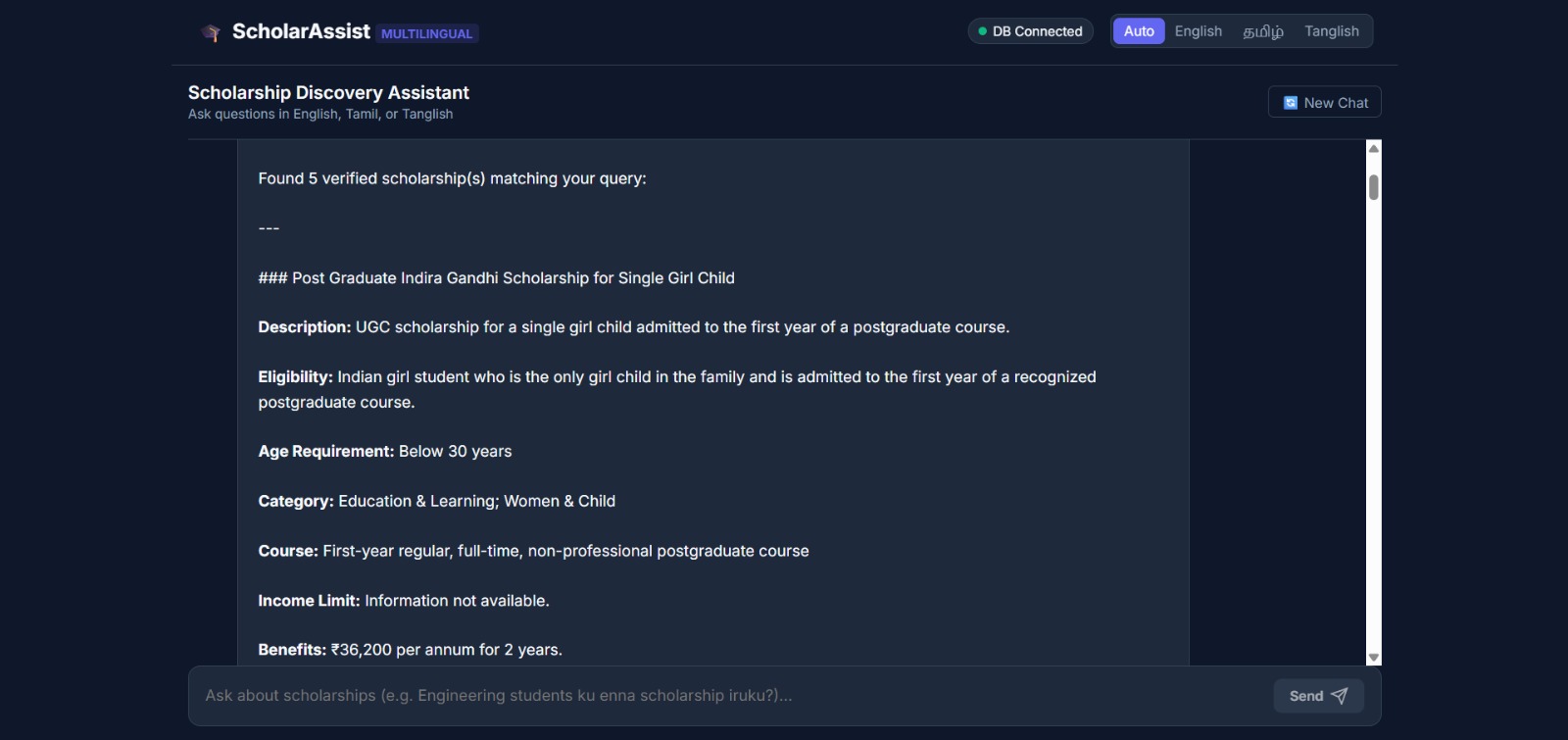
CHATBOT WORKING
-
-
-
-
-
-
-
ScholarBot — Ask. Discover. Check. Apply.
Inspiration
ScholarBot started with a problem we experienced ourselves. As college students, we knew that government scholarships existed, but we were not always sure which ones we were eligible for, what documents were required, or how to apply. When we discussed these doubts with our friends, we realized that many students faced the same problem.
That made us think:
"If we are college students and still don't know which scholarships we can apply for, how many other students might be missing out?" Scholarship information is available online, but finding the right opportunity can be confusing. Students may need to search multiple government websites, understand eligibility criteria, identify required documents, and navigate different application procedures. We wanted to make this experience simpler. What if students could discover scholarships through a natural conversation? And what if scholarship information could be collected, organized, and stored in a structured database so that students could access it more easily?
These questions inspired ScholarBot, a multilingual scholarship assistance chatbot that connects database-driven scholarship retrieval with an AI-assisted scholarship information pipeline.
What It Does
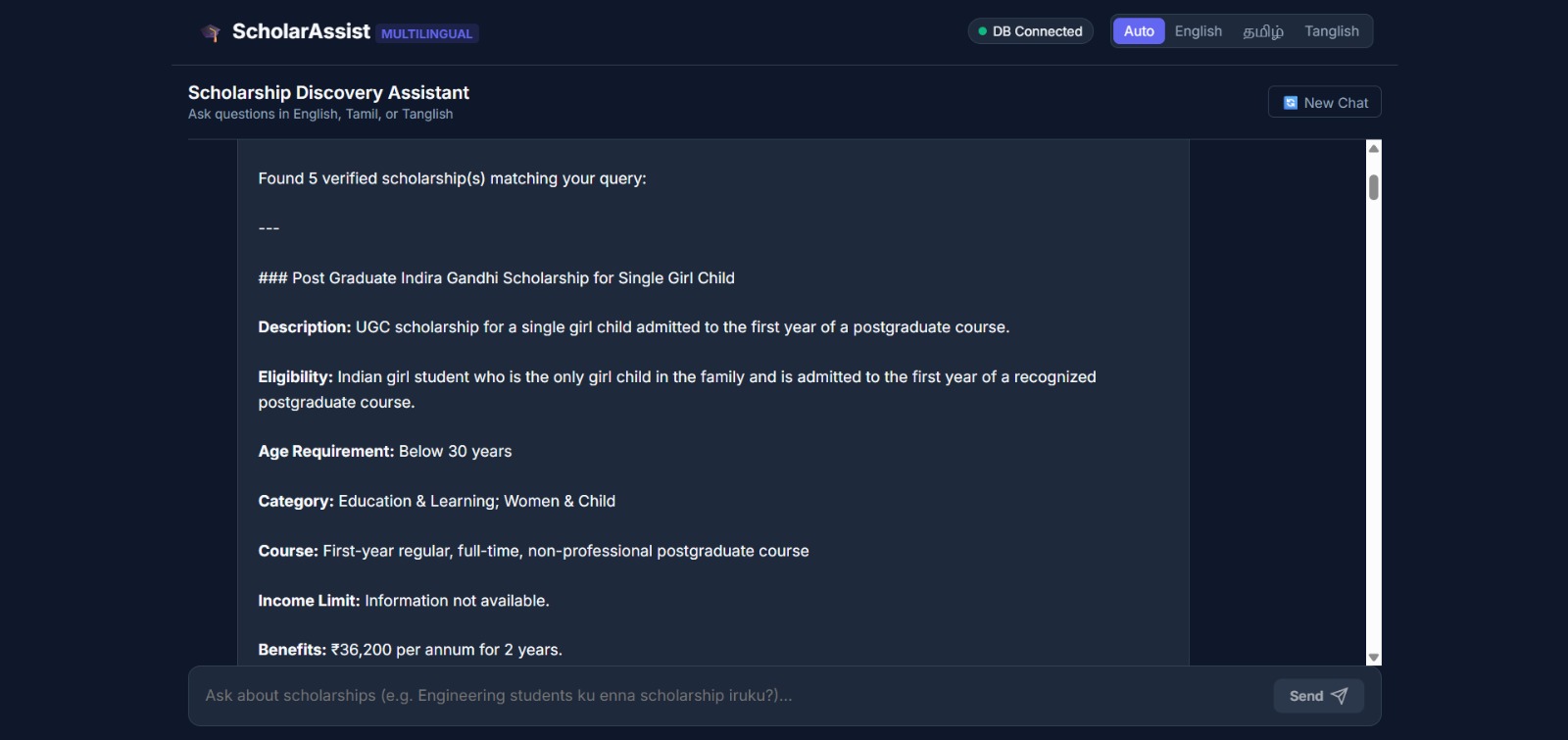
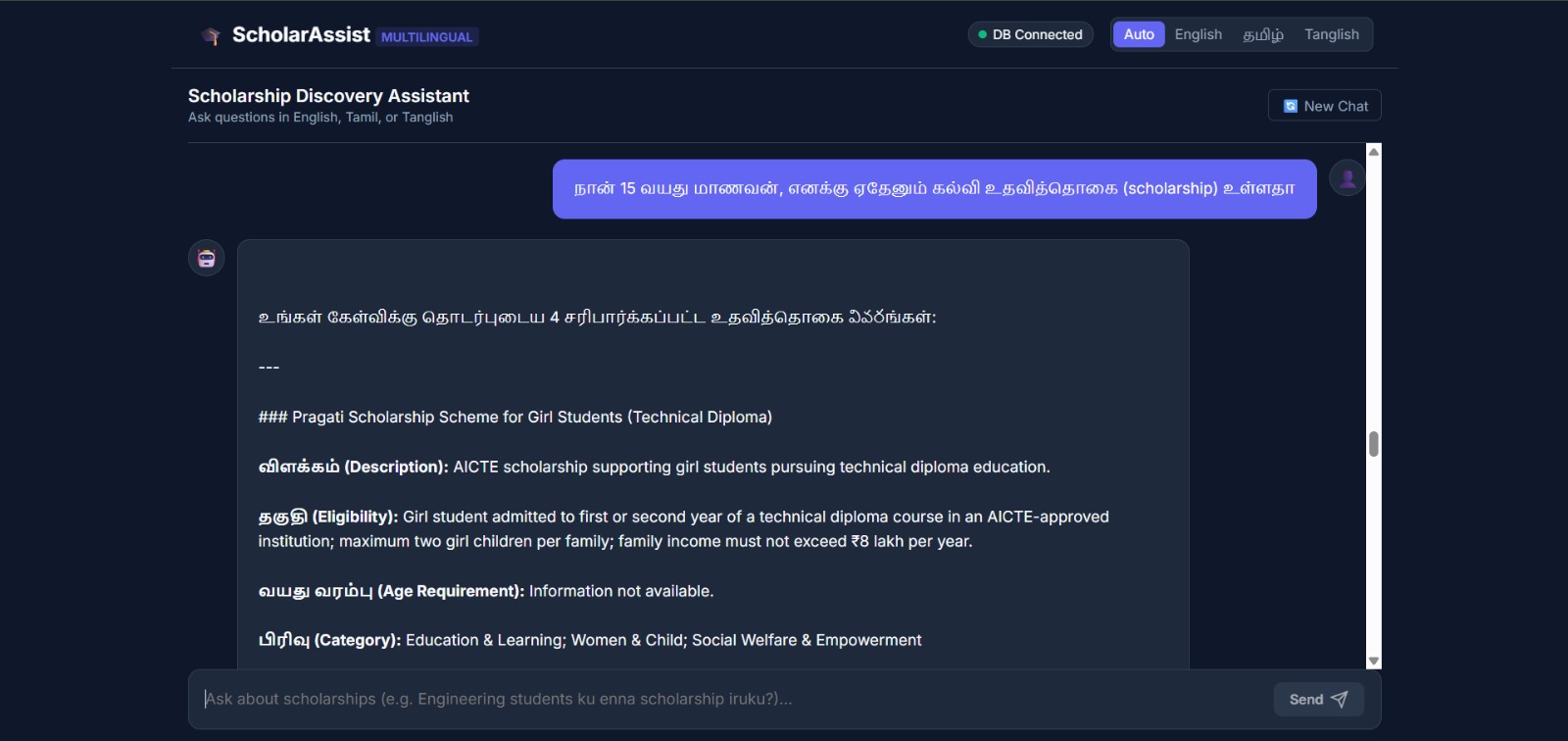
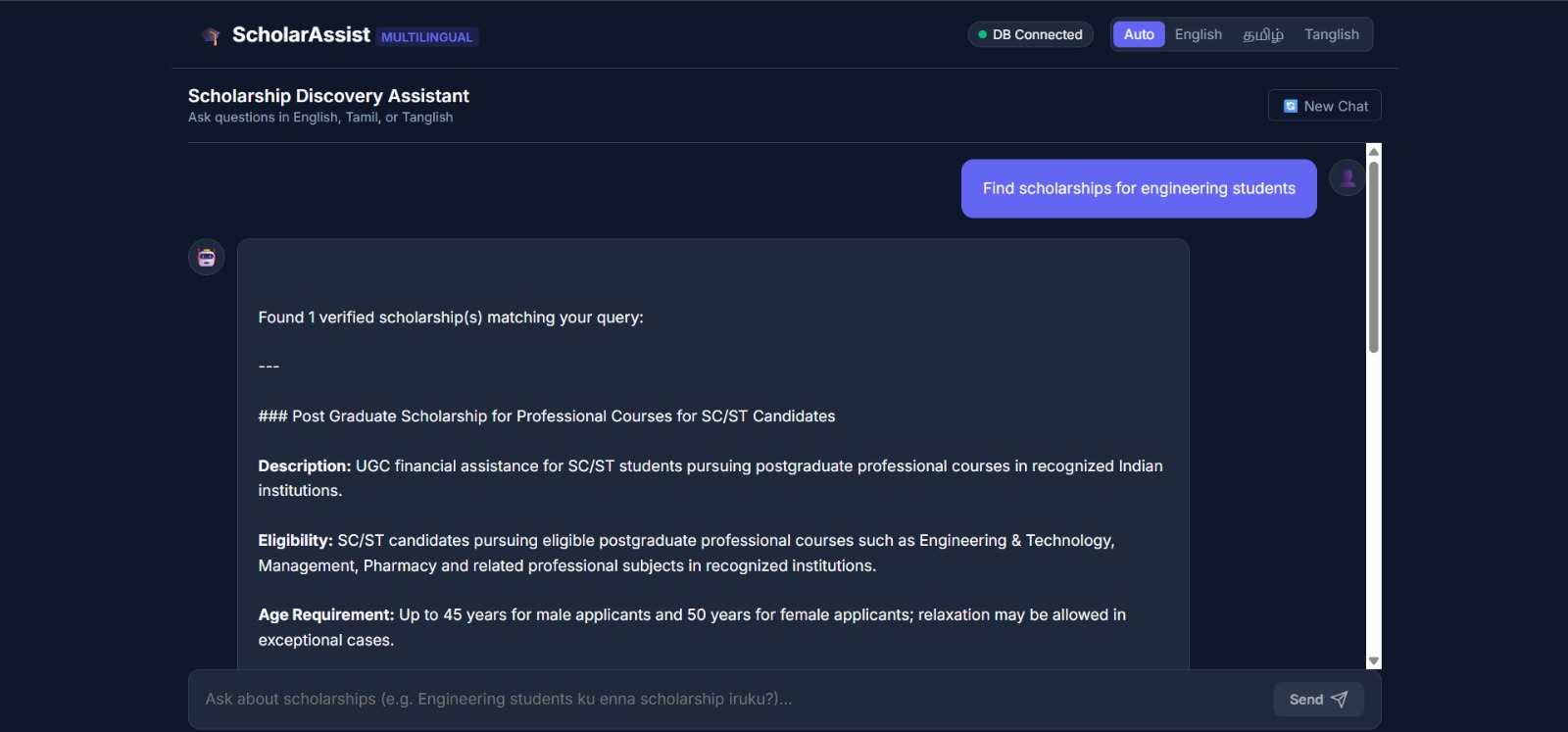
ScholarBot helps college students discover and understand government scholarships through conversations in English, Tamil, and Tanglish. Students can ask questions naturally without knowing the exact scholarship name or using specific keywords.
For example:
- Tanglish: "Naan BC category. Enakku enna scholarship available?"
- Tamil: "இந்த scholarship-க்கு என்ன documents தேவை?"
- English: "I am studying engineering. Which scholarships might be relevant to me?"
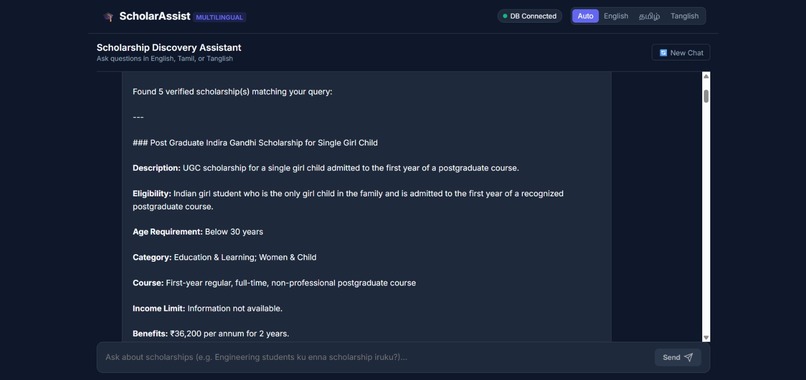
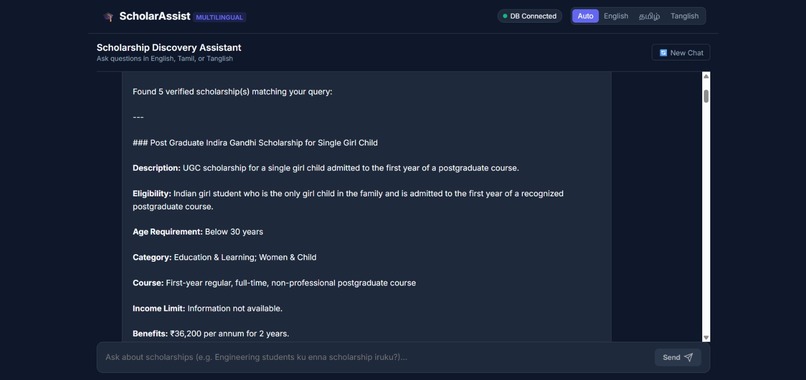
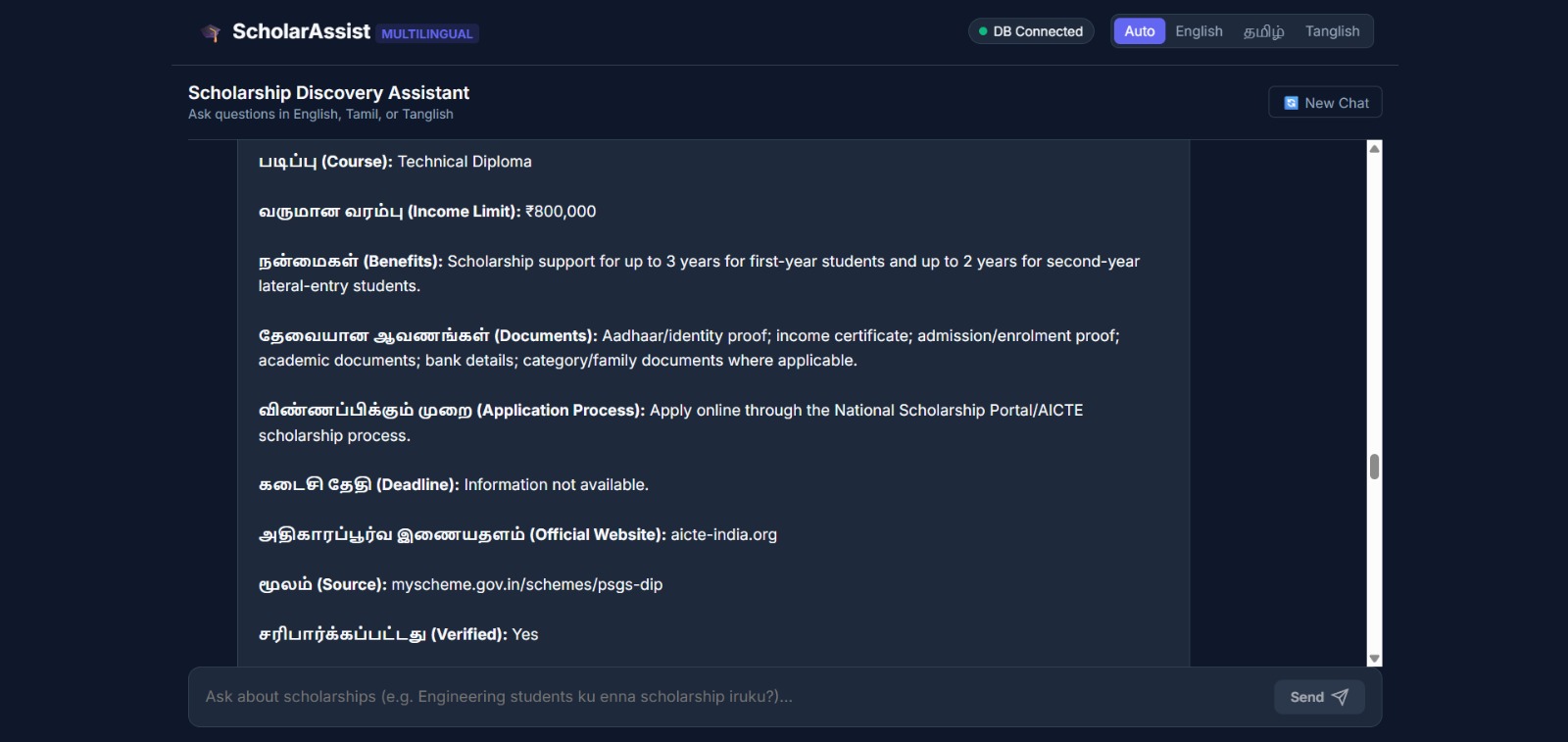
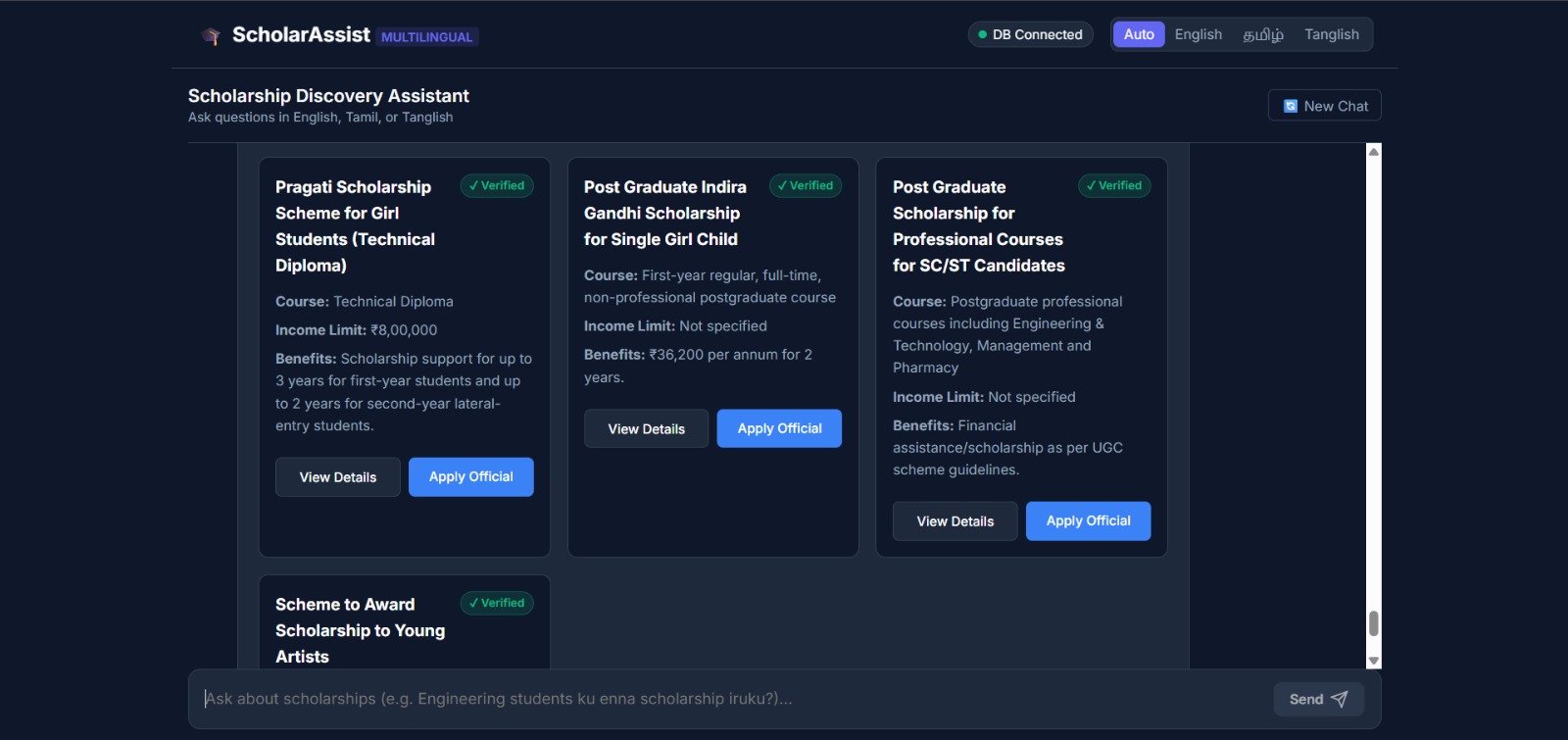
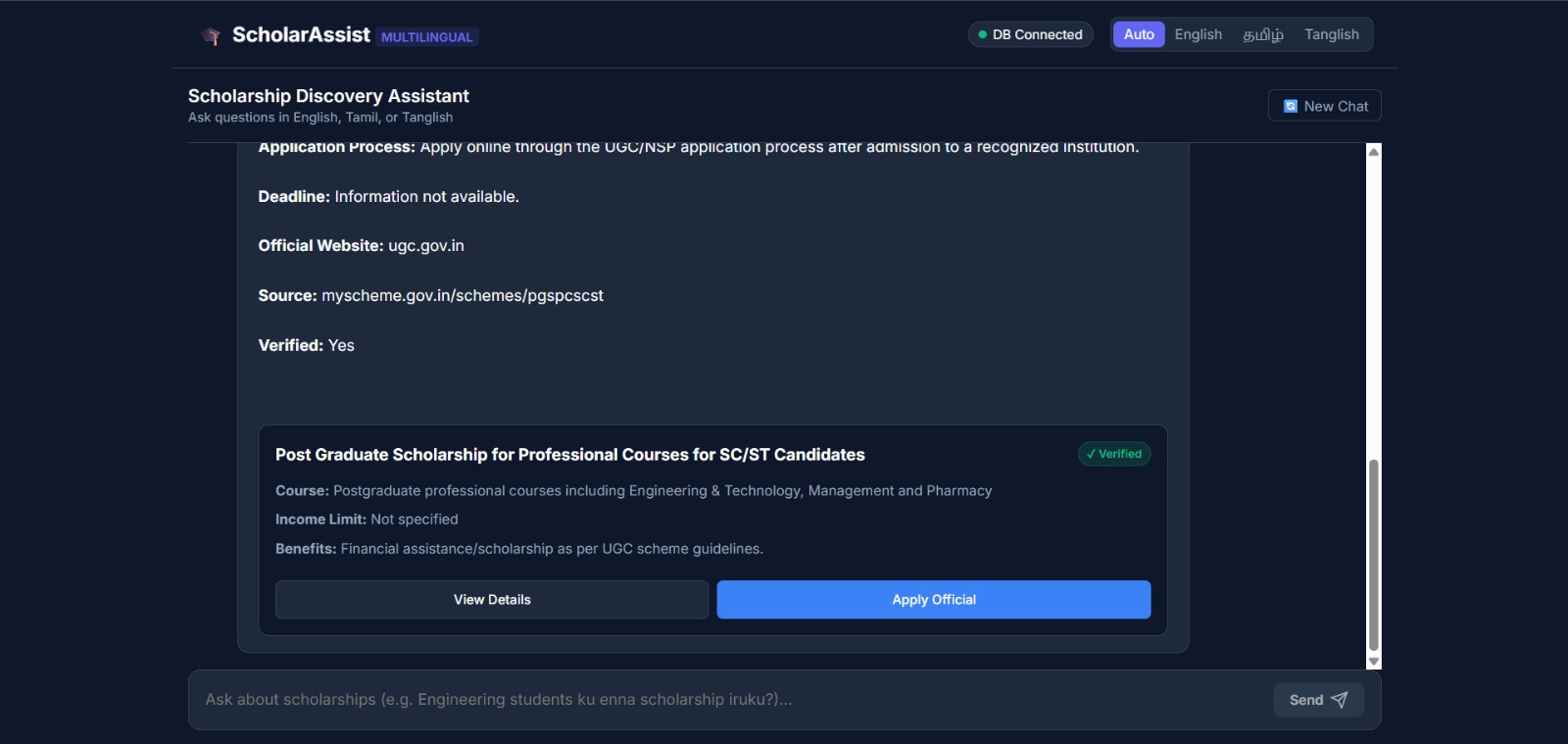
The chatbot retrieves scholarship information from our PostgreSQL database and helps students access details such as:
- Scholarship names and descriptions
- Eligibility criteria
- Benefits and financial assistance
- Required documents
- Application procedures
- Deadlines, when available in the stored records
- Official application links, when available in the stored records
AI-Assisted Scholarship Fetcher
A key component of ScholarBot is its AI-assisted Scholarship Fetcher, which is being developed to simplify scholarship information collection and management. Scholarship information can come from different official or authorized sources, and the details may be presented in different formats. The Fetcher is designed to help collect and extract relevant information, organize it into structured fields, and prepare it for storage in the scholarship database.
The intended data pipeline is:
Official / Authorized Sources → Information Extraction → Cleaning and Structuring → Validation → PostgreSQL Database → Chatbot Retrieval
The database provides a centralized place to store scholarship information that the chatbot can retrieve when students ask questions. The Fetcher is currently partially implemented. Expanding its extraction capabilities, strengthening validation, and supporting more automated updates are ongoing development goals.
Eligibility Assistance
ScholarBot is designed to help students understand which scholarships may be relevant to their circumstances. Student details such as course, category, age, and family income can be compared with published scholarship criteria through eligibility-matching logic. The goal is to move beyond simply listing scholarships and help students identify potentially relevant opportunities. Eligibility matching must account for missing information and differing scholarship requirements. The chatbot's suggestions are intended as assistance, not an official eligibility decision.
Reliability and Responsible AI
Scholarship information can directly affect a student's educational opportunities, so reliability matters. ScholarBot uses its PostgreSQL database as the source of truth for scholarship retrieval. Its design prioritizes using available records rather than inventing scholarship names, benefits, deadlines, or application links. When relevant verified information is unavailable, the intended behavior is to acknowledge the limitation and direct students to the appropriate official source where possible.
How We Built It
We built ScholarBot around two connected components: a scholarship database and a multilingual chatbot, with an AI-assisted Fetcher being developed to support the data pipeline.
1. Scholarship Data Management
The scholarship database stores structured information that can be retrieved by the chatbot. The AI-assisted Fetcher is being developed to support the process of collecting information from supported official or authorized sources, extracting useful fields, and preparing the information for database storage.
The intended workflow includes:
- Identifying supported scholarship information sources.
- Collecting accessible information from permitted sources.
- Extracting scholarship details.
- Cleaning and organizing the extracted information.
- Validating records and their source information.
- Storing structured scholarship records in PostgreSQL.
- Supporting future checks for newly available or changed information.
The current database and chatbot retrieval functionality provide the foundation for this pipeline. Broader automated collection, verification, and update capabilities remain areas for further development.
2. Multilingual Chatbot
Students enter questions in English, Tamil, or Tanglish. The chatbot processes the query and retrieves relevant scholarship information from PostgreSQL.
The basic workflow is:
Student Query → Query Processing → PostgreSQL Scholarship Search → Relevant Scholarship Information → Response to the Student
For example:
"Naan degree padikka scholarship iruka?"
and
"What scholarships are available for my degree?"
express similar intentions despite differences in language and wording.
Our multilingual interface makes scholarship discovery more accessible to students who prefer different ways of communicating.
Technology Stack
- Python — application logic and data processing
- FastAPI — backend API development
- PostgreSQL — structured scholarship data storage and retrieval
- HTML, CSS, and JavaScript — frontend development
- Natural Language Processing and multilingual processing — supporting conversational queries
- Eligibility-matching logic — comparing student details with scholarship criteria
- AI-assisted information extraction — a developing component of the scholarship data pipeline
- Git/GitHub — version control and collaboration
Challenges We Ran Into
One of our biggest challenges was integrating the database, backend APIs, and chatbot so that student queries could retrieve relevant scholarship information correctly.
Another challenge was scholarship data collection. Different sources may present details in different formats, making extraction, cleaning, and standardization important. This is one of the main reasons we are developing an AI-assisted Fetcher rather than relying entirely on manual data entry.
Eligibility matching introduced another challenge because scholarships can have different combinations of requirements. The system must avoid treating missing information as proof that a student satisfies a criterion.
Multilingual interaction was also an important challenge. Tamil can be typed in its native script or written using English letters as Tanglish, with many possible spelling variations.
The broader challenge is balancing automation, accessibility, and accuracy. We want ScholarBot to make scholarship discovery easier while remaining careful about the information it presents.
Accomplishments That We're Proud Of
We are proud to have turned a problem we personally experienced into a working database-driven chatbot prototype.
Our current accomplishments include:
- Database-backed retrieval: Scholarship records are stored in PostgreSQL and can be retrieved by the chatbot.
- Multilingual interaction: The chatbot supports queries in English, Tamil, and Tanglish.
- AI-assisted Fetcher development: We have begun implementing a component intended to simplify scholarship information collection and structuring.
- An extensible foundation: The database and retrieval workflow provide a basis for future eligibility improvements, enhanced data collection, and semantic search.
The most meaningful part of ScholarBot is that it goes beyond a static chatbot interface. It connects student questions with scholarship information stored in a database, while the Fetcher work addresses the upstream challenge of organizing that information.
What We Learned
This project taught us that building an AI application involves much more than generating conversational responses.
We gained practical experience with PostgreSQL, backend APIs, database retrieval, frontend-backend integration, and multilingual user interaction.
We also learned that collecting information is only one part of building a reliable knowledge-based application. The information must be structured, traceable to its source, and checked before being treated as trustworthy.
Working with Tamil and Tanglish showed us that users do not always communicate using formal sentences or standardized spelling. Designing an accessible chatbot requires attention to the different ways people express the same intent.
Most importantly, we learned about responsible AI.
It is easy to build a chatbot that gives an answer. It is much harder to build one that knows when it should not give an answer.
That principle continues to guide our approach to ScholarBot.
What's Next for ScholarBot
Our next goal is to improve scholarship data collection, retrieval, and personalization without compromising reliability.
Planned enhancements include:
- Enhanced AI-assisted fetching: Expanding extraction capabilities for additional supported official or authorized sources.
- Stronger validation and verification: Improving checks on extracted records and their source information.
- Automated update checks: Detecting new or changed scholarship information where supported.
- Advanced eligibility matching: Supporting more scholarship-specific criteria and handling missing information carefully.
- Multilingual semantic search: Using multilingual embeddings to retrieve relevant records based on meaning rather than exact keywords.
- Retrieval-Augmented Generation (RAG): Grounding conversational responses in retrieved scholarship information.
- Deadline and notification alerts: Helping students track relevant deadlines when reliable date information is available.
- Improved evaluation: Testing retrieval quality, multilingual performance, eligibility-matching accuracy, response correctness, and the handling of questions that cannot be answered from available records.
Our long-term vision is simple:
A student should not have to spend hours searching different websites just to discover whether financial assistance may be available to them.
By connecting a structured scholarship database, multilingual conversational assistance, and an AI-assisted information pipeline, ScholarBot aims to make scholarship discovery more accessible and understandable.
ScholarBot — Ask. Discover. Check. Apply.


Log in or sign up for Devpost to join the conversation.