-
-
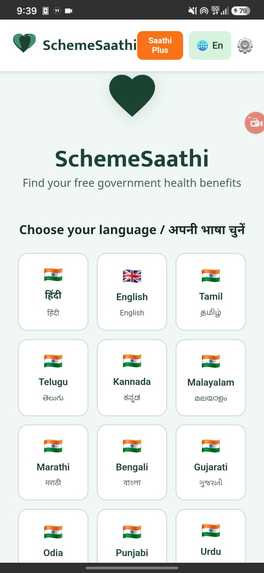
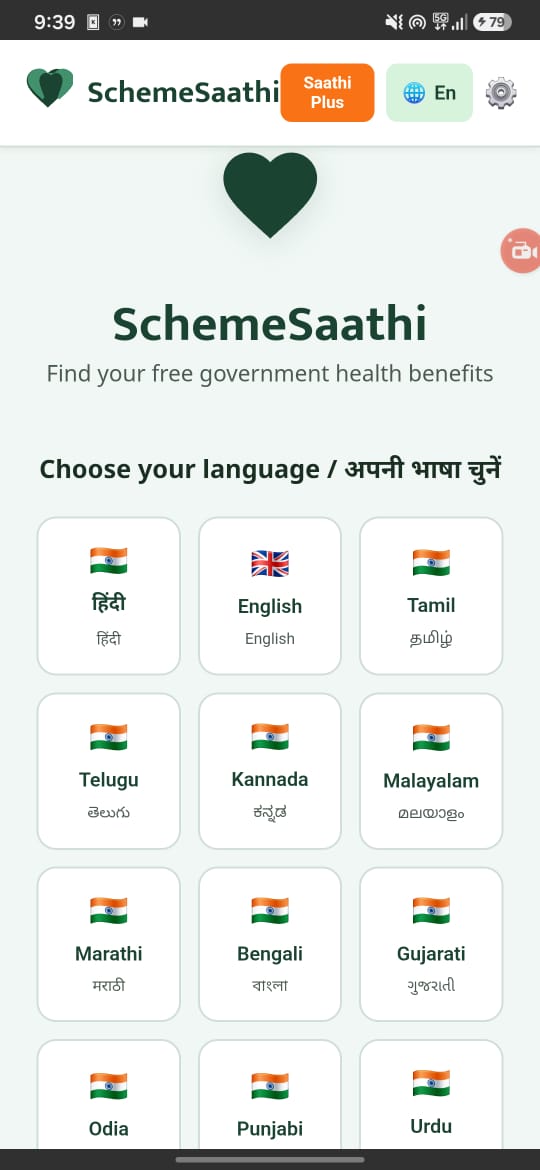
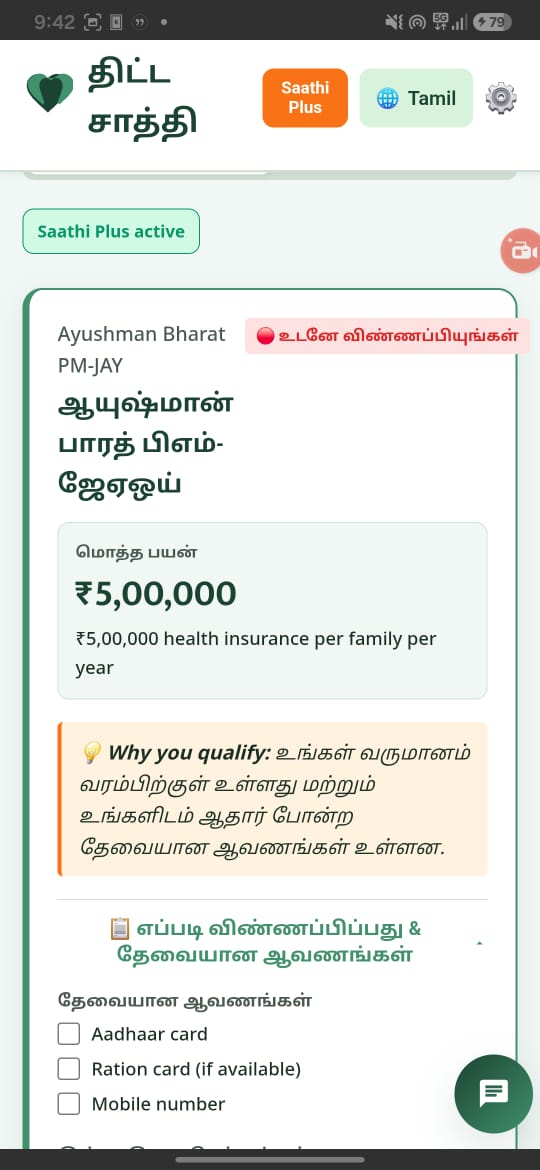
Multilingual access with 12 supported Indian languages, including Tamil, Hindi, and RTL Urdu.
-
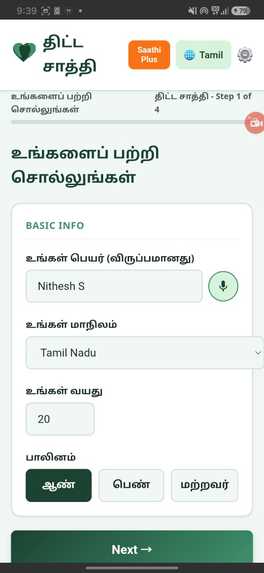
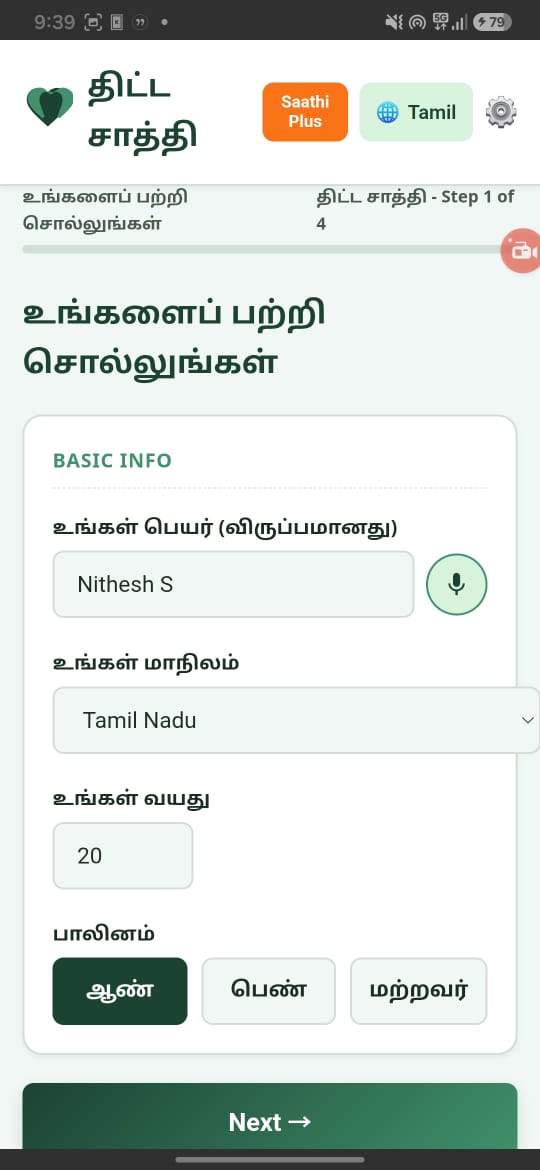
A guided profile collects the information needed for deterministic government health-scheme eligibility matching.
-
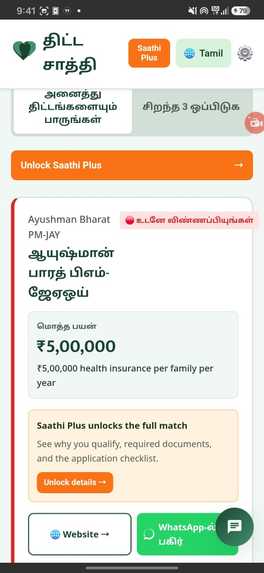
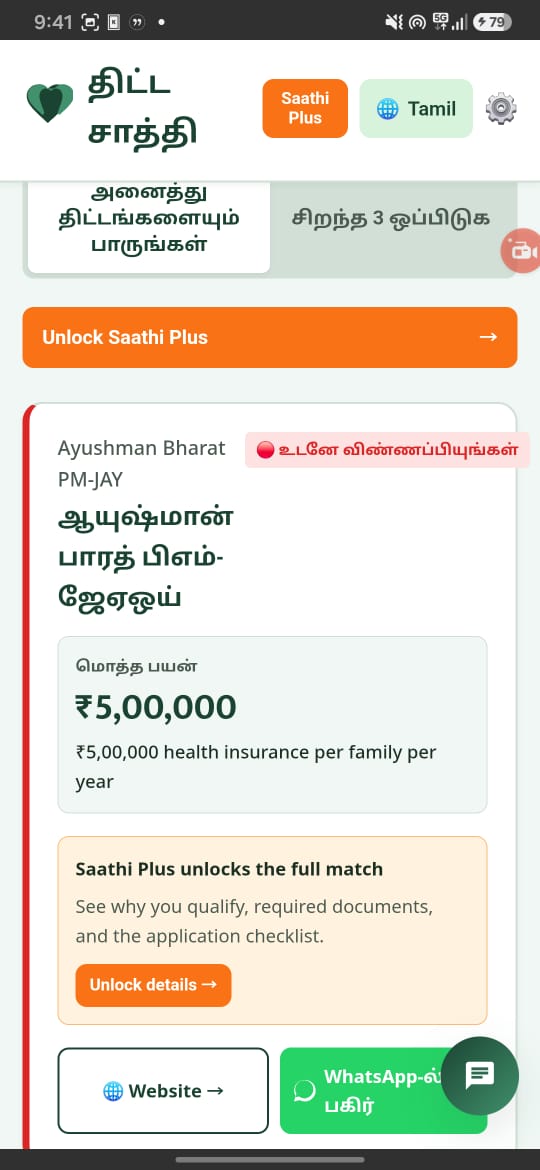
Free users receive matched schemes and essential information, while premium details remain clearly locked.
-
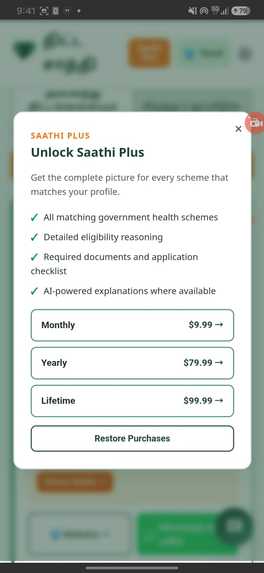
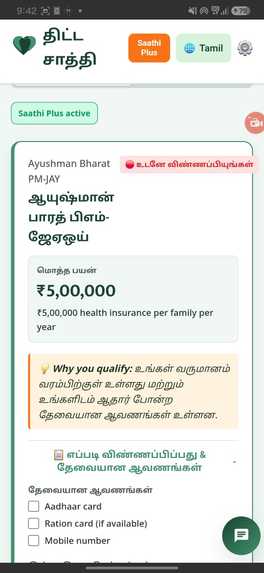
After the RevenueCat entitlement activates, Saathi Plus unlocks detailed eligibility reasoning and required documents.
-
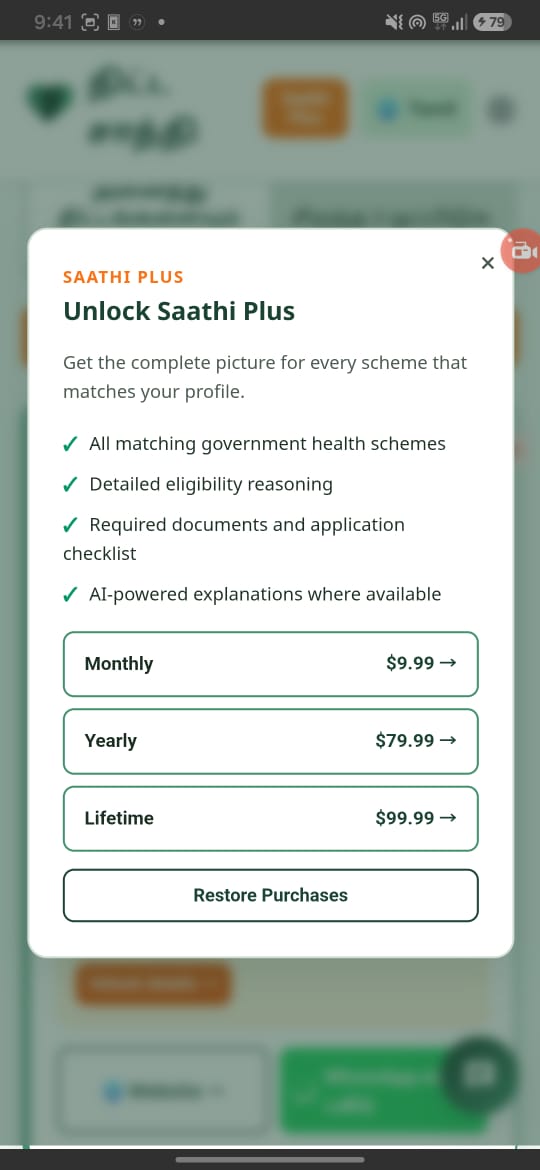
RevenueCat-powered Saathi Plus offering with Monthly, Yearly, and Lifetime Test Store packages.
-

SchemeSaathi app icon

Inspiration
Government health schemes can provide important support for families, but discovering the right scheme can be difficult. Eligibility rules, required documents, benefits, and application procedures are often spread across different portals and languages.
I wanted to build something that turns this complicated discovery process into a simple, guided experience.
That idea became SchemeSaathi — an accessible assistant that lets users create a short profile and discover government health schemes they may qualify for, in a language they are comfortable with.
A key design decision was to keep eligibility deterministic. Instead of asking an AI model to decide whether someone qualifies, SchemeSaathi uses a local rules-based eligibility engine to evaluate profile information against structured scheme eligibility rules. AI is used separately for explanations and follow-up assistance.
What I built
SchemeSaathi started as a Progressive Web App and was extended into an Android application using Capacitor for Shipaton 2026.
The application provides:
- A guided profile wizard for eligibility information
- Deterministic local scheme matching
- Personalized government health-scheme results
- Plain-language explanations and application guidance
- Support for 12 Indian languages
- Browser-based voice input where supported
- Offline-aware PWA behavior
- Optional Microsoft Work IQ grounding
- Optional AWS API Gateway, Lambda, and Amazon Bedrock reasoning
- RevenueCat-powered Saathi Plus monetization
For the Shipaton submission, I added Saathi Plus, a premium information layer built with RevenueCat.
The free experience provides the core eligibility discovery and essential scheme information. Saathi Plus unlocks additional matched schemes, detailed "Why you qualify" reasoning, required documents, and application guidance.
RevenueCat controls the premium state through the saathi_plus entitlement. The Android app loads the current RevenueCat offering, allows a Test Store purchase, refreshes Customer Info, and unlocks the existing premium content when the entitlement becomes active.
How I built it
The frontend remains intentionally lightweight and is built with vanilla HTML, CSS, and JavaScript.
The core eligibility engine is implemented locally using structured scheme data and deterministic filtering logic. This makes eligibility matching fast and available without depending on an AI service.
For optional AI-assisted functionality, the application can use Microsoft Graph Search / Work IQ for grounding and an AWS serverless path using API Gateway, Lambda, and Amazon Bedrock.
I then packaged the existing PWA for Android using Capacitor rather than rebuilding the application from scratch.
For monetization, I integrated @revenuecat/purchases-capacitor and configured a RevenueCat Test Store offering with Monthly, Yearly, and Lifetime packages. The saathi_plus entitlement is used as the source of truth for premium access.
What I learned
This project taught me that building a useful application is not only about adding more technology. Architecture decisions have to match the problem.
One of the biggest lessons was separating eligibility logic from AI reasoning. The deterministic engine remains responsible for eligibility, while AI is used where natural-language reasoning and assistance are useful.
I also learned how to take an existing web application and turn it into a native Android experience using Capacitor without rewriting the entire frontend.
Integrating RevenueCat taught me how subscription and entitlement systems should be treated as external sources of truth rather than simply storing a local "premium = true" flag.
I also learned the importance of designing accessibility and localization into the application instead of treating them as an afterthought.
Challenges
One challenge was maintaining a reliable free/premium boundary while the RevenueCat Customer Info request is asynchronous. The application initially needed to handle the difference between the default locked state and the eventual entitlement state correctly.
I fixed this by making the locked state safe by default and re-rendering the results when RevenueCat Customer Info becomes available.
Another challenge was building the Android version from the existing PWA. Capacitor, Gradle, and Java version compatibility required additional setup and debugging. The final Android debug build was successfully verified on a physical Android device.
The RevenueCat Test Store also required careful handling of offerings and entitlements so that the UI reflected the actual RevenueCat configuration instead of assuming products existed locally.
Why it matters
SchemeSaathi is designed around a simple idea:
Finding out what support you may qualify for should not require navigating a complicated collection of government portals.
The project combines deterministic eligibility matching, multilingual accessibility, optional AI assistance, offline-aware web technology, Android packaging, and RevenueCat monetization into one application.
For Shipaton 2026, the project demonstrates how an existing useful application can be extended into a sustainable product experience without compromising its core free eligibility functionality.
Built With
- amazon
- amazon-web-services
- android
- api
- app
- bedrock
- capacitor
- css
- gateway
- github
- graph
- html
- iq
- javascript
- lambda
- microsoft
- progressive
- revenuecat
- speech
- web
- work


Log in or sign up for Devpost to join the conversation.