
note: we all worked on this, but I (Soham) am the incoming student at Rutgers University, and this is written from my perspective.
The (frustrating) problem
I'm an incoming student at Rutgers University, and it's a big public school, like a lot of state schools.
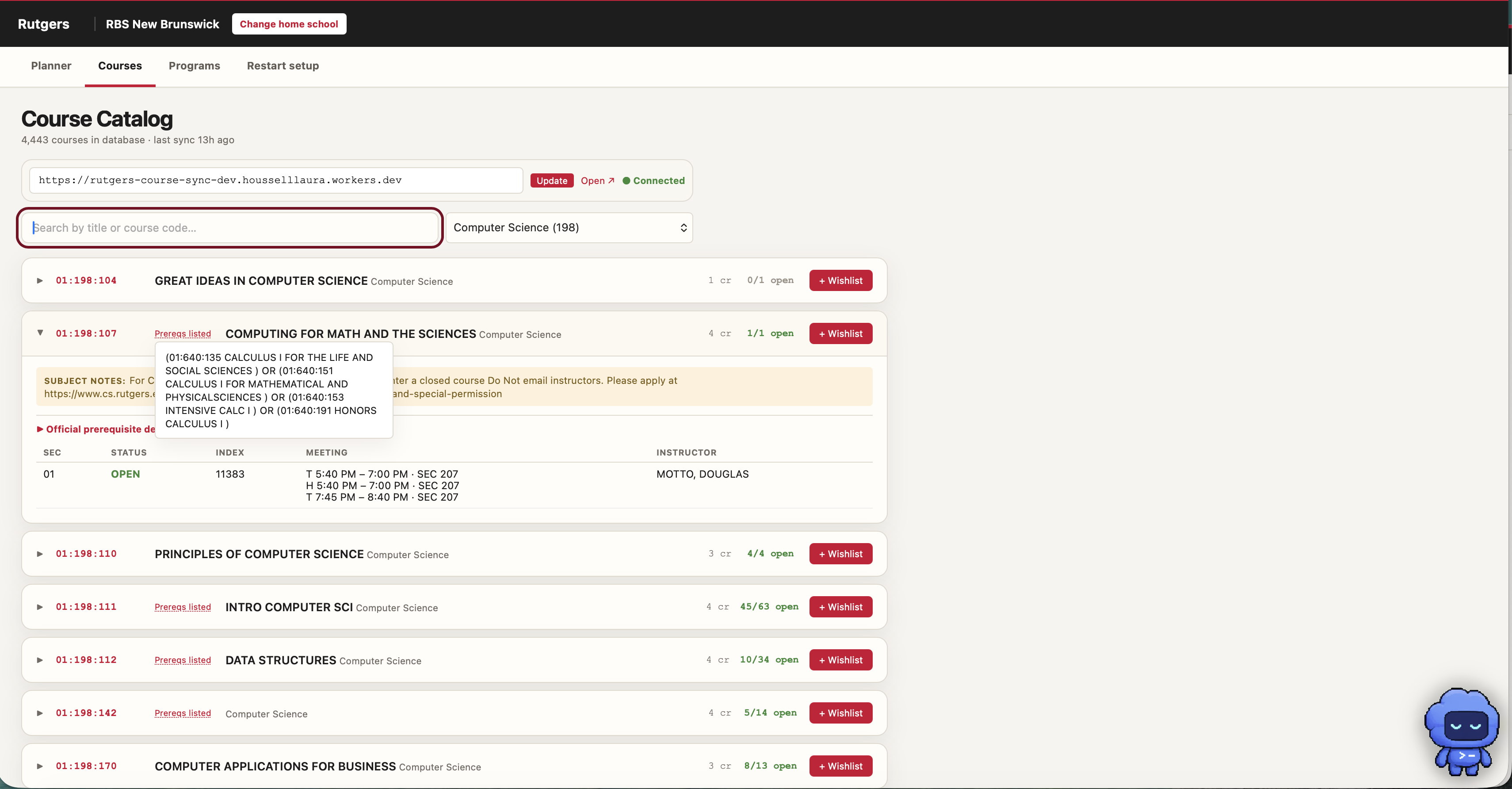
More commonly than not, these schools run on legacy software. This was the case for Rutgers. Course scheduling, particularly, takes hours for students, jumping around tools that all had bits of information but never worked together. Planning for four years takes around 6 hours on average, with a collected sample size of n=34.
I'm an enrolled summer student here at Rutgers, and seeing my cohort of ~40 go through the same problem, I started hand-scheduling all of them before realizing what great timing the Codex hackathon was to solve a problem impacting the entire school. Thanks to the event, I can help my friends schedule their years at college without spending hours working on the perfect permutation of their four-year plan.
The reddit upvotes went through the roof too.
What it does
We have a couple of features!
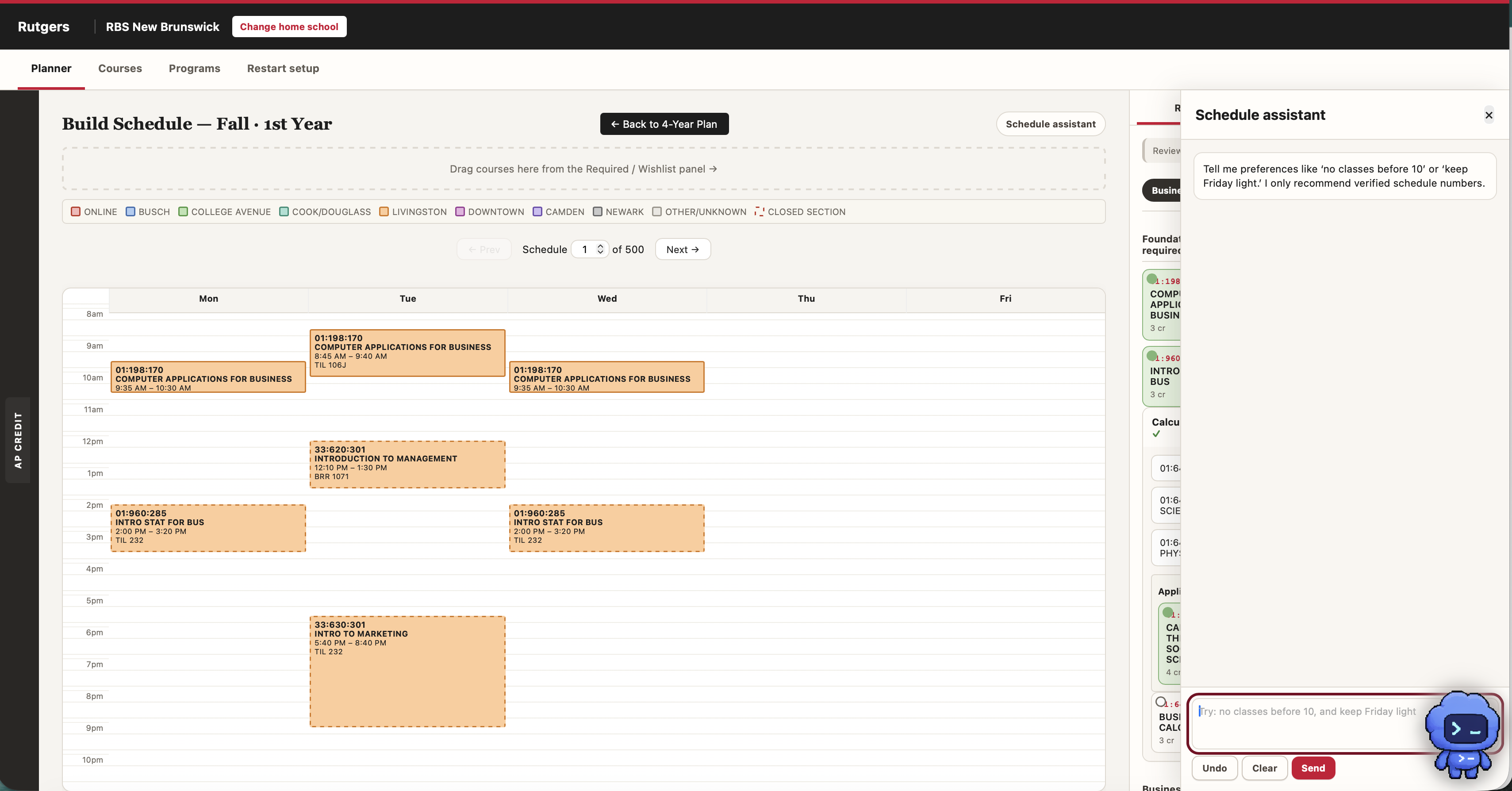
1) Auto-scheduling a four-year plan, following programmed logic to ensure that courses are taken in the correct order. Prioritizes work-life balance; i.e. a balanced and spread out schedule. Supports multiple programs of study.
2) Filtering through specific schedules of classes within a semester. There are over 500+ total combinations; reducing these combinations involves manually unchecking each individual "section" of a class you don't want to take. Just tell us that you don't want a warning class, and we filter through all schedule combinations and provide the best fit.
3) Planning around a wishlist of courses to give users room for any interests without committing to a full program of study
4) Bunch of qol features :)
How we built it
Initial planning was done by our team, refined through GPT 5.6 Sol, and executed using a combination of agent workflows and sequential work, mostly on Terra (and difficult problems on Sol). After testing, we rinsed and repeated.
Challenges we ran into
The logic was really hard to get right, as we had to scrape all the data and make sure each individual course path was correct. The auto scheduler was messed up more than once.
It was also difficult, at the start, to achieve exactly what we wanted to do with Codex. As someone relatively new to coding with the assistance of AI, I learned on the fly that you have to be extremely specific to get what you want, or Codex will take liberty with the ambiguity. Luckily, I was able to learn and appreciate Codex after just a couple hours; it's amazing for development, and efficient too.
Accomplishments that we're proud of
We could talk about the Reddit DMs and Upvotes (before the post was taken down by the moderators), but what I'm most proud of is that we were able to use this tool to actually help people. Due to the summer program I'm enrolled in, we can't attend an in-person orientation, and students here had a solid 3 days to figure out how to schedule their classes. I was able to help the students here through the use of Codex and this tool.
I've also started a small waitlist amongst my friends at Rutgers, and it's gone somewhat viral just by word of mouth. We already have ~400 students signed up to use the product despite only having developed it for two weeks. And we don't plan on stopping either.
What we learned
Managing data, and creating logic with it, is hard. Scraping thousands of prerequisites on the web requires careful precision and management.
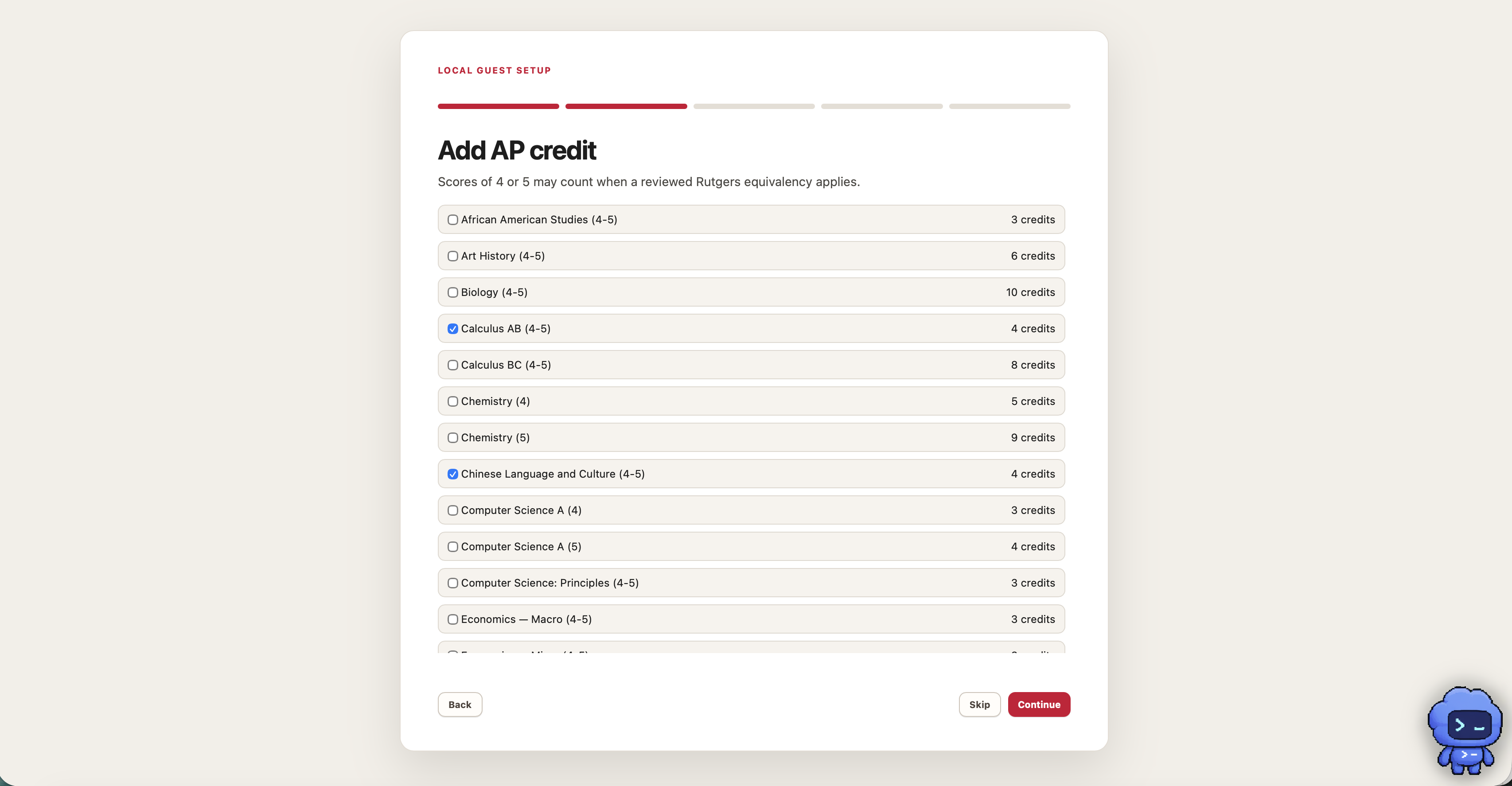
Synthetic test cases aren't enough. Our scheduler passed every case we wrote ourselves, then broke immediately once ~40 real students with different majors, minors, and AP credits ran their actual transcripts through it. Of course, it was fixed, but testing against real, messy data early would've caught issues sooner. We're lucky for our friends.
Most importantly: how much a simple thank you means when you've lifted a burden off of someone's shoulders.
What's next for ScheduleRU
I'm so excited for what comes next because of the success we've had already. We're currently in talks with Rutgers (yes, the university) to implement this as a school-wide tool for beta testing and, hopefully, true implementation into the system. After this, we're planning to expand to ALL of our schools, not just Rutgers - think Michigan, Georgia Tech, the University of California system - and replace the legacy systems at all of these locations. First-mover advantage is real here.
I also see a vision of this turning into even more of a hub for college students at these specific campuses, showing recommendations for clubs and interests based on their majors (which is already inputted!), and guiding them through college through a university-offered tool. The first-mover advantage is real here, and by integrating into college systems, we can start offering other products that will own the college experience for all students.
And of course, building all of it with Codex :)

Log in or sign up for Devpost to join the conversation.