-
-
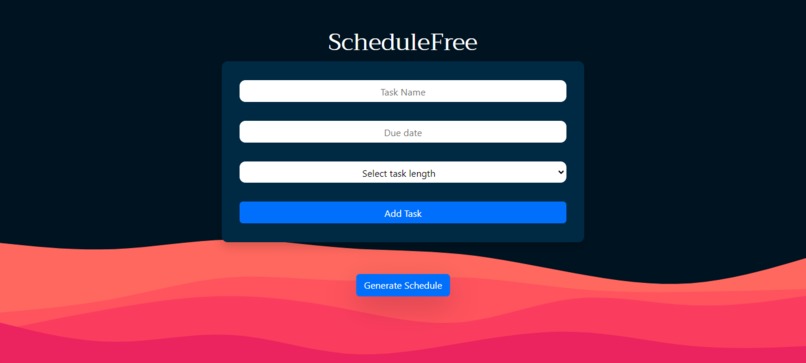
Add tasks-page
-
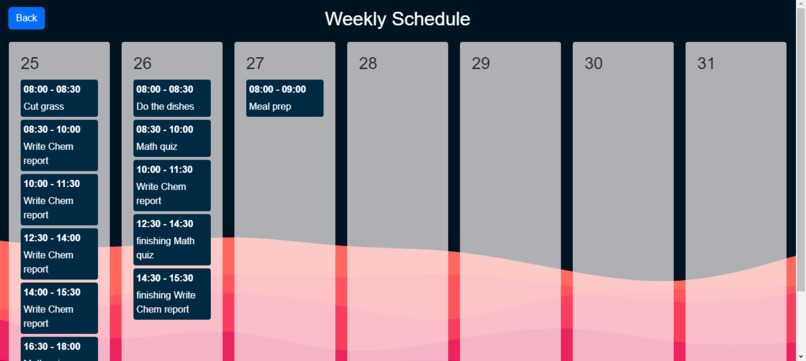
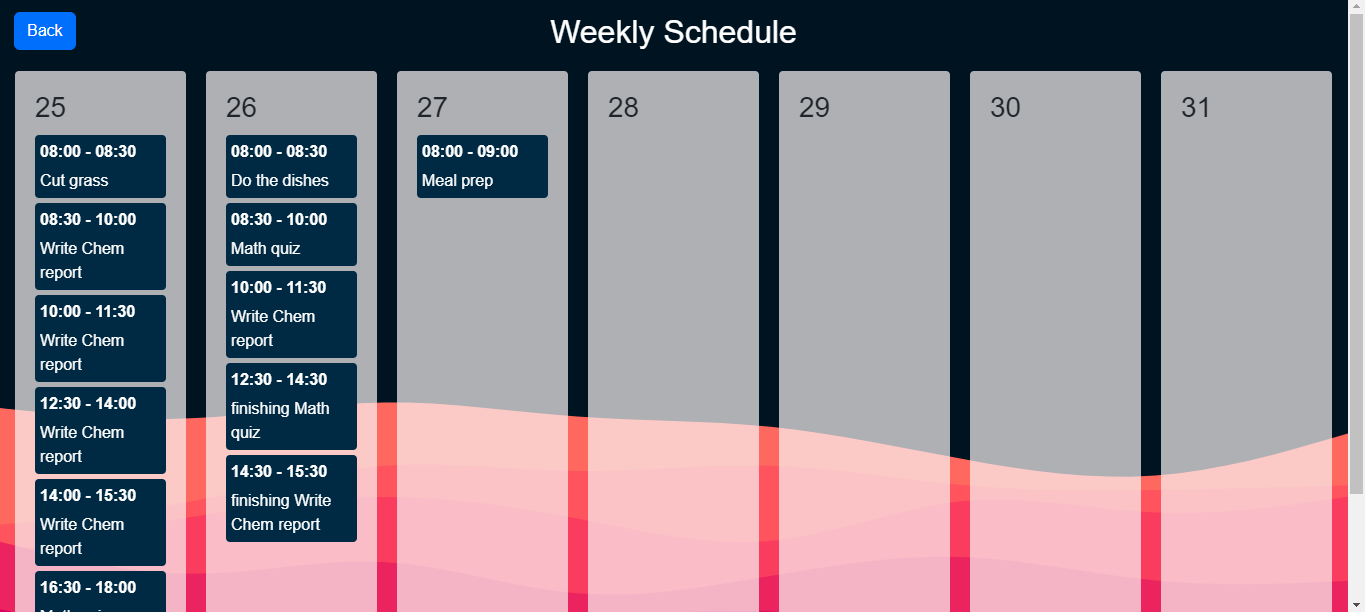
schedule view
Inspiration
The inspiration for our Schedule builder stems from my personal journey as a student facing challenges in organizing tasks during my time in University. It was a period when my own mental health declined due to the sudden deterioration in the health of my two younger siblings. Through this experience, I realized the significant difficulties faced by individuals with various disabilities when it comes to managing their daily activities. In particular, I discovered that individuals with "invisible" disabilities, including Autism Spectrum Disorder, ADHD, cognitive disabilities, executive functioning disorders, and mental health disorders like depression and anxiety, often struggle to find suitable solutions. These individuals, especially those deemed "high-functioning," are sometimes overlooked, resulting in a lack of tailored support systems. Motivated by these insights, I felt compelled to develop a Schedule builder that specifically addresses the needs of individuals with disabilities, providing them with a tool to effectively organize their daily lives. However, it's important to note that our solution is not limited to individuals with disabilities alone. The Schedule builder is designed to be user-friendly and applicable to anyone seeking an efficient and intuitive way to manage their tasks and responsibilities. By recognizing and catering to the requirements of individuals with disabilities, we aim to promote inclusivity and accessibility for all users, ensuring that everyone can benefit from an enhanced scheduling experience.
What it does
To solve the problem from our inspiration, ScheduleFree has the goal to take the planning out of scheduling. It does this by getting the required information needed from the user. This includes each task with their due dates and estimated lengh of time to complete. The schedulefree will generate a schedule for the week that will seperate long tasks into smaller blocks. Smaller tasks are added at the beginning of the day to benifit those with disabilities since it reduces decision fatigue, increases sense of accompishment, improves focus and productivity, and reduces stress and overwhelm. It also adds in break between working blocks.
How we built it
We built ScheduleFree using Python and Flask as our backend framework. For our frontend we used VUEjs and imported axios to make api requests front the client to our flask server.
Challenges we ran into
Both of us on the team did not a lot of previous knowledge with the front-end. Because of this, we did not realize how hard it would be to make a visually appealing calendar view that was also dynamically with our data from the backend
Another Challenge was making an algorithm to organize the tasks into smaller blocks and how to prioritize them. We were able to accomplish this, but would have liked to make a more
Accomplishments that we're proud of
We are proud to have completed our first Hackathon, we would have liked to add more of the features we planned to make. We also are happy with how the design of the schedule view looks like give us knowledge of VUEjs.
What we learned
We learned a lot more on making a website from start to finish and how to use REST APIs to transmit data between Flask and Vue. We also now know for future hackathons, to limit features and make compromises when planning the project due to time constraints.
What's next for ScheduleFree
We are planning on adding more user inputs for generating the schedule. We want to let the user select what time of the day they want to start and stop working. Another feature we plan on adding is the possibility to add events such as school lectures... that ScheduleFree would work around when generating a schedule.
When building the project we ran out of time to add seperate users with their own schedules. We plan on implementing a SQL database to solve this.
Other plans are to improve the UI, such as having different colors for groups of time blocks from the same task. This would improve the user's experience.

Log in or sign up for Devpost to join the conversation.