-
-
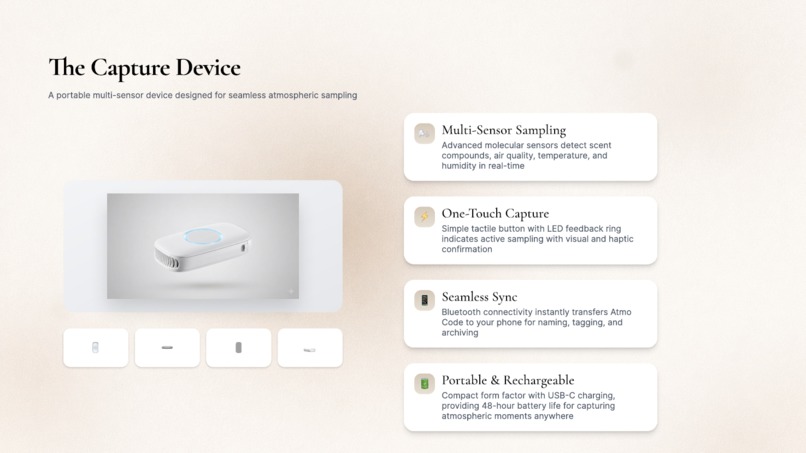
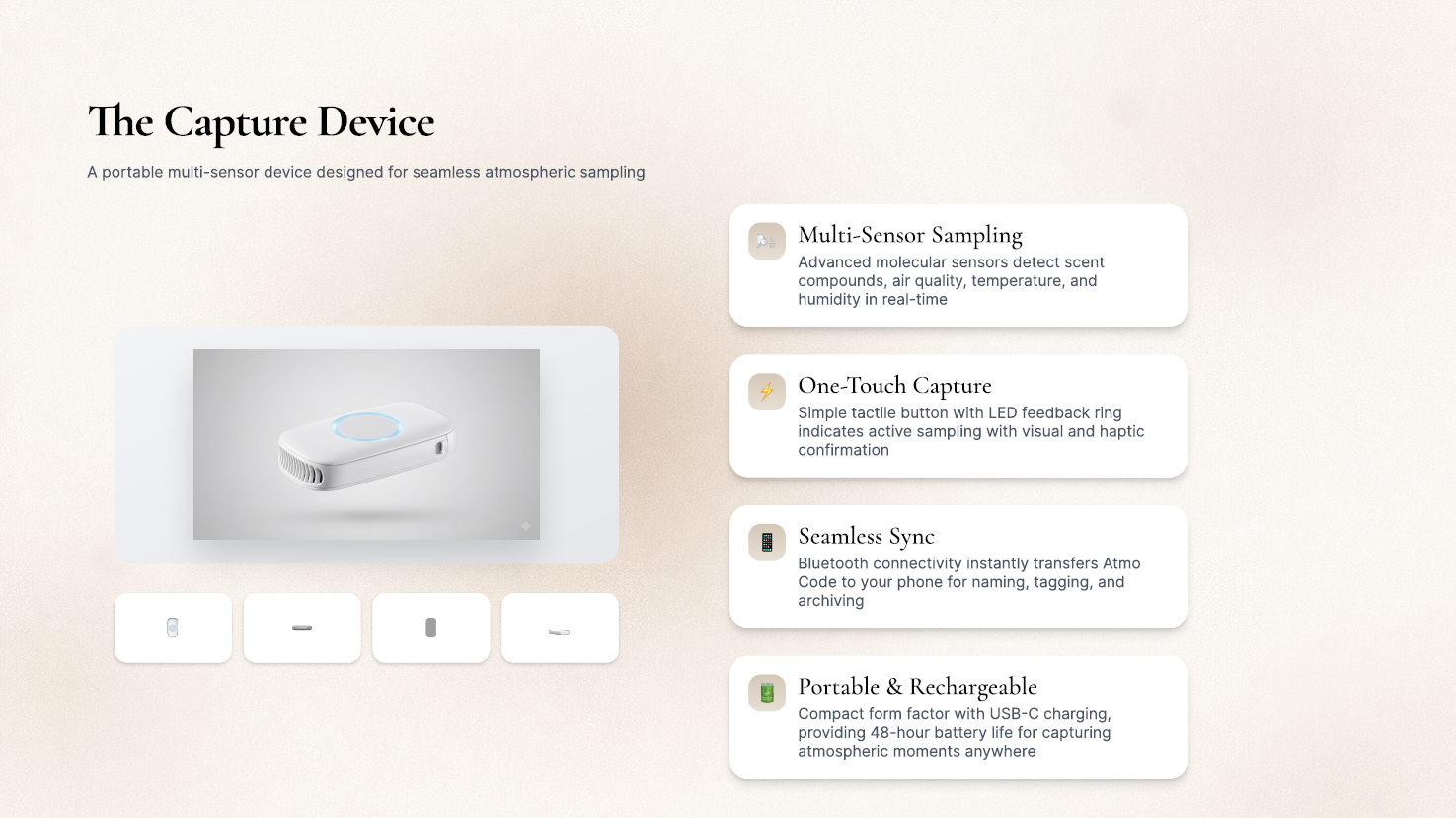
Capture Device
-
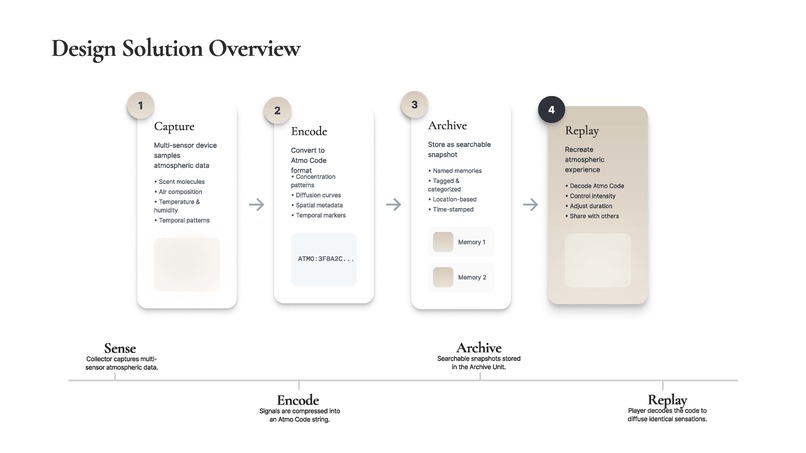
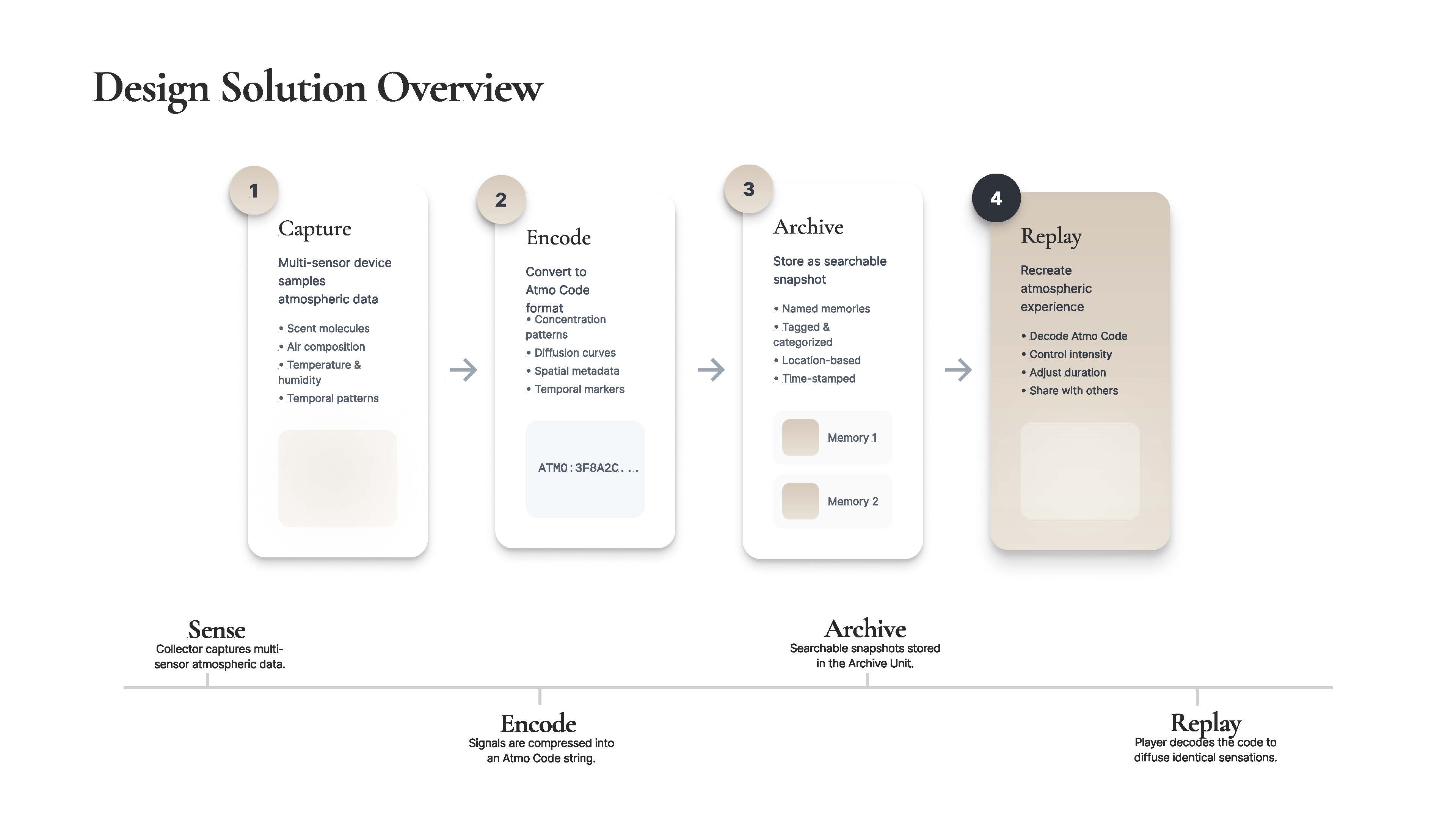
Design Solution
-
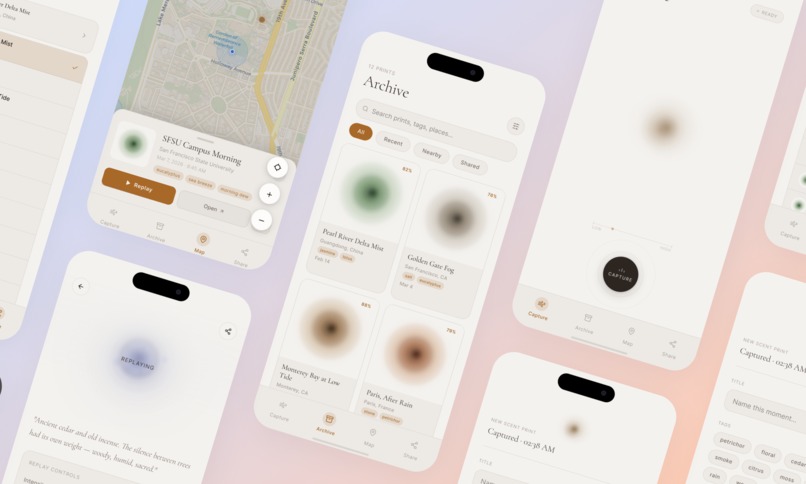
UI design
-
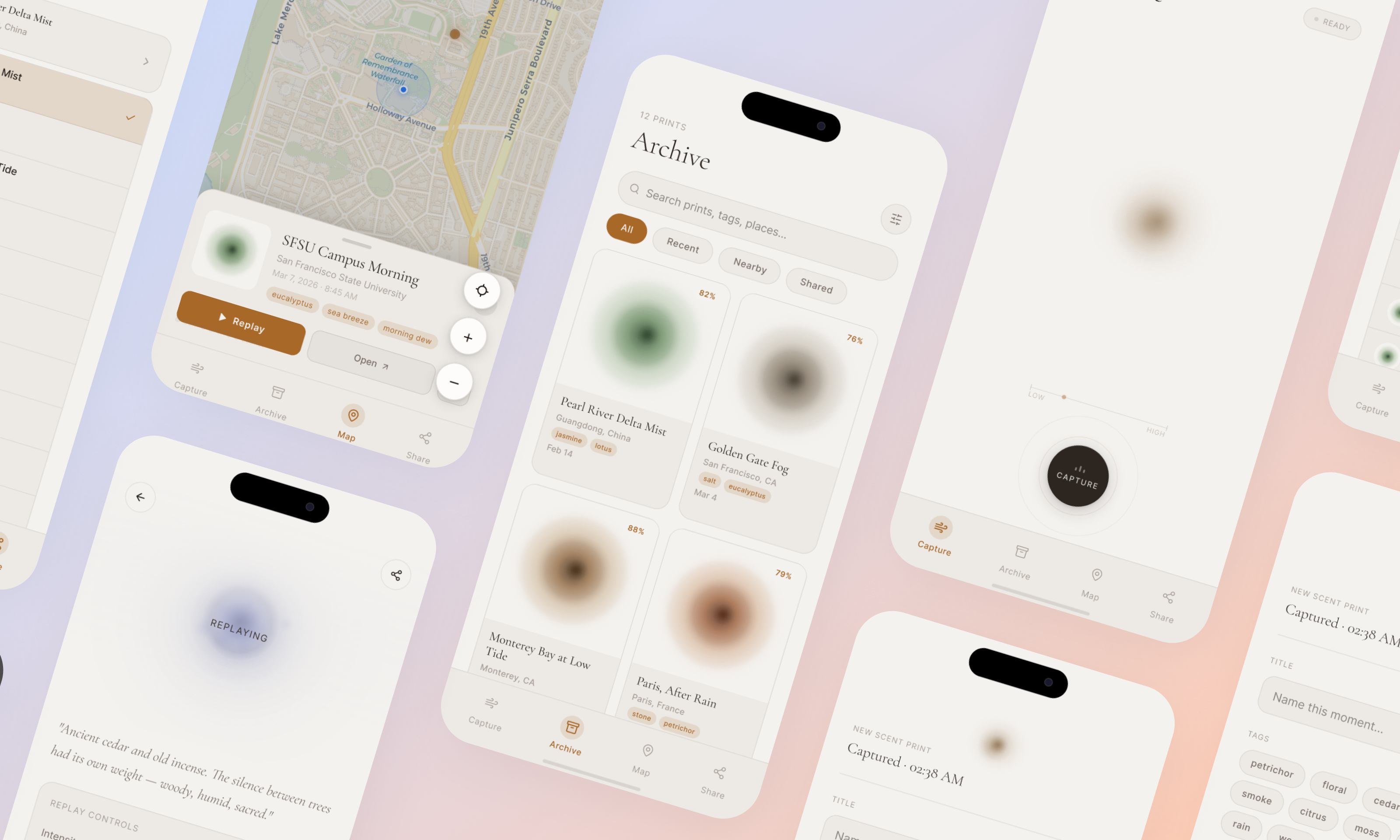
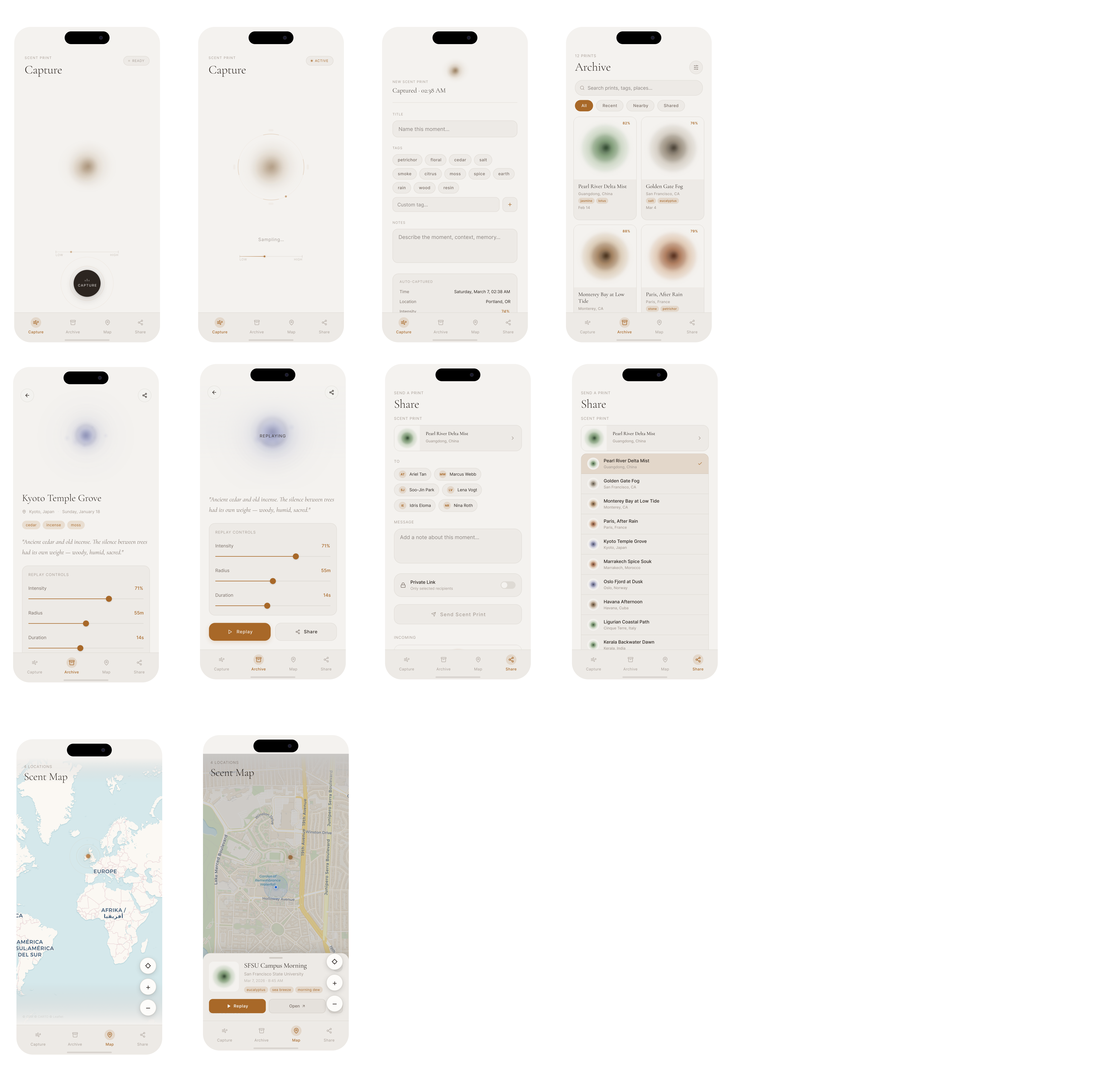
UI mockup
-
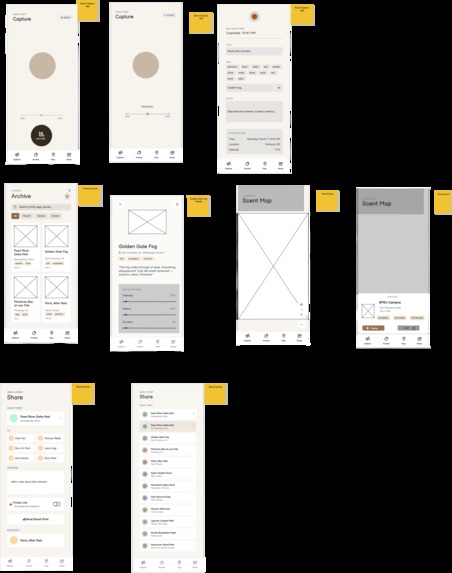
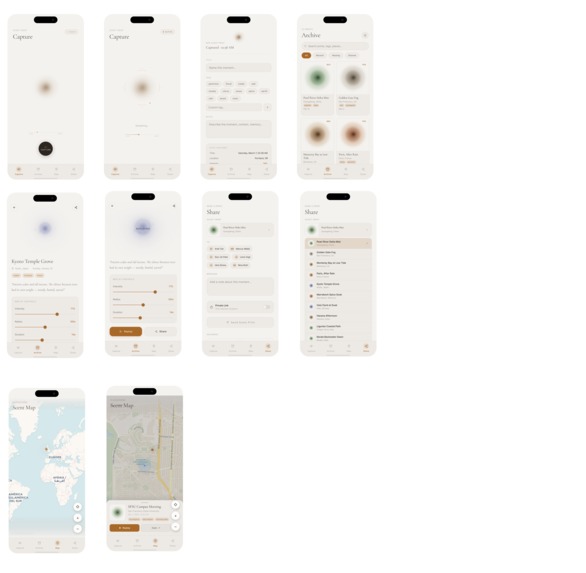
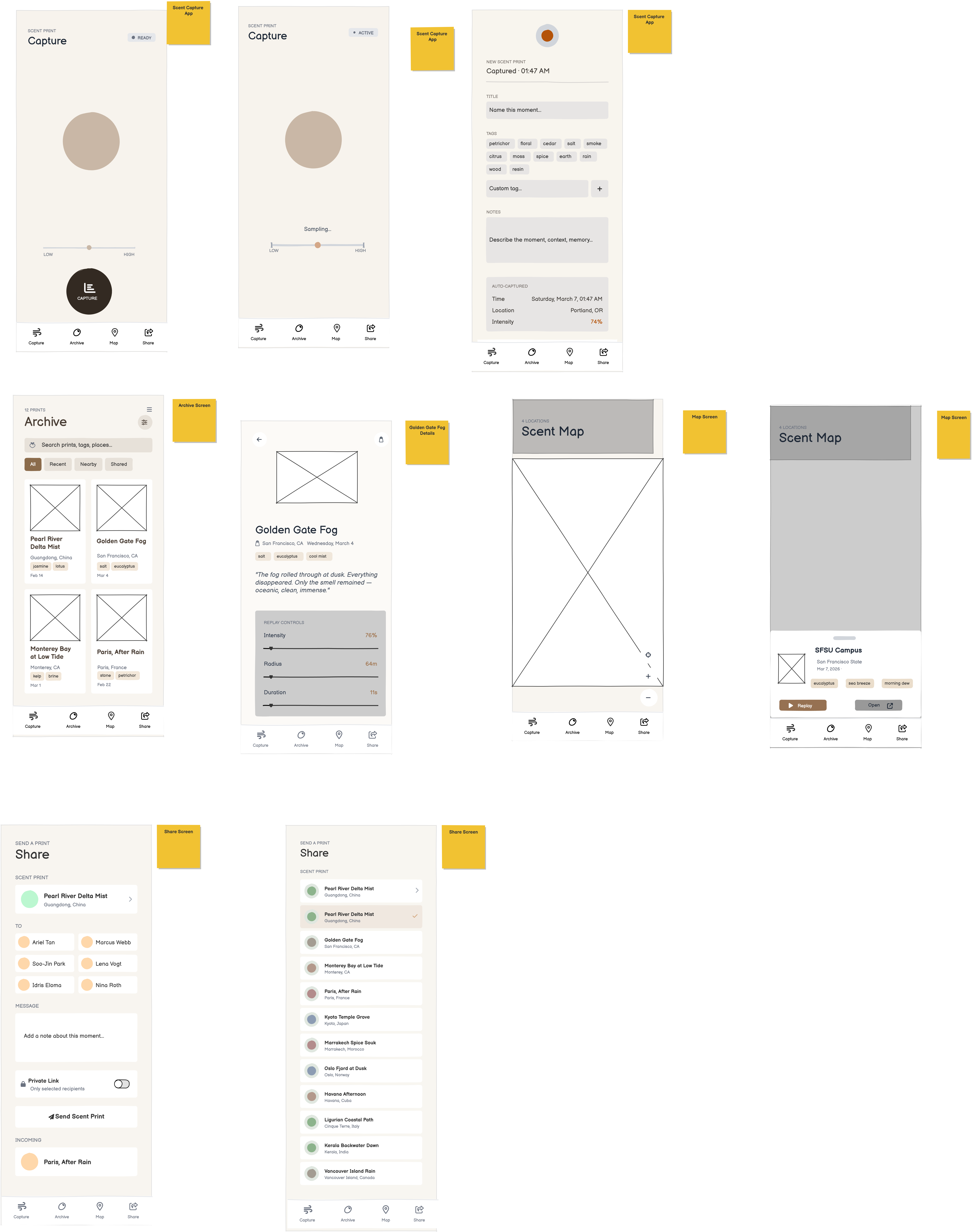
Wireframe
Inspiration
Scent is one of the most emotionally powerful human senses, yet it remains absent from digital systems.
We can capture images, audio, and video but atmospheric memory disappears the moment we leave a place.
Scent Print began as a speculative question:
What if atmosphere could be captured, encoded, and replayed like media?
This project explores scent not as fragrance, but as environmental memory a controllable sensory layer.
What It Does
Scent Print is a speculative sensory system that captures and reconstructs atmospheric memory.
Using a multi-sensor device called the Collector, environmental data such as scent intensity, air composition, temperature, and humidity is sampled and encoded into a standardized structure called Atmo Code.
Each capture becomes an Atmosphere Snapshot a structured unit of atmospheric memory that can be named, tagged, stored, searched, shared, and replayed within the app.
Users can:
- Organize memories by time and location
- Search by tags and emotional context
- Adjust replay intensity, radius, and duration
- Control privacy when sharing atmospheres
This transforms scent from a fleeting sensation into structured, digital memory.
Design System Overview
Scent Print operates as a multi-layer sensory system rather than a single interface.
Concept Layer Atmospheric Memory
Scent is reframed as atmosphere: a combination of molecular density, air composition, humidity, and time.
The goal is to transform something ephemeral into something structured and controllable.
System Layer — Capture, Encode, Archive, Replay
- Capture — The Collector samples environmental data in real time.
- Encode — Data is translated into Atmo Code, a reproducible atmospheric signature.
- Archive — Each capture becomes a searchable Atmosphere Snapshot.
- Replay — Atmospheres can be reconstructed and adjusted within the app.
Interaction Layer — Control & Structure
The app emphasizes control and organization over decoration.
Replay is tunable not binary allowing users to modulate intensity, radius, and duration.
Visual Translation Layer — Designing the Invisible
Since scent has no natural visual language, the interface uses:
- Soft gradients to represent atmospheric density
- Minimal UI to emphasize presence
- Spatial mapping to connect scent with geography
The system avoids literal representation and instead builds an abstract sensory translation.
How It Was Built
The entire system — including interaction design, interface, hardware concept, and visual identity was developed in Figma.
The project integrates:
- Multi-sensory data modeling
- Speculative hardware design (Collector device)
- Atmospheric encoding logic (Atmo Code structure)
- Interactive mobile prototype
The prototype demonstrates how scent could function as a future digital layer.
Challenges
The biggest challenge was designing for something invisible.
Unlike sound or image, scent has no established interface language.
To address this, we developed:
- A gradient-based visual system for atmospheric density
- A tunable replay model instead of fixed playback
- A structured archive that makes scent searchable
Balancing emotional intimacy with user control and privacy was also central to the design.
Accomplishments We're Proud Of
- Developing a visual language for an invisible sense
- Structuring atmosphere as standardized, transferable data
- Designing a tunable replay system rather than binary playback
- Embedding privacy and consent into sensory sharing
- Proposing a coherent speculative framework for a new digital sensory layer
What We Learned
Scent is not simply sensory input it functions as emotional infrastructure.
By externalizing atmospheric memory, we can imagine new forms of grounding, connection, and digital presence.
Scent Print proposes a future where atmosphere is no longer lost
it becomes something we can carry, shape, and revisit.
What's Next for Scent Print
Scent Print is currently a speculative prototype, but the next phase focuses on exploring technical feasibility and real-world integration.
Future directions include:
- Researching emerging olfactory hardware and scent diffusion technologies
- Refining the Atmo Code structure into a scalable encoding standard
- Prototyping a functional Collector device with real sensor integration
- Exploring partnerships with wellness, VR, and immersive experience platforms
- Conducting user research on emotional regulation and sensory grounding
Long term, Scent Print aims to investigate how atmospheric data could become a new digital layer integrated into spatial computing, virtual environments, and connected devices.
The goal is not just to replicate scent, but to redefine how atmosphere functions in future interaction systems.
Built With
- adobe-effects
- concept-hardware-design
- figma
- figma-make
- figma-prototype
- figma-site
- figma-slides
- kling
- tripo-(3d-modeling)
- ui/ux-design


Log in or sign up for Devpost to join the conversation.