Inspir## Inspiration
Film crews often turn a short scene into dozens of disconnected tasks: location permissions, safety checks, equipment planning, research, scheduling questions, and shot design. Important decisions are frequently buried in documents or unsupported web searches. We built SceneReady Studio to transform that fragmented process into one transparent, evidence-grounded production workspace.
What it does
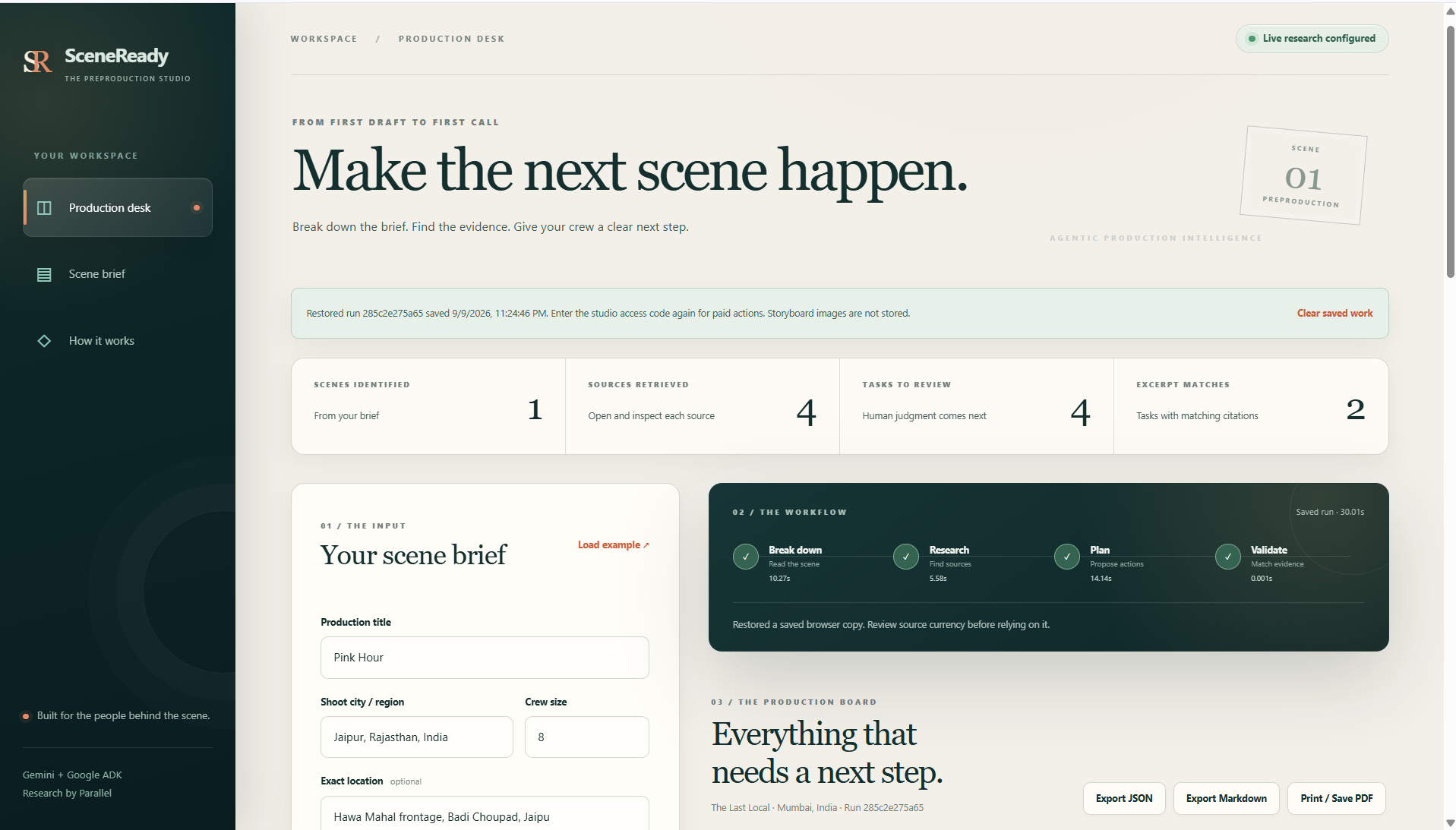
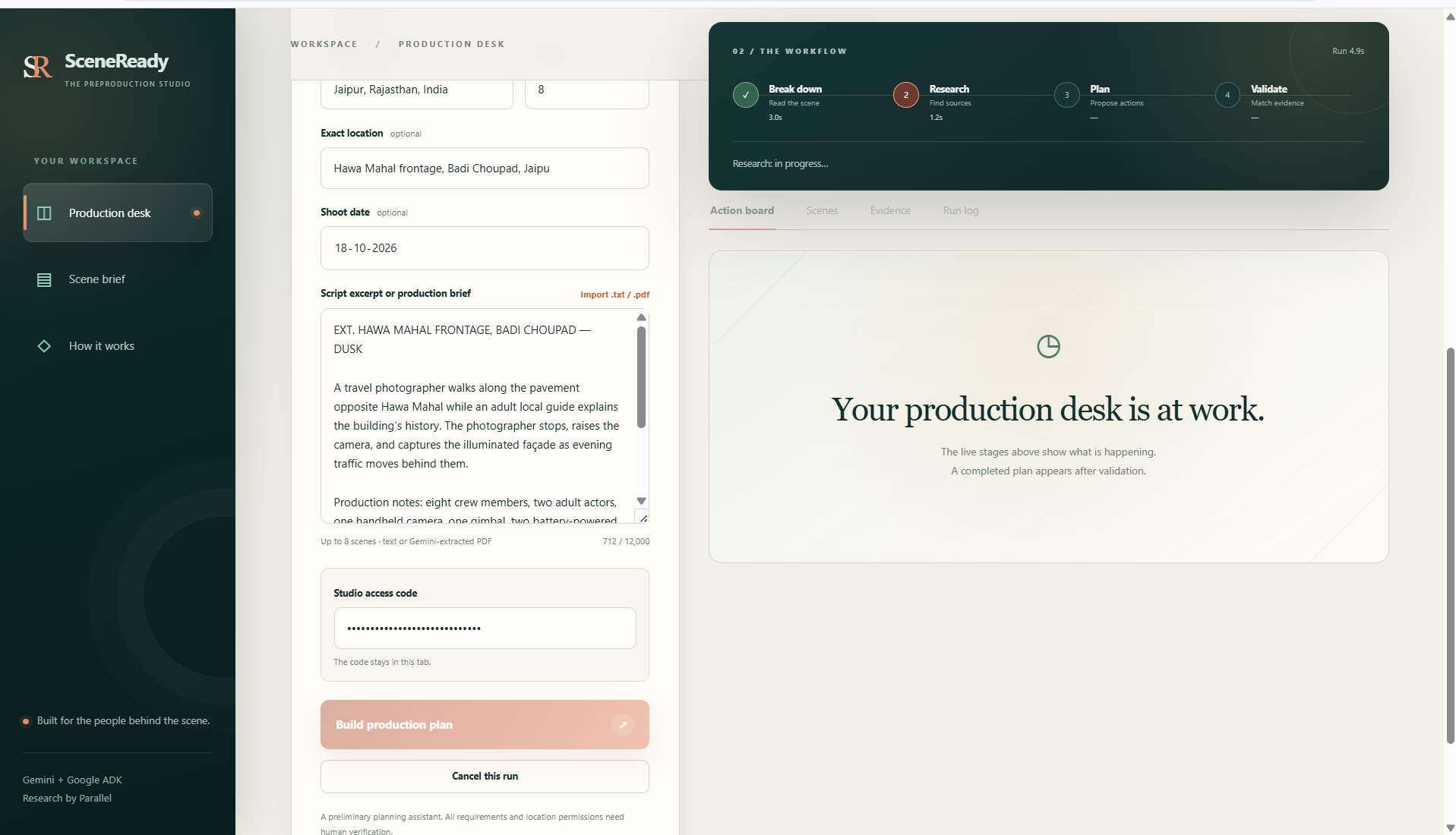
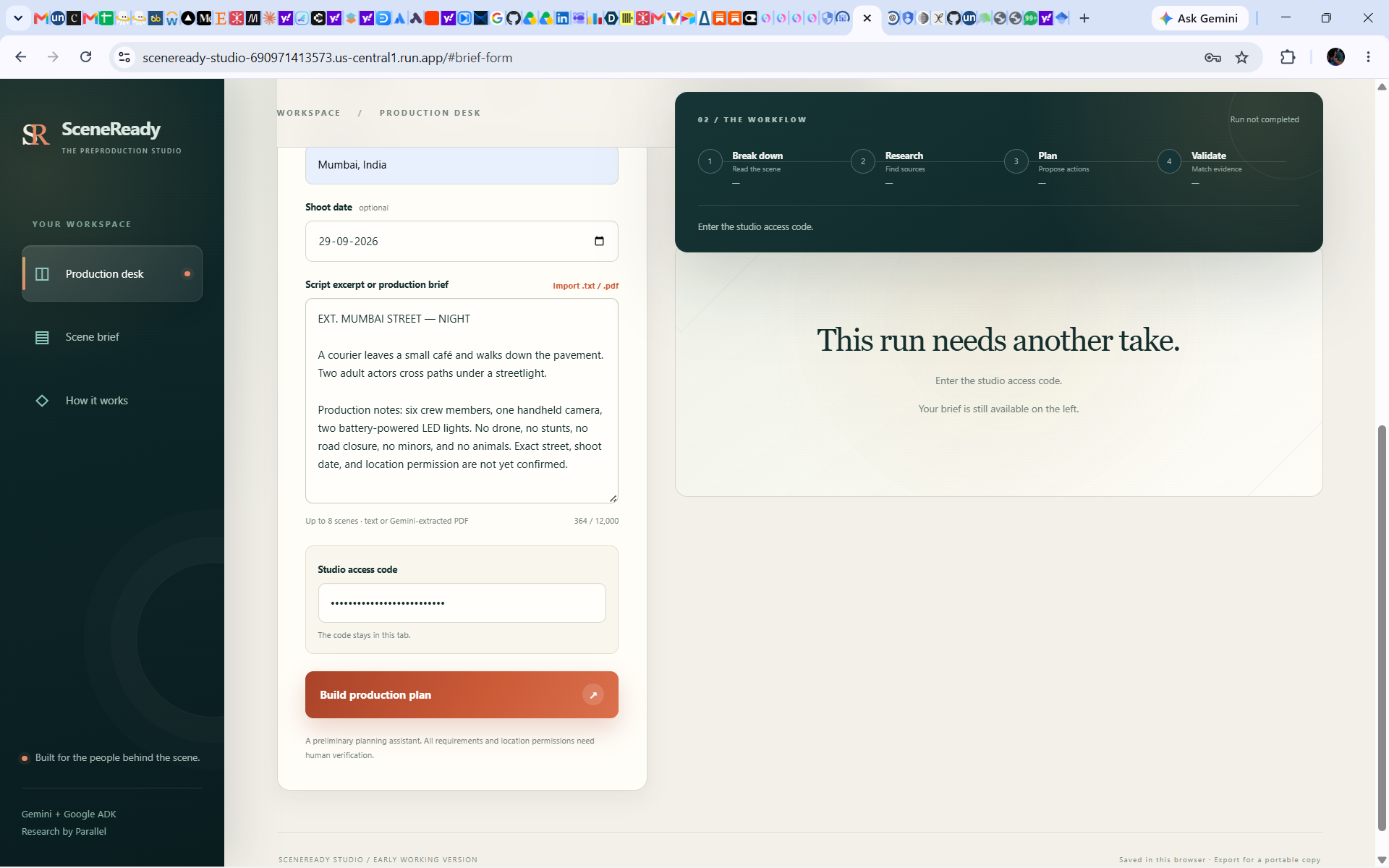
SceneReady accepts a production brief, TXT file, or PDF screenplay and runs a visible four-stage workflow:
- Break down the screenplay into structured scenes.
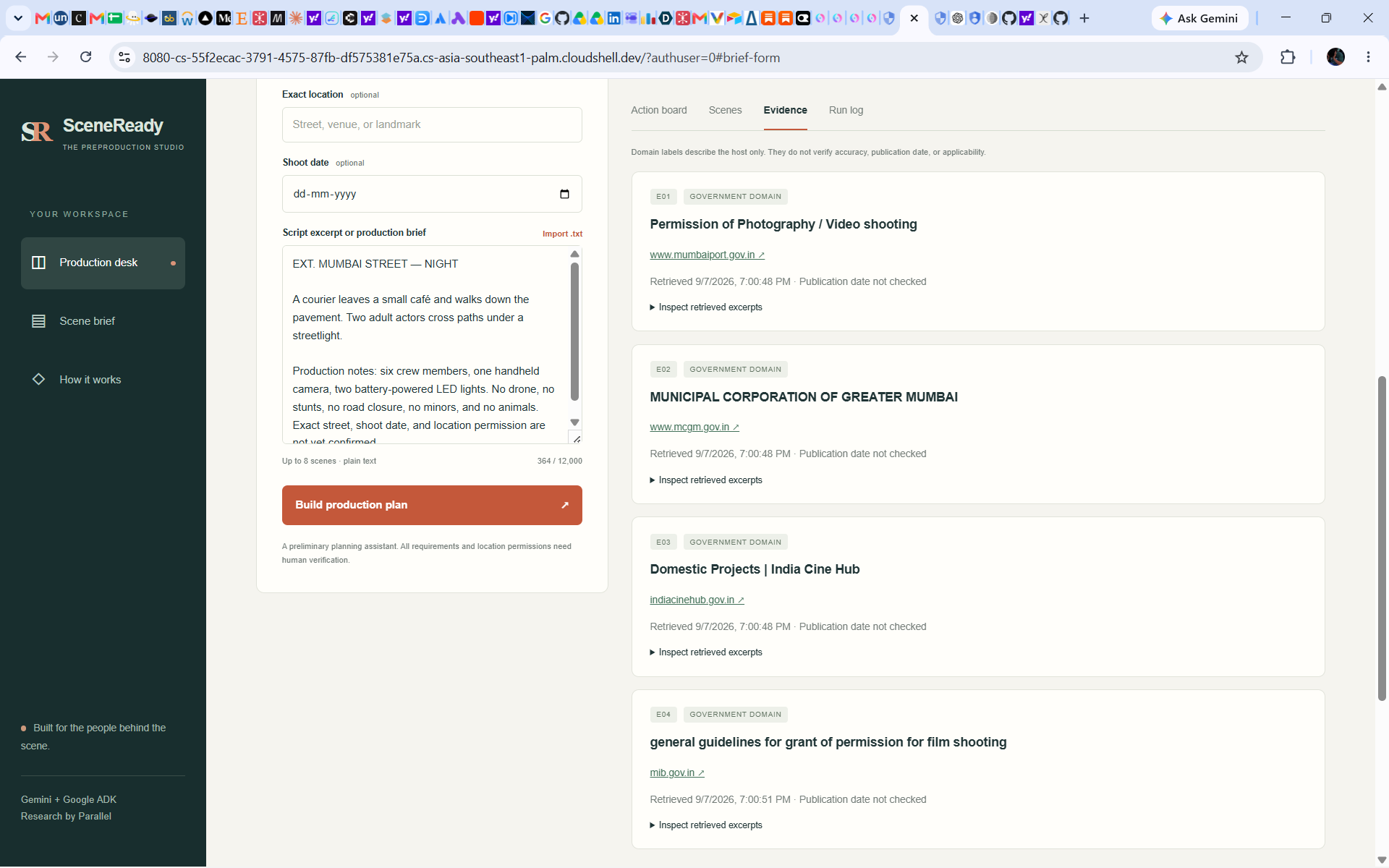
- Research relevant filming requirements using live Parallel Search.
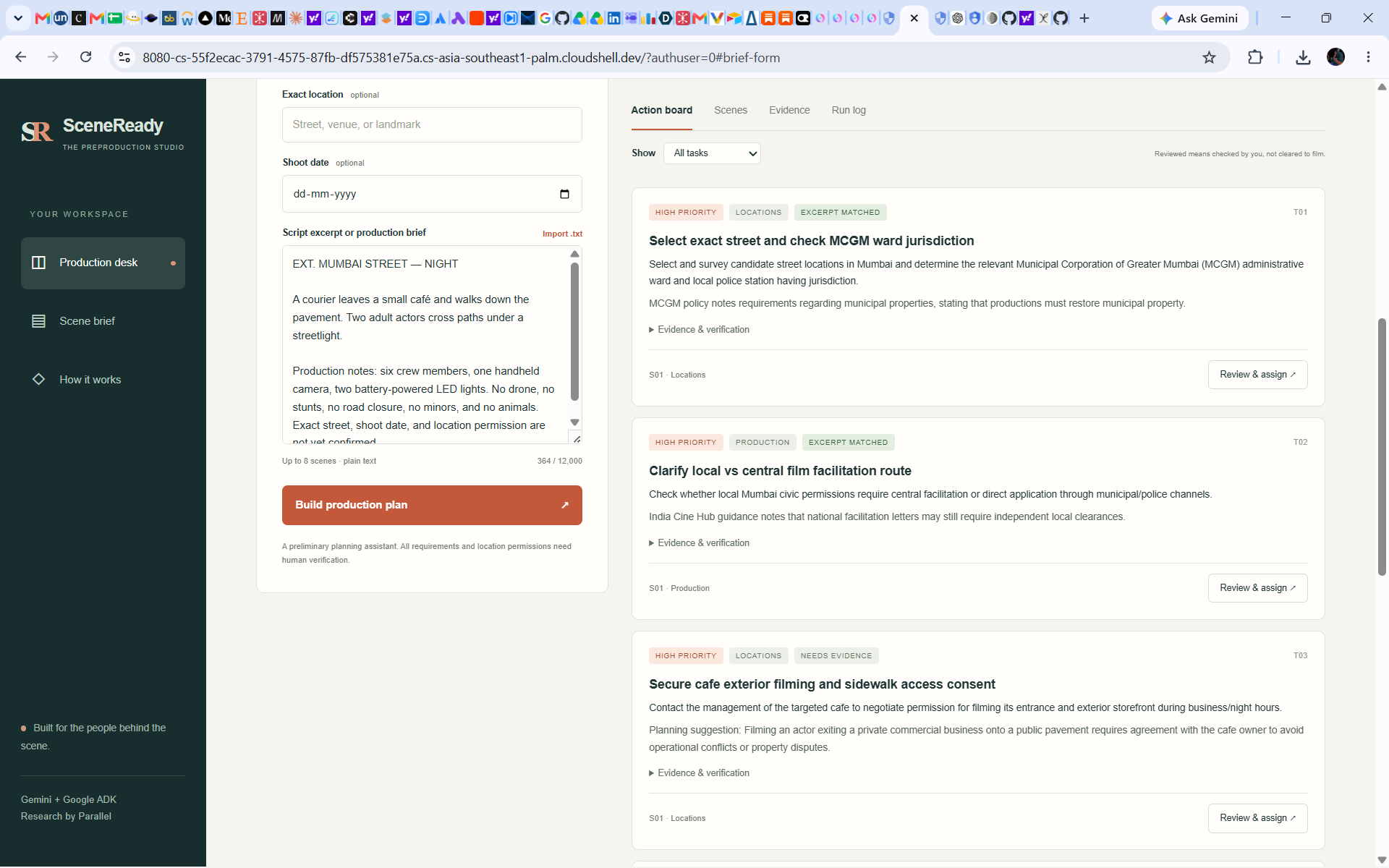
- Plan actionable production tasks using Gemini agents.
- Validate citations and scene references deterministically in Python.
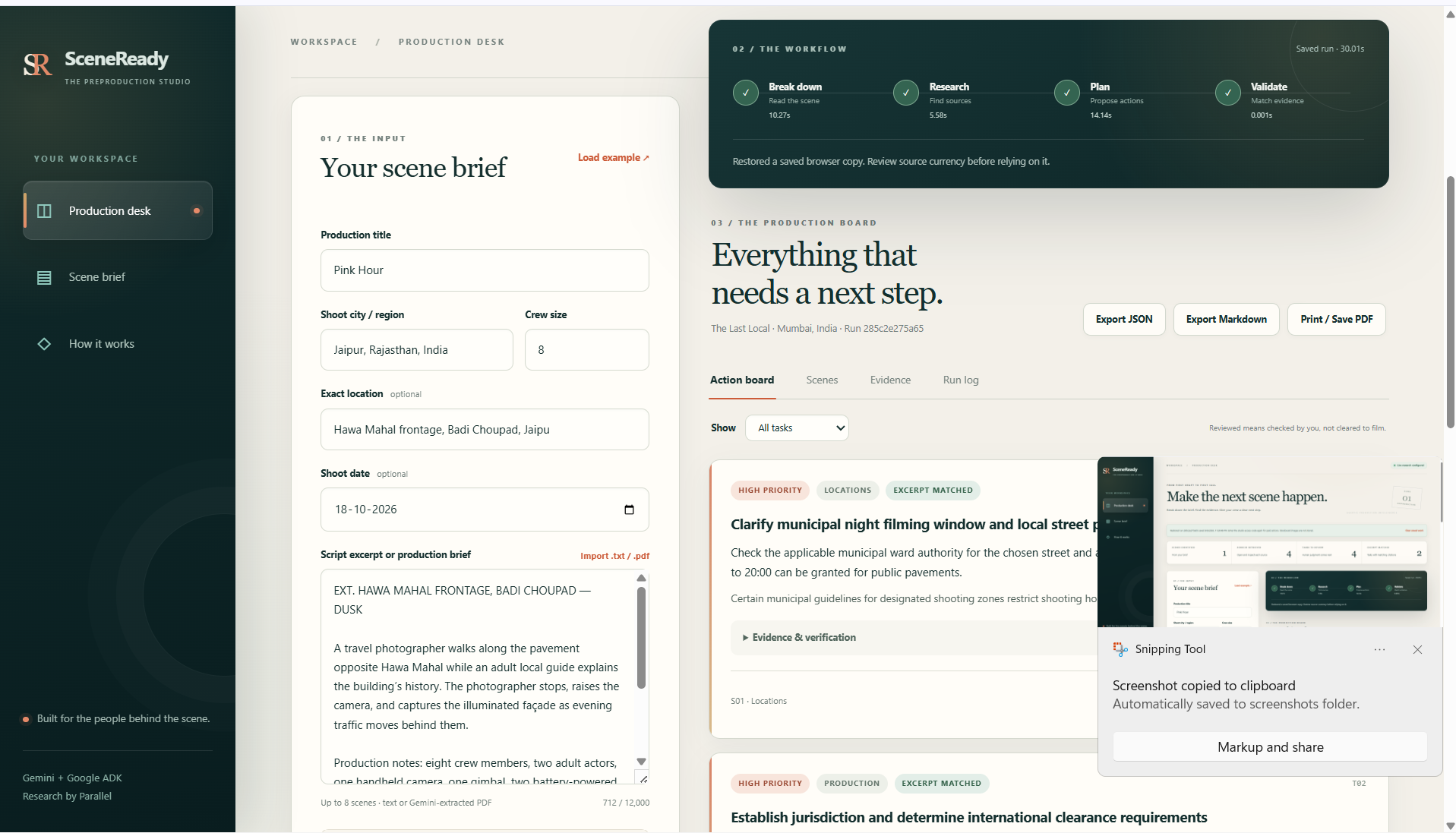
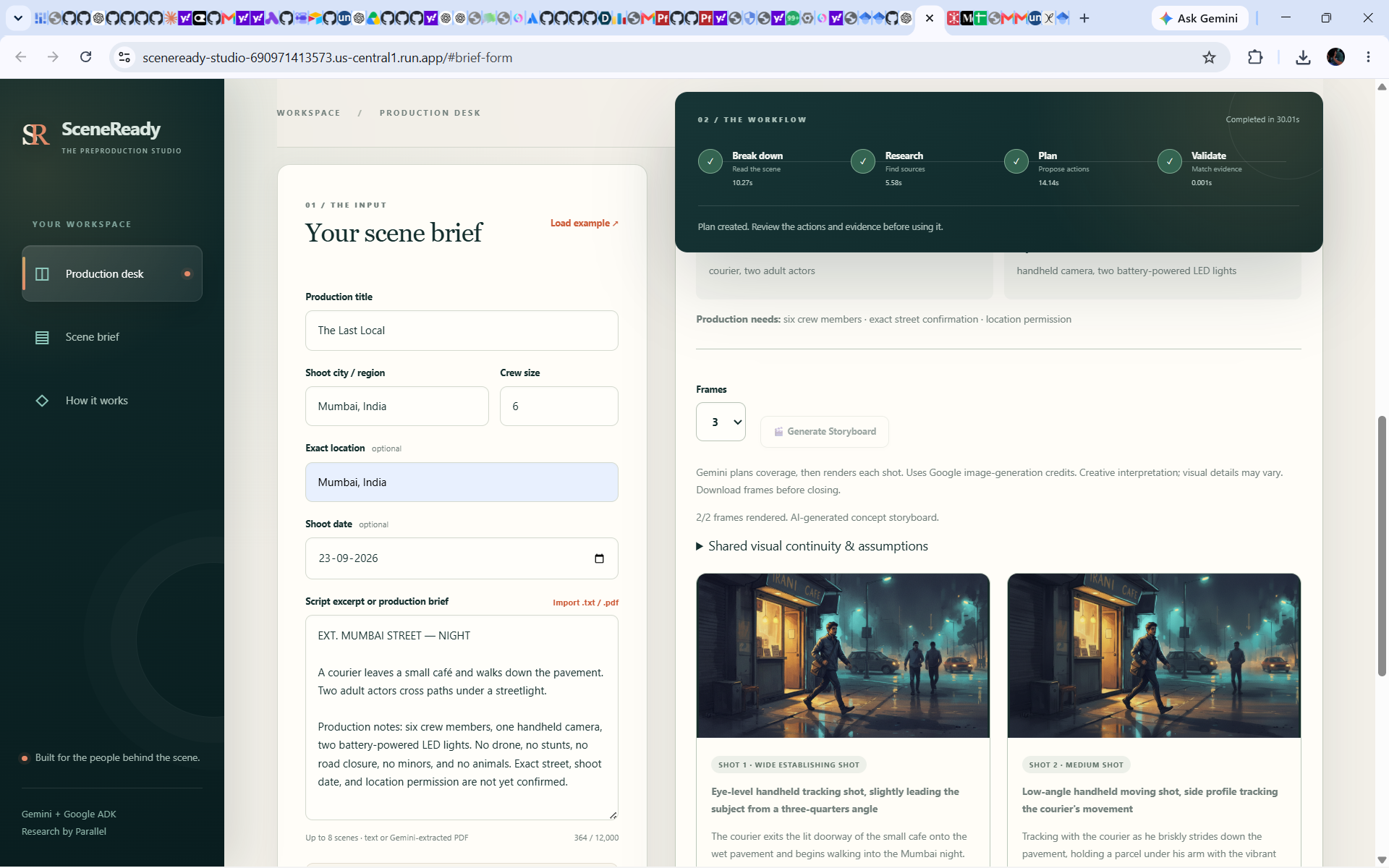
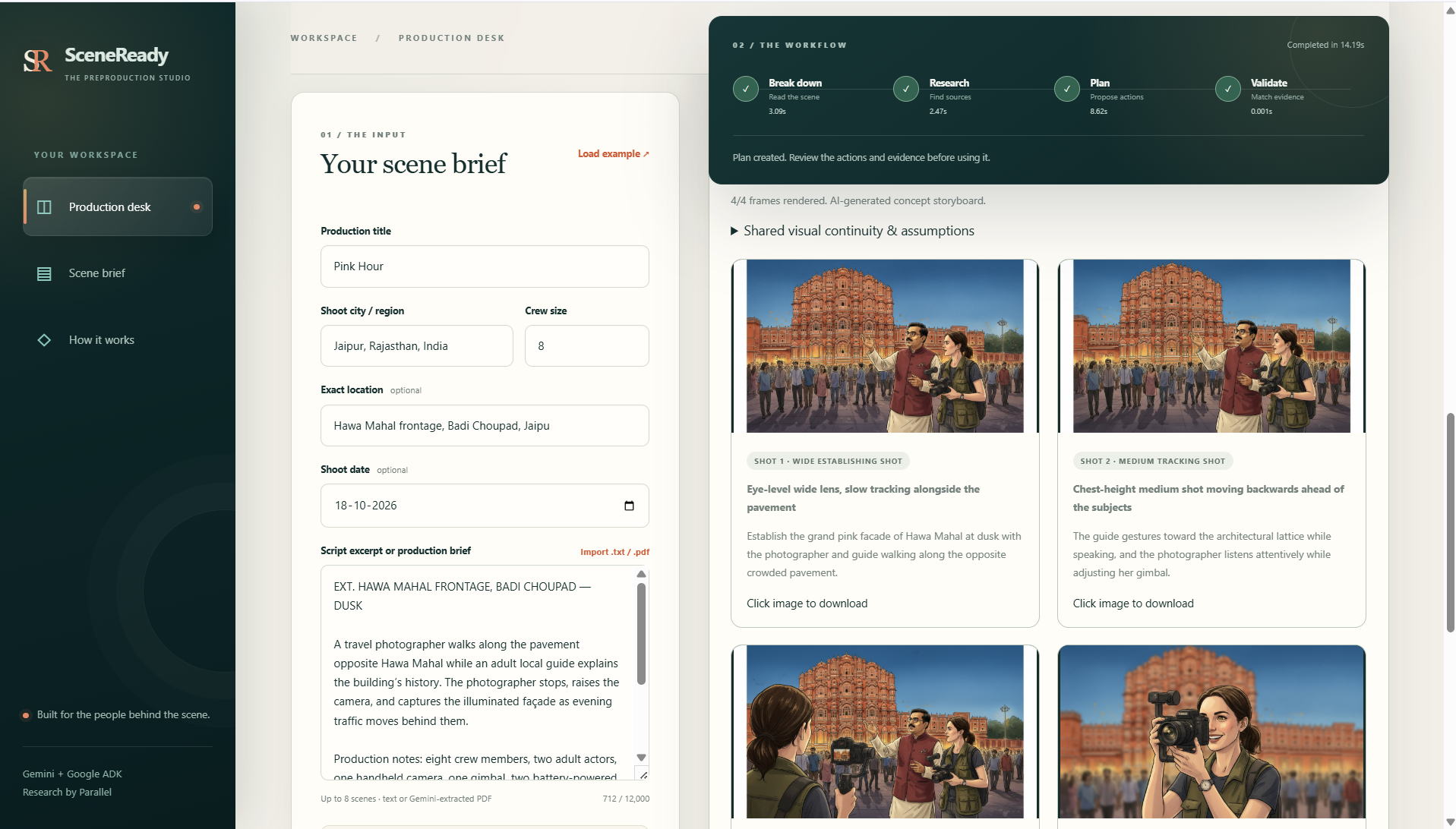
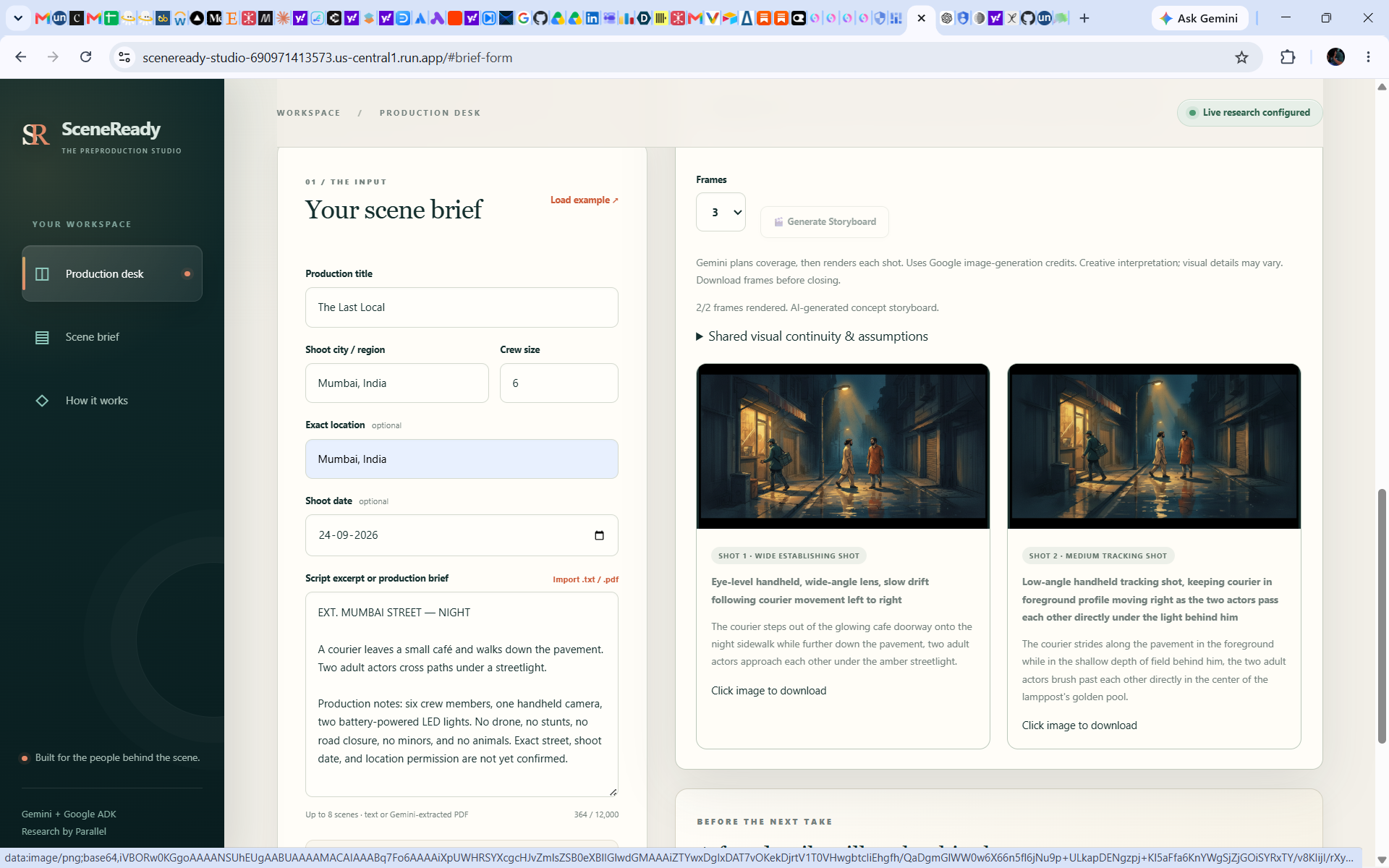
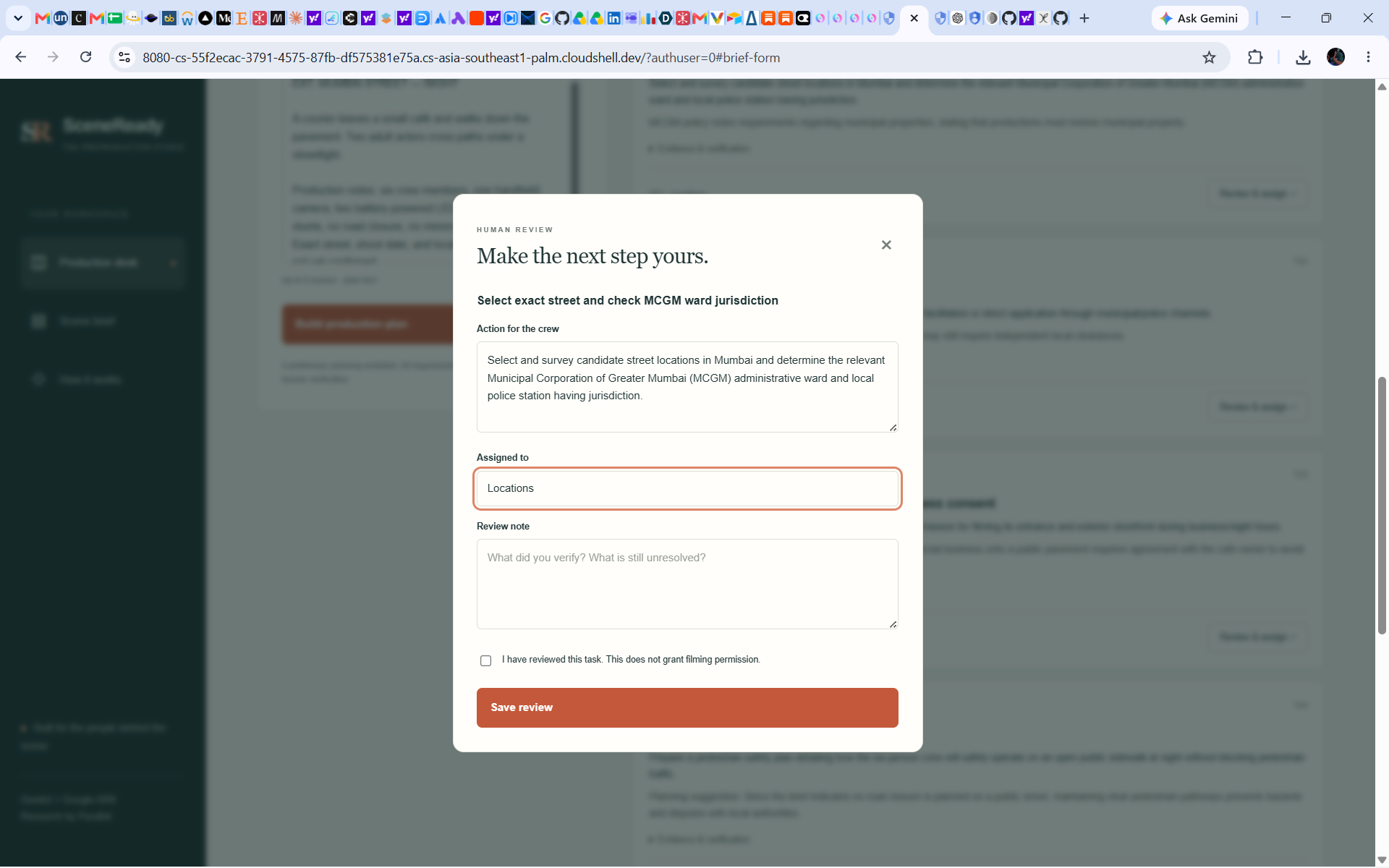
Users can inspect evidence, edit and assign tasks, record human reviews, compare revisions, export reports, and generate visual storyboards. Storyboards are not random scene images: Gemini first creates a structured 2–4 shot plan, then Google image generation renders visually consistent frames with shot type, camera direction, framing, and description.
How we built it
The application uses Google Agent Development Kit agents with Gemini through Vertex AI. Parallel is imported and called at runtime for bounded, authority-focused web research. FastAPI coordinates the fixed workflow and streams real stage events to the browser.
Python validates source IDs, URLs, quotations, duplicates, and scene references before displaying results. The frontend is an original responsive interface built with HTML, CSS, and vanilla JavaScript. The application is containerized and hosted on Google Cloud Run, with credentials secured through Secret Manager and a dedicated runtime service account.
Challenges
The main challenge was keeping generative outputs useful without presenting them as verified legal or safety decisions. We solved this by separating model reasoning from deterministic validation, visibly marking unsupported tasks, preserving research failures, and requiring human review. We also implemented bounded API calls, protected paid endpoints, browser recovery without storing secrets, structured privacy-safe logging, and a redacted public sample for judges.
Accomplishments
- Working Gemini and Parallel integration deployed on Google Cloud
- Evidence-grounded, human-reviewable production tasks
- Structured screenplay and PDF analysis
- Scene-to-shot-plan-to-image storyboard generation
- Real-time stage progress and execution timings
- Citation validation and visible unknowns
- JSON, Markdown, and browser PDF exports
- Public read-only judge sample with no paid API calls
- 42 automated tests with GitHub Actions CI
What we learned
We learned that trustworthy agentic systems need more than prompts. They require constrained orchestration, typed schemas, observable tool use, deterministic checks, careful secret handling, and clear boundaries between AI suggestions and human decisions.
What's next
Future work includes Firestore project history, Google authentication, production calendars, map-based location planning, stronger source-freshness verification, voice-based rehearsal, and multi-day scheduling. ation

Log in or sign up for Devpost to join the conversation.