-
-
SceneProof: from scene to shoot-ready proof
Inspiration
Film production often discovers its hardest problems too late. A scene can look perfect on the page and still collide with permits, location restrictions, weather, stunt safety, factual assumptions, or continuity errors only after time and money have already been committed. Most AI tools in filmmaking focus on generating scripts, images, or ideas. We wanted to solve a different problem: can the scene actually be filmed as written? That question led to SceneProof, a production reality engine designed to bring real-world evidence into the creative process before the camera rolls. Our goal was not to replace creative judgment, but to give filmmakers a way to test ambitious ideas against reality while still protecting what makes the scene worth shooting.
What it does
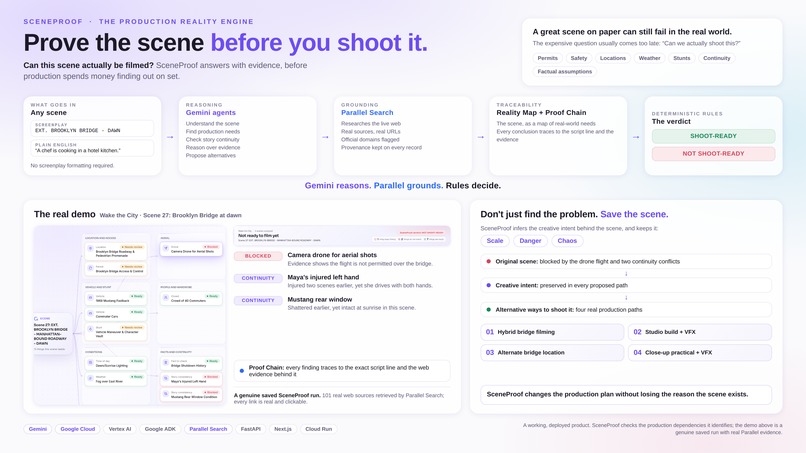
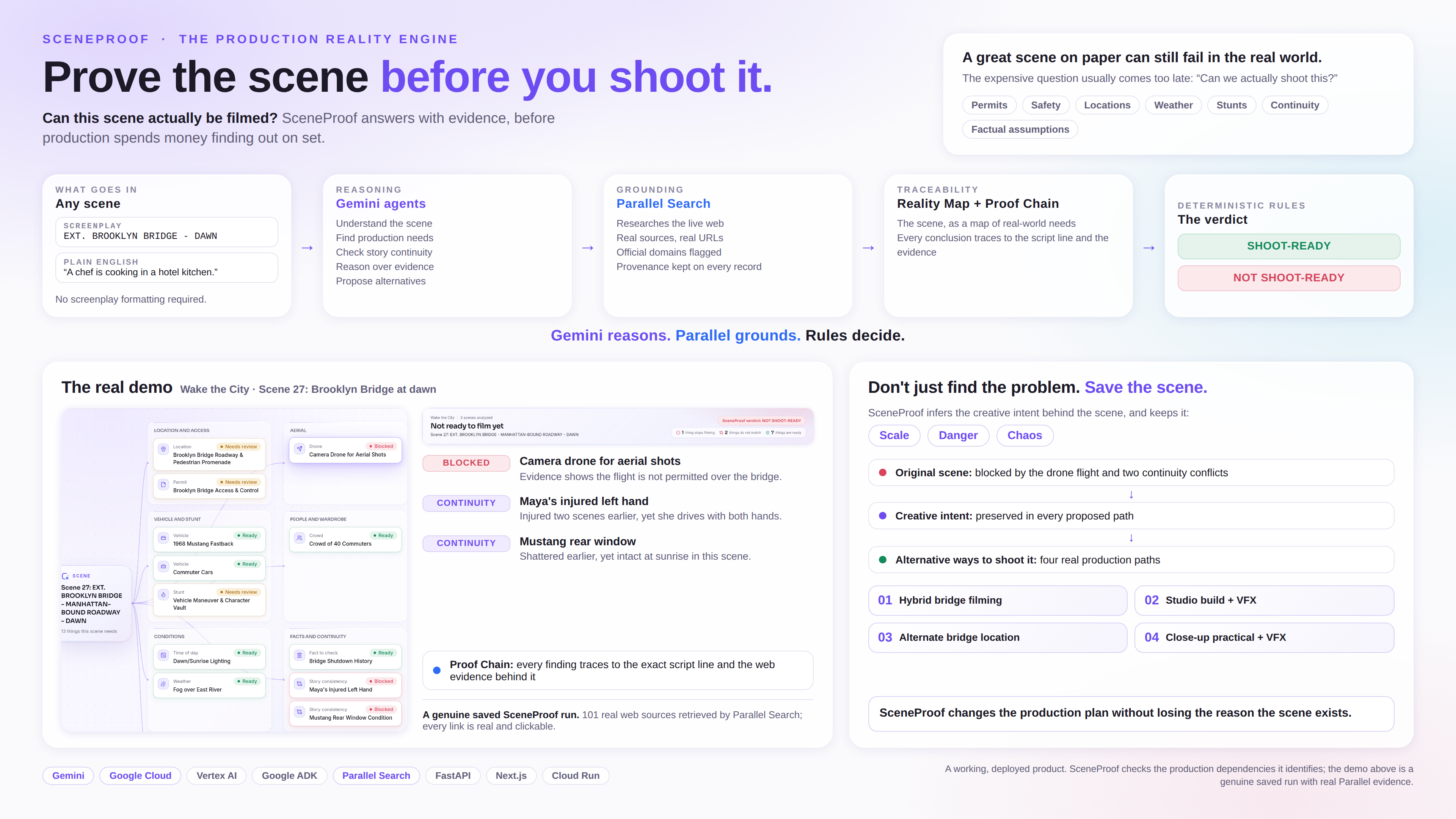
SceneProof accepts either a professionally formatted screenplay or a plain-English scene description and turns it into a structured production reality check. It identifies the real-world needs hidden inside the scene, such as locations, permits, vehicles, weather, props, crowds, safety concerns, factual claims, and continuity dependencies. Gemini-powered specialist agents reason over the scene, while Parallel Search researches live web evidence and preserves real source links for inspection. SceneProof then connects the script, evidence, findings, and recommendations through a visual Reality Map and Proof Chain, so users can see exactly how a conclusion was reached. Importantly, Gemini does not simply declare whether a scene is ready. Deterministic rules own the final SHOOT-READY or NOT SHOOT-READY verdict. When something fails, SceneProof goes one step further by identifying the director's creative intent and proposing alternative production paths that preserve the essence of the scene instead of simply saying no.
How we built it
SceneProof is built as a multi-agent production intelligence system on Google Cloud. The backend uses Python and FastAPI, with Gemini through Google ADK and the Google GenAI SDK. We created specialist agents for script breakdown, research planning, real-world reasoning, continuity analysis, and production strategy, coordinated by a deterministic SceneProof orchestrator. Parallel Search is the sole external research provider, giving the system grounded web evidence with real URLs and source provenance. The frontend is built with Next.js, TypeScript, and Tailwind and is deployed alongside the API on Cloud Run. The key architectural principle is simple: Gemini reasons, Parallel grounds, and deterministic rules decide. This separation lets us use generative AI for the work it is good at while keeping status resolution and the final verdict auditable and predictable. We also built a saved genuine demo run so judges can explore a completed analysis instantly, while the live path still runs the full pipeline from scratch.
Challenges we ran into
The hardest challenge was making an agentic system both intelligent and trustworthy. Early versions could produce good reasoning but still fail quality gates because model outputs varied, references became inconsistent, or one missed continuity detail could weaken the entire result. We hardened the system by moving mechanical bookkeeping out of Gemini and into deterministic code, validating references, normalizing relationships, retrying transport failures safely, and separating semantic reasoning from rule-owned state. Another major challenge was input flexibility. The first parser expected screenplay syntax, which meant a casual user typing something like “a chef is cooking in a hotel” could not use the product. We redesigned the input path so SceneProof automatically supports both formal screenplay structure and plain-language descriptions without inventing missing sluglines, locations, or time-of-day details. We also had to solve real product issues around Cloud Run CORS, live progress polling, overlapping agent stages, evidence density, result semantics, and making a technically complex system understandable to someone with no filmmaking or AI background.
Accomplishments that we're proud of
We are most proud that SceneProof became a real deployed product rather than a scripted prototype. A user can type a simple scene description, run the real Gemini and Parallel-powered workflow, inspect real research sources, trace conclusions through the Proof Chain, and receive a deterministic production verdict. The system can also analyze multi-scene screenplays and detect continuity failures that ordinary web research cannot catch. In our saved demo, SceneProof identifies a blocked drone requirement on the Brooklyn Bridge, catches that Maya injured her left hand in an earlier scene but later drives with both hands, and notices that a Mustang's shattered rear window later appears intact. It then proposes production alternatives that preserve the scene's intended scale, danger, and chaos. We also built strong regression coverage across the backend and frontend, hardened the live workflow through repeated production tests, and redesigned the interface until the primary result could be understood in seconds without hiding the underlying technical depth.
What we learned
We learned that the most useful agentic systems are not the ones that give the model the most authority. They are the ones that clearly separate reasoning, evidence, rules, and human judgment. Gemini is excellent at decomposing a scene, interpreting creative intent, and reasoning across messy evidence, but deterministic code is better suited to owning state transitions and final verdicts. We also learned that provenance is not a secondary feature. Once AI begins influencing production decisions, users need to know what came from the original scene, what was inferred by the model, what was verified on the web, and what was decided by rules. Finally, we learned that powerful systems can still fail as products if the interface exposes too much internal complexity. Some of our most important work was not adding another agent, but simplifying the experience until users could move from “describe a scene” to “here is what stops filming and why” without needing to understand the architecture first.
What's next for SceneProof
The next step is to turn SceneProof from a scene-level reality engine into a broader pre-production intelligence platform. We want to extend analysis across complete scripts, track dependencies and continuity across an entire production, add persistent collaborative projects, and support role-specific workflows for directors, producers, location teams, stunt coordinators, and production managers. We also want to deepen structured integrations with permitting, weather, scheduling, location, and production-data systems so that more checks can move from research to actionable planning. Human decision controls will become a full part of the interface so teams can accept risks, approve alternatives, and recompute the production plan transparently. The larger vision is for SceneProof to become the layer between creative intent and production reality, helping filmmakers discover what will break, understand why, and find a way forward before the cost of discovering it on set.
Built With
- agentic-ai
- ai-agents
- chatgpt
- claude
- cloud-run
- continuity-analysis
- deterministic-orchestration
- fastapi
- film-production
- gemini
- generative-ai
- google-adk
- google-cloud
- google-genai-sdk
- multi-agent-systems
- next.js
- openai
- parallel-search
- python
- react
- screenplay-analysis
- tailwind-css
- typescript
- vertex-ai

Log in or sign up for Devpost to join the conversation.