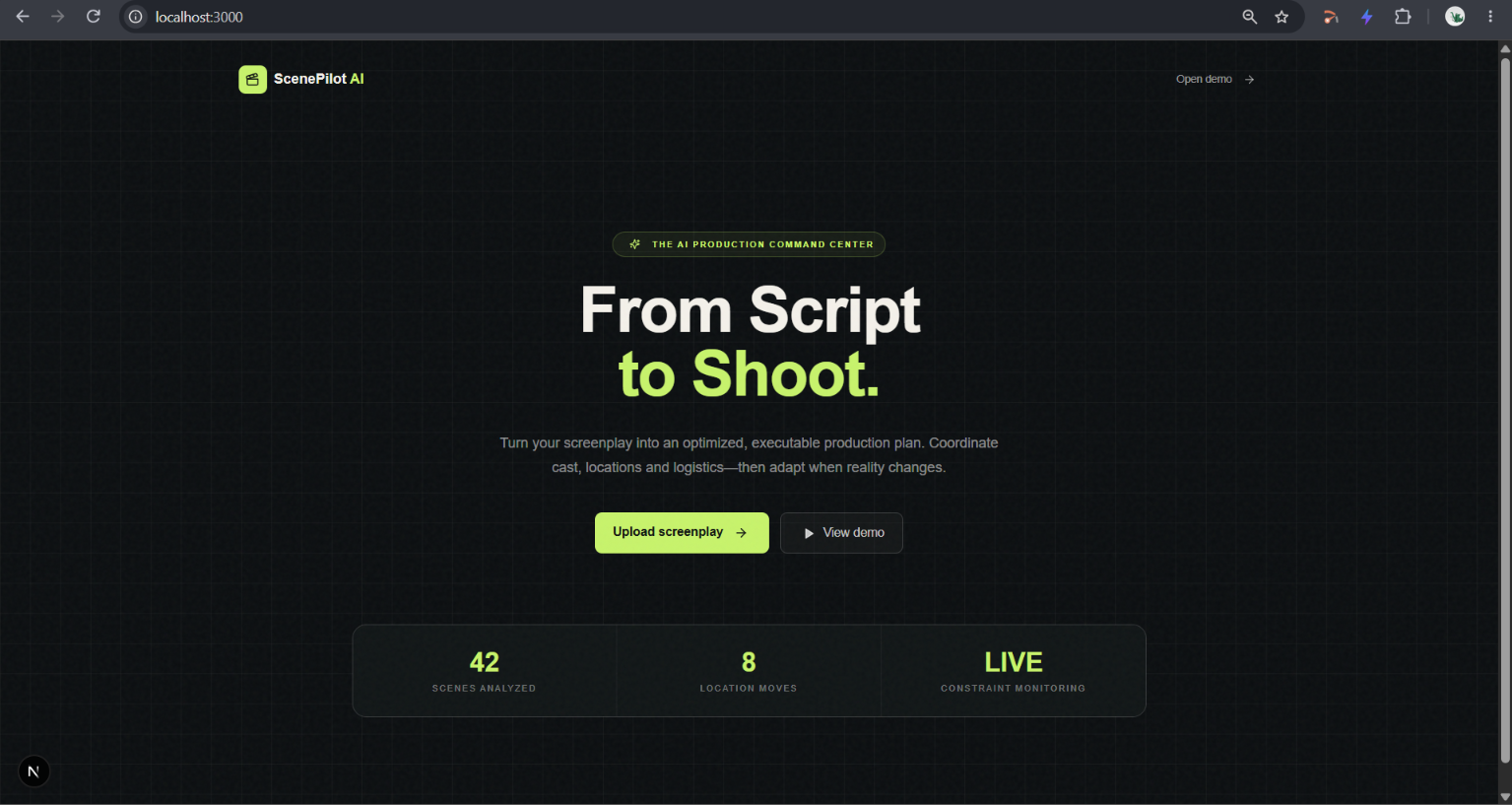

Film production involves a lot more than cameras and actors. A single screenplay can contain dozens of scenes, locations, actors, props, equipment, and timing requirements. Turning all of that into a practical shooting schedule can take a huge amount of manual work.
We were inspired by a simple question: What if AI could understand a screenplay and help a producer plan the actual shoot?
We also wanted to solve a problem that happens constantly in production: plans change. An actor may become unavailable, a location may be cancelled, or equipment may not be ready. Instead of rebuilding the entire schedule manually, we wanted an AI system that could understand the impact and adapt.
That idea became ScenePilot AI — From Script to Shoot.
What it does
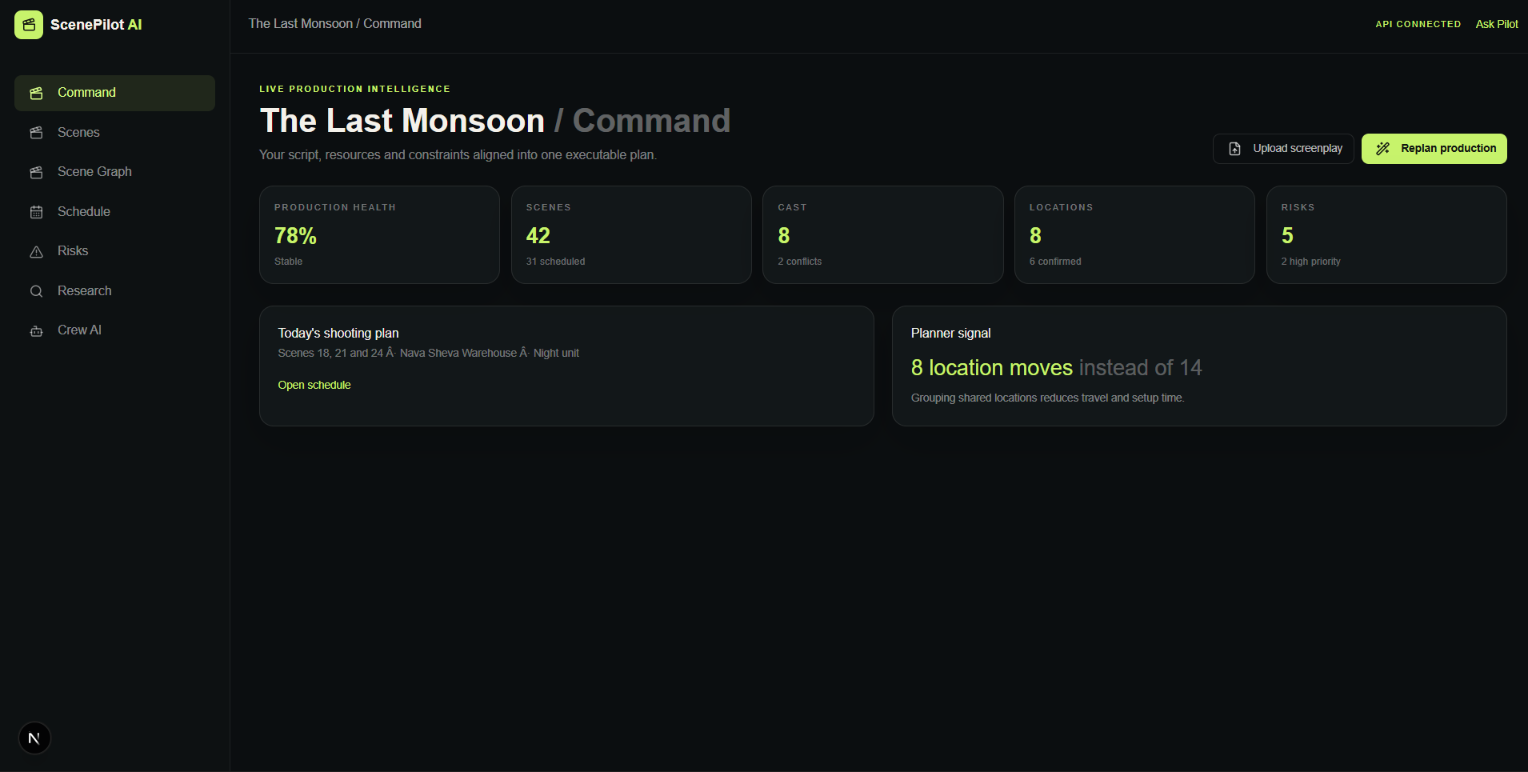
ScenePilot AI is an AI-powered production manager that turns a screenplay into an executable shooting plan.
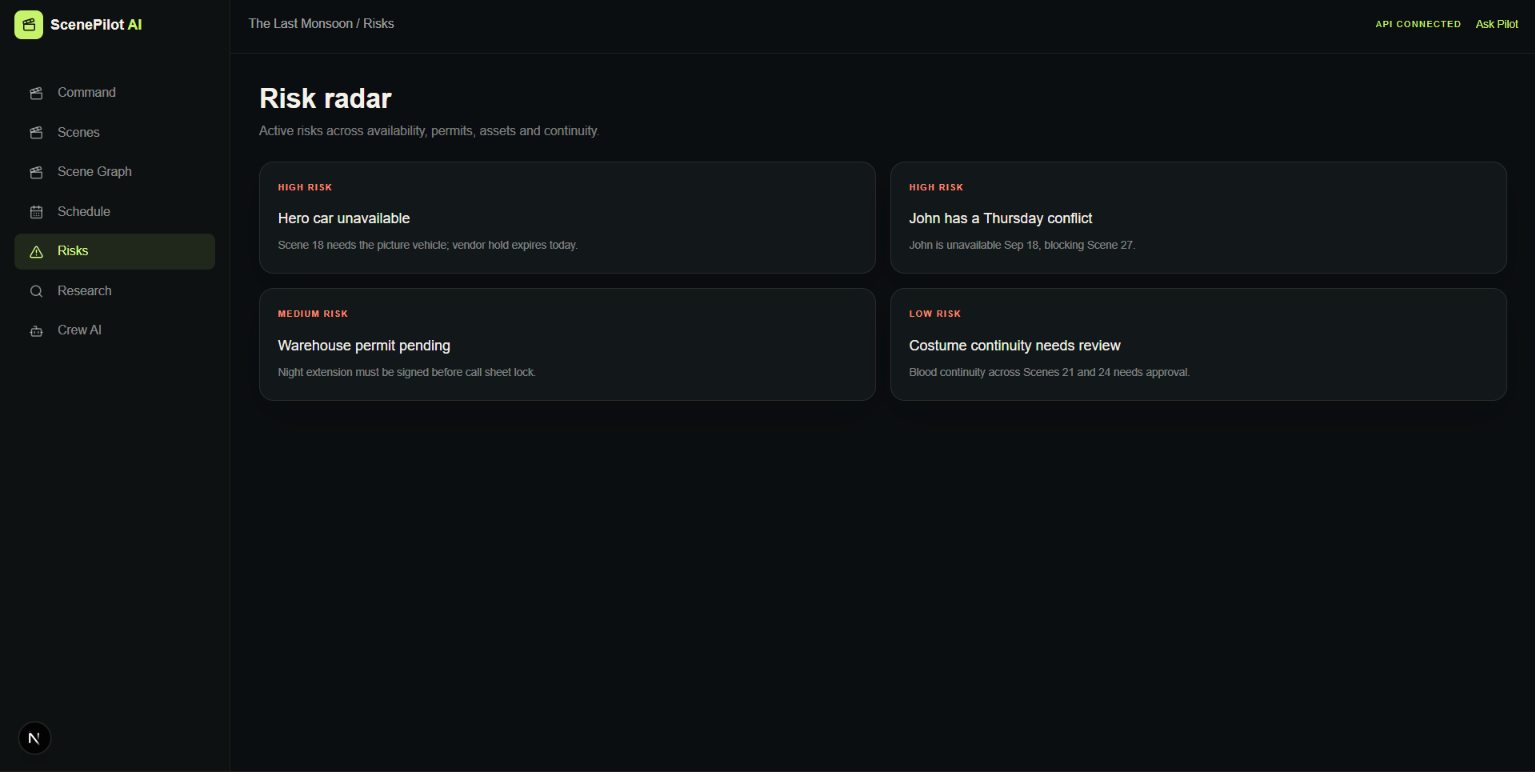
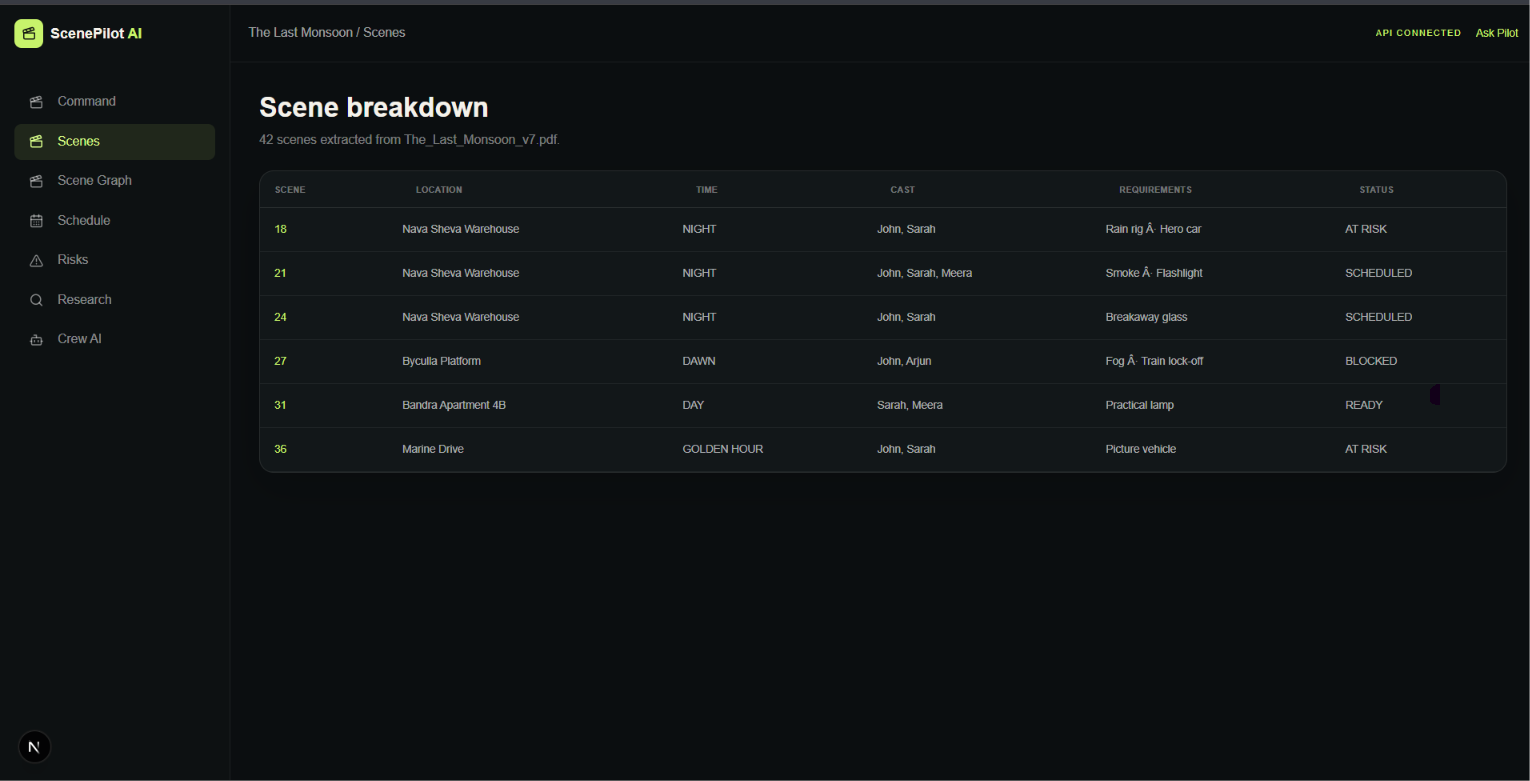
A producer uploads a screenplay, and ScenePilot analyzes it to identify:
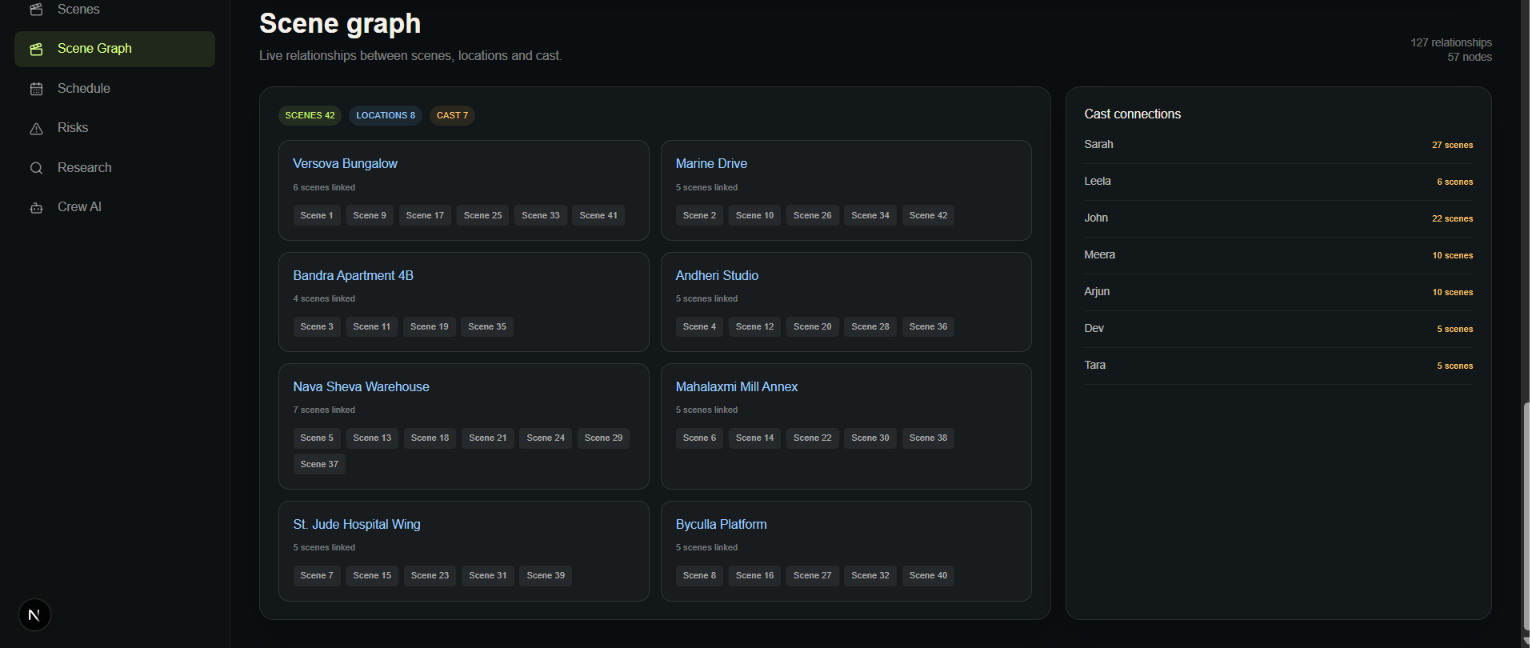
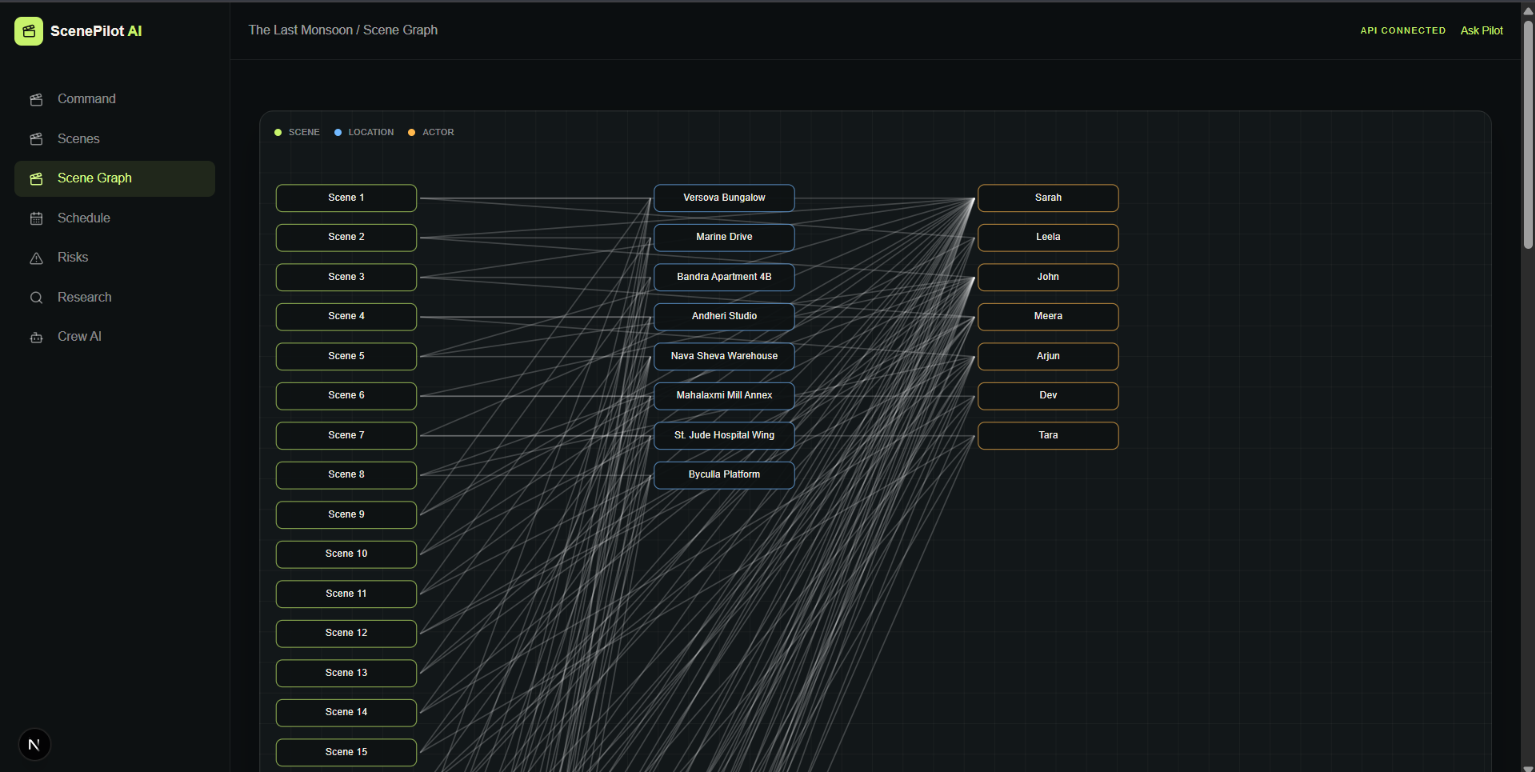
Scenes and locations Actors required for each scene Day/night requirements Props and equipment Vehicles Special production requirements Scene dependencies
The system then combines this information with real-world constraints such as actor availability, location availability, shooting dates, and production rules to generate an optimized schedule.
The most important feature is dynamic replanning.
For example, if a producer says:
“The warehouse is unavailable tomorrow.”
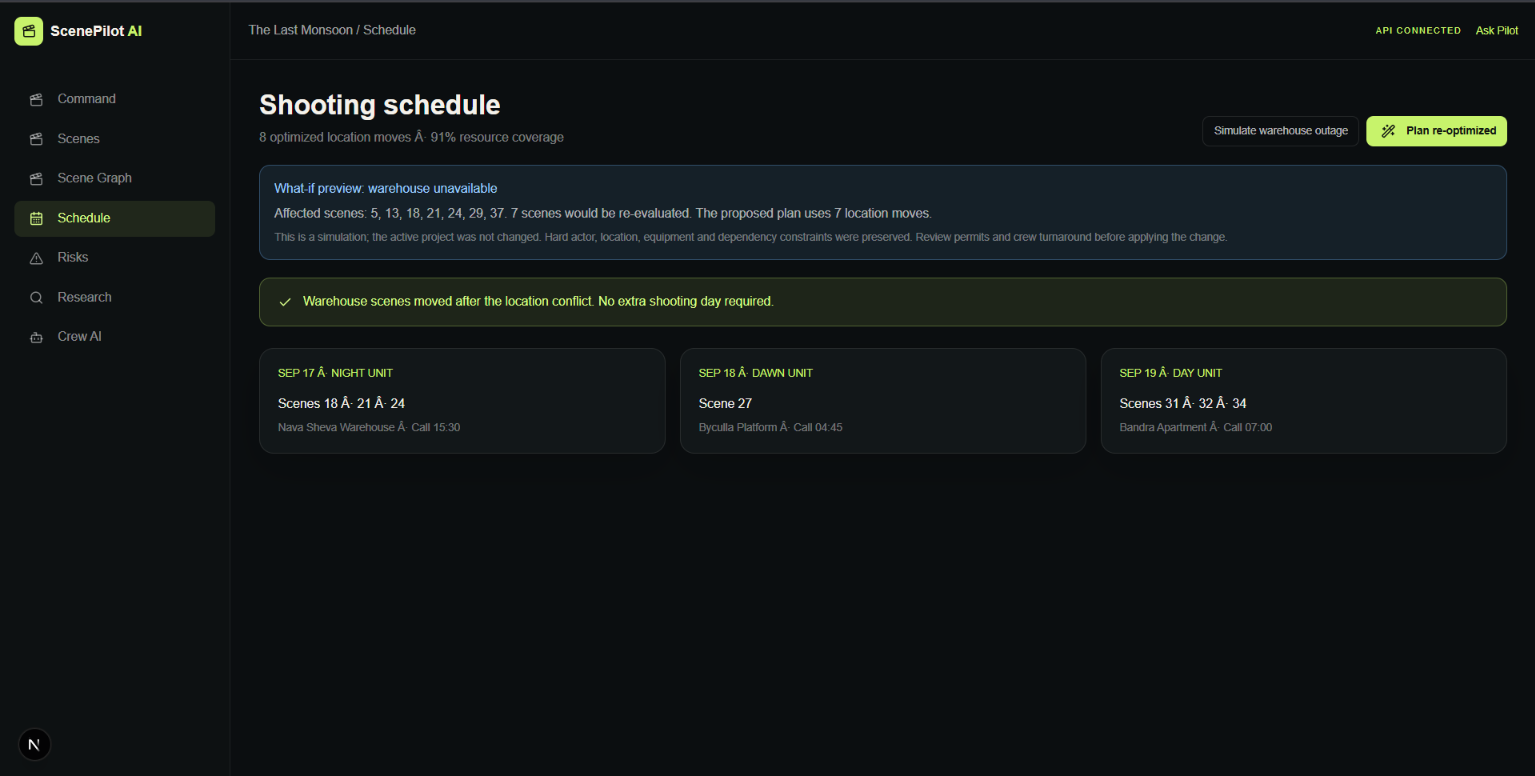
ScenePilot identifies the affected scenes, checks the dependencies, finds possible alternatives, and creates a new schedule.
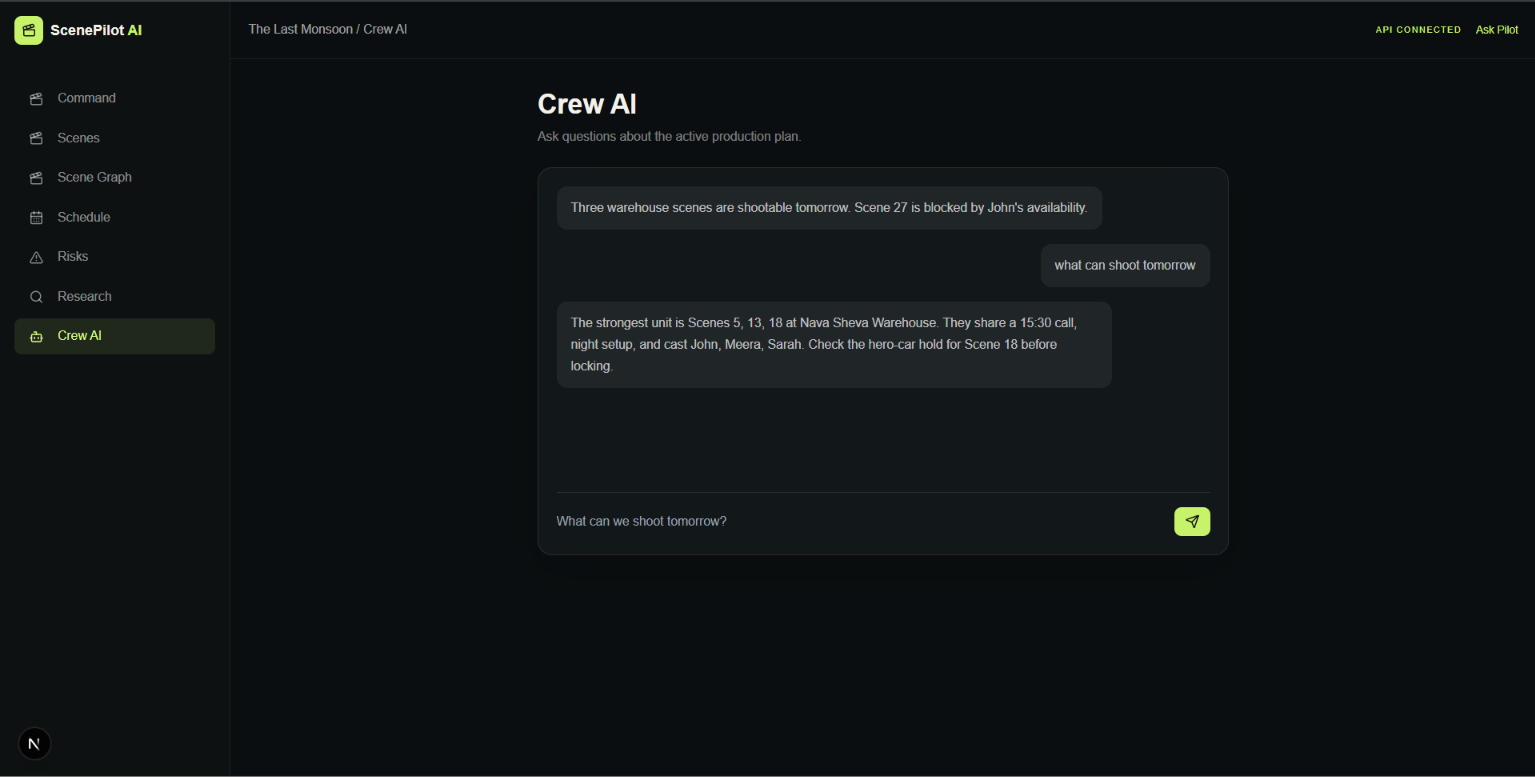
It also includes a crew assistant that can answer questions like:
“What can we shoot tomorrow?”
“Which scenes need Rahul?”
“Which scenes are blocked?”
“Why was Scene 24 scheduled on Friday?”
So ScenePilot isn't just generating a schedule—it helps the production team understand, plan, and adapt.
How we built it
We built ScenePilot as a combination of AI agents and traditional software logic.
Gemini handles screenplay understanding, production reasoning, and explanations. It converts unstructured screenplay content into structured scene information that the rest of the system can use.
We built a Python-based constraint and planning engine for the parts that need to be accurate, such as checking actor availability, location conflicts, production dates, and other scheduling constraints.
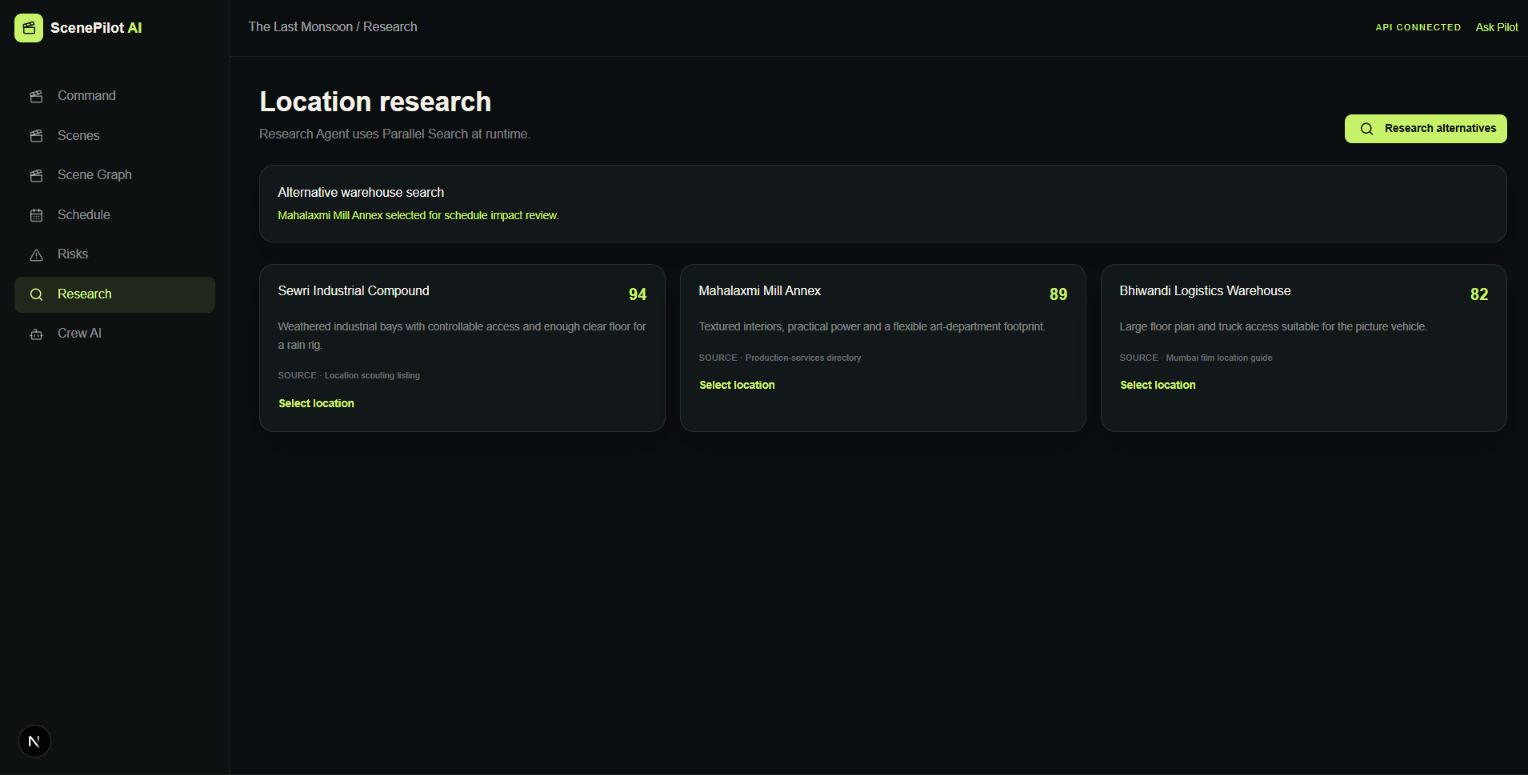
We also integrated the Parallel Search API for real-world research. This allows ScenePilot to search for things such as alternative filming locations or other resources when a production requirement changes.
The backend uses FastAPI and Firestore, while the frontend is built with Next.js and React as a production command center.
Our overall workflow is:
Screenplay → AI Scene Breakdown → Constraint Engine → Shooting Schedule → Risk Detection → Research → Replanning
Challenges we ran into
One of our biggest challenges was extracting reliable information from a screenplay. Important production details aren't always written in a structured format, so getting the AI to consistently identify actors, locations, props, timing, and special requirements required careful prompting and validation.
Scheduling was another major challenge. A scene can depend on multiple actors, a specific location, equipment, and a particular time of day. Changing just one constraint can affect several other scenes.
We also had to decide where AI should and shouldn't be used. We learned that letting an LLM handle every decision isn't always the best approach. We use Gemini for understanding and reasoning, while deterministic Python logic handles exact constraints and validation.
Finally, making replanning actually useful was challenging. We didn't want ScenePilot to simply say “Schedule conflict detected.” We wanted it to explain the impact and help the producer decide what to do next.
Accomplishments that we're proud of
We're proud that we were able to turn a complex real-world production problem into a working AI workflow.
Some of the features we're most proud of are:
🎬 Automatic screenplay breakdown 🧠 AI-powered production reasoning 📅 Constraint-aware shooting schedule generation ⚠️ Automatic risk and conflict detection 🔄 Dynamic what-if replanning 🔎 Real-time external research using Parallel Search 💬 Project-aware AI crew assistant 📊 A centralized production dashboard
Most importantly, we built the project around a realistic production workflow rather than just creating another chatbot.
What we learned
Our biggest lesson was that good AI products aren't necessarily about using AI for everything.
Gemini is extremely useful for understanding unstructured information and reasoning about production decisions. But when it comes to exact constraints—such as whether an actor is available on a particular date—we need deterministic logic.
We also learned that adaptability is just as important as the initial plan. In a real production, the first schedule will rarely remain unchanged. Building a system that can understand changes and intelligently replan made the project much more interesting.
Most of all, we learned how different technologies can work together to solve a problem that would be difficult for any single tool to handle alone.
What's next for ScenePilot AI
We see ScenePilot AI as the beginning of a larger production management platform.
In the future, we want to add:
Automatic call-sheet generation Budget and cost optimization Weather-aware scheduling Crew and equipment coordination Transportation and travel planning Permit and compliance tracking Production timeline forecasting More advanced risk prediction Integrations with professional film-production tools
Our long-term goal is to make ScenePilot an AI co-pilot for the entire production lifecycle.
Instead of simply asking AI to create content, we want to use AI to help make the production behind that content smarter, faster, and more adaptable.


Log in or sign up for Devpost to join the conversation.