-
-
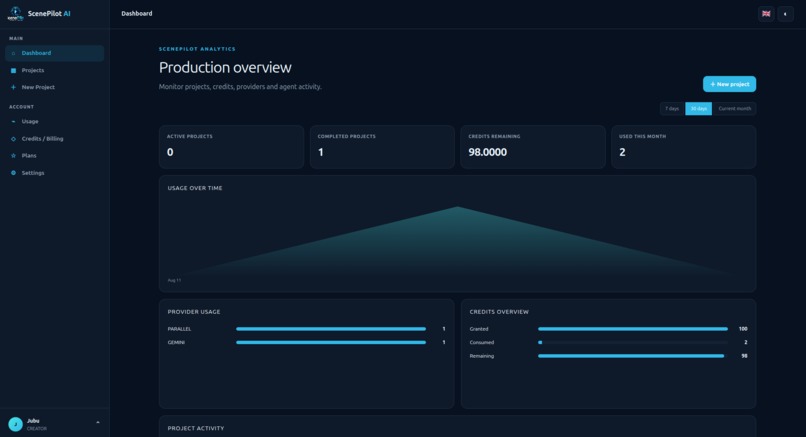
ScenePilot AI — Production Overview
-
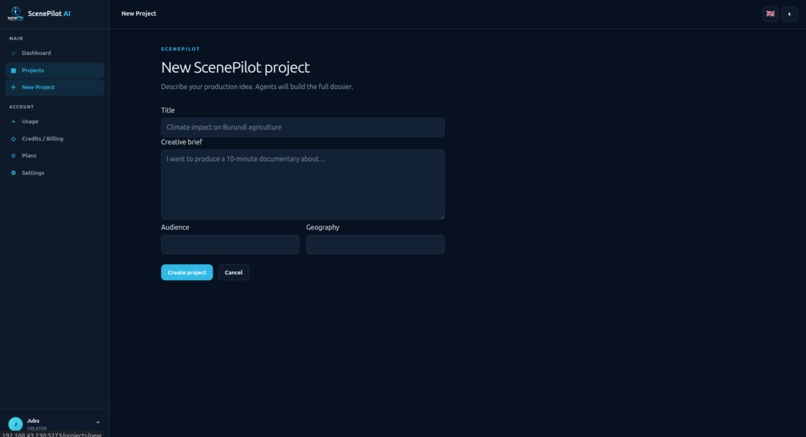
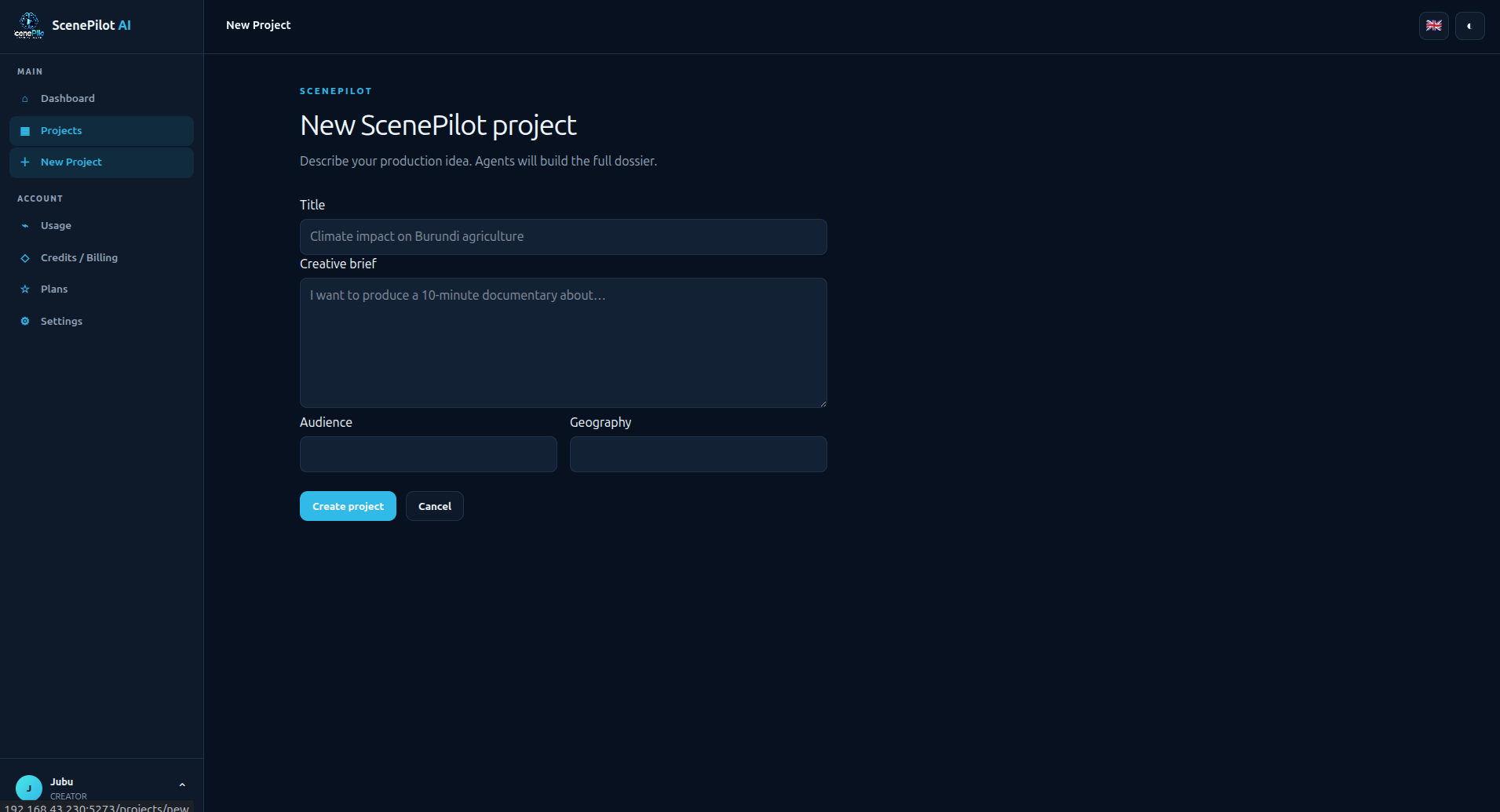
Create a Production
-
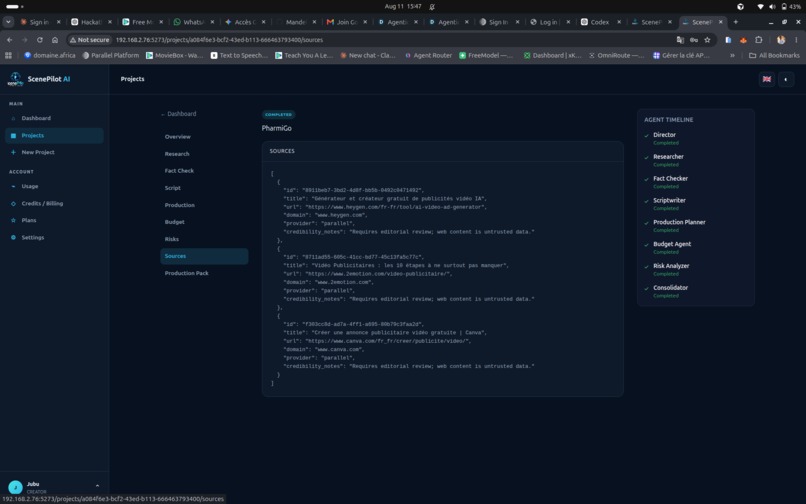
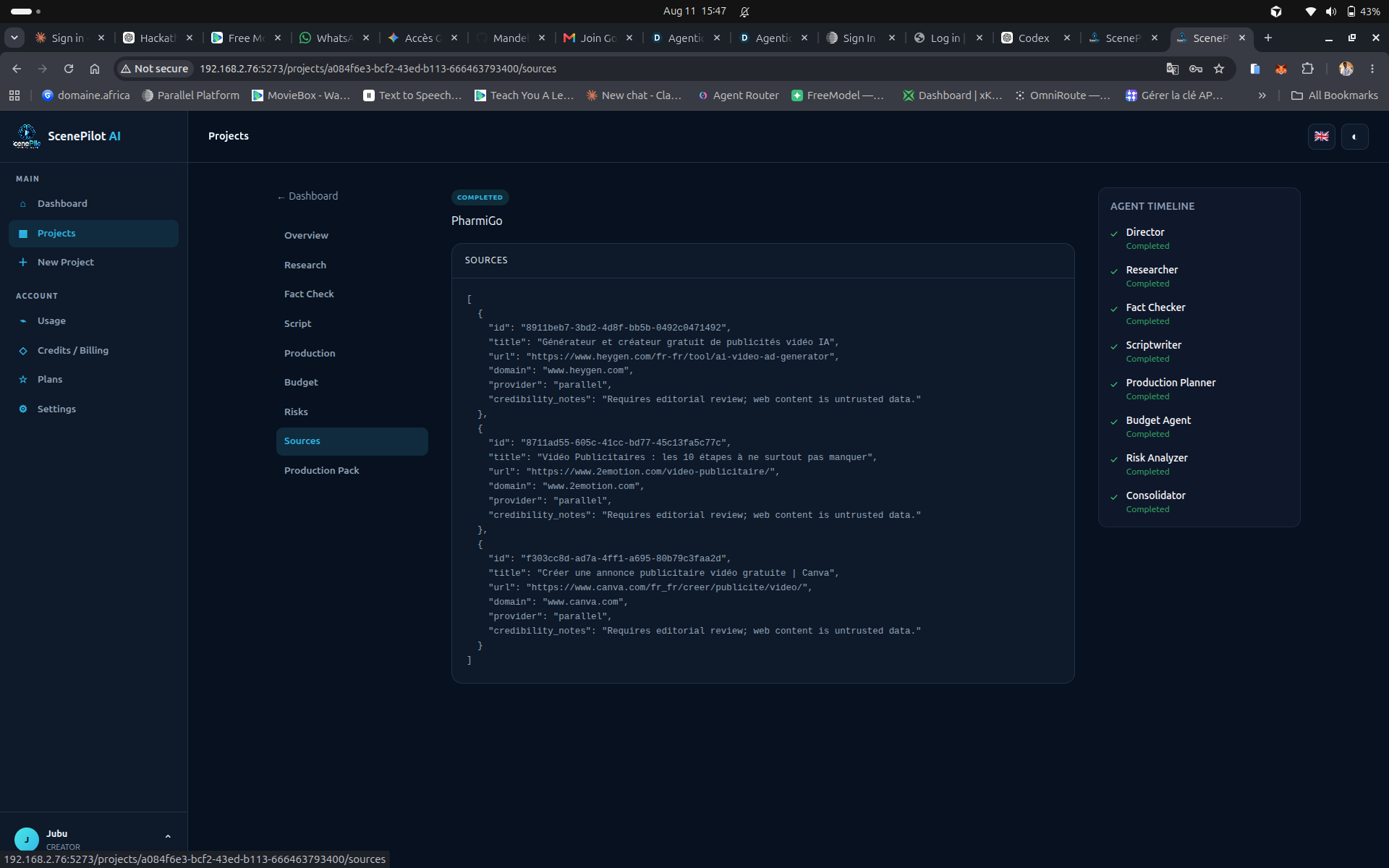
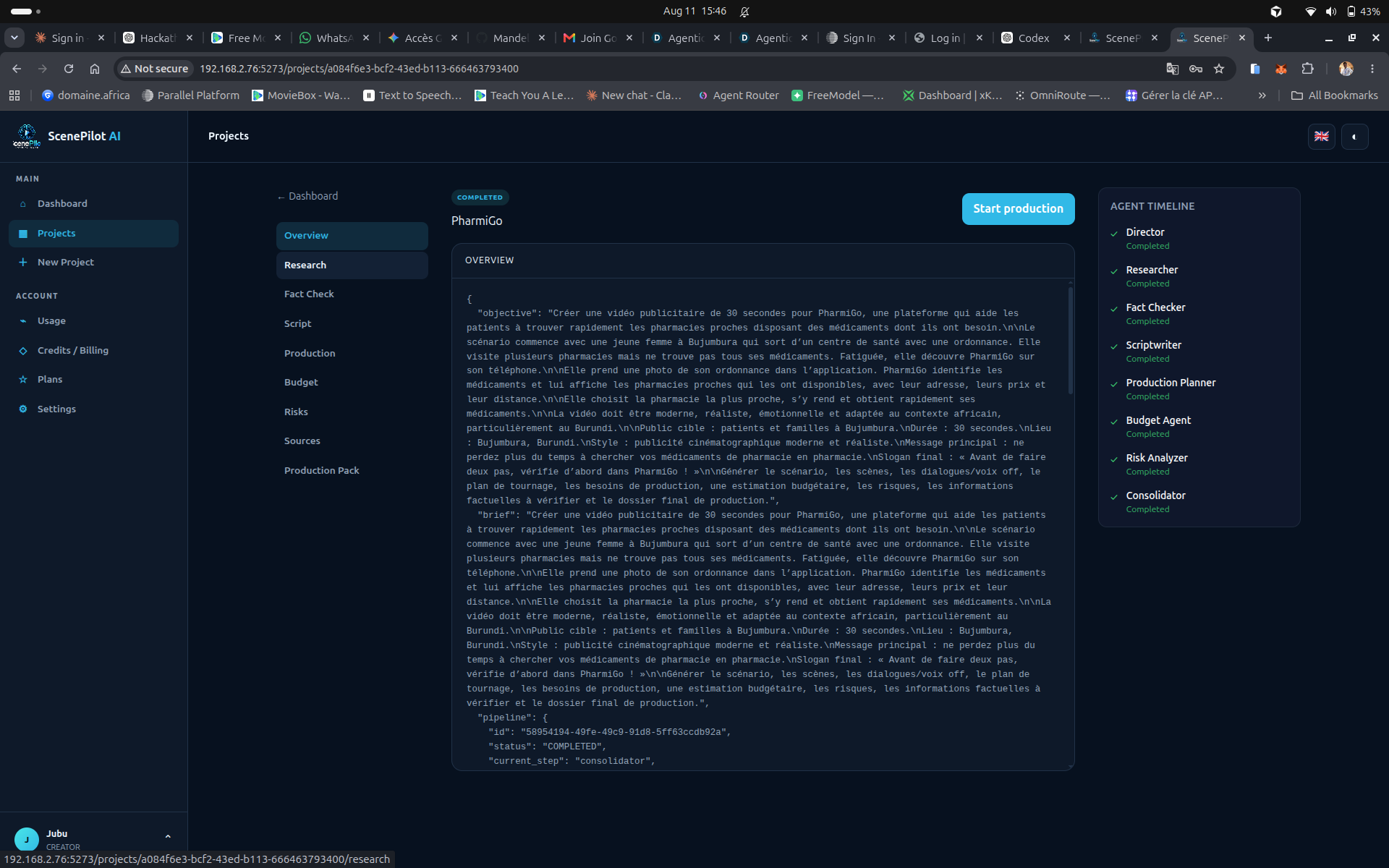
Research & Sources
-
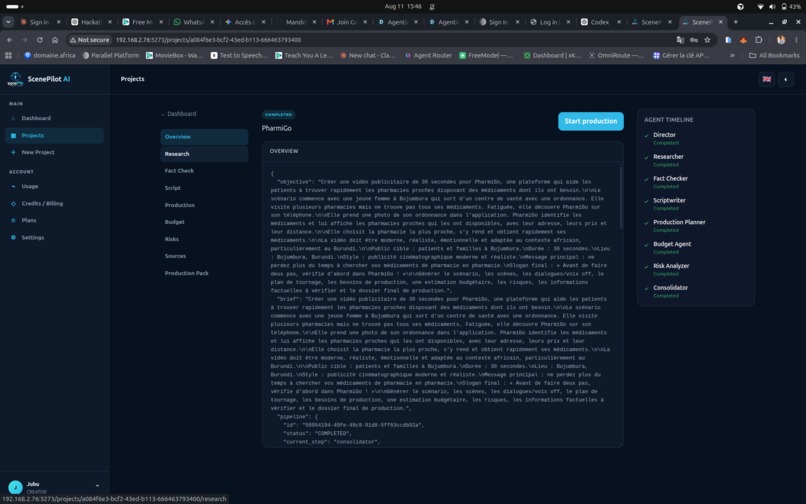
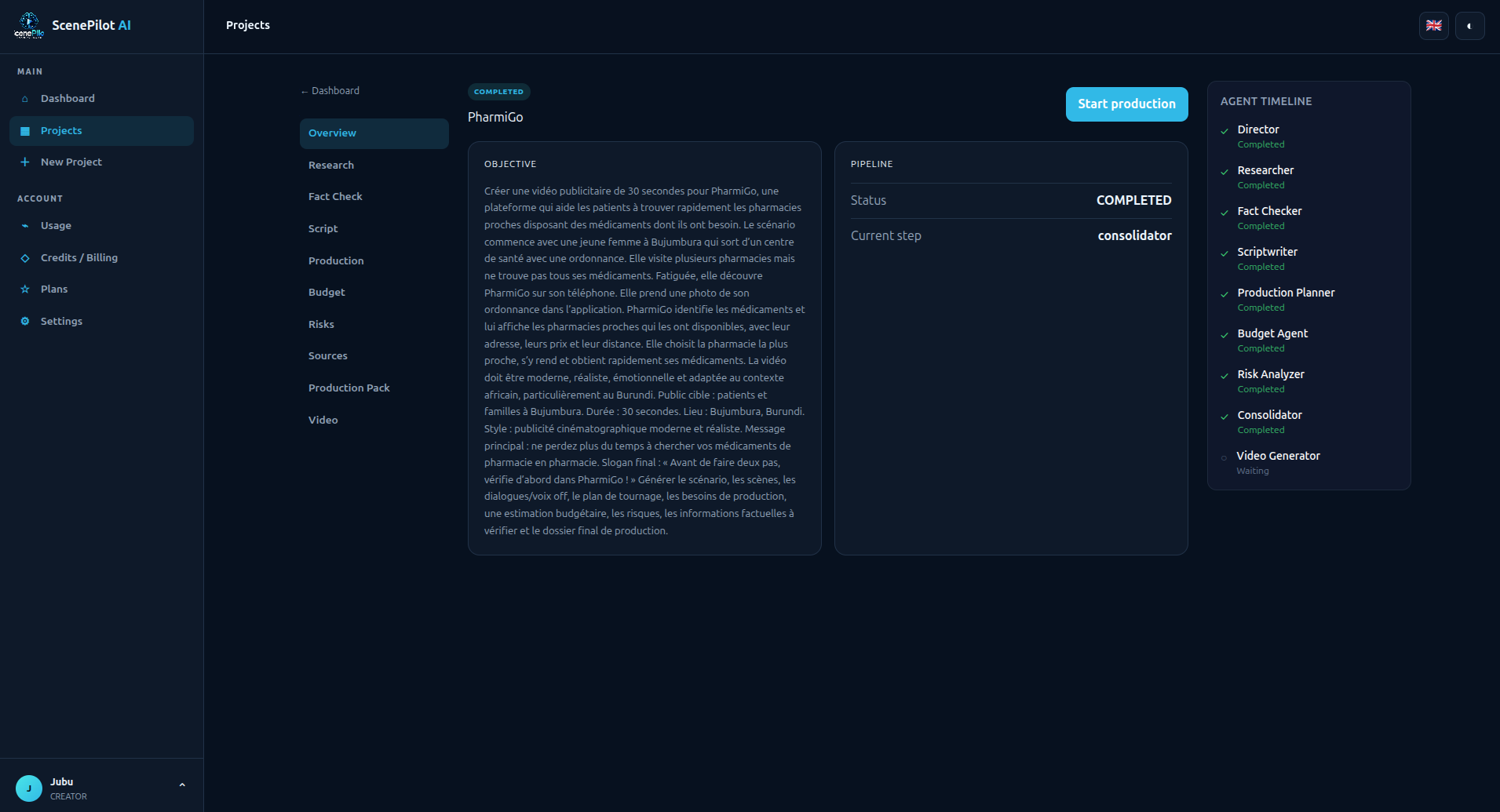
Agentic Production Pipeline
-
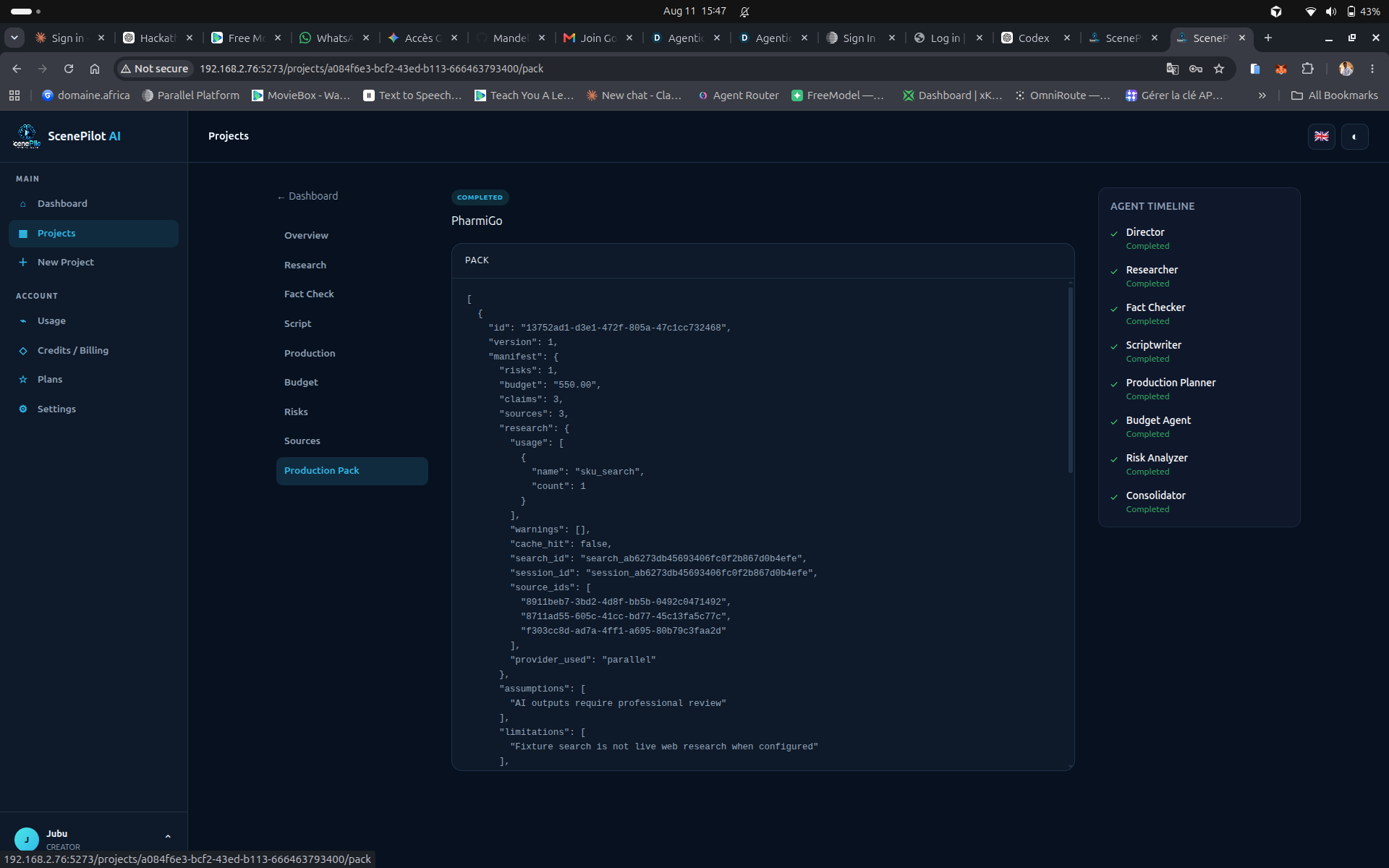
Production Pack
-
Script / Production Planning
-
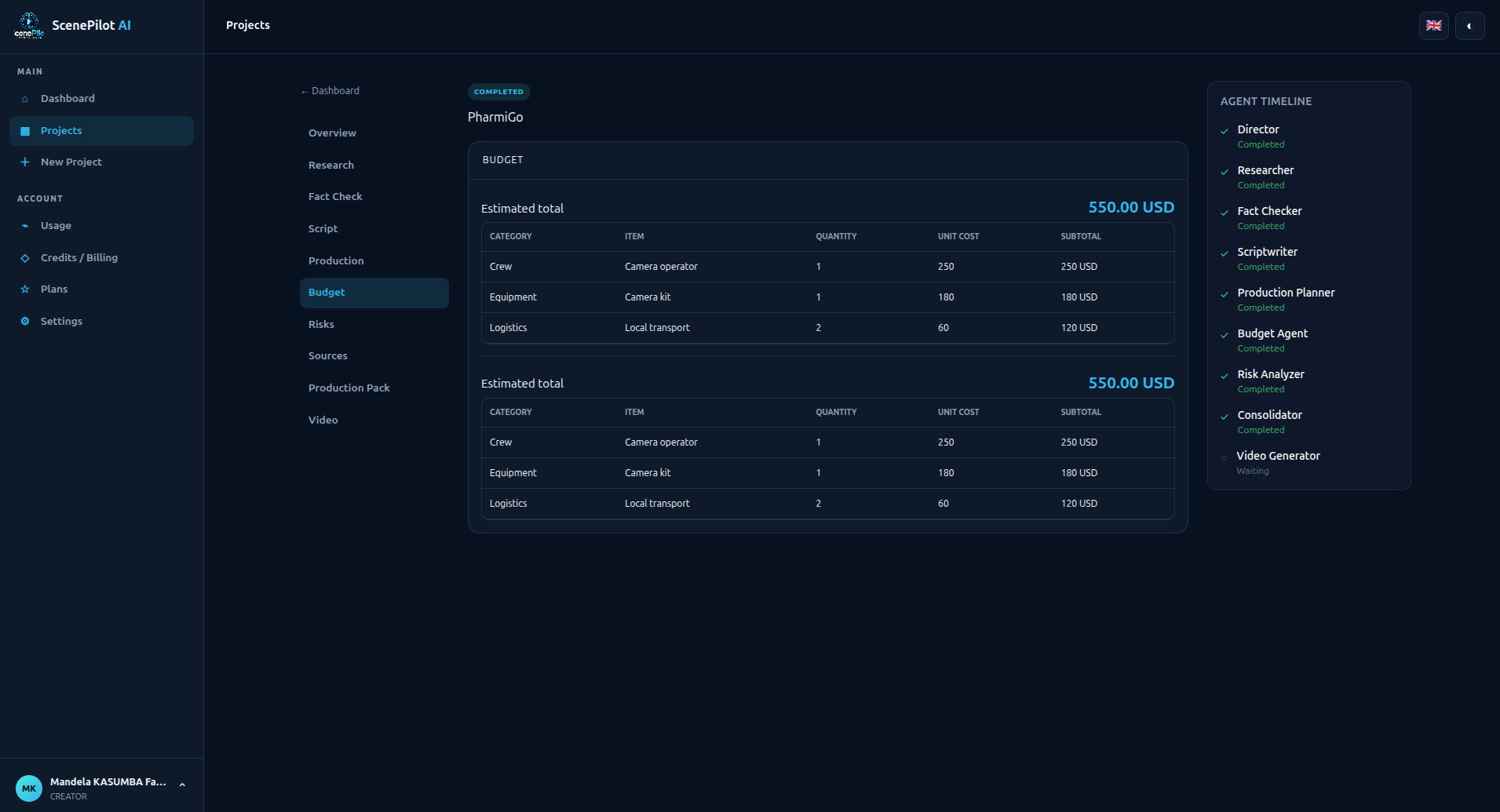
Budget & Risk Analysis
-
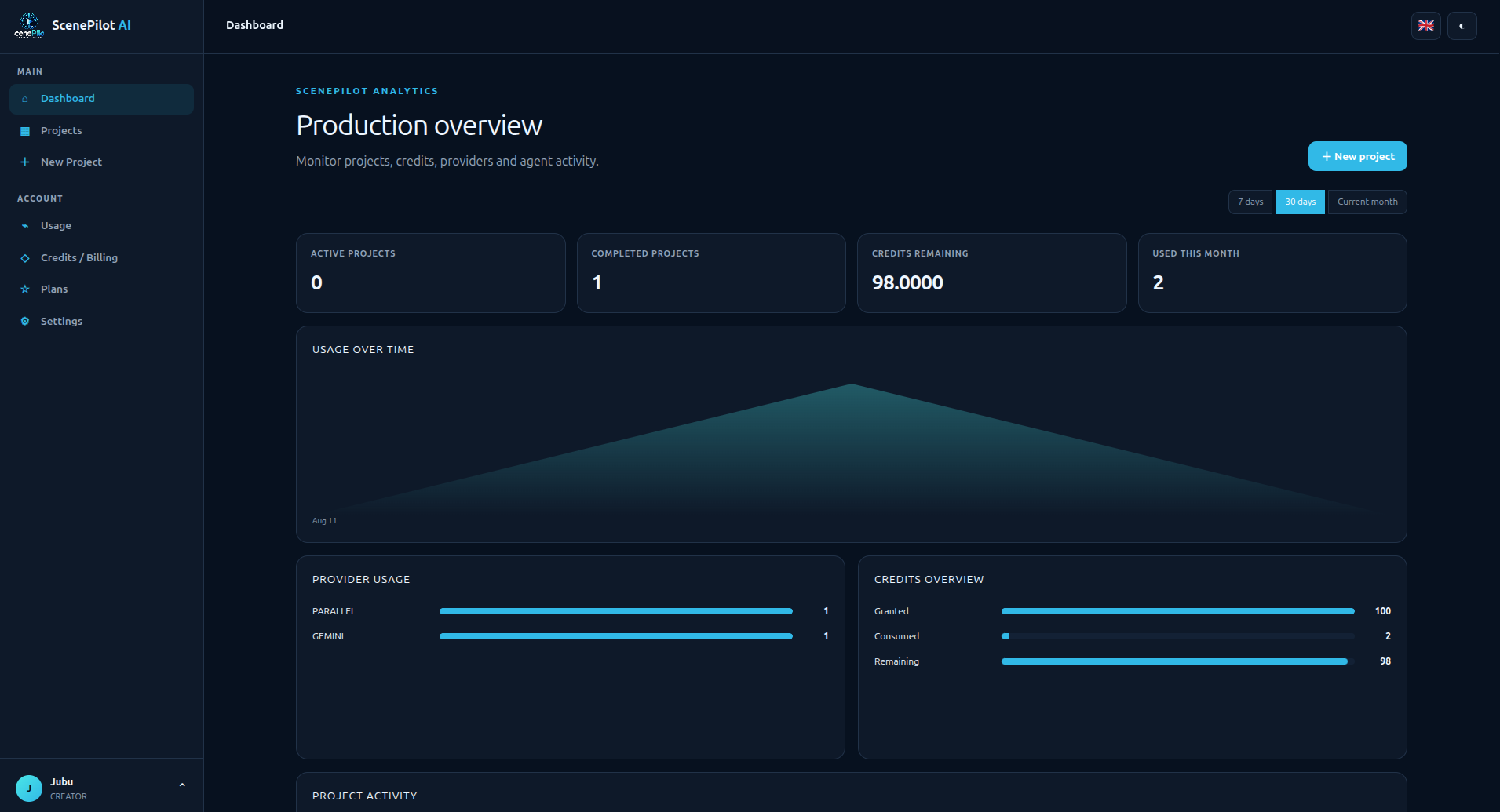
Usage & Credits
-
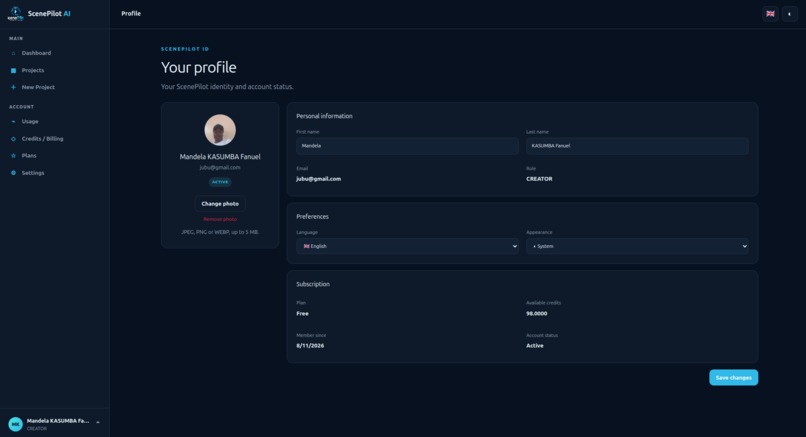
Profile / Creator Workspace
ScenePilot AI
Inspiration
A creator can finish a great idea in minutes, write a song in days, or prepare a campaign in a week — and then spend weeks or even months trying to turn that idea into a professional video.
The difficult part is often not creativity itself.
It is everything that comes after the idea.
A real audiovisual production may require research, fact verification, scriptwriting, story development, locations, actors, equipment, shot planning, budgeting, risk management, filming, reshooting, editing, sound, visual effects, review, and distribution.
For independent creators, musicians, small studios, businesses, educators, NGOs, and creative teams, these responsibilities are fragmented across different people and tools. And when production resources are expensive or difficult to access, a single professional video can become financially or operationally out of reach.
This problem is especially visible in emerging creative markets, including many African countries, where enormous creative talent exists but access to production infrastructure, specialized crews, equipment, post-production resources, and advanced creative technology can remain limited or expensive.
ScenePilot AI started with a simple question:
What if one creator could have an entire AI production team?
Not another chatbot. Not another isolated text-to-video prompt box. But an intelligent production system capable of understanding an idea, researching it, verifying information, writing the story, planning the production, estimating its cost, identifying risks, organizing the required resources, and progressively helping transform that plan into the final screen.
That is the idea behind ScenePilot AI — an agentic production studio for audiovisual creation.
What it does today
ScenePilot AI currently transforms a creative brief into a structured, traceable, production-ready audiovisual project.
A creator starts with something simple:
"an idea."
It can be a music video, advertisement, campaign, educational video, documentary, promotional film, short film, or another audiovisual production. Instead of asking one AI model to generate one enormous response, ScenePilot coordinates a team of specialized AI agents. Each agent has a specific production responsibility.
Director Agent
The Director interprets the creative brief, understands the objective, audience and context, and establishes the direction of the production. It coordinates the overall workflow and provides downstream agents with a structured understanding of what needs to be created.
Research Agent
The Research Agent investigates information relevant to the project.
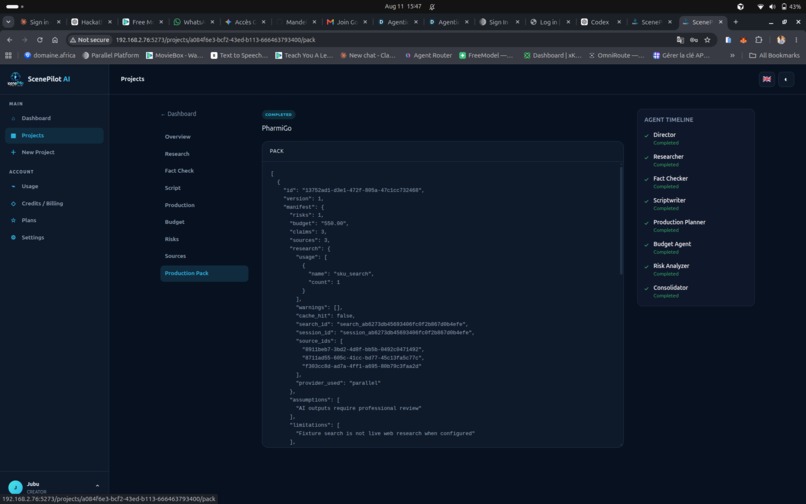
ScenePilot currently integrates external research capabilities through Parallel and preserves discovered sources and research evidence. This allows production decisions to be informed by external information instead of relying exclusively on generated knowledge.
Fact Checker
Research alone is not enough.
The Fact Checker evaluates important factual claims and evidence before those claims become part of the downstream creative workflow. This is especially important for advertisements, educational content, documentaries, institutional communication, public campaigns and other productions where inaccurate information can have real consequences.
Scriptwriter
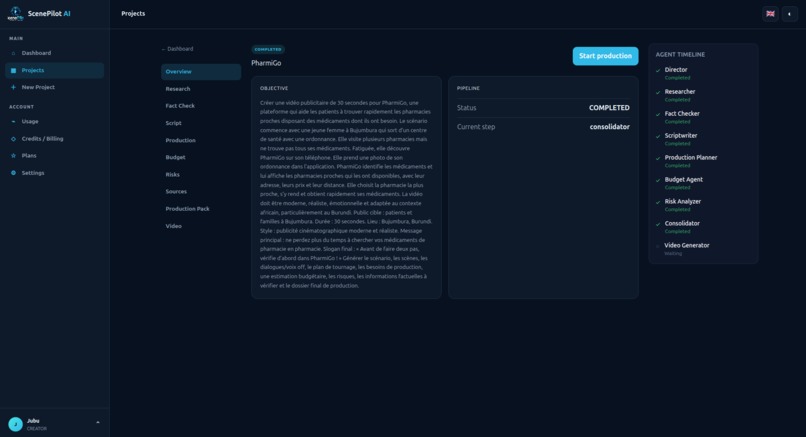
The Scriptwriter transforms the validated creative direction and research into a structured audiovisual script. Instead of producing disconnected creative suggestions, it prepares material that can be consumed by subsequent production stages.
Production Planner
The Production Planner converts the script into actionable production information. It determines how the story can move from text toward actual production by organizing scenes, shots and production requirements.
Budget Agent
Creative ideas have financial consequences.
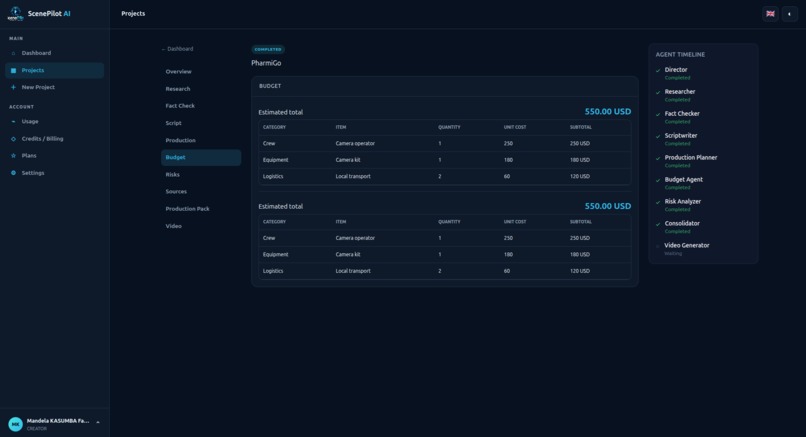
The Budget Agent evaluates production requirements and estimates the resources and expected costs associated with the project. This establishes the foundation for one of our larger goals: making ScenePilot capable of adapting creative ambition to the resources actually available to a creator.
Risk Analyzer
Productions can fail for reasons that have nothing to do with creativity. The Risk Analyzer identifies potential production risks and proposes mitigation strategies before production begins.
Consolidator
The Consolidator brings the work of the specialized agents together into a unified Production Pack.
The result is not simply another AI response. It is a structured production dossier built from the work of multiple specialized stages.
ScenePilot therefore creates a traceable workflow:
Idea → Direction → Research → Verification → Script → Production Planning → Budget → Risk Analysis → Production Pack.
Why agentic AI?
ScenePilot AI is intentionally not designed as a single chatbot producing one large answer.
Real audiovisual production involves different responsibilities. A researcher should not behave exactly like a scriptwriter. A scriptwriter should not make financial decisions in the same way as a budget specialist. A production planner has different responsibilities from a fact checker. ScenePilot therefore uses specialized agents whose outputs can be persisted and consumed by subsequent stages.
The application exposes this process through an Agent Timeline, allowing creators to see which agents have completed their work, what stage the production has reached, and what remains to be done.
This gives the creator something extremely important:
"visibility into how the production was built."
Instead of hiding the entire process behind a single prompt-response interaction, ScenePilot creates an inspectable production workflow.
Real AI and research integration
ScenePilot AI currently integrates real external AI and research infrastructure. "Gemini" participates in the AI reasoning workflow. "Parallel" provides external research capabilities. Research results, sources, evidence, provider usage and production artifacts are persisted by the application instead of disappearing at the end of an AI conversation.
ScenePilot also introduces fact verification between research and downstream production stages. This allows the system to preserve the reasoning context behind important production decisions.
From Production Pack to Final Production
Our current working system focuses heavily on one of the most important but frequently underestimated parts of audiovisual creation:
"pre-production intelligence."
ScenePilot can already transform an initial brief into research, verified claims, scripts, production plans, budget information, risks, sources and a consolidated Production Pack. But this is only the first major layer of the system we are building.
Our larger vision is:
"Idea → Research → Script → Storyboard → Cast → Locations → Shots → Budget → Production → Generation → Editing → Audio → Review → Export → Distribution"
We want ScenePilot to eventually help manage the entire journey from the first creative thought to the final screen. And we believe that journey should support three different production models:
AI Production
Scenes and audiovisual assets can be generated using compatible AI generation providers.
Physical Production
ScenePilot can help humans organize and execute real-world filming with cameras, actors, locations, equipment and production crews.
Hybrid Production
Real footage and AI-generated assets can work together.
A creator could film a performer locally while ScenePilot helps generate environments, additional shots, visual effects or other production elements that would otherwise require significantly larger budgets.
This hybrid approach is particularly important to our vision.
"Our objective is not simply to replace cameras or human creators. It is to give creators access to production capabilities that may otherwise be too expensive, too slow, or inaccessible."
Video generation architecture
ScenePilot already contains a provider-oriented architecture for the future production layer.
The architecture supports concepts such as:
- asynchronous generation jobs;
- video assets;
- clips;
- generation status tracking;
- credit reservation;
- failure handling;
- cancellation;
- and provider abstraction.
The current implementation contains a Veo-oriented video provider architecture. However, the availability of a production-authorized video generation provider is separate from the working agentic pre-production pipeline. We deliberately chose not to simulate successful video generation when a real provider is unavailable.
If the required credentials or authorized generation model are not configured, ScenePilot explicitly reports that the video provider is unavailable. It does not silently replace the missing provider with a fake generated video.
For us, this is an important engineering principle:
"an intelligent production system should know the difference between work that has actually been completed and a capability that is not currently available."
The bigger vision
ScenePilot is not intended to become only a better AI video generator. Our goal is considerably larger.
We want ScenePilot to become an "AI-native audiovisual production operating system". Imagine a musician who has completed a song. Instead of spending weeks coordinating the entire video production manually, the creator uploads the song and explains the vision.
ScenePilot could eventually analyze the music, understand its structure and emotional progression, design a visual concept, create the screenplay, generate storyboards, organize shots, estimate a realistic budget, determine what should be filmed physically and what could be generated, help coordinate the production, analyze recorded footage, assist with editing, synchronize cuts to the music, prepare audio and visual versions, and export content for different distribution channels.
Or imagine a creator with only:
- a smartphone;
- two actors;
- one accessible location;
- and a limited production budget. Instead of proposing an unrealistic production, ScenePilot could design a production strategy around those constraints.
The question would no longer be:
"How much money do I need to execute this idea?"
It could increasingly become:
"What is the best production we can create with what I already have?"
That is a major part of our long-term vision.
Built for creative accessibility
Professional audiovisual creation should not belong only to creators with access to expensive studios, large production crews or advanced post-production infrastructure.
A talented creator in Bujumbura, Nairobi, Lagos, Kigali, Kinshasa, Accra, Johannesburg — or anywhere else — should be able to transform an idea into professional production without being blocked simply because advanced production infrastructure is difficult to access. Africa is not the limit of ScenePilot's ambition.
But it represents an important example of why we believe this technology matters. There is enormous creative talent across the continent. The opportunity is to make sophisticated production capabilities dramatically more accessible.
ScenePilot therefore aims not simply to automate creative work, but to "expand who can produce at a professional level."
How we built it
ScenePilot AI combines a modern creator workspace with asynchronous multi-agent orchestration.
The current platform includes:
- a web-based creator workspace;
- specialized autonomous production agents;
- Gemini integration;
- Parallel-powered external research;
- persistent research evidence and sources;
- fact verification;
- structured scripts;
- scenes and production planning;
- budget estimation;
- production risk analysis;
- consolidated Production Packs;
- asynchronous background processing;
- PostgreSQL persistence;
- Redis-backed infrastructure;
- Celery tasks;
- WebSocket events;
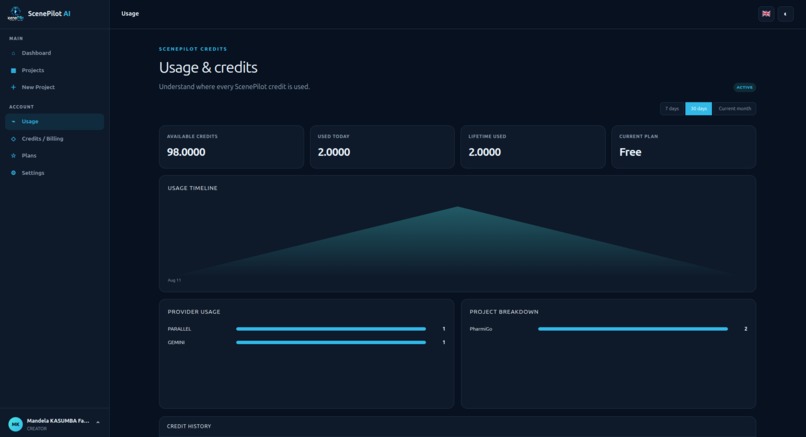
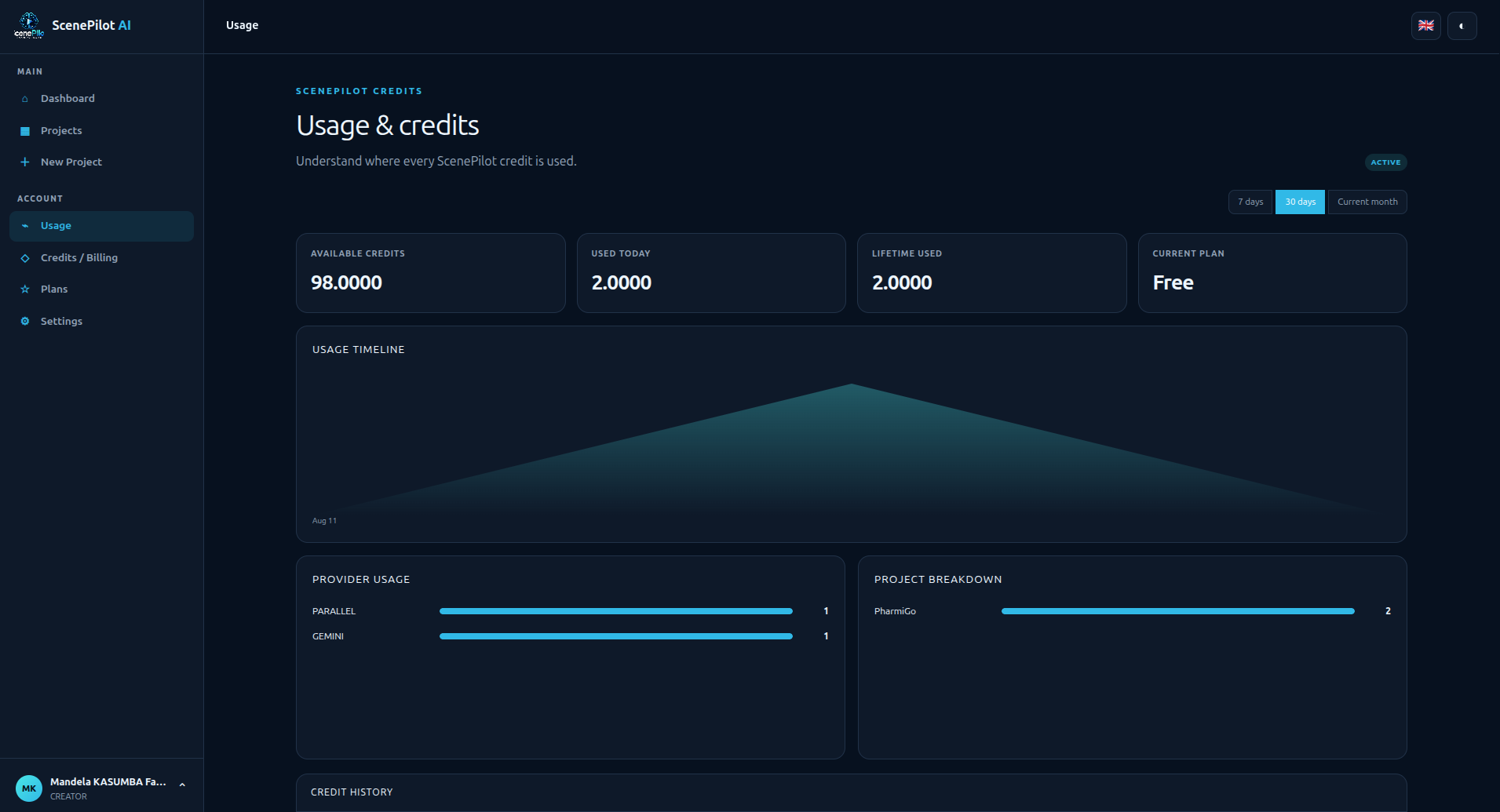
- usage and credit accounting;
- project-level authorization;
- and a provider-oriented video generation architecture.
Rather than storing only a final AI response, ScenePilot persists artifacts produced throughout the workflow. This creates an inspectable production history and provides the foundation for future agents to continue working from previous production decisions.
Current deployment status
ScenePilot AI's public frontend is currently deployed on Vercel, allowing judges and users to explore the current interface and product experience.
The backend and multi-agent orchestration infrastructure are implemented and have been tested in our development environment, but they are not yet hosted as a permanent production service due to current infrastructure and operational cost constraints.
As a result, some backend-dependent capabilities are not available through the public Vercel deployment. The accompanying demo video shows the current working implementation and the progress achieved with the agentic workflow.
This distinction is intentional: we want to be transparent about what is publicly deployed, what already works in our development environment, and what remains part of the next production milestone.
Challenges we ran into
One of our biggest engineering challenges was making multiple autonomous stages cooperate reliably. Connecting several prompts is relatively easy. Building agents whose outputs must be structured, persisted, validated and safely consumed by subsequent agents is considerably harder.
We also had to deal with the reality of external providers.
During development, for example, our Parallel research integration initially returned an HTTP 422 response because of an unsupported request payload.
Debugging the actual provider contract and correcting the request allowed the research workflow to execute using real search and session identifiers. Video generation introduced another important architectural challenge.
We needed the application to distinguish between:
- production planning being completed;
- video generation being requested;
- a provider being available;
- a generation job being processed;
- generation failing;
- and generation being unavailable.
We deliberately avoided pretending that an unavailable provider had produced a real asset. Security also required significant attention because ScenePilot handles authentication, external providers, uploaded assets, project information and credits.
The platform therefore includes authorization controls, project-scoped access, protected WebSocket connections, atomic credit operations, upload validation, provider URL validation and dependency auditing.
Accomplishments that we're proud of
We are proud that ScenePilot evolved beyond a prompt-to-text prototype. The current platform can execute a structured multi-agent production workflow and preserve the artifacts produced by its specialized stages.
The working pipeline can generate and persist:
- research;
- external sources;
- evidence;
- factual claims;
- scripts;
- scenes and production plans;
- budget information;
- production risks;
- and a consolidated Production Pack.
We also implemented provider usage and credit tracking so external AI activity can be associated with the platform's accounting model. Most importantly, ScenePilot is designed to remain transparent about the state of its operations.
Completed work is marked as completed. Failures remain visible as failures. Unavailable capabilities remain unavailable. The system does not need to pretend that every part of our larger vision is already finished. We would rather demonstrate a real foundation for a much larger production system than disguise missing infrastructure behind simulated results.
What we learned
Building ScenePilot AI taught us that agentic applications require much more than connecting multiple AI prompts.
Reliable autonomous workflows need:
- clearly separated responsibilities;
- persistent state;
- structured outputs;
- communication between stages;
- failure recovery;
- provider observability;
- authorization;
- usage accounting;
- asynchronous execution;
- and transparent status reporting.
We also learned something equally important about creative AI:
generation is only one part of production. Knowing what should be generated, why it should be generated, whether it is factually appropriate, whether it fits the available budget, how it connects to other scenes and how it becomes part of a complete production can be just as important as generating the asset itself. That insight fundamentally shaped ScenePilot.
What's next for ScenePilot AI
Our next milestone is connecting the existing production architecture to authorized video generation infrastructure and progressively extending ScenePilot beyond pre-production. The core agentic production workflow already exists; our next step is not to redesign the system, but to productionize its infrastructure, permanently deploy the backend, and connect the final generation layer as resources and authorized provider access become available.
Our roadmap includes:
- real video generation provider integration;
- multi-provider video routing;
- AI storyboard generation;
- audiovisual previsualization and animatics;
- music structure and beat analysis;
- music-video planning;
- budget-aware production optimization;
- character and visual consistency;
- location intelligence;
- hybrid real-footage + AI production;
- multi-clip generation and assembly;
- automated narration;
- audio workflows;
- scene-level regeneration;
- intelligent footage analysis;
- AI-assisted rough cuts;
- natural-language video editing;
- continuity analysis;
- human review and approval;
- collaborative production workspaces;
- production-day assistance;
- multilingual localization;
- multi-format exports;
- and distribution-ready versions for platforms such as YouTube, TikTok and Instagram.
In the longer term, ScenePilot could also connect creators with the human resources that AI should not replace:
camera operators, actors, editors, sound engineers, studios, equipment owners and other production professionals.
The Production Pack could therefore become not only a document describing what must be produced, but an actionable bridge between AI planning, AI generation and real creative economies.
Our vision
Our vision is simple to express, even if it is ambitious to build:
One idea should be enough to start a production.
From that idea, ScenePilot should progressively be able to understand, research, verify, write, visualize, budget, organize, generate, assist filming, edit, review and prepare the final audiovisual production.
A video generation model can generate a clip.
ScenePilot's ambition is to understand what should be created, why it should be created, how it can realistically be produced, what should be filmed versus generated, how much it should cost, how all the pieces fit together, and how the result reaches the final screen.
That is the future we are building toward.
ScenePilot AI — from idea to screen.
Built With
- agentic-ai
- celery
- django
- drf
- gemini
- gemini-api
- generative-ai
- parallel
- postgresql
- python
- react
- redis
- rest-api
- typescript
- vite
- websockets

Log in or sign up for Devpost to join the conversation.