-
-
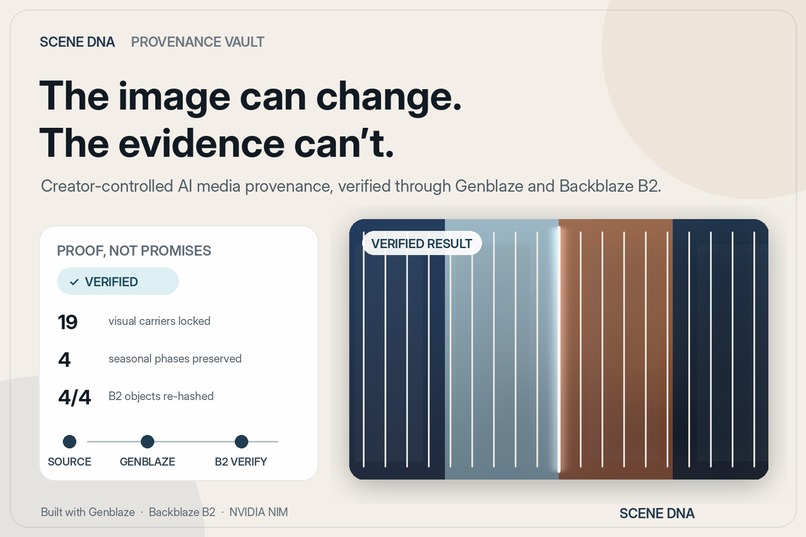
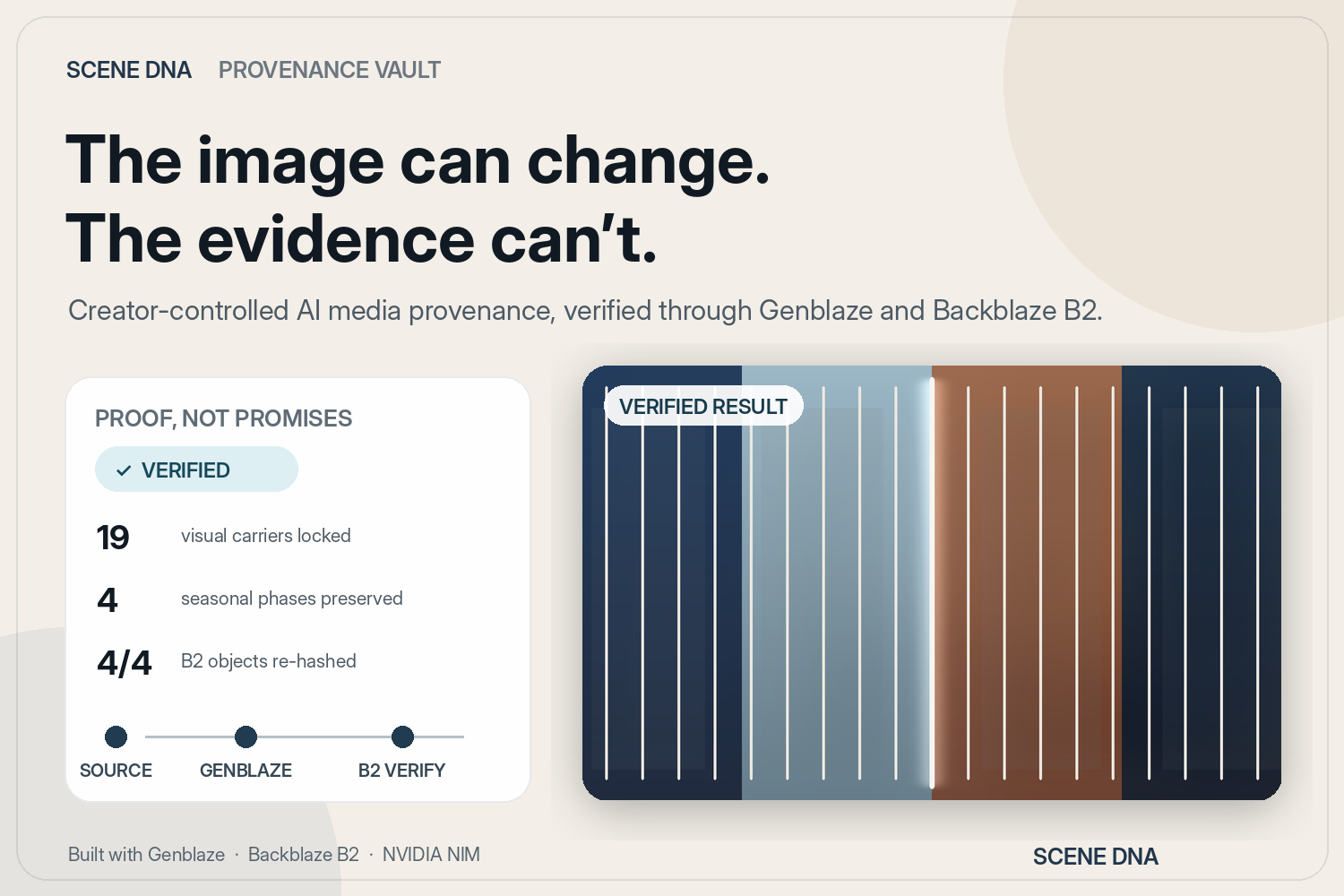
Creator-controlled AI media provenance: 19 visual carriers, four seasonal phases, and 4/4 verified B2 read-back hashes.
-
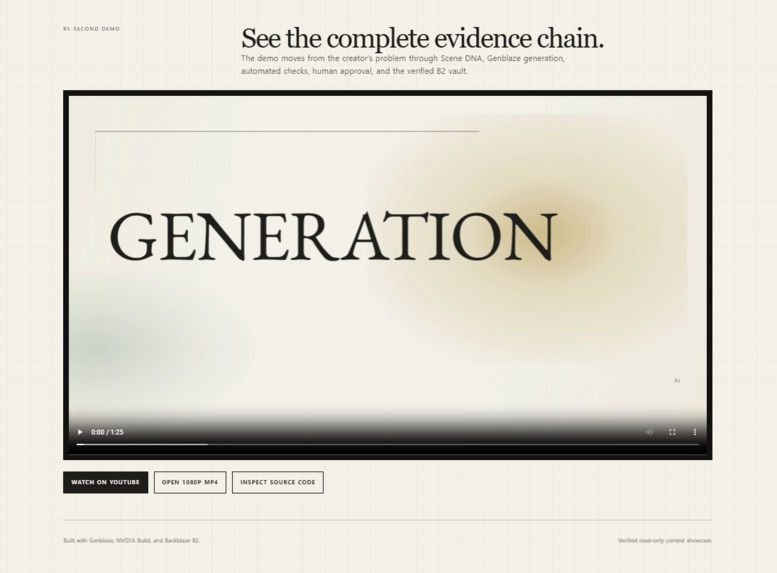
Public read-only judge experience with the complete 85-second demo, YouTube link, source code, and verified evidence.
-
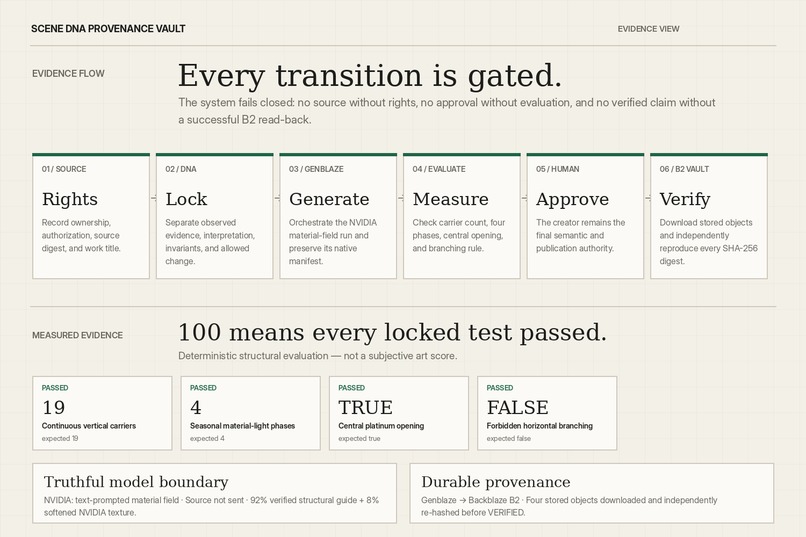
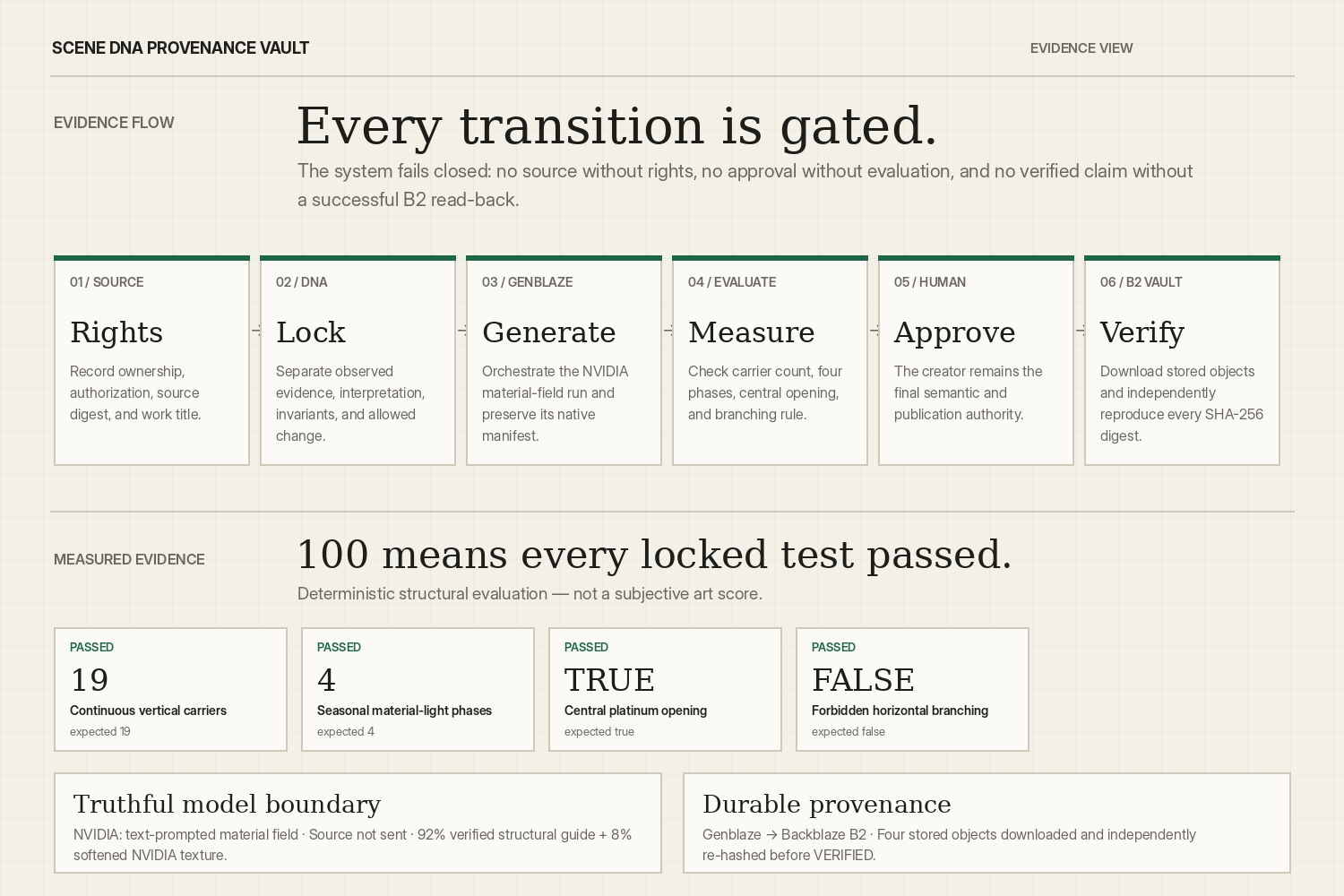
Evidence flow and truthful model boundary: Genblaze orchestration, 92% locked structure, 8% NVIDIA texture, and B2 verification.
Inspiration
Generative media tools make it easy to produce a final image, but the image alone cannot answer the questions that matter in a professional creative workflow:
- Who owned and authorized the source?
- Which creative decisions had to survive the transformation?
- What did the AI actually contribute?
- Who evaluated and approved the result?
- Can the stored media still be independently verified later?
SCENE DNA Provenance Vault was built to keep the creative result and the evidence behind it in one inspectable chain.
What it does
SCENE DNA Provenance Vault turns one creator-controlled generative transformation into a verifiable workflow.
The creator first records source ownership and AI-transformation authorization. Scene DNA then separates observed evidence, interpretation, locked visual invariants, and permitted change.
Genblaze orchestrates an NVIDIA NIM image-generation step. A deterministic local composition stage preserves the creator-defined structure, and an automated evaluator verifies the locked invariants before human approval is allowed.
The verified contest scenario, “Gangnam Eyes — One Gaze,” checks:
- exactly 19 continuous vertical carriers;
- four left-to-right seasonal material-light phases;
- a bright platinum central axis;
- collision-free convergence;
- no prohibited branching;
- creator semantic review and final approval.
Backblaze B2 stores the generated asset and provenance records. Every stored object is downloaded again and independently re-hashed before the result is marked verified.
The public judge experience is intentionally read-only. It exposes the verified workflow and evidence without exposing API credentials, private object paths, or paid generation endpoints.
How we built it
The application is built with Python and FastAPI, with a sanitized static judge experience deployed through GitHub Pages.
Genblaze connects the media-generation and storage stages. The generation provider is:
- Provider: NVIDIA NIM via NVIDIA Build
- Model:
black-forest-labs/flux_2-klein-4b
The NVIDIA route generated a text-prompted material field. It did not receive the creator-owned source bytes.
To preserve that boundary honestly, the final composition uses:
- 92% verified creator-controlled structural guide;
- 8% softly blurred NVIDIA-generated material texture;
- a reapplied carrier mask that prevents structural drift.
A separate SHA-256 composition manifest binds the source guide, raw NVIDIA asset, final composite, and Genblaze manifest.
Genblaze uses its S3-compatible storage backend to write generated media and provenance artifacts to Backblaze B2. Four stored objects were subsequently downloaded and independently re-hashed.
The release candidate also includes fail-closed validation across the public showcase, application, provenance records, manifest identifiers, creator approval, and B2 read-back evidence.
The original SCENE DNA concept existed before the hackathon as a creator-controlled visual-analysis workflow. During the hackathon, it was substantially extended with real Genblaze orchestration, NVIDIA generation, deterministic structural evaluation, SHA-256 manifests, Backblaze B2 storage, independent read-back verification, security boundaries, and a public judge experience.
Challenges we ran into
The biggest challenge was proving provenance without overstating what the model had done.
The NVIDIA trial route accepted a text prompt but could not receive the creator-owned source image. Rather than implying full image-to-image generation, we separated structural authority from material synthesis and disclosed the exact 92% / 8% composition boundary.
A second challenge was balancing public inspection with credential safety. Live generation occurred in an isolated outbound worker, while the public deployment remains read-only and contains no API keys or private B2 object locations.
A third challenge was making verification fail closed. The application must not display a verified result unless the generation manifest, composition manifest, structural evaluation, creator approval, and all four B2 read-back records agree.
Accomplishments that we're proud of
- Completed a real Genblaze media-generation run.
- Stored generated media and provenance evidence on Backblaze B2.
- Independently downloaded and re-hashed four B2 objects with 4/4 matches.
- Preserved the creator-owned structural guide as the final visual authority.
- Achieved a deterministic structural evaluation score of 100/100.
- Recorded explicit creator review and approval.
- Built a public, credential-free judge experience.
- Produced an 85-second working demonstration.
- Passed 156 automated tests with 100% statement and branch coverage across the measured application and submission scripts.
The 100/100 result refers only to deterministic locked-structure tests. It is not presented as a subjective score for artistic quality.
What we learned
Provenance works best when it is part of the product workflow, not a document created after the media is finished.
We also learned that a failed verification gate can be more valuable than a visually impressive but untraceable output. Rights, generation, evaluation, approval, and storage must agree before the system makes a verified claim.
Most importantly, generative assistance does not have to erase creator authority. The model can contribute material variation while the creator retains control over source rights, structural decisions, semantic review, and publication.
What's next for SCENE DNA Provenance Vault
The next step is to expose bounded live generation through a secure server-side worker after the upstream dependency constraint is resolved.
Future work includes:
- creator-configurable invariant templates;
- preserved failed runs and parent-linked correction lineage;
- downloadable provenance evidence bundles;
- project-level B2 evidence organization;
- optional C2PA-compatible signing and export;
- additional media providers behind the same Genblaze adapter boundary.
The goal is not autonomous authorship. The goal is a production-ready system where creative change remains inspectable, verifiable, and controlled by the creator.

